The Subala Upanishad is a short Sanskrit Upanishad attached to the Shukla Yajurveda and classified as a Samanya (general) Upanishad. Its best-known theme is that Narayana, identified with Vishnu, is the Brahman, the highest reality. Together with the older Mudgala Upanishad, it discusses the Purusha Sukta of the Rigveda and presents Narayana as the father, mother, refuge, friend, and goal of every living being. Its author and date are unknown, and scholars read it in different ways, so this article separates what the text says from later Vaishnava teaching and modern scholarly opinion.
What the Subala Upanishad Is
An Upanishad is a philosophical text usually placed at the end of a Veda, which is why Upanishads are often called Vedanta, the “end” of the Veda. The Subala Upanishad, also written as Subalopanishad, is one of the smaller texts in this large literature. Wikipedia describes it as a Vaishnava Upanishad written in Sanskrit, attached to the Shukla Yajurveda, and listed among the Samanya Upanishads.[1] The Vyasa Mahabharata website gives the same basic classification and adds that the text is linked to the Vaishnava philosophical tradition.[4]
Readers searching for the subala upanishad often want three things: the basic identity of the text, its main teaching, and a reliable way to read it. The sections below address each in turn, beginning with the short answer.
The short answer
The Subala Upanishad teaches that the highest reality is Narayana, and that Narayana is present within all beings as their inner support. It uses the Purusha Sukta as a foundation, which is one reason it is studied alongside Vedic hymns rather than only with later devotional literature. Its structure moves from a cosmological question about the origin of the universe, through the body and senses, to the state of the self and its eventual dissolution into the supreme.
The Name, the Sage Raikva, and the Vedic Connection
The title refers to a sage named Subala. Wikipedia notes that the title means the name of a Vedic sage.[1] Grokipedia, a community-edited and AI-assisted encyclopedia, identifies this sage with Raikva, who appears in the Chandogya Upanishad in connection with the Samvargavidya teaching.[2] Wikipedia makes the same identification in its description of the opening dialogue: the conversation is between Raikva (Subala) and Prajapati, and Raikva is credited in the Chandogya Upanishad for the Samvargavidya.[1]
The text is also called the Subalopanishad, and manuscripts are found under that title.[1] Both forms are common and refer to the same work. Readers who see the spelling “Subala” in one source and “Subalo” in another are usually looking at a variant transliteration or title form, not a different text.
Where it sits among the Upanishads
Wikipedia reports that in the Telugu-language anthology of 108 Upanishads of the Muktika canon, which is presented as a teaching narrated by Rama to Hanuman, the Subala Upanishad is listed at number 30.[1] This is useful for understanding how the text was catalogued in a particular later collection. It does not by itself establish the text’s age, authority, or the way it was used in every community. For broader context on the category, see our guide to the meaning of Upanishad (URL to confirm; WordPress target draft, may not be public yet).
Narayana as Brahman: The Central Teaching
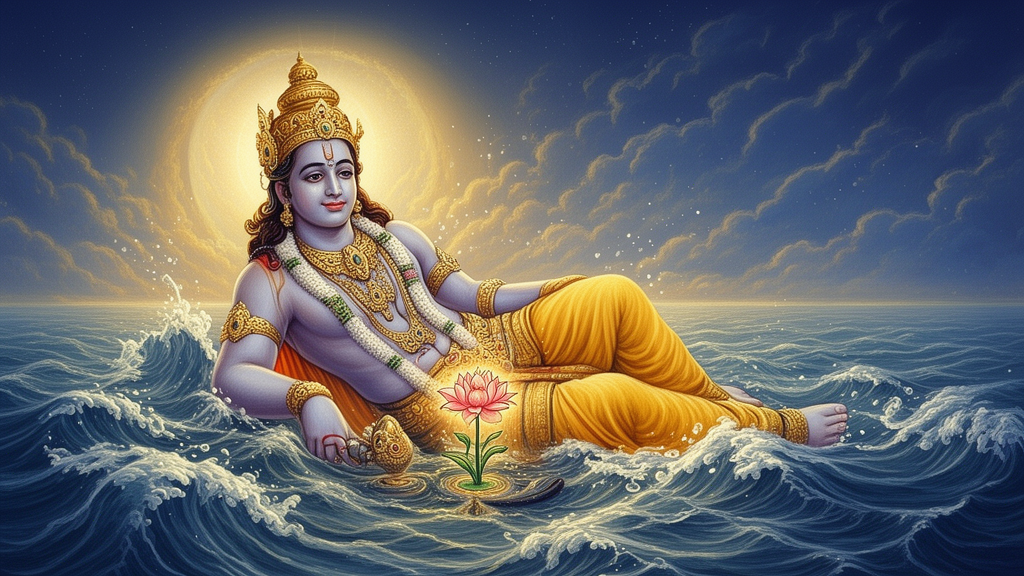
The Subala Upanishad is notable for identifying Narayana with Brahman. In the Vedanta vocabulary used by most Upanishads, Brahman means the ultimate reality, the source and ground of the universe. In this text, that reality is named as Narayana, the figure that Vaishnavas worship as Vishnu. Wikipedia states that both the Subala and the older Mudgala Upanishad assert that Narayana (Vishnu) is the Brahman.[1]
This is the point where the text departs from a purely impersonal reading of Brahman that is often associated with some Advaita interpretations. Whether one reads the Subala Upanishad as Vaishnava, non-dual, or both is a matter of interpretation, which is discussed later in this article.
The relationship with the Purusha Sukta
The Purusha Sukta is a hymn of the Rigveda describing a cosmic Purusha, a cosmic person from whom the world is formed. Wikipedia states that the Subala Upanishad and the Mudgala Upanishad are two Upanishads that discuss this hymn.[1] The Subala Upanishad contains more verses of the Purusha Sukta than the Mudgala Upanishad, and it is longer overall.[1][4]
For a reader, this means the Subala Upanishad is best approached as a commentary-like extension of a Vedic hymn. It takes the hymn’s cosmic imagery and asks what it reveals about the highest reality and about the self. A reader who studies the Purusha Sukta first will find many of the Subala Upanishad’s images easier to follow.
Narayana as father, mother, refuge, friend, and goal
One of the text’s most quoted themes is its description of Narayana as father, mother, refuge, friend, and goal of every living being.[1][4] This is a devotional and relational way of speaking about the highest reality. It describes Narayana not only as a distant cause but as a source of care, shelter, companionship, and final destination for all beings.
This language should be read as the text’s own teaching. It is not a statement that every Hindu worships Narayana in this way. Many Hindus worship Shiva, Devi, Ganesha, Surya, or other deities as their chosen form of the highest, and many Upanishadic teachings speak of Brahman without a personal name. The Subala Upanishad speaks clearly within a Narayana-centered framework.
Structure and Main Topics
Wikipedia describes the Subala Upanishad as structured into sixteen chapters and dealing with cosmology, physiology, psychology, and metaphysics.[1] Grokipedia describes the text differently, as divided into ten lessons or chapters comprising sixteen sections in its primary recension.[2] The two sources do not fully agree on the internal division, so readers should check the chapter numbering against the edition they use. The topics, however, are broadly consistent across the descriptions: creation, the body, the inner self, and dissolution into Brahman.
Cosmology: from the undifferentiated beginning
The text opens as a conversation between Raikva (Subala) and Prajapati. Raikva asks about the origin of the universe, using the question “What was at first?” Wikipedia notes that the answer mirrors the Nasadiya Sukta, Rigveda 10.129, in which the beginning is described as neither Sat (being), nor Asat (non-being), nor a mixture of both.[1]
Wikipedia reports that the Subala Upanishad places the absolute Para-brahman in this undifferentiated state and then describes darkness emerging from it. It links this to the Purusha Sukta’s cosmic imagery.[1] Grokipedia describes the sequence as moving through tamas (darkness) and prakriti (primordial matter), to the formation of elements, a cosmic egg, and the Virat Purusha.[2] Because this sequence is described in a secondary source, a reader who wants to cite the exact order should check the Sanskrit text or a scholarly translation.
Physiology and psychology: the inner self
The Subala Upanishad is also concerned with the human body and the inner self. Wikipedia lists physiology and psychology among its topics.[1] A widely reported teaching in the text is that the organs of the body are connected to divine powers, and that the inner self is the controller of the senses and vital functions. Grokipedia describes the text as correlating the body, the external world, and the deities, and gives examples such as the eye with the sun and the ear with the quarters.[2]
These correspondences are a feature of Upanishadic and later Vedic thought. They are best read as teaching devices. They invite the reader to see the body and the cosmos as linked and to turn attention inward, rather than as a physiological manual.
States of consciousness and the inner controller
Secondary descriptions of the text emphasize the inner controller, or antaryamin, that is present in all beings and is identified with Narayana or Purusha.[2] The text also discusses the states of consciousness, including the fourth state, turiya, which is a common concept in Upanishadic literature. The Mandukya Upanishad is the best-known source for the fourword scheme of waking, dreaming, deep sleep, and turiya, so readers should not assume that every reference to these states means exactly the same thing in each text.
Dissolution and liberation
The text describes a process of dissolution, in which the elements and phenomena that arose from the primordial state return to Brahman, leaving no duality.[2] Grokipedia also describes liberation as attained through truthfulness, austerity, detachment, and concentrated realization, and not through ritual or learning alone.[2] This is a secondary summary, and the exact wording should be checked against a scholarly translation before it is quoted. Within any tradition, such teachings are typically read as spiritual guidance, not as a guarantee of a particular outcome.
Influence on Ramanuja and Vishishtadvaita
The Subala Upanishad is best known in later history for its use by Ramanuja. Wikipedia describes Ramanuja as an 11th-century proponent of the Vishishtadvaita (qualified non-dualism) school of Vedanta and a major influence on Vaishnavism in the 2nd millennium CE. It states that the Subala Upanishad is notable as a text frequently referred to by him.[1][9]
Some modern scholars suggest that the Narayana theology of the Subala Upanishad may have been a decisive impetus for Ramanuja’s Vishishtadvaita philosophy.[1] This is a scholarly suggestion, not an established fact. Scholars debate how much a single text shaped a philosophical system, and it is safer to say the Subala Upanishad was one of several texts Ramanuja used to support his reading of the Upanishads.
Why this matters for readers
For readers who are familiar with the Bhagavad Gita or the Vishnu Purana, the Subala Upanishad offers a bridge between Vedic cosmology and later devotional theology. It shows how the Narayana tradition used the Vedic corpus, especially the Purusha Sukta, to build its account of the highest reality.
Date, Authorship, and Manuscript Traditions
The author and composition date of the Subala Upanishad are unknown.[1] Hans Hock, as cited by Wikipedia, describes it as a late Upanishadic text.[1] Wikipedia also classifies the text as medieval in date, in its infobox, which reflects a scholarly placement but still leaves a range of possible periods.[1]
Readers should be cautious about exact dates. Phrases such as “ancient” or “Vedic” can describe the Upanishad’s connection to the Shukla Yajurveda and its Vedic themes, but they do not establish a precise date for this particular text. A safe statement is that the text is attached to a Vedic school and is generally placed in a late period of Upanishadic literature, while its exact date remains uncertain.
Manuscripts and transmission
Manuscripts of the text are found under titles such as Subalopanisad.[1] The existence of different titles and transliterations is normal for Sanskrit texts that were copied across regions and scripts. Readers who compare editions should expect differences in spelling, verse numbering, and section divisions.
Versions, Commentaries, and Where to Read It
Several online resources provide access to the text or its traditional commentaries. The Acharya.org website offers the Subala Upanishad in script, commentary, and audio form, with a Bhashya and Parishkara by Rangaramanuja Muni and Uttamur Veeraraghavachariar Swami.[5] A commentary is a traditional explanation of a text, and it should be distinguished from the text itself. A reader who wants to know what the Upanishad says should compare the Sanskrit or a translation with the commentary rather than treating the commentary as the scripture.
The Vyasa Mahabharata website also provides a page on the Subala Upanishad and a link to a Sanskrit version attributed to Brahmayogin.[4] The Sanskrit Documents collection publishes a transliterated text and PDF, though the PDF content was not inspected for this article, so readers should verify it directly before relying on it.[3][6]
How to choose a reliable edition
- Look for an edition that states its editor, source manuscript, and date of publication.
- Check whether the text includes both Sanskrit and a translation, so you can compare the wording.
- Compare the chapter and section numbering across two editions, because published divisions differ.
- Distinguish a scripture edition from a commentary, which often contains later theological interpretation.
Reading the Text Across Traditions
The Subala Upanishad is studied in several ways, and readers should keep these approaches separate. A devotional reader may take the text’s language about Narayana as personal guidance. A Vaishnava theologian may read it through the framework of Ramanuja’s Vishishtadvaita. A scholar may focus on its place among Upanishads, its relationship to the Purusha Sukta, and its manuscript history.
Wikipedia’s presentation places the text within Vaishnavism, which is the most direct reading of its Narayana theology.[1] Grokipedia, by contrast, emphasizes non-dualism and the identity of the Atman with Brahman, and it discusses the text in terms that are close to Advaita.[2] These two descriptions do not necessarily contradict each other, because the Upanishads are often read by different schools in different ways. But they do show that the text’s interpretation is contested, and a responsible account should say so.
Belief, text, tradition, and scholarship
- Text: The Subala Upanishad identifies Narayana with Brahman and uses Purusha Sukta imagery.
- Tradition: Vaishnava communities and commentators read the text within a Narayana-centered theology.
- Belief: Devotees may hold Narayana as their personal form of the highest reality.
- Scholarship: Scholars debate the text’s date, its influence on Ramanuja, and how to classify its philosophy.
A Practical Reading Path
Readers new to the Subala Upanishad can use a simple sequence. This is a study method, not a ritual instruction, and it does not promise any particular spiritual result.
- Read a short overview of the Upanishad to understand its title, classification, and main subject.
- Read the Purusha Sukta, since the Subala Upanishad draws on it heavily.
- Read a translation of the opening dialogue between Raikva and Prajapati, paying attention to the Nasadiya Sukta parallel.
- Compare a translation with a traditional commentary, noting where the commentator adds interpretation.
- Read an academic introduction to Ramanuja’s Vishishtadvaita to see how later philosophers used the text.
An example of careful reading
Suppose a reader encounters the phrase that Narayana is the father, mother, refuge, friend, and goal of every living being. A careful reader would ask three questions. What does the Sanskrit say, and how does a translator render it? Is the statement presented as the text’s teaching, a commentator’s explanation, or a devotional expression? And how did later theologians such as Ramanuja interpret similar language? Asking these questions keeps the reading accurate without reducing the text to a single meaning.
Frequently Asked Questions
Is the Subala Upanishad a Vaishnava text?
Wikipedia classifies its philosophy as Vaishnavism and states that the text extols Narayana (Vishnu).[1] That classification reflects the text’s central identification of Narayana with Brahman. Some readers and commentators also discuss it in non-dual terms, so the label is best understood as describing the text’s dominant theme rather than settling every interpretation.
Who was Subala?
Subala is the sage named in the title. Wikipedia describes the title as the name of a Vedic sage.[1] Grokipedia identifies the sage with Raikva, who is credited in the Chandogya Upanishad for the Samvargavidya teaching.[2] The identification is useful but should be checked against a scholarly source if you need to cite it.
Is the Subala Upanishad related to the Purusha Sukta?
Yes. Wikipedia states that the Subala Upanishad and the Mudgala Upanishad both discuss the Purusha Sukta of the Rigveda, and that the Subala Upanishad presents more of its verses.[1]
Who is Ramanuja, and why is he connected to this text?
Ramanuja was an 11th-century philosopher and proponent of Vishishtadvaita Vedanta. Wikipedia reports that he frequently referred to the Subala Upanishad, and that some modern scholars think its Narayana theology may have influenced his philosophy.[1]
Summary and Next Steps
The Subala Upanishad is a short Sanskrit Upanishad that presents Narayana as the highest reality and as the inner support and final goal of all beings. It draws on the Purusha Sukta, opens with a cosmological dialogue that echoes the Nasadiya Sukta, and discusses creation, the body, the inner self, and dissolution into Brahman. Its influence on Ramanuja and later Vaishnava thought is a major reason it is studied today.
Because the text’s date, division, and interpretation are not fully settled, readers should compare editions and commentaries. For further reading, see our guide to 10 Upanishads (URL to confirm; WordPress target draft, may not be public yet) and 108 Upanishads (URL to confirm; WordPress target draft, may not be public yet), which place this text within wider Upanishadic collections.
Related Upanishad Topics on HindusGod.com
Readers who want to compare the Subala Upanishad with other Upanishads may also find these topics useful, once the linked posts are confirmed live: Advaita Upanishad (URL to confirm; WordPress target draft, may not be public yet), Adhyatma Upanishad (URL to confirm; WordPress target draft, may not be public yet), Aitareya Upanishad (URL to confirm; WordPress target draft, may not be public yet), Aranyaka Upanishad (URL to confirm; WordPress target draft, may not be public yet), Ashtavakra Upanishad (URL to confirm; WordPress target draft, may not be public yet), and Atmabodha Upanishad (URL to confirm; WordPress target draft, may not be public yet). Each covers a different theme, so comparison is most useful when the reader keeps each text’s own context in view.
Sources and Further Reading
- Subala Upanishad, Wikipedia: general description, classification, Purusha Sukta connection, Ramanuja reference, date notes, and the Muktika listing.
- Subala Upanishad, Grokipedia: secondary summary of the opening dialogue, chapter structure, and interpretive emphasis. This is an AI-assisted secondary source and should be checked against primary texts before citation.
- Subala Upanishad, Vyasa Mahabharata: classification, Purusha Sukta connection, Ramanuja reference, and a link to a Sanskrit version.
- Subala Upanishad, Acharya.org: script, commentary, and audio, with a Bhashya and Parishkara by Rangaramanuja Muni and Uttamur Veeraraghavachariar Swami.
- Subala Upanishad PDF, Sanskrit Documents: transliterated text file. Not inspected for this draft; verify before relying on it.
Note on verification
This article is a draft for editorial review. Claims are attributed to the sources listed above. Chapter numbering, the sequence of cosmological elements, and the translation of key phrases should be checked against a scholarly edition before publication.