Parsifal is a knight of Arthurian legend whose long search for the Holy Grail ends only after he learns to ask the right question. The story reached its best-known form in the early 13th century in Wolfram von Eschenbach’s German romance Parzival, and it was reshaped again in Richard Wagner’s music drama Parsifal, first staged in 1882. This article explains what the sources actually say, where they differ, and how later spiritual and devotional readings build on the legend.
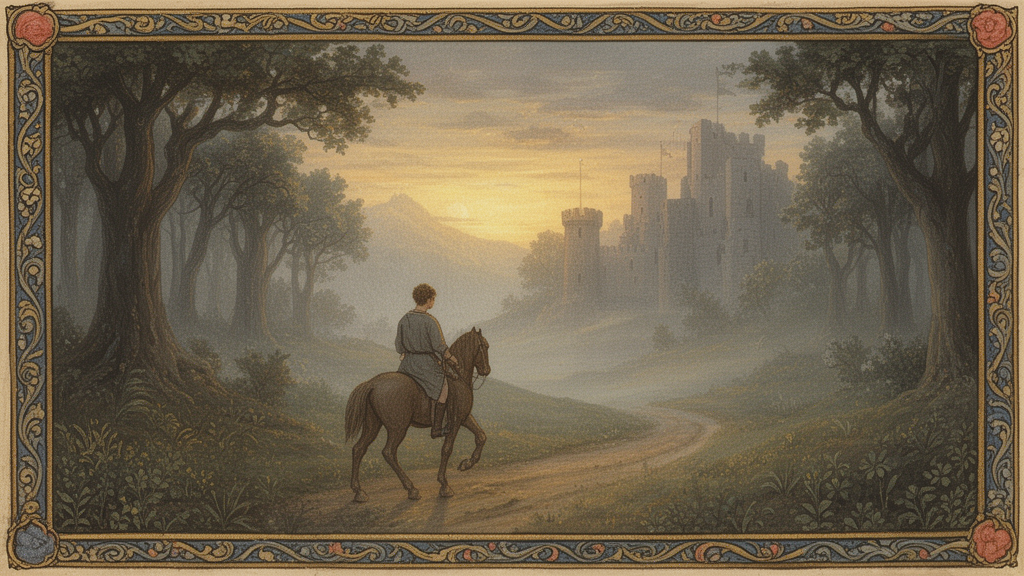
This topic belongs to European medieval literature and its later reception, not to Hindu scripture. We cover it here because many readers of a Hindu-focused site meet the Grail legend through art, opera, and comparative interest in sacred stories. Where we discuss belief or spiritual interpretation, we label it as such.
Quick answer: who is Parsifal and what is the Grail quest?
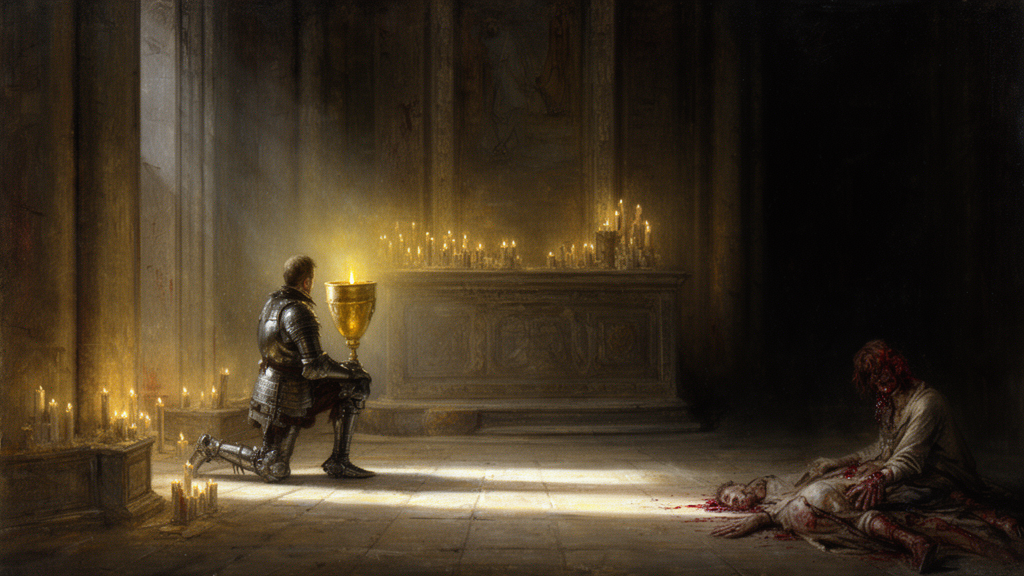
Parsifal (called Parzival in the German medieval poem and Percival in English) is a young knight who fails to achieve the Grail at first, then spends years seeking it again. The Grail is a sacred object tied in the legend to a Christian setting. The quest tests humility, compassion, and the willingness to ask a meaningful question. The sources do not agree on what the Grail physically is, so the answer depends on which version you read.
Three names, one legend
Readers often encounter the same hero under different names. The reason is linguistic and literary history rather than a difference in the hero himself.
- Parzival is the name used in Wolfram von Eschenbach’s Middle High German poem. Wikipedia’s English article on the poem notes that it is commonly dated to the first quarter of the 13th century and was the most popular vernacular verse narrative in medieval Germany.
- Perceval is the form used in the Old French romance Perceval ou le Conte du Graal by the 12th-century trouvère Chrétien de Troyes, which Wagner also drew on.
- Parsifal is the spelling used for Wagner’s opera. The English Wikipedia article on the opera describes the libretto as freely based on Wolfram’s poem and Chrétien’s romance.
When this article says Parsifal, it means the character across these traditions. When it names a specific text, it uses that text’s spelling.
The medieval romance: Wolfram’s Parzival
Structure and themes
Wolfram’s poem begins before its hero. It follows Parzival’s father Gahmuret, his marriage to Herzeloyde, whose name is glossed in Middle High German as roughly ‘heart’s sorrow’, and Parzival’s birth. The boy grows up sheltered from knighthood, meets three knights, and decides to seek King Arthur’s court. The poem then follows his search for the Grail alongside a long section about his friend Gawan.
The English Wikipedia article on the poem summarizes its most-cited themes: humility, compassion, sympathy, and the pursuit of spirituality, along with love as a driving force for chivalric action, which is fulfilled in marriage. These are scholarly summaries of the text, not the only possible reading.
Why the poem matters for later versions
The poem is one strand among several medieval accounts. The Simple English Wikipedia article on Parsifal notes that the story survives in several forms dated roughly between 1170 and 1220, and that Wagner combined several versions when he prepared his libretto. Readers should treat any single retelling, including this one, as a selection from a tradition with many variants.
Wagner’s Parsifal
Richard Wagner conceived the work in April 1857 but did not finish it until about 25 years later. The English Wikipedia article on the opera gives the premiere as 26 July 1882 at the Bayreuth Festspielhaus. Wagner described the work not as an opera but as a ‘Bühnenweihfestspiel’, a stage consecration festival drama.
Several details of the production history are documented in reference sources:
- The Bayreuth Festival maintained a monopoly on Parsifal productions until 1914, according to the English Wikipedia article.
- The opera was performed at the Metropolitan Opera in New York in 1903 after a US court ruled that such a performance was legal.
- Wagner built the Bayreuth theatre and composed the work with that space’s acoustics in mind, according to both the English and Simple English articles.
The music uses leitmotifs, short musical ideas tied to characters or concepts, and a long, continuous melodic line. Wagner’s changes to the story, including his emphasis on compassion and the sacred vessel, are his own creative choices rather than a faithful copy of any medieval text.
The stage and the Grail
In Wagner’s version the Grail is kept in a sacred community and its knights are sustained by it. The opera’s themes of redemption, pity, and renewal are interpretive choices that scholars discuss at length. Readers who want the plot should consult the Simple English summary or a full libretto rather than rely on a short overview.
What the Grail is: cup, stone, or something else?
The sources do not agree on a single identity for the Grail, and this disagreement is one of the most useful things to explain.
- The cup. In many popular retellings, the Grail is the cup used at the Last Supper or the vessel said to have caught Christ’s blood at the Crucifixion. A modern devotional retelling on The Unstuck Spirit blog describes the Grail in folklore as the cup from which Jesus drank at the last supper, and in mythology as representing connection to Jesus.
- The stone. In a spiritual-science reading discussed on an anthroposophical Substack, Wolfram’s version is treated as the one in which the Grail is a stone rather than a cup. That Substack attributes this to Rudolf Steiner’s lectures, which it cites as GA 149 and GA 264. We did not verify those lecture texts directly, so this claim is attributed to the Substack author’s account, not to Steiner’s text.
- A state of consciousness. The same spiritual-science Substack argues that the Grail is an inner attainment rather than an external object. This is an interpretation, not a statement found in the medieval poems.
A careful reader should keep these three categories separate. The medieval romances describe a sacred object in narrative form. Later Christian devotional writing connects it to Christ. Spiritual-science and esoteric readings give it inner, symbolic meanings that are not part of the medieval texts themselves.
The question that makes the difference
A recurring motif in retellings
Many modern summaries highlight a question Parsifal fails to ask at first. The Unstuck Spirit retelling describes a mentor who tells him to ask ‘Whom does the grail serve?’, a failure to ask because of his mother’s advice not to ask too many questions, and a second visit in which he asks it and the king is healed. That retelling also reports a hermit who rebukes him for the omission.
This motif is prominent in popular retellings. Readers should check the specific version they are reading, because the question and the mentor’s role vary across sources. The sources reviewed for this article do not confirm that every medieval version includes this exact question.
Why the question matters to readers
The motif is often read as a lesson about compassion and attentiveness. The hero’s failure is not a failure of courage or skill but a failure of sympathy for a suffering person. The retelling frames the lesson as humility and learning through defeat, which is a common interpretive reading rather than a single agreed meaning.
Spiritual and devotional readings
Many readers meet Parsifal through spiritual writing rather than medieval scholarship. These readings are valuable for personal reflection, but they are interpretations, and they should be read as such.
- Christian devotional readings treat the Grail as connected to Christ’s sacrifice and the Eucharist. This is a long-standing reading in some Christian circles, but the medieval sources themselves are more varied.
- Anthroposophical readings, such as the Substack article on Rudolf Steiner, read the Grail as an image of the purified human soul and of the transformed intellect. These readings draw on a particular spiritual system and are not a neutral summary of the legend.
- Literary and mythological readings treat the story as a narrative about chivalry, identity, and moral education. These readings rely on textual comparison rather than personal spiritual experience.
Each approach answers a different question. Spiritual readings ask what the story means for a seeker today. Literary readings ask how the text works. Neither replaces the other.
Why this matters to a Hindu-focused reader
Hindu traditions have their own rich stories of quest, humility, and sacred vessels, but the Parsifal legend belongs to a separate religious and literary world. Comparing the two can be useful if we keep distinctions clear. A quest in the Ramayana or Mahabharata and a quest for the Grail differ in theology, setting, and literary form. A helpful comparison names those differences rather than forcing a single pattern.
Readers interested in the wider category of quest stories can explore related HindusGod.com drafts on Grail history and legend, listed below. Those pages are internal drafts and may not yet be public.
Common questions
Is Parsifal the same as Percival?
Yes, in the sense that both names refer to the same Arthurian hero in different languages and traditions. Parzival is the German poem’s form, Perceval is the Old French form, and Parsifal is the form used in Wagner’s opera.
Did Wagner invent the Grail?
No. Wagner drew on earlier medieval romances, especially Wolfram’s poem and Chrétien’s romance, and combined elements from several versions. He also made substantial changes of his own.
Is the Holy Grail a single historical object?
The sources do not identify a historical object. The Grail is a literary and devotional symbol in the medieval texts and their later reception. Claims that a specific physical cup survives should be treated with caution unless supported by reliable historical evidence.
Summary
Parsifal’s quest for the Holy Grail is one of the most influential stories in Western literature. The medieval romances, Wagner’s opera, and later spiritual readings each present the Grail differently. The safest approach is to separate what the medieval texts say, what the later opera does with them, and what spiritual writers add as interpretation. Each layer has its own value, and none should be presented as the only correct meaning.
Sources and further reading
- Parzival, Wikipedia (English): used for the poem’s date, subject, themes, and popularity. Secondary summary; check the scholarly editions it cites.
- Parsifal, Wikipedia (English): used for Wagner’s composition dates, the 1882 premiere, Bayreuth production history, and the sources Wagner drew on. Secondary summary.
- Parsifal, Simple English Wikipedia: used for the statement that the story survives in several forms dated roughly 1170 to 1220 and for the Wagner summary. Secondary summary.
- The Holy Grail: Unveiling the Path of Parsifal and Inner Development, Spiritual Science Insights: a devotional and anthroposophical reading. Used only to represent that interpretive view, not as a neutral source on the legend.
- The Stone of Wisdom: Rudolf Steiner on the Holy Grail and the Quest of Parsifal, Spiritual Science Insights: used to describe the spiritual-science account of the Grail as cup and stone. Attributes claims to Steiner’s lectures without verifying those texts.
- Parsifal and the Myth of the Holy Grail, The Unstuck Spirit: a popular devotional retelling used to illustrate the question motif and the cup symbolism. Not a scholarly source; its etymology of ‘pure fool’ is not verified here.
Related HindusGod.com drafts (URL status: target drafts, may not be public)
- Perceval and the Holy Grail for the Old French name and related romance tradition.
- Story of the Holy Grail for a broader narrative overview.
- History of the Holy Grail for how the legend developed over time.
- Lancelot Holy Grail for the knightly figures around the quest.
- In the Quest of the Holy Grail for the medieval quest narratives.