Readers who search for patanjali swami are usually trying to learn about one of two things: the ancient sage Patanjali, traditionally credited with the Yoga Sutras, or a modern teacher who uses the title Swami and has written about Patanjali’s text. This article explains the sage first, then clarifies how the title Swami fits into the picture, and points out where the sources disagree.
Quick answer

Patanjali is the name traditionally given to an ancient Indian author associated with the Yoga Sutras, a foundational text of classical yoga philosophy. Scholars do not know exactly when he lived. Estimates for the text range from the 2nd century BCE to the 4th century CE, and some sources place it around the 1st to 2nd century CE. The name Swami is not part of the sage’s traditional title. It is a religious title used by many monastic and teaching figures, and the most common modern use of the phrase patanjali swami refers to later teachers who wrote about his teachings, such as Swami Kriyananda, or to unrelated businesses that share the name.
Which Patanjali does this phrase refer to?
The name Patanjali appears in several contexts, and the search phrase can mix them up. Before reading further, it helps to separate them:
- The ancient sage or author. This is the figure traditionally linked to the Yoga Sutras, to a major work on Sanskrit grammar, and in some traditions to medical writing.
- Modern teachers who use the title Swami. A well-known example is Swami Kriyananda, born J. Donald Walters, who presented the Yoga Sutras through the teachings of Paramhansa Yogananda in a book published in 2013.
- Patanjali Ayurved. This is an Indian company based in Haridwar, founded in 2006 by Ramdev and Balkrishna. It shares the name but is a commercial conglomerate, not a religious or scholarly subject.
When this article uses the word Patanjali without qualification, it refers to the ancient sage and the texts traditionally attributed to him.
Who was Patanjali in tradition?
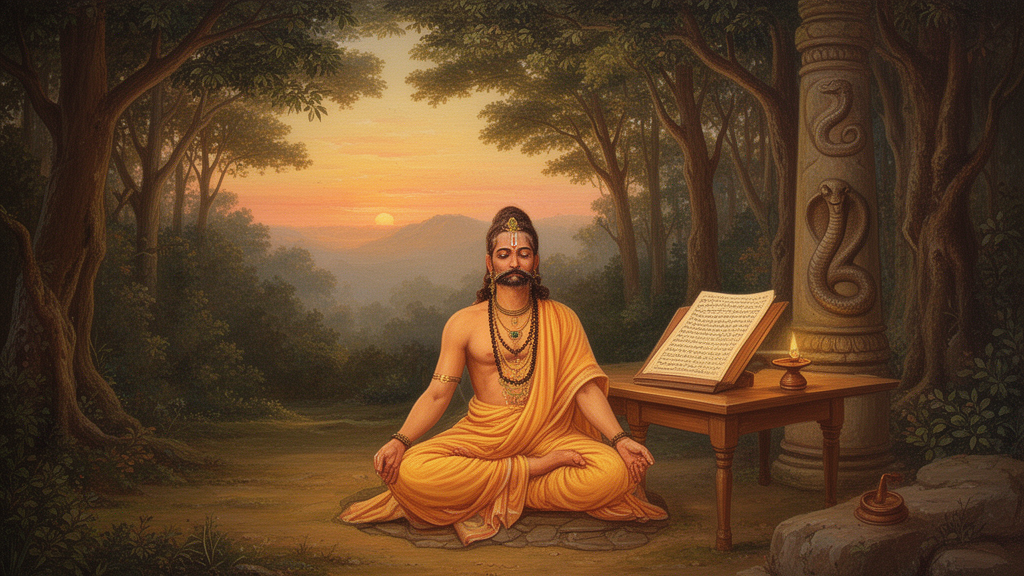
In Hindu tradition, Patanjali is honored as a great sage, or Maharishi. The Wikipedia article on Patanjali notes that a well-known statue shows him in snake form, which is associated with the idea of kundalini or with an incarnation of Shesha, the serpent associated with Vishnu. A popular devotional account, found in a 2025 yoga-school blog by Dr. Ram Jain, describes him as an incarnation of Ananta, the thousand-headed serpent on whom Vishnu rests, and as a symbol of endless wisdom.
These are important religious and devotional identifications. They explain how Patanjali is remembered and depicted, but they are not historical evidence. A reader should treat the serpent identity as part of the tradition’s imagery and storytelling, not as a biographical fact that can be verified from historical records.
Devotional belief and historical evidence
Traditional accounts often combine three kinds of material: sacred or sectarian belief, oral tradition, and documented texts. For Patanjali, the first two are prominent. The third, documented texts, is more limited. Very little is known for certain about his life. The Yoga Sutras and the grammatical commentary are the works most often discussed in scholarship, but even their authorship is debated.
How scholars date Patanjali
Dating is one of the most debated questions. Different sources give different ranges, and it is important to present them as estimates.
Traditional and popular dates
The Ram Jain blog gives a popular range of about 400 BCE to 200 CE for the sage’s lifetime. This is a commonly repeated estimate in yoga teaching and is not presented in the blog as a result of primary-source dating.
Academic estimates
Academic reference sources are more cautious. Britannica describes the basic text of yoga, the Yoga-sutras, as attributed to Patanjali and dates it to around the 2nd century BCE or the 5th century CE. The Grokipedia summary of a book on the Yoga Sutras reports that scholarly estimates for the text’s composition generally range from the 2nd century BCE to the 4th century CE, with many placing it around the 1st to 2nd century CE. Grokipedia is a summary site, so its figures are useful for orientation but should be checked against the scholarly works it cites.
The broader point is that a single calendar date cannot be confidently assigned to a person whose life is poorly documented. Readers who see a precise year should ask what kind of source it comes from: tradition, a teaching blog, a reference encyclopedia, or peer-reviewed research.
The works traditionally linked to Patanjali
The Wikipedia article on Patanjali lists several works under his name. Each has a different subject and a different scholarly status.
The Yoga Sutras
The Yoga Sutras is the best-known work. It is a compact set of aphorisms that systematizes meditative and ascetic practices already present in the wider tradition. Grokipedia’s summary describes the text as attributed to Patanjali, who compiled and systematized preexisting meditative traditions rather than inventing yoga. This is a useful distinction: the text is a systematization, not a claim that yoga began with one author.
Britannica describes yoga as one of the six systems, or darshanas, of Indian philosophy, and notes that the Yoga-sutras is its basic text. It also notes that the school’s influence extended widely across other Indian schools of thought. Readers who want the text itself should use a scholarly edition or a translation with a clear introduction, and should compare more than one translation, because the Sanskrit terms are interpreted differently.
The Mahabhashya
The Wikipedia article on Patanjali lists the Mahabhashya as a grammatical work attributed to him. It is a commentary on Panini’s grammar and is one of the most important texts in the history of Sanskrit grammatical analysis. The Wikipedia article also notes that the Mahabhashya contains theories about sphota, a concept about the nature of linguistic meaning, and discusses metaphysics as part of its grammatical reasoning.
This is a significant point for readers. The same name is attached to a yoga text and a grammatical commentary. Grokipedia notes that scholars debate whether these works were written by the same person, since the chronological span often suggests separate authors despite traditional identifications.
Medical and tantric attributions
Some traditions attribute medical commentaries to Patanjali, and the Wikipedia article lists a work called the Patanjalatantra. These attributions are more difficult to assess. A reader should understand that a traditional attribution means the tradition connects a name with a text. It does not by itself establish authorship. For medical and tantric works, scholars must examine manuscripts, language, and historical context before reaching conclusions.
Why the name matters: Pata and Anjali
The Ram Jain blog offers a popular interpretation of the name. It explains that Pata can mean to fall or descend, and that Anjali can mean an offering or folded hands. The blog reads the name as one who has fallen into folded hands, symbolizing divine knowledge coming down to humanity.
This is a devotional or teaching interpretation. It is meaningful for many practitioners, but it should not be presented as a verified etymology from a historical text. Readers who want a linguistic explanation should consult Sanskrit dictionaries and scholarship on the name, and should note that different interpretations may exist.
Swami Kriyananda and the modern Swami teachers
The search phrase may be looking for modern teachers who use the title Swami. One example is Swami Kriyananda. Grokipedia’s summary of his book Demystifying Patanjali: The Yoga Sutras: The Wisdom of Paramhansa Yogananda as Presented by his Direct Disciple, Swami Kriyananda reports that it was published in 2013 by Crystal Clarity Publishers. It describes Kriyananda, born J. Donald Walters, as a disciple of Paramhansa Yogananda from 1948 and as a founder of the first Ananda community in 1969.
The book presents the Yoga Sutras through explanations Kriyananda says he received from Yogananda, and it is written for readers from many religious backgrounds, according to the summary. A reader should note the difference between the ancient text and a modern commentary. Kriyananda’s book is a teaching presentation rooted in the Kriya Yoga tradition associated with Yogananda. It is not the original Sanskrit text and does not represent a scholarly consensus on the Yoga Sutras.
What the Swami title means
Swami is a respectful title used for many renunciates and teachers in Hindu traditions. It is not part of the ancient sage’s traditional name, and the sources reviewed for this article do not describe Patanjali as a swami in that sense. Readers should therefore be careful when a phrase combines the ancient sage’s name with a modern religious title. The combination may refer to a commentator, a teacher, or a different person entirely.
Patanjali Ayurved: a different subject
Readers searching for Patanjali may also encounter Patanjali Ayurved. The Wikipedia article describes it as an Indian multinational conglomerate holding company based in Haridwar, founded in 2006 by Ramdev and Balkrishna. It says the company manufactures cosmetics, Ayurvedic medicine, personal care products, and food products. It also says the company has faced various controversies over misleading promotions and false claims related to COVID-19 treatment.
The sources reviewed here do not establish that the company’s name comes from the ancient sage, and this article does not assume such a connection. If you are researching the company’s products, regulatory history, or claims, use the Wikipedia article’s cited sources and primary regulatory or official documents rather than this article. The company’s own website is a primary source for its claims, but it should be read as marketing and corporate information.
Traditions and variations in how Patanjali is remembered
Patanjali is not remembered in one uniform way. Hindu traditions differ in how they describe the sage, what they emphasize in his work, and which legends they include. The Wikipedia article on Patanjali includes a section on a Tamil Saivite legend, which shows that Shaiva narratives associate him with particular stories. Readers should understand that these legends belong to specific traditions and communities, and that they should not be treated as one shared biography.
Yoga practice today also varies. Some schools treat the Yoga Sutras as a philosophical and meditative guide. Others teach physical postures and breathing as the main path. Some readers approach the text as devotional scripture, while academic readers approach it as a classical philosophical source. None of these approaches is the only valid one, but each should be clearly identified when used.
How to read the Yoga Sutras with care
If you want to study the Yoga Sutras, begin with a translation that identifies its translator and explains its method. Compare at least two translations, especially on terms such as citta, usually translated as mind or mental activity, and samadhi, usually translated as absorption or meditative union. The meaning depends on the translator’s philosophical background.
Look for a clear division between the text, the commentary, and the teacher’s explanation. A verse or sutra is the original text. A commentary is an interpretation. A modern teacher’s explanation may be devotional, practical, or scholarly. Keeping these layers separate will make your reading more accurate and will help you avoid treating a teaching as the text itself.
Practical steps for further reading
- Start with a reliable reference. Britannica’s entry on Patanjali is a useful orientation to the Yoga Sutras and the six darshanas.
- Read a scholarly or well-introduced translation. Choose an edition that explains its translation choices and includes notes or an introduction.
- Check the modern source’s background. If you read a book by a Swami or another contemporary teacher, identify the lineage, purpose, and whether the book is a commentary or a translation.
- Separate tradition from history. When you read a dating claim or a legend, ask whether it is a devotional belief, a traditional attribution, or a claim supported by manuscript evidence.
- Read related internal material. For background on the sage’s traditional identity and imagery, see the target draft on Patanjali Maharishi. This is a WordPress draft and may not yet be public, so confirm before publishing this link.
Frequently asked questions
Is Patanjali a swami?
The ancient sage Patanjali is not described in the sources reviewed here as a swami. The title Swami is used for many modern teachers and monastic figures. If your search refers to a specific modern teacher, check that person’s own biography and publications.
Did Patanjali write the Mahabhashya and the Yoga Sutras?
Both works are traditionally attributed to Patanjali. Scholars debate whether they came from the same author, because the dates and subject matter suggest different authors may be involved. The answer depends on the historical evidence, not on tradition alone.
Is Patanjali Ayurved connected to the ancient sage?
The sources reviewed here do not establish a connection. The company is a modern Indian business founded in 2006. Its name overlap should not be read as evidence of a historical or religious relationship.
Summary
Patanjali is a name tied to the Yoga Sutras, to a major grammatical commentary, and to other works in later traditions. The ancient sage is honored in Hindu tradition and depicted with serpent imagery. His dates are uncertain, and scholars debate whether the attributed works share a single author. The search phrase patanjali swami may refer to the sage, to a modern Swami who wrote on the Yoga Sutras, or to an unrelated company. Clear reading depends on separating tradition, text, commentary, and historical evidence.
Sources and further reading
- Patanjali, Wikipedia: used for the traditional identity, the serpent imagery of the statue, the list of attributed works including the Yoga Sutras and Mahabhashya, and the Tamil Saivite legend as a separate tradition.
- Patanjali, Encyclopaedia Britannica: used for the description of yoga as one of the six darshanas and the Yoga-sutras as its basic text, with its dating estimate.
- Demystifying Patanjali, Grokipedia summary: used for the composition date range, the debate about single authorship, the description of Kriyananda’s book, and his biography. This is a secondary summary and should be checked against the original book and scholarly sources before publication.
- Who Is Patanjali? Discover The Sage Behind The Yoga Sutras, Arhanta Yoga: used only for the popular etymology of the name, the traditional 400 BCE to 200 CE estimate presented as belief, and the Ananta identification as devotional teaching.
- Patanjali Ayurved, Wikipedia: used for the company’s founding, headquarters, product categories, and the summary of controversies.
- Patanjali Ayurved official website: a primary source for the company’s own statements. It is marketing and corporate content and is not independent evidence of its product claims.