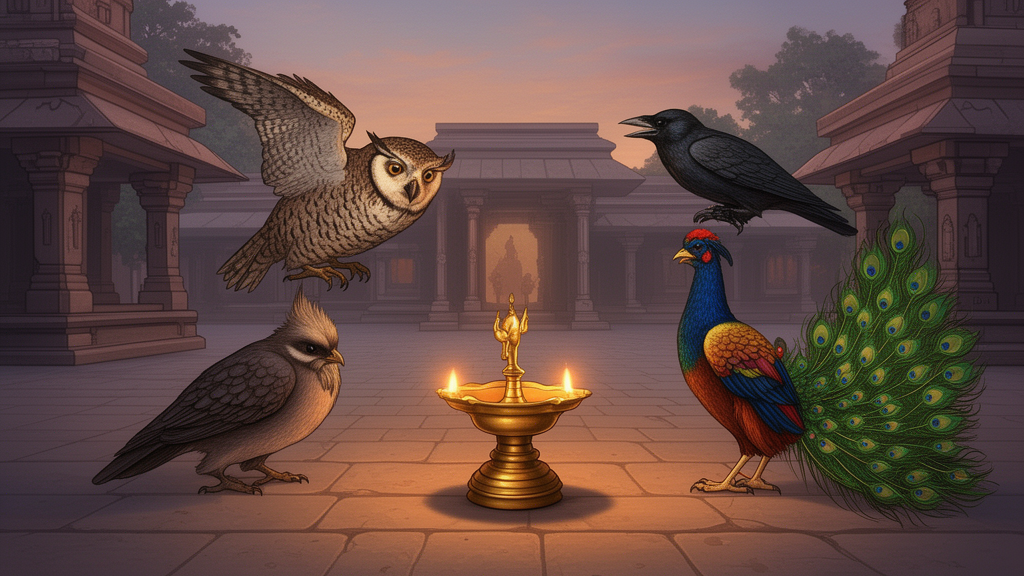
Pancha Pakshi Shastra is a system of divination historically popular among Hindu astrologers in southern India. Its name is usually translated as “science of the five birds.” The system groups the nakshatras (lunar mansions) under five birds: the hawk, owl, crow, cock, and peacock. Each bird is said to be in one of five states, namely ruling, eating, walking, sleeping, and dying, and these states are said to shift with the time of day, the day of the week, and the paksha (lunar fortnight). Practitioners use this framework, together with a person’s birth nakshatra, to judge which times are considered auspicious or inauspicious for various activities. The short answer, then, is that Pancha Pakshi Shastra is a timing system within traditional Hindu astrology, not a single devotional practice shared by all Hindus.
This guide explains how the system is described in the sources, where its attributed origins and manuscript history come from, and how readers can separate textual claims, community tradition, and modern interpretation. It also notes where the evidence is thin. For a shorter introduction to the Telugu-language version of this topic, see our Pancha Pakshi Shastra Telugu guide (URL to confirm: draft, not yet public).
What Pancha Pakshi Shastra Claims to Do

The core claim of Pancha Pakshi Shastra is practical. It proposes that the activity of five symbolic birds follows a repeating pattern in time, and that a person’s birth star determines how that pattern applies to them. According to the standard description, the system tells a user when a bird is in a state associated with strength and success, and when it is in a state associated with weakness or harm. From that, practitioners derive guidance on when to begin travel, undertake a business matter, sign an agreement, or start a journey.
It is important to be precise about the status of this claim. The system describes itself as a method for identifying auspicious and inauspicious times. It does not, in the sources available here, promise health, wealth, protection, or any guaranteed material result. Readers should treat the method as a claim made within a particular astrological tradition. Whether a given timing choice produces a given outcome is a separate question that the system’s texts cannot settle on their own, and that a responsible reader should not assume.
Where the System Sits Within Hindu Astrology
Pancha Pakshi Shastra is commonly classified with Hindu astrology and divination. Its classification in encyclopedic references reflects that it works with time, celestial reckoning, and the nakshatra scheme, which are central to Jyotisha, the Vedic-linked tradition of astral science. The Wikipedia entry on the subject places it in the category of Hindu astrology and in the category of birds in mythology, which signals that the birds are an organizing symbol rather than a deity cult. Readers should not conclude from this classification that every Hindu community accepts or uses the system. Its popularity has been regional and practitioner-based.
The Five Birds
The five birds are the organizing structure of the system. Each one is associated with a group of nakshatras. The names used in the standard description are the hawk, owl, crow, cock, and peacock. In Sanskrit-language texts, these birds are named using Sanskrit terms, and English renderings of those names vary between sources. This is one reason readers may see different spellings across books, websites, and regional publications.
The birds should be understood as symbolic units in a classification scheme. They are not presented in the sources as independent beings with their own worship or narrative cycles in the way that a deity like Ganesha or Durga has. The Wikipedia summary describes them as the framework through which nakshatras are grouped, and the sources reviewed here do not describe devotional worship of the birds as part of this system.
Why the Birds Matter in the Method
Because each bird is linked to a set of nakshatras, the birds act as a lookup layer. A practitioner first identifies the relevant nakshatra from the birth star, then determines which bird group it belongs to, and then reads the state of that bird at the relevant time. The bird-level grouping therefore compresses a large amount of astronomical and calendrical information into a manageable scheme. Readers who want the full mapping should consult a specific manuscript or a tradition-specific published manual, because the mapping details are not reproduced in the summary sources used for this article.
The Five States: Ruling, Eating, Walking, Sleeping, Dying
The five states are the second key element of the system. According to the standard description, each bird is in one of five states at a given time, and these states are ranked from most auspicious to least auspicious. The order given is ruling, eating, walking, sleeping, and dying.
- Ruling is described as the most auspicious state.
- Eating follows, and is generally read as favourable.
- Walking is an intermediate state, associated with movement and ordinary activity.
- Sleeping is described as less favourable, suggesting inactivity.
- Dying is described as the least auspicious state.
The names of these states are labels within the system. They should not be read as literal predictions about physical death or harm. Practitioners who use the system interpret the labels within their own framework, and this interpretive step is one of the places where individual teachers and texts may differ.
How the States Are Said to Change
The sources say the state depends on three variables: the time, the day of the week, and the paksha. The paksha is the bright or dark half of the lunar month. Because these variables change through the day and across the lunar cycle, the same bird can be in different states at different times. This is what gives the system its time-sensitive character. A reader who wants to understand the method must therefore keep in mind that the states are not fixed traits of a person or a bird. They are positions within a calendar-based pattern.
How the Method Is Said to Work
The standard description outlines a sequence of steps. Readers should note that the sequence is presented as the logic of the system, not as a complete operational manual. Full instructions appear in manuscripts and in later published guides, and they can differ.
Step One: Birth Nakshatra
The method begins with the birth nakshatra. Nakshatras are the lunar mansions, a set of divisions of the sky used in Indian astral reckoning. The birth nakshatra is determined by the Moon’s position at birth, which is also a central input in many Hindu astrological charts. Pancha Pakshi Shastra uses the birth star as the personal anchor. Readers who are unsure of their birth nakshatra should consult a qualified and transparent practitioner or a regional almanac, and should recognize that calculation methods can differ between traditions.
Step Two: The Bird Group
Once the birth nakshatra is identified, the system places it within one of the five bird groups. This step converts an individual’s birth star into a bird-linked reference point. The grouping is part of the system’s internal structure, and it is one of the reasons that the birds are used at all.
Step Three: Current Time, Weekday, and Paksha
The third step involves reading the current bird state from the time, weekday, and paksha. In practice, this means determining which bird is in which state at the moment of interest. The sources state that the system then uses these readings to identify auspicious and inauspicious times for activities. Because the calculation depends on the precise moment, practitioners often work with a timetable or a method specified in their text.
An Illustrative Example
The following example is illustrative only and does not represent a real calendar reading. Suppose a reader wants to decide whether to start a short journey. A practitioner using this system would first identify the birth nakshatra, locate its bird group, and then check the bird’s state for the day and the paksha in question. If the state is among the more favourable ones in the scheme, the practitioner would consider the time suitable. If the state is among the less favourable ones, the practitioner would likely advise waiting. A careful reader should ask three questions at this point. Which text or teacher supplies the mapping? Does the teacher explain how a less favourable state should be interpreted? And what practical steps can the reader take regardless of the timing result? The example shows the method’s logic, but it does not provide a guaranteed outcome for the journey.
Origins and Attributed Authorship
Pancha Pakshi Shastra is said in the tradition to be connected with the legendary sage Agastya. The standard description notes that a Sanskrit-language work on the system is ascribed to him. This is an attribution, not a verified historical fact. In the Hindu tradition, many texts are attributed to ancient sages, and such attributions often function as a mark of authority and lineage rather than as evidence of date or authorship in a modern academic sense.
Readers should therefore distinguish between three kinds of statements. The first is devotional or traditional belief: that Agastya is the source of the teaching. The second is textual evidence: that particular manuscripts exist and can be described. The third is historical or scholarly interpretation: when these texts were composed, how they developed, and how they spread. The sources reviewed for this article support the first two categories. They do not, in the material reviewed, establish a firm date of composition for the Agastya-attributed work, and this article does not offer one.
Manuscripts, Editions, and Textual History
The textual record gives the clearest factual footing for the system. According to the standard description, manuscripts of a Sanskrit work on Pancha Pakshi Shastra survive in Telugu and Grantha scripts and are held at the Thanjavur Palace library. Telugu and Grantha are both script traditions, and their presence indicates that the text circulated across more than one linguistic community in South India.
The Thanjavur Palace Manuscripts
The Thanjavur Palace library is cited as the location of manuscripts in Telugu and Grantha scripts. This fact is useful because it points to institutional preservation of the texts. A reader interested in examining the manuscripts directly should contact the institution to confirm current access arrangements, since holdings and access policies can change.
The 1906 Critical Edition
The standard description reports that a critical edition by Shivarama Pati was published in 1906 under the title Pañca-pakṣi-praśna. A critical edition is a scholarly text that compares manuscripts and records variant readings. Readers who want to understand the system at a deeper level should consult scholarly editions rather than relying only on popular summaries, since the edition’s introduction and notes will explain which manuscripts were compared.
Tamil Versions and the Chennai Manuscript
Tamil-language versions of the text also exist, according to the standard description. As an example, the Government Oriental Manuscripts Library in Chennai holds a manuscript titled Ahattiyar-pañca-pakṣi-sūttira. The title includes the name Ahattiyar, which is a Tamil form associated with the sage Agastya in some traditions. This shows that the attribution to Agastya appears in regional forms as well as in Sanskrit. Readers should note that the appearance of a name in a manuscript title records a tradition’s claim about authorship and does not by itself settle questions of dating or authorship.
Other Named Works
The standard description lists several other historical texts on the topic. These include Pañca-pakṣi or Pakṣi-jyotiṣa of Krishna, Pañca-pakṣi-prakaśa of Gangadhara, and Pañca-pakṣi-śakunāvalī of Narayana Bhatta. The presence of multiple named works suggests that the system was discussed and developed by different authors over time. Readers should not assume that these works all agree in every detail. Where they differ, the differences matter, and a careful reader will check the specific text being used.
Variant Spellings
Readers will encounter several spellings of the system’s name. The most common forms are Pancha Pakshi Shastra, Panchapakshi Shastra, and the diacritical form Pañca-pakṣi-śāstra used in scholarly transliteration. This article uses Pancha Pakshi Shastra for readability and cites diacritical forms only when quoting titles of works. Sanskrit titles are given in the form found in the cited source.
Regional Context: South India and the Telugu and Tamil Traditions
The standard description identifies the system as historically popular among Hindu astrologers of southern India. That is a regional claim, and it should be read as such. Practice of this kind is usually shaped by local teachers, local calendars, and local manuscript traditions, so the system is not uniform across all Hindu communities. Readers from northern or diaspora communities may encounter it through online materials or through relatives, and they should be aware that local practice can differ from the textbook description.
The Telugu and Tamil manuscript evidence supports the view that the system had a presence in these language communities. For readers exploring the Telugu side of the tradition, our Pancha Pakshi Shastra Telugu guide (URL to confirm: draft, not yet public) can serve as a companion piece once it is published. Readers working in Tamil should consult Tamil-language editions and the Chennai holdings described above, since translation can change the meaning of technical terms.
Belief, Tradition, and Scholarship: How to Read the Claims
Discussions of Pancha Pakshi Shastra often mix several kinds of statement. A responsible reader can keep them separate by asking what kind of evidence stands behind each claim.
- Textual claims describe what a named manuscript or edition says, or that it exists. For example, the existence of Telugu and Grantha manuscripts at Thanjavur is a textual claim supported by a bibliographic reference.
- Traditional attributions describe what a community believes about origin. The association with Agastya is a traditional attribution.
- Practice claims describe how the system is applied. The statement that practitioners use it to choose times for activities is a practice claim.
- Outcome claims describe whether following the system produces a result. The sources reviewed here do not support any claim that it guarantees outcomes, and this article does not make such a claim.
- Scholarly interpretations describe how historians of science or religion understand the system’s development, status, or relationship to other astral traditions. Such interpretations should be cited to specific academic work when they are used.
The distinction matters because the same sentence can carry different kinds of authority. A statement that a text is ascribed to Agastya carries traditional weight. A statement that a manuscript exists in a named library carries documentary weight. A statement that the timing method works carries no evidentiary support in the sources reviewed here.
Practical Guidance for Readers
Readers who are curious about Pancha Pakshi Shastra can approach it in a grounded way. The first step is to read a source that identifies its textual base, such as a critical edition or a regionally specified manual. The second is to learn the Sanskrit and regional terms, since translations of state names and bird names vary. The third is to compare more than one tradition before accepting a claim about dates, procedures, or interpretations.
Readers who use the system to plan personal matters should also keep common sense and professional advice in view. Decisions about health, legal matters, finances, or safety should be made with qualified professionals, regardless of what a timing system says. Traditional astrology can be part of cultural or devotional life for many people, and it is reasonable to engage with it respectfully. It is not a substitute for medical, legal, or financial advice.
Frequently Asked Questions
Is Pancha Pakshi Shastra a religious practice or a form of astrology?
It is best described as a system of traditional divination within Hindu astrology. It uses nakshatras, paksha, and the time of day to organize timing guidance. Its religious and astrological status depends on the community and practitioner. The sources reviewed here describe it as a divination system rather than a worship practice.
Who is said to have written the original text?
A Sanskrit work on the system is ascribed to the sage Agastya. This is a traditional attribution. The sources reviewed here do not establish a verified author or a firm date of composition, so readers should treat the attribution as a belief within the tradition.
Are there surviving manuscripts?
According to the standard description, manuscripts in Telugu and Grantha scripts are held at the Thanjavur Palace library, and a Tamil manuscript titled Ahattiyar-pañca-pakṣi-sūttira is held by the Government Oriental Manuscripts Library in Chennai. Access to these holdings should be confirmed with the institutions before any visit.
Does the system guarantee success or protection?
No source reviewed for this article supports a guarantee of success, health, wealth, or protection. The system describes auspicious and inauspicious times. Whether any choice leads to a result depends on many factors outside the timing scheme.
Closing Takeaway
Pancha Pakshi Shastra is a historically important South Indian system of traditional divination. Its core structure is the grouping of nakshatras under five birds, the assignment of five states to those birds, and the reading of those states by time, weekday, and paksha. It is attributed to Agastya in tradition, is documented in manuscripts and editions across Telugu, Grantha, and Tamil-language communities, and is described in standard references as a method for identifying auspicious and inauspicious times.
The most useful way to approach the system is to keep its textual evidence, its traditional attributions, its practice, and its outcome claims clearly separate. Readers who want to go further should consult the scholarly edition and the regional manuscript holdings, and should use the system as one cultural and textual resource among many rather than as a guarantee of any result.
Sources and Further Reading
- Pancha Pakshi Shastra, Wikipedia. Used for the general description of the five birds, the five states, the method’s stated logic, the Agastya attribution, manuscript locations, the 1906 edition, Tamil versions, and the list of named works. Wikipedia is a secondary summary and is used here for orientation; its underlying citations should be checked directly before any scholarly use.
- P. V. Jagadisa Ayyar, South Indian Customs (Asian Educational Services, 2001), pp. 100–102. Cited in the Wikipedia article for the regional description. Not directly inspected for this draft.
- David Pingree, ed., Census of the Exact Sciences in Sanskrit, Series A, Vol. 1 (American Philosophical Society, 1970), p. 35; Vol. 2 (1971), pp. 11, 51, 80; Vol. 3 (1976), p. 155. Cited in the Wikipedia article as bibliographic references for the Sanskrit manuscript record. Not directly inspected for this draft; readers should consult these volumes for manuscript details.
- Pancha Pakshi Shastra Telugu guide, HindusGod.com (URL to confirm: draft, not yet public). Internal companion piece for the Telugu tradition.