Pancha Pakshi Shastra (Telugu: పంచ పక్షి శాస్త్రం) is a traditional system that uses five birds to describe cycles of activity in a day. In Telugu-speaking regions it is often discussed as a folk-astrological method for judging the time of an action. This article explains the basic structure, the five birds and their traditional activity states, how the system is commonly taught, and where the evidence is thin. It does not present the system as proven or as a guarantee of any result.
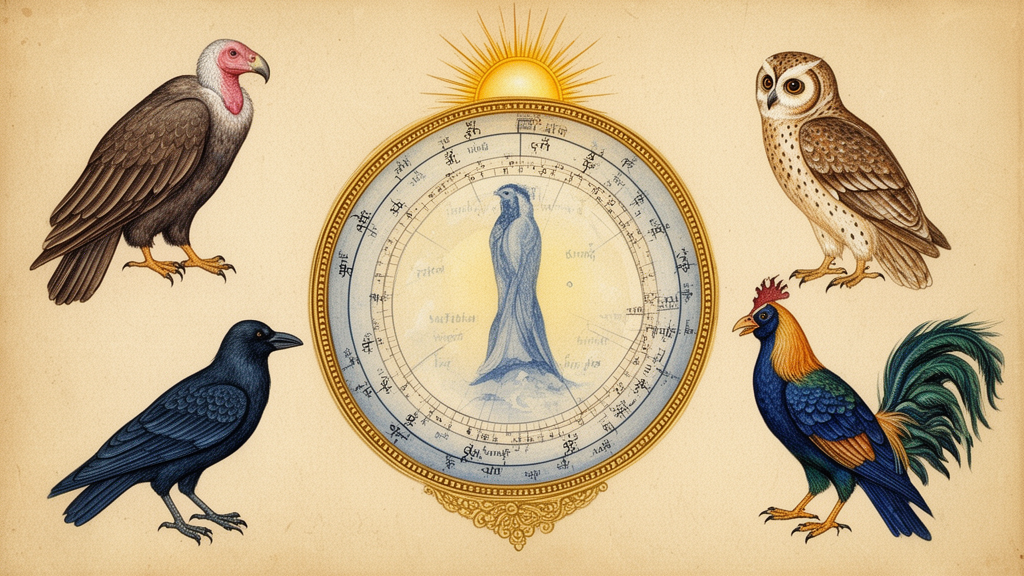
The short answer: Pancha Pakshi Shastra divides the day and night into periods governed by five birds. Each bird is linked to a set of conditions such as ruling, eating, walking, sleeping and death. Practitioners use these periods to decide when a task is considered favourable or unfavourable. The method belongs to the wider family of Indian shastra (systematic knowledge) texts, but its authority rests on tradition and manuscript teaching rather than on modern empirical testing.
What the term means
Pancha means five, pakshi means bird, and shastra means a treatise, discipline or body of teaching. Together the phrase refers to a teaching built around five birds. The name is the clearest point of agreement across sources. Almost everything else, including attribution, dating and exact procedures, varies by text, teacher and region.
Readers searching the Telugu form will also see the spelling Panchapakshi Sastram, and sometimes Pancha Pakshi Sastra. These spellings refer to the same subject. This article uses the transliteration Pancha Pakshi Shastra for consistency.
Belief, text, tradition and scholarship
Several kinds of claims are mixed together in popular discussions of this topic, and it helps to separate them:
- Traditional belief: Many practitioners believe the birds’ cycles reflect a real influence on the timing of actions. This is a devotional or astrological belief, not a finding of modern science.
- Textual content: The birds, their names and the activity states are described in manuscripts and printed works that circulate in Telugu and Tamil contexts. Which text is treated as authoritative depends on the teaching lineage.
- Regional practice: The system is most visible in Andhra Pradesh and Telangana, and it also appears in Tamil Nadu and Karnataka. Local teachers may use different bird assignments, time divisions or interpretive rules.
- Scholarly interpretation: Historians of Indian science and religion generally treat such systems as part of the broader tradition of predictive and calendrical knowledge. Scholars focus on how the system was transmitted, how it relates to other astrological methods, and when it appears in written sources. Precise dating claims should be checked against specialist publications before being repeated.
For a HindusGod.com reader, the practical rule is simple: understand the system as a traditional astrological framework, and treat claims about outcomes with caution.
The five birds
Most traditional presentations name five birds. The exact names differ by source, so the list below shows the common forms used in popular Telugu and Tamil teaching. Owners should verify each name against a specific manuscript or edition before publishing a definitive table.
- Vulture (Gridhra or Garuda in some sources): commonly associated with the ruling state in popular accounts.
- Owl (Uluka): associated in many accounts with night-time activity.
- Crow (Kaka): widely described in popular teaching as a bird of ordinary daily activity.
- Cock (Kukkuta): associated with the early-day cycle in many presentations.
- Peacock (Mayura): often linked with pleasant or auspicious states in popular summaries.
These associations are teaching conventions, not zoological claims. The birds are symbolic labels within a diagram of time.
The five activity states
Each bird is assigned to a state of activity. The states commonly listed in Telugu teaching are:
- Ruling (Rajya): the bird is described as strong and governing in the period.
- Eating (Bhojana): the period is described as suitable for gaining or consuming.
- Walking or travelling (Gamana or Chalana): the period is described as suited to movement or journeys.
- Sleeping (Nidra): the period is described as low in activity.
- Death or harm (Maran): the period is described as the most unfavourable state in the traditional scheme.
Teachers often describe these states as indicators, not commands. Someone who reads a state as unfavourable may still be advised to act for necessary reasons, such as medical care or emergency duties. Where a text is used for personal decisions, the reader should make clear that the system is one traditional input among many.
How the cycle is traditionally applied
In popular presentations, the day is divided into segments, and a bird rules each segment in sequence. The sequence changes between day and night and is often explained with reference to sunrise and to a unit of time such as the ghati, a traditional subdivision of the day. The exact starting bird and the length of each segment are not identical across all teachings.
A simple way to explain the method to a reader is as follows:
- Identify the traditional day-start point used by the teaching you follow, commonly tied to sunrise.
- Find the bird that governs the first segment.
- Follow the sequence of birds through the segments of the day.
- Read the activity state assigned to the current bird.
Because the rules vary, a student should learn the method from a specific teaching lineage, a printed edition, or a qualified teacher, and should check whether that source uses local sunrise times, a fixed clock or another convention.
A concrete example
Suppose a family wants to plan a short journey and consults a Telugu almanac that includes a Pancha Pakshi chart. The chart lists the governing bird for each segment of the day. The family looks up the segment that falls at their intended departure time and sees that the walking or travelling state is marked as suitable in that teaching. They might then choose that time, while also checking traffic, weather and the health of travellers. The traditional reading shapes the timing decision, but it does not replace practical planning.
This example shows the typical use of the system: as an aid to timing within a tradition. It is not a method that the family could use to test whether the journey will be safe or successful.
Why the evidence is limited
Pancha Pakshi Shastra does not have modern experimental support, and no reliable study in the scientific literature has shown that the bird cycles affect events. Readers should treat claims about accurate prediction, guaranteed success, protection or health outcomes as unsupported unless they are backed by a specific, checkable source. Several issues make evaluation difficult:
- Manuscripts exist in several versions, and the bird names and state assignments are not always identical.
- Popular books and online charts may combine material from different sources without saying so.
- Authorship and date claims are often repeated without citation. Such claims should be verified before publication.
- Predictive systems are hard to test because outcomes depend on many factors, and believers and skeptics often interpret the same events differently.
A balanced reading holds two things together. The system is a significant part of Telugu and South Indian astrological culture, and it is studied as a body of tradition. It is also not established as a reliable predictor of events.
Regional and community differences
Pancha Pakshi Shastra is discussed in several Indian languages, and each linguistic and regional community may have its own terminology and teaching style. Telugu sources often present the system as part of a wider interest in shastras dealing with time, planning and ritual. Tamil and Kannada presentations may use different names for the birds or different rules for the cycle.
Hindu communities also differ widely in how much weight they give to astrological timing. Some families consult almanacs routinely. Others rely mainly on the festival calendar or on the advice of a family priest. Others do not use such systems at all. Content should avoid saying that all Hindus follow this practice or that it is required by Hindu scripture.
Related shastra topics on HindusGod.com
Readers interested in traditional Indian knowledge systems may also want to explore related posts. Each link below is a verified WordPress target draft in the current content inventory; these posts may not yet be public, so their live status should be confirmed before publication.
- For another time-based and predictive tradition, see Prashna Shastra in Telugu, which covers question-based astrological reasoning.
- For a broader overview of traditional treatises, see Shastra Veda in Telugu.
- For a general introduction to the classification of Dharma literature, see Dharma Shastra in Telugu.
- For a text associated with social and legal norms, see Manu Shastra in Telugu.
- For tantric traditions and their terminology, see Tantra Shastra Telugu.
- For another category of Telugu shastra content, see Agama Shastra in Telugu, which discusses temple and worship treatises.
- For a traditional knowledge topic involving letters, see Akshar Shastra.
- For a related topic on numbers and their traditional interpretation, see Anka Shastra.
- For a topic on love-related traditional literature that should be read with care, see Vajikarana Shastra Telugu.
Note for the owner: The primary Pancha Pakshi Shastra target draft at ?p=5736 uses the same keyword. Before publishing this post at ?p=5737, decide whether the two drafts should be merged, differentiated by intent, or one of them skipped to avoid keyword cannibalization. URL to confirm for public status.
Frequently asked questions
Is Pancha Pakshi Shastra the same as Panchang?
No. Panchang is the traditional Hindu almanac that records tithi, nakshatra, yoga, karana and weekday. Pancha Pakshi Shastra is a separate system built around the five birds and their cycles. Some almanacs include Pancha Pakshi charts alongside panchang data, but the two are not the same method.
Is it scientifically proven?
No reliable scientific evidence supports the system as a predictor of events. It is best understood as a traditional astrological framework.
Should I make major decisions based on it?
Major decisions involving health, legal matters, finances or safety should be based on qualified professional advice and practical assessment. Traditional timing may be a personal or cultural consideration, but it should not replace those steps.
Summary
Pancha Pakshi Shastra in Telugu is a traditional system that assigns five birds to cycles of time and reads each bird’s activity state, such as ruling, eating, walking, sleeping or death. Its names, sequences and rules vary by text and teacher. Its significance lies in its place within Telugu and South Indian astrological culture. Its predictive claims are traditional beliefs rather than established findings. Readers who study it are best served by identifying the specific text or teaching they follow, checking its terminology, and keeping practical judgment in view.
Sources and further reading
No external source was retrieved and verified for this draft. The following are search directions for the owner to verify before adding links:
- A critical edition or printed Telugu text of a Pancha Pakshi manuscript, with publisher, date and editor identified. URL to confirm.
- Academic work on Indian astrology and predictive knowledge systems, such as university library catalogues or peer-reviewed journals on South Indian religion and science. URL to confirm.
- Scholarly discussion of Telugu and Tamil shastra manuscripts held in regional research libraries or institutional archives. URL to confirm.