Prajnaparamita is the Sanskrit term prajñāpāramitā (प्रज्ञापारमिता), usually translated as “perfection of wisdom” or, in some English versions, “perfection of transcendent wisdom.” It names a principle in Buddhism, a group of Mahayana texts called the Perfection of Wisdom literature, and a female personification known as Prajñāpāramitā Devi. The word is a compound of prajñā, meaning wisdom or insight, and pāramitā, meaning perfection. Readers searching for “prajnaparamita sanskrit” usually want the correct Sanskrit form, its meaning, and the best-known Sanskrit text, the Heart Sutra. This article answers those questions and marks where sources differ.
One point matters for HindusGod.com readers from the start. Prajñāpāramitā is a Buddhist concept and belongs to Buddhist literature. It is not presented here as a Hindu scripture. The Sanskrit language connects these traditions, but each tradition has its own texts, commentaries and practices.
The direct answer: what prajnaparamita means

In Sanskrit, the correct form is prajñāpāramitā, with diacritics. The English spelling “prajnaparamita” drops the marks, and some sources write “Prajna-paramita.” All of these refer to the same term. The Wikipedia article on the subject gives the Sanskrit form, the IAST transliteration Prajñāpāramitā, and the common English rendering “Perfection of Transcendent Wisdom” as parallel entries.[1]
The word has three layers of meaning that readers often confuse:
- A concept: In Mahayana Buddhism, prajñāpāramitā is one of the six perfections (pāramitās) that a bodhisattva cultivates. A glossary entry on Wisdom Library describes it as the “virtue of wisdom” among the six perfections, citing an appendix to the Mahāprajñāpāramitāśāstra.[6]
- A body of texts: The Perfection of Wisdom sutras form a large group of Mahayana scriptures, including the longer and shorter works and the Heart Sutra.[1]
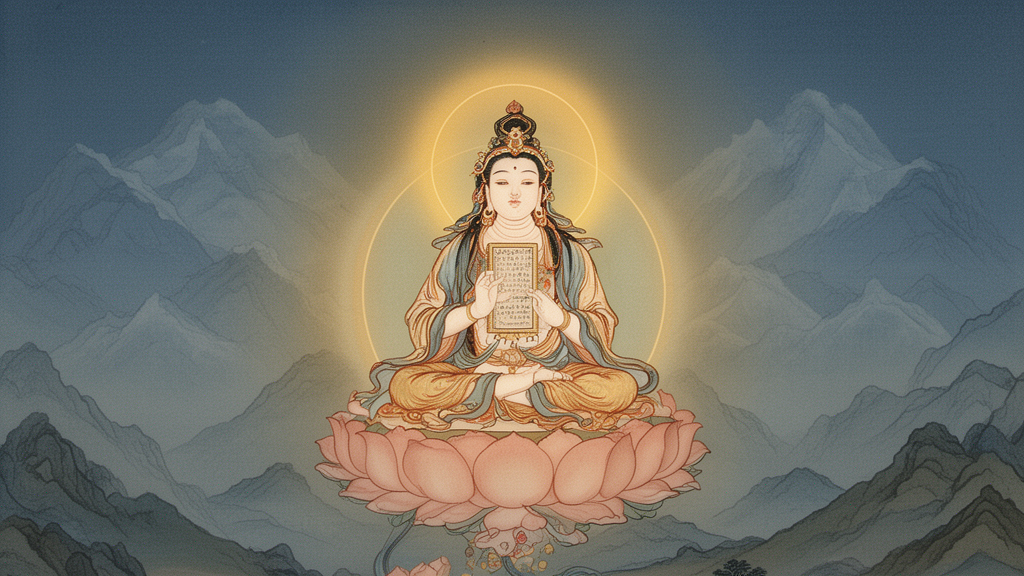
- A personification: Prajñāpāramitā Devi is described as a personification of Transcendent Wisdom, and she appears in Tibetan and other Buddhist art.[1]
The glossary entry also reports that, in the Mahāprajñāpāramitāśāstra, the profound perfection of wisdom is said to give birth to the Buddhas and is called “the Mother of the Buddhas.”[6] This is a doctrinal statement from a commentary, not a historical claim, and readers should treat it that way.
Sanskrit spelling, variants and transliteration
Readers will meet several forms of the same term, and it helps to know them before searching further:
- Devanagari: प्रज्ञापारमिता
- IAST (scholarly transliteration): Prajñāpāramitā
- Common English without diacritics: Prajnaparamita, Prajna-paramita
- Chinese: 般若波羅蜜多 (Pinyin: bōrě bōluómìduō)
- Tibetan: shes rab kyi pha rol tu chin pa
The Wikipedia entry lists these alongside Japanese, Korean and other equivalents, which shows how the term moved from Sanskrit into East and Central Asian Buddhist languages.[1] This site uses the transliteration Prajñāpāramitā when discussing the Sanskrit term and “Prajnaparamita” in the title and URL-level keyword phrases. Related pages on this site use closely related spellings, so readers may find different forms in different posts.
The compound itself is straightforward. Prajñā is the noun for wisdom or insight. Pāramitā is the feminine form of a term for perfection or completion, and in Buddhist usage it refers to a quality practiced to its fullest form. The glossary entry from the Gaganagañjaparipṛcchā, a chapter of a Mahāyāna collection, describes prajñā as a word for calm, cultivation and awakening, which shows that the term was used in several senses within a single text.[6]
Where the term appears: the Perfection of Wisdom texts
The Perfection of Wisdom literature is one of the major categories of Mahayana sutras. The Wikipedia overview divides its history into early texts, the larger Prajñāpāramitā sutras, esoteric Prajñāpāramitā texts, Central Asian transmission, and developments in China and Tibet.[1] That overview is a useful map, but the details of dating and transmission are specialist questions, and the sources do not settle every point.
The larger Prajñāpāramitā sutras
The longer sutras in this group are the best-known source for the Perfection of Wisdom teaching. Wikipedia lists them under “The Main Prajñāpāramitā Sūtras” and records separate sections for Xuanzang’s Chinese translation library and for the Tibetan Kangyur, which contains translations of Indian Buddhist texts.[1] A shorter Sanskrit work, the Pañcaviṃśatisāhasrikā Prajñāpāramitā Sūtra, is named in another source as the origin of a passage now found in the Heart Sutra.[5]
For readers who want the full Sanskrit sutras, the most useful step is to start with a critical edition or a scholarly translation rather than with a short devotional summary. A general introduction, such as the Wikipedia article, can orient a reader, but it cannot replace the texts themselves. Related posts on this site explore the sutra in more detail: see the Prajnaparamita Sutra draft and the Ashtasahasrika Prajnaparamita draft, which discusses one of the larger texts. Both are WordPress drafts and may not yet be public.
The Heart Sutra
The Heart Sutra, known in Sanskrit as Prajñāpāramitāhṛdaya Sūtra, is the most widely recited Perfection of Wisdom text. A Sanskrit and English interlinear edition hosted by Ancient Buddhist Texts presents it as “a summary of the heart of wisdom teachings in the Mahāyāna,” based on the edition by Edward Conze, with English translation by Ānandajoti Bhikkhu.[3] The Visible Mantra page notes that the sutra exists in a longer and a shorter form, and that many standard commentaries read it from different traditional viewpoints.[5]
The Heart Sutra is short enough to read in a few minutes, but its wording is dense. Its opening lines identify the speaker as the bodhisattva Avalokiteśvara, who is described as “dwelling deep in the practice of the perfection of wisdom.”[3] That framing matters. The sutra presents itself as a teaching within a Buddhist narrative, not as a freestanding philosophy.
Key Sanskrit lines and what they teach
Most readers who search for the Sanskrit of this term want to see the lines of the Heart Sutra. The following is a short, attributed selection, not a full reproduction. The Sanskrit appears in the Conze-based interlinear edition, and the English is the interlinear translation by Ānandajoti Bhikkhu.[3]
Iha, Śāriputra, rūpaṁ śūnyatā, śūnyataiva rūpaṁ.
Here, Śāriputra, form is emptiness, emptiness is surely form.
The line is the best-known passage in the sutra. The Sanskrit word śūnyatā is usually rendered “emptiness,” but Buddhist usage does not mean a void in the everyday sense. The same translation pairs this line with the statement that emptiness is not different from form, and that form is not different from emptiness.[3] Readers new to this vocabulary can find the subject treated more fully in the Wikipedia section on negation and emptiness.[1]
A second line describes the bodhisattva’s state of mind:
Tasmāc Śāriputra, aprāptitvād bodhisattvasya prajñāpāramitām āśritya viharaty acittāvaraṇaḥ.
Therefore, Śāriputra, because of the Buddha-to-be’s non-attainments, he relies on the Perfection of Wisdom and dwells with his mind unobstructed.
This passage explains the sutra’s practical intent. The text says that reliance on the perfection of wisdom leaves the mind unobstructed. Interpretations differ on how this should be practiced, and the commentarial traditions cited on the Visible Mantra page each read it differently. The text itself does not give a step-by-step method.[3]
Major themes in Prajñāpāramitā teaching
The Wikipedia article organizes the core teaching into several themes: the bodhisattva and Prajñāpāramitā, other bodhisattva qualities, tathātā (suchness), negation and emptiness, and māyā (illusion).[1] These themes appear across many texts, but the emphasis varies by text and tradition.
The bodhisattva and the perfection of wisdom
In the Mahayana framework, wisdom is linked to the bodhisattva path. The glossary entry from the Mahāprajñāpāramitāśāstra says that from the first production of the mind of awakening, bodhisattvas seek knowledge of all aspects, and in that process they understand the true nature of dharmas. The text calls this wisdom the perfection of wisdom.[6] This is a commentary’s account of the bodhisattva path, and it should be attributed to that commentary.
Emptiness and non-attainment
The Heart Sutra’s list of negations, such as “no arising, no ceasing; no purity, no impurity,” illustrates the teaching that phenomena lack fixed self-nature.[3] Students often misread this as a denial of ordinary experience. Standard commentaries tend to present it as a correction of how phenomena are grasped, not as a denial that they appear. Because this interpretation varies among traditions, readers should consult the commentaries they are studying.
Māyā and tathātā
Wikipedia’s theme list also includes tathātā, a term for “suchness” or the true nature of things, and māyā, which refers to illusion or apparent reality.[1] The Wisdom Library glossary says the Gaganagañjaparipṛcchā links the perfection of wisdom to the true nature of dharmas.[6] For readers who want to go further, the Heart Sutra and the commentaries are the primary places to see how these terms are used.
Prajñāpāramitā Devi and Buddhist iconography
Prajñāpāramitā is also a figure in Buddhist art. Wikipedia describes Prajñāpāramitā Devi as a personification of Transcendent Wisdom and shows a Tibetan manuscript folio of a 100,000-line Prajñāpāramitā text. It also notes that Mañjuśrī, a bodhisattva associated with wisdom, is often shown with a sword of wisdom and a sutra manuscript, which are common symbols of the Perfection of Wisdom in Buddhist art.[1]
The distinction between the text, the concept and the image is important. A devotional image of Prajñāpāramitā Devi is an artistic and devotional representation within Buddhist practice. It is not a scriptural claim about the Sanskrit term itself. A sword, a book and a lotus are symbols in this tradition, and their meanings are given by the iconographic tradition that uses them.
The mantra at the end of the Heart Sutra
The Heart Sutra closes with a mantra that many readers encounter in Sanskrit. The Visible Mantra text gives the final line as gate gate pāragate pārasaṃgate bodhi svāhā, and it describes the passage as the mantra of the perfection of wisdom.[5] The same page also notes that the sutra’s mantra passage calls it “great mantra” and “unsurpassed mantra,” language that the text uses for itself.
The mantra’s wording is often translated as “gone, gone, gone beyond, gone completely beyond, awakening, hail.” That is a common rendering, but it is a translation and should be treated as one. Traditions differ in how they recite and explain the mantra. Some Buddhist communities chant the whole sutra; others recite only the mantra. Recitation practices are tradition-specific, and this article does not describe a required method.
Composition and dating: what sources say
Dating is one of the areas where sources need careful reading. The Visible Mantra page reports that it is now generally believed by scholars that the Heart Sutra was composed in China, and it notes that the central passage was extracted from a Chinese translation of the Pañcaviṃśatisāhasrikā Prajñāpāramitā Sūtra.[5] This is a scholarly view reported by a non-academic site, so readers should check it against the academic literature before relying on it.
The Wisdom Library glossary dates the Mahāprajñāpāramitāśāstra to the 2nd century, but glossary entries are summaries, and dating commentary texts involves uncertainty.[6] The Wikipedia article covers the development of the texts over time, including early texts, larger sutras, esoteric texts and translation traditions, but this article does not have a verified chronology for each text.[1] Avoid presenting any single date as settled unless a scholarly source is consulted.
Where Hindu readers may encounter the term
HindusGod.com readers often arrive at this term while searching for Sanskrit texts in general. A Sanskrit document archive lists a “Prajnaparamita Stotram” and a “Prajnaparamita Stuti” in its catalog, with the subject tags philosophy, Hinduism and religion, and the category tags Devī and Buddha. The archive page was not inspected in full for this article, so it is cited only for the existence of these titles and their catalog tags, not for their content or their use in any community.[2][4]
The catalog tags do not establish that these works are part of a Hindu devotional tradition. Readers should check the transliteration, the editor, the lineage and the community that uses each text before drawing conclusions. For this site, the safe description is that the Perfection of Wisdom is a Buddhist teaching written in Sanskrit, and that Sanskrit is the language in which many of its key texts survive.
How to read Prajñāpāramitā texts responsibly
- Start with a clear source: A critical edition, a scholarly translation or a traditional commentary identified by name is more reliable than an unsourced summary.
- Separate text from commentary: The Heart Sutra says one thing, and a later commentary explains it. Keep the two distinct when quoting.
- Name the tradition: A Tibetan, Chinese, Japanese or Theravada reading may differ. Identify which one you are following.
- Check translations: Compare the Sanskrit with an English version. Attribute any translation you use.
- Respect recitation practices: Chanting and mantra use are practices within specific communities. Describe them as those communities do, not as universal rules.
Frequently asked questions
Is prajnaparamita a Hindu term?
The term is primarily Buddhist. The Wikipedia article describes it as a principle in Buddhism and the texts associated with it, and its major texts belong to the Mahayana tradition.[1] Some Sanskrit archives catalog related works under Hinduism-related subject tags, but that catalog metadata does not change the tradition the texts belong to.
What is the Sanskrit for prajnaparamita?
The Sanskrit is prajñāpāramitā, written in Devanagari as प्रज्ञापारमिता.[1] The spelling without diacritics, “prajnaparamita,” is common in English searches.
What does the Heart Sutra say about wisdom?
The Heart Sutra presents wisdom through the teaching of emptiness and non-attainment. It says that a bodhisattva relying on the perfection of wisdom dwells with an unobstructed mind.[3] Commentaries explain the practical meaning in different ways.
Related reading on HindusGod.com
For broader context on Sanskrit scripture and terms, readers can explore these related drafts, which may not yet be public: the Prajnaparamita Meaning article, the Prajnaparamita overview, the Prajnaparamita Sutra Sanskrit article, the Sanskrit Shastra guide, the Sanskrit Sutra guide and the Sanskrit Upanishad guide. Each link is a target draft whose URL status must be confirmed before publication.
Sources and further reading
- Prajnaparamita – Wikipedia: overview of the term, texts, themes, iconography and translations.
- Prajnaparamita-Hrdayam – Ancient Buddhist Texts: Sanskrit and English interlinear edition of the Heart Sutra, based on Edward Conze’s edition.
- Heart Sutra – Visible Mantra: notes on the Sanskrit text, its forms, its mantra and the scholarly view on its composition.
- Prajnaparamita – Wisdom Library: glossary entries citing Mahāyāna commentaries and sutras.
- Prajnaparamita Stotram – Sanskrit Documents: catalog entry for a Sanskrit stotra; content not inspected for this article.
- Prajnaparamita Stuti – Sanskrit Documents: catalog entry for a Sanskrit stuti; content not inspected for this article.
Closing takeaway
The Sanskrit term prajñāpāramitā, or prajnaparamita in common English spelling, names the perfection of wisdom in Buddhist thought, a body of Mahayana texts, and a personified figure in Buddhist art. The most accessible entry point is the Heart Sutra, where lines such as “form is emptiness, emptiness is form” show the central teaching. Read the texts in their original language or in attributed translations, keep scripture separate from commentary, and identify the tradition you are studying.