When readers search for vishnu shastra tamil, they are usually looking for the Tamil text of the Vishnu Sahasranamam, the hymn of the thousand names of Lord Vishnu. The word shastra is used loosely in this search phrase. The hymn is more precisely a stotra (a devotional hymn) and a sahasranama (a litany of a thousand names), not a legal or technical treatise. This guide explains what the hymn is, how the Tamil text is presented in published editions, how devotees traditionally chant it, and where the claims made about it come from.
Quick answer: what ‘Vishnu Shastra Tamil’ usually means
In most search results, the phrase points to the Tamil-script or Tamil-transliterated version of the Vishnu Sahasranamam. Published Tamil pages typically offer the opening invocation, a dhyana verse, the main body of names, a concluding section, and often a PDF for offline reading. Several sites that publish the Tamil text describe it as part of the Mahabharata, in the Anushasana Parva, and attribute its teaching to Bhishma speaking to Yudhishthira.
The Sanskrit original is the reference text for the tradition. Tamil editions are translations into script or transliterations of that Sanskrit, and they can differ in punctuation, verse division, and spelling. Readers who want the Tamil lyrics should compare more than one edition before relying on a single page.
What the Vishnu Sahasranamam is
The Vishnu Sahasranamam is one of the most widely recited hymns in Hinduism. It consists of a thousand names of Vishnu, arranged within a narrative frame. Source pages describe it as a Vaishnava hymn that devotees recite for devotion, peace of mind, and spiritual purpose.
Its place in the Mahabharata
The hymn is presented as part of the Mahabharata, in the Anushasana Parva (the book of instruction). According to the Tamil and English pages reviewed for this guide, Bhishma, lying on a bed of arrows after the Kurukshetra war, teaches the hymn to Yudhishthira. One of the reviewed pages gives the chapter as Anushasana Parva 149. Editions and websites use this framing consistently, but readers who want to confirm the chapter number should check a critical Sanskrit edition of the Mahabharata, which this guide did not inspect directly.
The hymn also contains a question-and-answer structure. Yudhishthira asks which single deity is supreme, which single refuge is best, and what a person should chant to be freed from the cycle of birth and rebirth. Bhishma answers by pointing to Vishnu and to the recitation of his names. This dialogue form is one reason the text is treated as a teaching rather than only a list.
Why the text is called a thousand names
The title sahasranama combines sahasra (thousand) and nama (name). The hymn is traditionally counted as containing one thousand names. Names are not always counted identically across editions, because some editions divide compound names differently, repeat a name, or include closing verses in the count. Source pages reviewed for this guide also show different verse numbering, with one site listing 215 numbered verses including introductory and concluding sections. Readers should therefore treat any single verse count as edition-specific.
Devotional belief and textual content
It is important to separate what the text contains from what devotees believe it does. The text itself includes a closing section, often called the phalashruti, that describes the fruits of hearing or reciting the hymn. Devotional pages commonly summarize these as peace, freedom from fear, and divine grace. These are beliefs and traditional claims. They are not measurable outcomes, and this guide does not present them as guaranteed results of recitation.
Some sites go further and say that sincere chanting removes obstacles or grants liberation. Those statements belong to devotional explanation and to the tradition’s understanding of the hymn. They should be read as expressions of faith, not as verified claims about health, finances, or outcomes in daily life.
The Tamil text: script, transliteration, and editions
Tamil readers encounter the hymn in several forms. Understanding these forms helps avoid confusion when comparing pages.
- Sanskrit in Tamil script: Sanskrit words are written with Tamil letters, often with extra signs or dots to represent sounds that Tamil script does not distinguish. Some pages use the Grantha-influenced sign set for these sounds.
- Tamil transliteration: Some editions present the Sanskrit in Latin letters alongside Tamil text, which helps learners follow the sound.
- Tamil translation or meaning: Some pages add prose explanations in Tamil. These are interpretations, and translators may differ in their choices.
- Standalone PDFs: Many sites offer printable files. Check the publisher, the date of the edition, and whether the text matches the Sanskrit version you intend to follow.
The opening verses
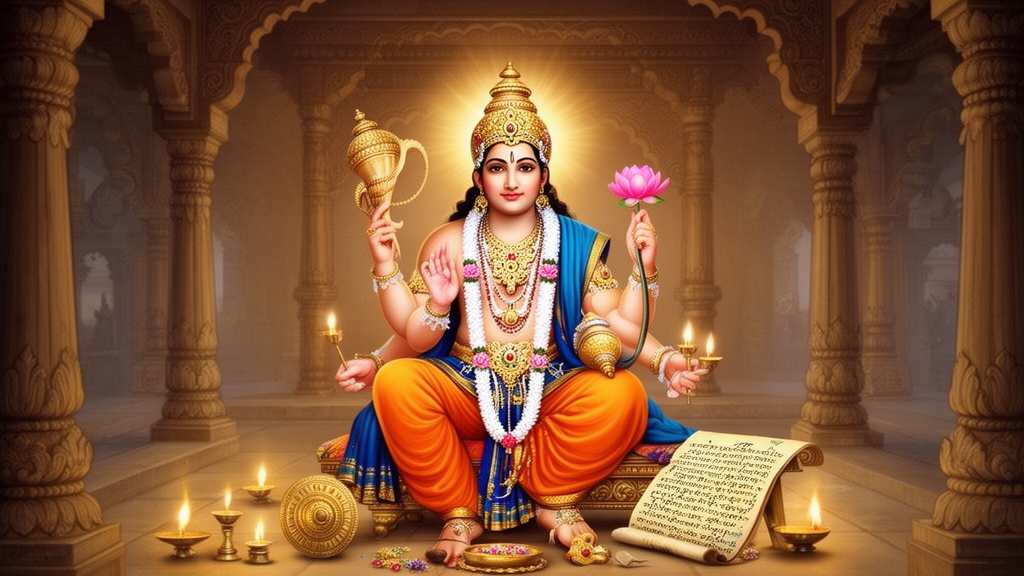
Most Tamil editions begin with an invocation and a short dhyana verse, a meditative verse that describes the deity to be visualized. Reviewed Tamil pages open with the words Shuklambaradharam Vishnum Shashivarnam Chaturbhujam, which describe Vishnu as clad in white, moon-coloured, and four-armed, and recommend meditating on him with a cheerful face to remove obstacles. Pages then continue with further invocations and with the question-and-answer opening between Yudhishthira and Bhishma.
How to choose an edition
When choosing a Tamil text, consider these points:
- Check whether the page states its source text, such as a named Sanskrit edition or a named tradition.
- Compare the opening verses and the number of verses across two or three editions.
- Look for consistent spelling of names such as Vishnu, Keshava, and Purushottama, since Tamil spellings can vary.
- Avoid treating a page’s claim of a ‘complete’ or ‘perfect’ text as proof. Independent comparison is the reliable check.
If you want a Tamil text that is organized by name, a related HindusGod.com draft on Lord Vishnu names in Tamil may help you explore individual names alongside the hymn. A broader introduction to the deity is available in the draft on Vishnu.
Names of Vishnu in the hymn
The names are the core of the hymn. Each name describes a quality, an action, or a form of Vishnu. Some names are read as descriptions of cosmic functions, some as ethical or philosophical attributes, and some as references to stories from Puranic and epic literature. Commentary traditions, especially the Advaita and Vishishtadvaita schools, have offered different interpretations of many names. This guide does not give a single authoritative meaning for each name.
The opening of the stotram’s thousand-name section, as reproduced in reviewed Tamil and transliterated sources, begins with names such as Vishvam and Vishnu, followed by names describing creation, sustenance, and the Lord’s presence in all beings. Later names include Keshava and Purushottama, which are widely used in Vaishnava devotion. Readers who want word-by-word meanings can consult an annotated edition, such as the one linked in the reviewed sources, and should note which commentary the annotation follows.
Why names matter in devotion
In Vaishnava practice, repeating a name of God is a form of focused remembrance. The hymn invites the reader to recall the Lord through many aspects. Many devotees find that learning the meanings of names makes recitation more meaningful. The practice of learning gradually, one section at a time, is common across traditions.
How devotees traditionally chant it
Practices vary by family, region, temple, and sampradaya. The following steps describe common approaches, not a universal requirement. Follow the guidance of your family tradition, a teacher, or a temple priest where one is available.
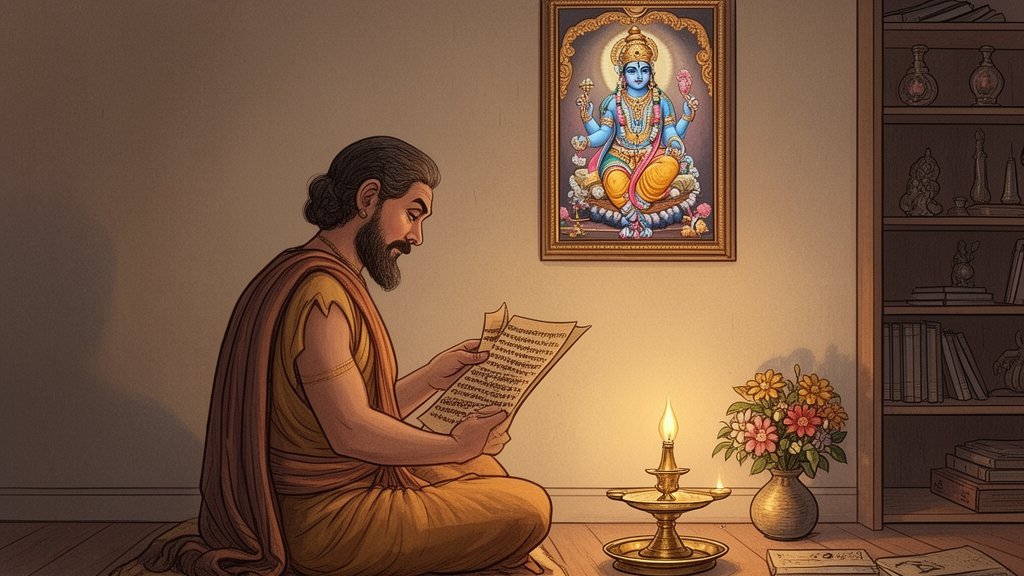
- Prepare the space. Many people choose a clean, quiet place, often near a image or picture of Vishnu, and sit facing a direction that suits their household custom.
- Begin with the invocation. Many traditions open with the invocation and dhyana verse, then move into the names.
- Read or recite steadily. Some devotees recite the complete hymn daily. Others read a set number of names, or chant only the opening verses on busy days.
- Close with the concluding verses. Many editions end with the phalashruti and a closing prayer. Devotees commonly offer the recitation to the Lord at this point.
Some households recite the hymn on Ekadashi, which is observed in Vaishnava tradition, but observances vary, and the date of Ekadashi depends on the lunar calendar and local panchang. Check a current, regional calendar for dates. Do not infer this year’s dates from a previous year.
Tamil recitation and pronunciation
Tamil readers face a practical question: whether to recite Sanskrit sounds in Sanskrit pronunciation or to adapt them to Tamil phonetics. Many Tamil devotees learn from audio recordings and temple recitation, while others read the transliteration. Neither method is required by a single authority. If you are learning, it helps to listen to a trusted recording and follow the text, then practise slowly.
Regional and sectarian differences
The Vishnu Sahasranamam is widely shared across Hindu communities, but it is not practised identically everywhere. Differences include the following.
- Edition and numbering: Tamil, Telugu, Kannada, Malayalam, Hindi, and Sanskrit editions may differ in verse division and in the placement of introductory and closing verses.
- Commentary: Different schools read the names in different philosophical frames, so the same name can be explained in more than one way.
- Recitation context: Some families recite the hymn daily in the home, some recite it in temples, and others use it at specific festivals or fasts.
- Language of recitation: Some devotees prefer Sanskrit recitation with a translation, while others recite primarily in their regional language.
For readers who want to compare versions in other languages, HindusGod.com has related draft pages on the Vishnu Sahasranama Shastra topic and on Vishnu Shastra in Hindi, which can help place the Tamil text within a wider linguistic context. Each link should be checked for publication status before you rely on it.
Separating scripture, tradition, and scholarship
Content about the hymn often mixes several kinds of statement. It helps to keep them apart.
- Scripture (text): The hymn’s names, invocation, and dialogue frame. These can be checked against a Sanskrit edition or a reliable translation.
- Tradition: Recitation practices, the belief that chanting brings peace or grace, and the use of the hymn at certain times. These are practices and beliefs held within particular communities.
- Scholarship: Historical questions about when the Mahabharata and the hymn took shape, how the text was transmitted, and how names were interpreted. Academic work on the Mahabharata recognizes that the epic developed over a long period, but specific dates for the hymn’s composition should be treated cautiously unless a cited scholarly source supports them. This guide does not offer a specific date.
- Modern interpretation: Articles and videos that link the hymn to modern self-help goals. These should be read as commentary.
When a website says the hymn guarantees wealth, health, or success, the statement is not a textual finding. It is a devotional or commercial claim. Responsible reading treats such claims as beliefs that individuals may hold, without expecting them to produce a measurable result.
Common questions readers ask
Is the Vishnu Sahasranamam the same as a Vishnu shastra?
Not in the strict sense. The Sahasranamam is a hymn of names, while the word shastra commonly means a treatise or body of teaching. Search queries often use the two words interchangeably. This guide uses the term Vishnu Sahasranamam for the hymn and explains the search phrase only to help readers find the correct text.
Can a person chant the Tamil version without knowing Sanskrit?
Many devotees do. Tamil transliterations and translations are widely used for this purpose. The meaning becomes clearer with study, but many traditions regard sincere recitation as meaningful even while learning. The guidance of a teacher is useful for pronunciation.
Does chanting the hymn bring specific results?
The text includes a closing section that describes fruits of recitation, and devotional pages describe these as peace, protection, and grace. Those are traditional beliefs. No source reviewed here establishes a measurable material outcome, and this guide does not promise one.
Practical tips for using a Tamil edition
- Save a copy of the edition you choose, and note its publisher and date.
- Compare the opening verses with a second source before printing a long document.
- Use a recording alongside the text to check pronunciation.
- Start with the invocation and a short portion of names, then extend your reading over time.
- Mark any part of the text that you find unclear, and ask a teacher or temple priest.
Summary
The phrase vishnu shastra tamil most often leads to the Tamil text of the Vishnu Sahasranamam, a hymn of a thousand names of Vishnu presented within the Mahabharata’s Anushasana Parva. The Tamil text is available in several formats, and editions differ in verse division, spelling, and commentary. Devotees recite the hymn for devotion, peace, and grace, and these beliefs belong to tradition. Readers who want to study the text carefully should compare editions, check the source, and separate textual content from devotional and modern interpretation.
Sources and further reading
- Vishnu Sahasranamam Tamil Lyrics and PDF: a Tamil lyrics page with a PDF download, used here to describe the Tamil presentation of the hymn and its opening verses.
- Vishnu Sahasranamam Lyrics in Tamil: a Tamil devotional site describing the hymn as part of the Mahabharata’s Anushasana Parva, taught by Bhishma to Dharmaraja.
- Vishnu Sahasranamam in Tamil, Complete Stotram: a Tamil-script edition that identifies the text as the Mahabharata, Anushasana Parva 149, and includes the dhyanam and opening verses.
- Vishnu Sahasranama Stotram in Tamil, Meaning: a page attributing the hymn to Vyasa within the Mahabharata and describing its devotional uses, with a word-by-word explanation of the opening invocation.
These references describe editions and devotional context. For scholarly study of the Mahabharata and the textual history of the hymn, readers should consult a critical Sanskrit edition and academic work on the epic, which this guide did not verify in detail.