The Trishikhibrahmana Upanishad is a short Sanskrit text attached to the Shukla Yajurveda and counted among the Yoga Upanishads. It is usually described as a text that combines Yoga practice, cosmology, meditation, and non-dual (Advaita-oriented) teaching about Brahman and the Atman, the inner Self. Its opening asks four basic questions: what the body is, what life is, what the Prime Cause is, and what the Atman is. The answers are developed through the figure of Trishikhi Brahmana, a yogi, and through the teaching that all reality is Shiva.
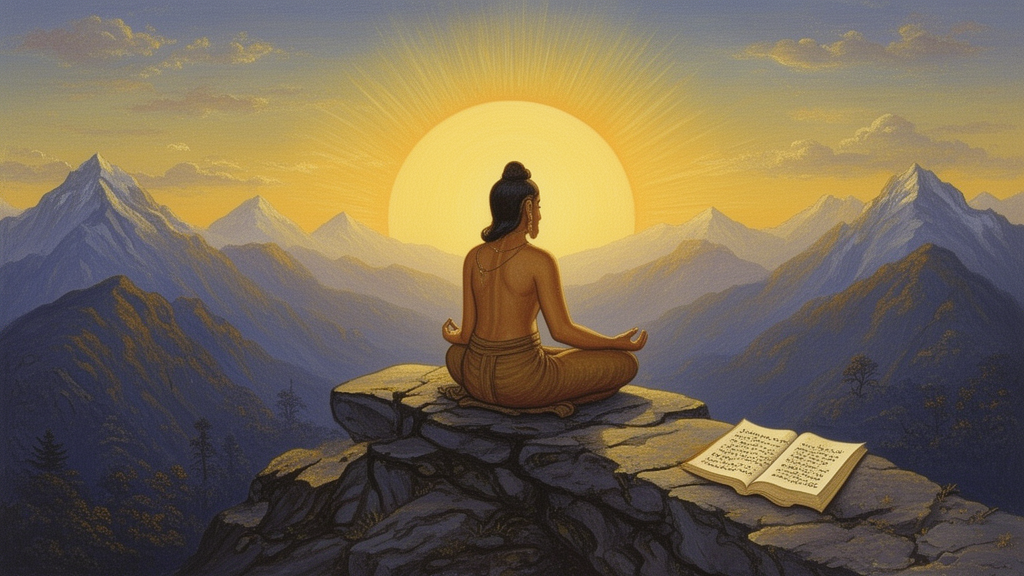
This guide explains what the text says, where its claims come from, how scholars date it, and where traditions and interpretations differ. It separates the content of the text from later commentary, modern summaries, and devotional readings. Readers who want to study the Sanskrit or a complete translation should consult the editions listed at the end.
What the Trishikhibrahmana Upanishad Is
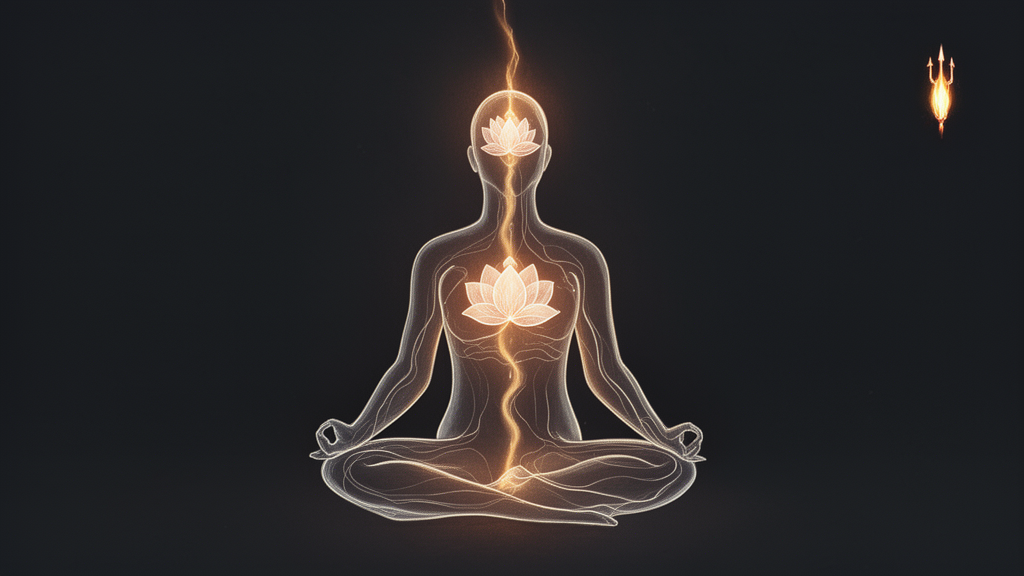
The title combines two words. Trishikhi can be understood as “three-flamed” or “trident,” and Brahmana in this title refers to the sage or teacher who is the central figure of the text. Wikipedia’s entry lists the title as meaning “three-flamed or Trident Brahman” and records the Devanagari form as त्रिशिखब्राह्मण (Wikipedia, Trishikhibrahmana Upanishad). Translators do not all render the title the same way, so readers may see it spelled Trisikhi, Trishikhi, or Triśikhi-brāhmaṇa. These are variant transliterations of the same name.
Three classifications matter for understanding the text. First, it is traditionally linked to the Shukla Yajurveda. Second, it is counted among the Yoga Upanishads, a group of late texts that focus on Yogic discipline. Third, the Telugu anthology of 108 Upanishads of the Muktika canon lists it at number 44, where it is narrated by Rama to Hanuman, according to Wikipedia (Wikipedia). The Muktika listing is a specific anthology tradition. It is not the only way Hindus have organised the Upanishads.
The text is short. Wikipedia reports two chapters and 164 verses (Wikipedia). The Sanskrit Documents edition presents the text in Devanagari and includes the verse-numbered passages, which is useful for checking references (Sanskrit Documents, Trishikhibrahmana Upanishad).
The Opening Question and the Journey to the Sun
The narrative begins when Trishikhi Brahmana travels to the world of the Sun (Adityaloka) and asks his questions there. The Sanskrit text opens with the phrase that introduces this journey, and the question he asks is the one most commonly cited from the first verse: what is the body, what is life, what is the Prime Cause, and what is the Atman. Wikipedia renders the question as “O Lord! What is the body? What is life? What is the Prime Cause? What is the Atman?” and cites it to Trishikhibrahmana Upanishad 1.1 (Wikipedia; Sanskrit text at Sanskrit Documents).
The structure is useful for readers. The text does not begin with a list of rules. It begins with inquiry. Each question points to a different level of the human person: the physical body, the life-breath, the underlying cause of the world, and the inner Self. The rest of the text answers these questions in increasing depth.
The answer given in the Sanskrit is that everything should be known as Shiva alone. The Sanskrit states that the Brahman is eternal, pure, stainless, all-pervading, and non-dual, and that Shiva, one and self-luminous, shines as all this. This is a teaching statement within the Upanishad. It is not a historical claim about the author’s identity or about the Shaiva community. Readers should keep that distinction in mind.
Cosmology: From Brahman to the Elements
A large part of the early discussion is cosmological. The Sanskrit text describes Brahman as ultimately unmanifest and then traces a sequence of manifestation. In the passage numbered as the prose section, the text says that from Brahman comes the Unmanifest, from the Unmanifest comes the Great (mahat), from the Great comes the ego-principle (ahankara), from ahankara come the five subtle elements (tanmatras), from these come the five great elements (mahabhutas), and from the five great elements comes the whole world (Sanskrit Documents).
The vocabulary here is familiar from other Indian philosophical systems. The sequence of the Unmanifest, the Great, the ego, the subtle elements, and the gross elements closely parallels the cosmology of Samkhya, and later Vedanta and Yoga texts adopted related frameworks. The text itself uses these terms, so it is accurate to say that it draws on a shared cosmological vocabulary. It is not accurate to say that this sequence is the only view in Hindu thought, because different schools describe creation and the relation between Brahman and the world in different ways.
The Sanskrit then discusses how the elements are combined. It uses the term pancikarana, usually understood as the “quintupling” or mixing of the five elements, and describes how each element is associated with particular faculties. Space is linked with the ear and sound; air with touch and the life-breaths; fire with sight and the form of things; water with taste; and earth with smell, along with the organs of speech, grasping, walking, excretion, and generation. These correspondences are part of the text’s systematic cosmology, and they appear in the Sanskrit passage in that form (Sanskrit Documents).
For a general reader, the practical lesson is this: the text treats the body and the world as a structured whole. The same principles that explain the universe are said to operate within the person. This is the bridge that leads into the Yogic discussion of the body.
The Body, Breath, and Subtle Channels
Much of the second half of the Upanishad concerns the body as the place where the cosmos is mapped. The Sanskrit describes sixteen parts (kala), breath-currents, and channels (nadi) that run through the body. The text states that twelve channels inside the body carry the life-breaths, and it associates these channels with the powers that the Sanskrit names as presiding deities. The meaning of these correspondences is developed in detail in the verses that follow (Sanskrit Documents).
The Sanskrit verses also describe the heart and the crown. One verse compares the heart to a lotus with its stalk and bud, and another places the Self, described as the nature of inner bliss, at the crown in the highest state. The imagery of lotuses, channels, and centres is shared with many later Yogic and Tantric texts, but the details differ from text to text. Readers should not assume that every Yoga tradition uses the same map of the body.
Here it is important to separate three levels. The first is the text’s own description of the body as a structure of elements, breaths, and channels. The second is commentarial and practitioner interpretation, which often gives these channels and centres more detailed meanings. The third is modern popular teaching, which sometimes presents such maps as physiological facts. The Upanishad itself is a religious and philosophical text. It should be read on its own terms, not as anatomy.
Wikipedia’s summary notes that the text includes subtle-body concepts as part of its Yoga teaching (Wikipedia). The Sacred Texts of Hinduism editorial note also highlights subtle-body theory and Kundalini-related teachings as central features of the text’s Yogic dimension (Sacred Texts of Hinduism). The word Kundalini does not occupy the same place in every verse, and the editorial summary is a secondary description, so it should be read as an orientation to the text rather than as a verse-by-verse proof.
Meditation and the Four States of Consciousness
A distinctive teaching in the Sanskrit is the description of consciousness across four states. One verse says that the Self is present everywhere and is found in the waking state, the dream state, deep sleep, and the fourth state called turiya. The verse states that the Self is not found in any other state at any place (Sanskrit Documents). The fourth state, turiya, is a recurring term in the Upanishads, and it is most famously developed in the Mandukya Upanishad.
The practical point is that meditation is directed toward recognising the unchanging witness behind changing experience. The text does not present meditation as a method for acquiring powers. Its framing is the removal of ignorance about the Self. Readers should be cautious about claims that a particular practice produces specific material or health outcomes. The Upanishad’s stated goal is knowledge of the Self and liberation, and any promises beyond that come from later teachers or modern sources.
Meditation in this text is also tied to ethical discipline and detachment, according to the summary offered by Vedanta Students (Vedanta Students). That site is a devotional and educational resource rather than a critical edition, and its “key verses” are paraphrases rather than checked translations. It is useful as an example of how a modern Vedanta community presents the text, but its wording should not be quoted as the Upanishad’s own words.
Yoga and Vedanta in One Text
The Trishikhibrahmana Upanishad is often described as a bridge between Yoga and Vedanta. Wikipedia lists its philosophy as Yoga and Vedanta and states that the text presents non-dualist Vedanta ideas through Yoga practice, with most of its discussion centred on Yoga (Wikipedia). The Sacred Texts editorial note makes a similar point, describing the text as an integration of Yogic discipline, cosmological reflection, subtle-body theory, meditation, Kundalini-related teachings, and non-dual realisation (Sacred Texts of Hinduism).
Vedanta in this context refers to the non-dual philosophy that identifies the Atman with Brahman. Yoga refers here to disciplined practice, including meditation and breath-related methods. The text does not treat them as opposites. Its teaching is that disciplined practice prepares the mind to understand the Self, and that understanding is the aim.
This is one reason the text attracts both Yoga students and Vedanta students. Different readers may emphasise different parts. A reader interested in breath and meditation may focus on the body and subtle-channel sections, while a reader interested in philosophy may focus on the cosmology and the non-dual statements. Neither emphasis is wrong, but each should be recognised as a reading choice.
Dating the Text: Where Scholars Disagree
The date of the Trishikhibrahmana Upanishad is uncertain, and scholars do not agree. Wikipedia summarises several positions. Gavin Flood dates this and other Yoga Upanishads to probably the early first millennium CE. Raman, by contrast, argues that it is probably a late Upanishad composed after the tenth century because parts of it reflect Hatha Yoga traditions. Mikel Burley places it in Hatha Yoga literature and says its composition date is uncertain. Alain Daniélou accepts that dates for the Yoga texts are uncertain but classifies the Trishikhibrahmana as a Raja Yoga text (Wikipedia).
These positions are not simply right or wrong. They depend on what evidence the scholar emphasises. An early date may be supported by the Upanishad’s place in the Yoga Upanishad corpus and its philosophical vocabulary. A late date may be supported by references to practices associated with Hatha Yoga, which are generally linked to later medieval developments. Readers should treat any single date with caution unless they see the reasoning behind it.
The disagreement also shows the difference between devotional belief and scholarship. Many devotees and teachers treat the Upanishads as eternal revelation (shruti). Academic historians ask when a particular text was composed, who compiled it, and how its ideas changed over time. Both approaches can be respected, but they answer different questions.
How Different Readers Approach the Text
The Trishikhibrahmana Upanishad is read in several ways. In some Yoga and Vedanta communities it is studied as a manual of contemplative instruction. In academic settings it is examined as a document in the history of Yoga. In devotional settings, especially those influenced by Shaiva theology, its declaration that all is Shiva may be emphasised. Within a single community, practice can also vary by teacher, lineage, and region.
This variety matters for readers who want to practise. The text describes meditation and breath-related ideas, but it does not provide a complete, step-by-step manual in the way a modern course might. Anyone who wishes to practise Yoga should learn from a qualified teacher within a recognised tradition, especially for breath control and advanced methods. Health concerns, pregnancy, heart conditions, and other medical issues should be discussed with a qualified doctor before beginning intensive breath or posture practice.
Tradition-specific guidance is also important for ritual. The Upanishad itself is not a puja manual. If a reader encounters instructions for particular rites in other materials, those instructions belong to the specific community or teacher and should be identified as such.
A Practical Way to Begin Reading
Readers who are new to the text can approach it in a structured way. The following steps help separate what the text says from what later commentators add.
- Read the opening question in a reliable translation, and note the four questions about body, life, Prime Cause, and Atman.
- Compare two translations or the Sanskrit edition for the first chapter to see how translators handle key terms such as Brahman, Atman, and Shiva.
- Mark the cosmological sequence, from the Unmanifest to the five great elements, and compare it with a general introduction to Samkhya.
- Read the body and subtle-channel passages slowly, and write down which statements are descriptions within the text and which are interpretations by later readers.
- Study the meditation and turiya verses, and consider how the text connects knowledge of the Self with ethical discipline and detachment.
- Check the dating discussion in an academic source before forming a view on the text’s age.
This method keeps scripture, commentary, tradition, and modern interpretation distinct. It also helps readers avoid treating a summary as a verse-by-verse translation.
Frequently Asked Questions
Is the Trishikhibrahmana Upanishad a Shaiva or a Vaishnava text?
The text is most strongly associated with Shiva. Its teaching that everything should be known as Shiva is central to its opening answers. Wikipedia also notes that it includes Vishnu, so the text is not limited to one deity in the way some readers assume (Wikipedia). How a reader or community understands its deity language depends on the tradition they follow.
Is the text the same as the Shukla Yajurveda?
No. The Upanishad is attached to the Shukla Yajurveda, which means it is traditionally associated with that Veda. It is a separate text within that association. Wikipedia lists the Linked Veda as the Shukla Yajurveda (Wikipedia).
Does the text give a step-by-step meditation method?
The text discusses meditation, concentration, and pranayama as part of its Yogic teaching, but its main concern is the knowledge of the Self and liberation. For detailed practice, students should consult a qualified teacher in a recognised lineage. Claims that a method produces specific powers or health benefits are not supported by the text and should not be treated as its teaching.
Why do sources describe the text differently?
Sources emphasise different parts. Academic summaries focus on Yoga history and dating. Devotional and educational sites may emphasise knowledge, devotion, and the Guru. Some modern summaries are paraphrases rather than translations. The best approach is to compare a Sanskrit edition, a scholarly translation, and a clearly identified commentary.
Closing Takeaway
The Trishikhibrahmana Upanishad asks what the body, life, the Prime Cause, and the Self are, and it answers through a combination of cosmology, subtle-body teaching, meditation, and non-dual realisation. Its strongest textual claims are that Brahman is one and all-pervading, that the Self is present in every state of consciousness, and that everything should be known as Shiva. Its date and classification remain debated, and its practices should be learned within a tradition with proper guidance.
Sources and Further Reading
- Trishikhibrahmana Upanishad, Wikipedia: general summary, title meaning, Shukla Yajurveda link, two chapters and 164 verses, the Muktika listing, the question in 1.1 in English rendering, and the scholarly dating positions of Flood, Raman, Burley, and Daniélou.
- Trishikhibrahmana Upanishad, Sanskrit Documents: Devanagari text used to check the opening question, the cosmological sequence from Brahman to the five great elements, the element correspondences, the twelve channels, the heart and crown verses, and the four states of consciousness.
- Trishikhi Brahmana Upanishad, Sacred Texts of Hinduism: secondary editorial note describing the text as a Yoga Upanishad associated with the Shukla Yajurveda, integrating Yogic discipline, cosmology, subtle-body theory, meditation, and non-dual realisation.
- Trisikhi Brahmana Upanishad, Vedanta Students: devotional and educational summary emphasising knowledge, devotion, the Guru, and detachment. Its verse paraphrases are not treated here as the Upanishad’s own wording.
Related HindusGod.com reading (WordPress drafts; links may not be public until the owner publishes them): Aranyaka Upanishad, Brahmana Aranyaka Upanishad, Veda Brahmana Aranyaka Upanishad, Jaiminiya Upanishad Brahmana, Meaning of Upanishad, 10 Upanishad, 108 Upanishad, Adhyatma Upanishad, Advaita Upanishad, and Ashtavakra Upanishad.