The Yoga Upanishads are a group of minor Upanishads that deal with yoga: its techniques, its methods of meditation, and its understanding of breath, body and mind. According to the Muktika anthology of 108 Upanishads, as summarized by Wikipedia, there are twenty Yoga Upanishads. They are generally classified apart from the older Principal Upanishads. This article explains what the texts are, what they teach in general terms, how they differ from later yoga manuals, and how readers can study them with accurate sources.
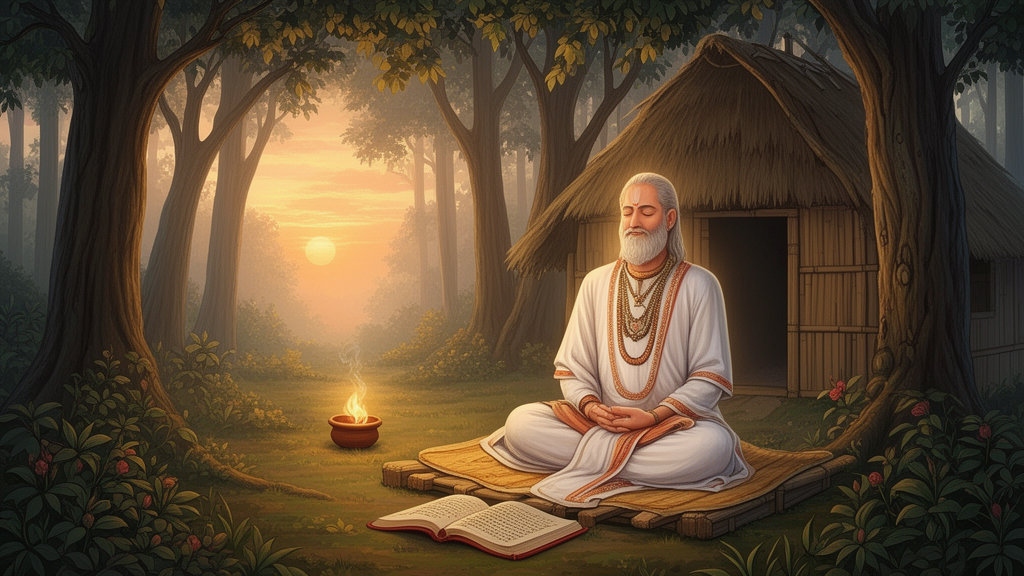
Quick answer: what are the Yoga Upanishads?

The Yoga Upanishads are a set of twenty Upanishadic texts classed under the broader heading of yoga. They belong to the Hindu scriptural tradition of the Upanishads, but they are not usually grouped with the earliest and most widely studied Principal Upanishads. Their subject is yogic theory and practice, with different texts placing different emphasis on method, meditation and the purpose of yoga. Some of their ideas are shared across the group, but the texts do not present one single manual of practice.
For most readers, the most useful first step is to separate three things: what the texts say, how later traditions have used them, and what modern scholars and teachers conclude about their history. The sections below follow that order.
Where the Yoga Upanishads sit within the Upanishads
The word Upanishad is commonly understood to refer to the teaching texts that are placed at the end of the Vedic literature, though the precise meaning of the term and the boundaries of the category are debated in scholarship. Within the Upanishads, the Principal Upanishads are considered older and more central to Vedanta. The Yoga Upanishads belong to a larger group of later or minor Upanishads. Wikipedia notes that they are generally classified separately from the Principal Upanishads, which are regarded as more ancient and as part of the Vedic tradition.
This classification matters. A reader who expects the Yoga Upanishads to contain the same material as the Brihadaranyaka or Chandogya Upanishads will be surprised. The Yoga Upanishads are more concerned with method. They describe practices and states of meditation rather than offering the same kind of philosophical dialogue found in the older texts.
Why the count can differ
Readers searching for Upanishad counts often encounter several numbers, including 108, 112 and other totals. The count used in this article is the Muktika anthology of 108 Upanishads, which is the source of the twenty Yoga Upanishads according to the Wikipedia summary. Popular websites and printed lists sometimes organize the Upanishads differently. For an overview of how the broader group is discussed on this site, see the Upanishads overview draft, and for a comparison of counting systems, see the 112 Upanishads article draft. Both pages are WordPress drafts and may not yet be public.
Yoga Upanishads and the wider yoga tradition
The term yoga covers many meanings. In the Yoga Upanishads, yoga refers to a set of practices aimed at controlling the mind and directing attention inward. The same word also appears in the Bhagavad Gita, in the Yoga Sutras attributed to Patanjali, and in later texts of Hatha Yoga. These works are not the same, and their teachings differ in method, vocabulary and date. Grouping them under the single word yoga can hide real differences, so it is helpful to name the text whenever a claim is made.
What the Yoga Upanishads teach in general terms
Wikipedia describes the Yoga Upanishads as dealing with the theory and practice of yogic techniques. The emphasis varies from text to text. Some focus more on methodology, some on meditation, and some share ideas with one another. Because the group contains twenty texts, it is best to avoid one summary that applies identically to all of them.
The following themes recur across the broad field of yoga literature. They are offered here as descriptive categories, not as a universal teaching that every text repeats.
- Method: instructions about posture, breath and sitting, often given in compact form.
- Meditation: teaching on focusing the mind on a single point, and on stages of inward attention.
- Inner body and energy: ideas about subtle channels and vital energy, which later manuals describe in much more detail.
- Liberation: a goal framed in Upanishadic language of release from bondage and realization of the self, although the precise meaning varies by text.
Breath and prana: explaining a key term
Breath control is one of the most visible subjects in yoga teaching today. The Yoga Upanishads include discussion of the breath in connection with the subtle body and with meditation. Modern educational sites often explain pranayama in simple terms. For example, Yoga Basics describes pranayama as breathing exercises developed by ancient yogis for purification, explains that prana is often translated as life force energy, and says that yama is commonly rendered as control or mastery. That site also gives a modern teaching instruction: for most pranayama practices, the breath is slow and steady, taken in and out through the nose, with the body seated upright and the attention kept on the breath. Yoga Basics is a modern instructional resource, so its wording should be read as a contemporary explanation rather than as the text of an Upanishad.
This distinction is important. A Yoga Upanishad may discuss breath or prana in its own terms and vocabulary. A modern class may teach breathing exercises using the same words but with different instructions, meanings and claims. Readers should not assume that a modern description of pranayama reproduces the text.
Meditation as a central concern
Meditation is repeatedly connected with yoga in the modern sources reviewed for this article. Yoga Basics, for instance, describes meditation as a focusing of the mind on a single object, and it explains that the ability to keep the mind focused takes practice. That description is a modern educational account. The Yoga Upanishads themselves should be consulted directly when a reader wants to know how a particular text describes meditative absorption, since terminology and stages can differ between texts.
A practical way to read a passage is to ask three questions: what object or method the text describes, what state it claims to lead toward, and whether the passage presents a method, a metaphor or a claim about experience. These questions help readers avoid treating every instruction as a literal physical procedure, and they help them see when a text is using symbolic language.
Translations and editions
Most English-speaking readers meet the Yoga Upanishads in translation. One widely referenced edition is associated with G. Srinivasa Ayyangar. The Internet Archive lists a text titled The Yoga Upanishads by Srinivasa Ayyangar, and a PDF hosted on the Archive contains a file name indicating a 1938 Sanskrit and English text. The opening passage available in the search snippet describes the volume as the first of an English translation of the One Hundred and Eight Upanishads. The Archive’s page is a library catalogue entry, so it is best used to locate the edition rather than to judge the translation.
Translations are interpretations. Terms such as yoga, prana, samadhi and atman may be rendered differently by different translators, and an older translation may use vocabulary that modern readers no longer share. When you read a translation, check whether the translator provides notes, a glossary or an introduction. If you plan to quote a passage, use an edition you can verify, cite the translator and page number, and avoid copying long stretches from copyrighted translations.
Using the Sanskrit alongside English
Readers who know some Sanskrit may prefer to compare the original text with the English rendering. Even without Sanskrit, a bilingual edition helps readers see where a translation is making a choice. A quick check of the same key term in several translations can show how much interpretation is involved. This article does not quote Sanskrit verses from the Yoga Upanishads, because the sources reviewed here did not include a verified verse-level text for direct citation.
Belief, text, tradition and scholarship
Discussion of the Yoga Upanishads often mixes four different kinds of statements. Keeping them apart makes the subject clearer.
- What the text says: the words of a named Upanishad, in a specified edition or translation.
- What a tradition teaches: the understanding of a lineage, teacher, monastery or community, which may draw on the texts but is not identical with them.
- Historical and scholarly questions: when the texts were composed, in what contexts they were used, and how they relate to other yoga literature.
- Devotional or personal belief: what individuals hope, experience or believe as a result of practice.
Scholars generally treat the Yoga Upanishads as part of a wider and changing body of literature. The Wikipedia article indicates that the group is classified apart from the Principal Upanishads and is often associated with later yoga development. Exact dates and authorship should be treated cautiously. Where a specific date is needed, readers should consult a current academic history of the Upanishads rather than relying on popular summaries.
Shared ideas and differences
The Yoga Upanishads share some ideas, but they are not a single system. One text may stress breath, another may stress sound, another may stress the subtle body or a particular object of meditation. Readers should expect variation in terminology and emphasis. A good reading habit is to compare how several texts discuss the same term, such as breath, meditation or liberation, and to note where they agree and where they differ.
The Yoga Upanishads also differ from later manuals in the Hatha yoga tradition. Wikipedia lists the Shiva Samhita and the Gheranda Samhita among separate Hindu texts, and these are commonly discussed as later yoga manuals rather than as Upanishads. Their instructions on postures, cleansing practices and kundalini are not the same as the content of the Yoga Upanishads. Mixing the two groups can lead to historical errors.
Practice, devotion and the limits of a text
Many people approach the Yoga Upanishads as a guide to practice. That is a legitimate and common response, but it helps to recognize the difference between studying a text and following a tradition of instruction. Texts can describe methods, but practical guidance is often given through a teacher, a lineage, or a community of practice. Where a practice is described in a text, it is wise to ask whether it is presented as universal, optional, or specific to a school.
Modern yoga teaching frequently presents breath control, posture and meditation as tools for health, calm and focus. Some modern sources describe benefits such as reduced stress or improved concentration. Those claims come from modern educational and wellness material and should be evaluated separately from the text. This article does not claim that practice guarantees any health, psychological or spiritual result. Readers with medical conditions should consult a qualified health professional before starting breathing or meditation practices, especially those involving breath retention or intense exertion.
A respectful way to study
- Begin with a readable translation and a short introduction, then read a second translation of the same passage.
- Note the Upanishad name, edition, translator, and page or section number for every passage you cite.
- Separate the text’s instructions from modern teachers’ explanations and from your own experience.
- Ask a qualified teacher about physical practices, especially if you have health concerns.
- Respect that different communities read these texts in different ways.
Common questions about the Yoga Upanishads
Are the Yoga Upanishads the same as the Yoga Sutras?
No. The Yoga Upanishads are a group of Upanishads that deal with yoga. The Yoga Sutras are a separate text traditionally attributed to Patanjali and belong to a different literary category. Both discuss yoga, but they have different structures, vocabularies and historical contexts. Wikipedia lists the Yoga Sutras as a separate text in its scriptural index, which supports keeping them distinct.
Should I read all twenty Yoga Upanishads?
Reading all twenty can be useful for research, but most readers benefit from starting with one or two texts and a good introduction. A reader interested in breath might compare passages on breath, while a reader interested in meditation might focus on passages about concentration. Because the texts vary considerably, reading selectively and comparing carefully often works better than trying to summarize the whole group at once.
Do the Yoga Upanishads prescribe a single routine?
The sources reviewed for this article do not support the claim that the Yoga Upanishads prescribe one universal routine. They discuss yogic techniques and meditation with varied emphasis. Any modern sequence of postures or breathing exercises should be described as a later teaching or as a school-specific method, not as the uniform instruction of the Upanishads.
Closing takeaway
The Yoga Upanishads are a useful entry point into the Upanishadic literature of yoga. They are best understood as a varied group of texts, classed apart from the Principal Upanishads, that deal with yogic techniques, meditation and the inner life. Readers who approach them with a verified edition, careful attention to terminology and a clear distinction between text, tradition, scholarship and modern practice will get the most from them.
Sources and Further Reading
- Yoga Upanishads, Wikipedia: used for the classification of the twenty Yoga Upanishads within the Muktika list of 108 Upanishads, their separation from the Principal Upanishads, and the general description of their subject matter.
- The Upanishads: History, Teachings, and Best Quotes, Yoga Basics: a modern instructional source used for its explanation of pranayama, prana, yama and meditation. It is not a primary scripture source.
- The Yoga Upanishads by Srinivasa Ayyangar, Internet Archive: a library catalogue entry used to identify this edition and its availability.
- The Yoga Upanishads Sanskrit and English text PDF, Internet Archive: used to identify a 1938 Sanskrit and English edition and to note that it presents the first volume of an English translation of the 108 Upanishads. The full PDF was not inspected for this draft, so readers should verify passages directly.
Internal links in this draft point to WordPress drafts that may not yet be public. Confirm their status before publication.