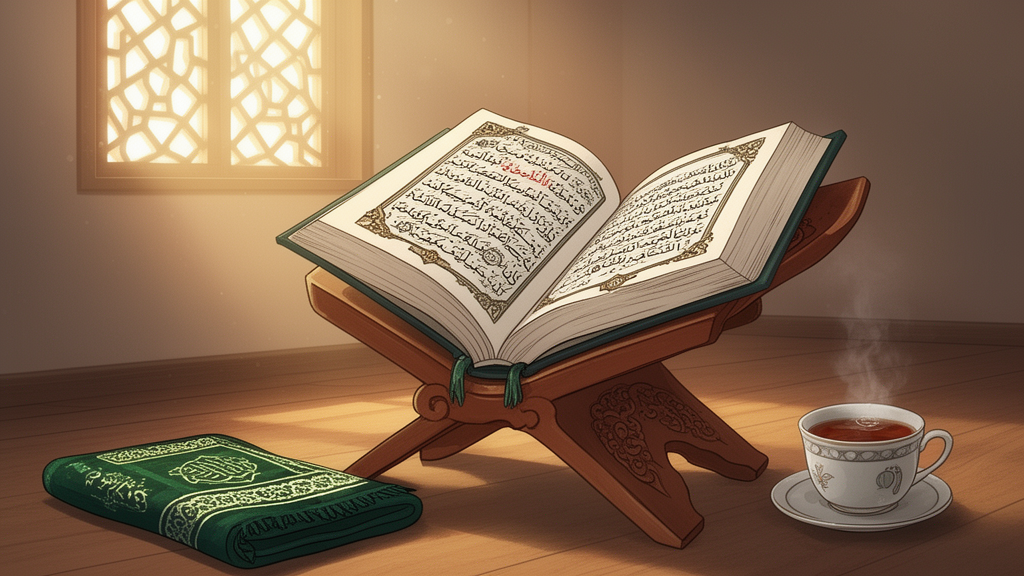
The word Quran means ‘recitation’ or ‘reading’ in Arabic, and for Muslims it names the central scripture of Islam. Muslims believe it is the speech of God revealed to the Prophet Muhammad through the angel Gabriel, and they treat its Arabic text as the authoritative Quran. When people search for the meaning of the holy Quran, they usually want three things: the meaning of the word itself, what Muslims believe the book is, and how readers understand its message through translation and commentary. This article answers those questions and keeps belief, text, tradition, and scholarship clearly separate.
This article is written for HindusGod.com readers who want an accurate, respectful introduction. The Quran is not a Hindu scripture. It belongs to Islam, and this guide describes it on its own terms. Where Hindu readers want to compare sacred texts, the distinctions matter, and they are discussed later.
The short answer: what the Quran means

The Quran is the sacred book of Islam. The Arabic word ‘Quran’ is commonly understood to come from the root qara’a, meaning to read or recite. A guide from Safdriya Quran Academy explains that the term is seen in Islam as a recitation of God’s guidance for humanity, and the same guide describes the book as the word of God revealed to the Prophet Muhammad over 23 years (Safdriya Quran Academy, ‘What Is the Quran?’).
In practical terms, the meaning of the Quran has four layers:
- Linguistic meaning: the word refers to recitation and reading.
- Religious meaning: for Muslims, it is the revealed word of God and the foundation of Islamic faith and practice.
- Textual meaning: it is a collection of 114 chapters called surahs, divided into verses called ayahs (Encyclopaedia Britannica, ‘Qur’an’).
- Interpretive meaning: its message is explained through translation, commentary, law, and community practice, which vary across traditions.
Muslims do not generally treat the Quran as a story book or a historical record in the modern sense. It is read as guidance for worship, ethics, community life, and a relationship with God, while also containing narratives about earlier prophets.
What the word ‘Quran’ means
Recitation and reading
The Arabic word ‘Quran’ is usually linked to the verb qara’a, to read or recite. Al Azhar Quran Teaching notes that the word literally means both ‘recitation’ and ‘reading’ (Al Azhar Quran Teaching, ‘Understanding Quran’s Meaning’). That double meaning matters. The text was meant to be recited aloud, and it was also written down.
This is why many Muslim teachers describe the Quran first as something spoken and heard. Writing was an aid for memorisation and preservation. According to the same Al Azhar article, the Quran was both recited orally and written in book form, and the verses were collected and ordered in book form privately and later institutionally.
Why the spelling varies
Readers will see several English spellings: Quran, Qur’an, Qur’an, and occasionally Koran. The spelling changes come from transliteration, not from different books. Arabic letters do not map neatly onto English, so writers choose different conventions. The Safdriya guide notes that ‘Quran’ is the commonly used English spelling, and that some people write ‘Koran.’ It also notes that ‘Al-Qur’an’ is commonly used in Arabic-language contexts (Safdriya Quran Academy).
This article uses ‘Quran’ as its main spelling. Quotations from other works keep the spelling used by the original author. When you search, you may also see the phrase ‘the meaning of the holy Qur’an’ in various forms. These variants point to the same subject.
What Muslims believe the Quran is
It is important to separate belief from history. The following points describe Islamic belief as taught by Muslim sources. They are not historical findings established by the sources cited here.
Revelation through the Prophet Muhammad
Muslims believe the Quran was revealed to Muhammad through the angel Gabriel. Britannica describes this as the Islamic belief that the Quran is a literal transcript of God’s speech, revealed to Muhammad through Gabriel to be recited to his community (Britannica). Al Azhar Quran Teaching gives the same account, adding that the revelation came partly in Mecca and partly in Medina (Al Azhar Quran Teaching).
The Safdriya guide describes the revelation as gradual, over 23 years, responding to specific events and questions. It presents this gradual pattern as allowing the community to learn and apply guidance step by step (Safdriya Quran Academy). The guide is a Muslim educational resource, so its description reflects a devotional and educational viewpoint rather than an academic historical study.
Arabic as the language of the Quran
Muslims regard the Arabic text as the Quran itself. The Quran was revealed in Arabic, which was the language of the people first addressed. Al Azhar Quran Teaching notes that although the message was revealed in Arabic for an Arabic-speaking community, it is understood as meant for all humanity (Al Azhar Quran Teaching).
This belief is the reason many Muslims learn Arabic, or at least learn to recite the Arabic text correctly, even when they rely on translations for understanding. The Safdriya guide describes translations as widely available for reference, while the Arabic is treated as the sacred original.
How the Quran is structured
Surahs and ayahs
The Quran has 114 chapters, called surahs. Britannica states that the surahs vary in length (Britannica). Each surah is made up of verses, which Arabic calls ayahs. Al Azhar Quran Teaching explains that the word ayah literally means ‘a sign,’ and that verse divisions were not decided by human editors but are regarded by Muslims as part of the divine text (Al Azhar Quran Teaching).
Readers should note that English ‘verse’ numbers are a publishing convention used in translations and printed editions. Muslim tradition holds that the division into ayahs is part of the sacred text, but the numbering systems in printed editions can differ slightly. When you look up a passage, check the edition and numbering used.
Not arranged as a single chronological story
A common mistake is to expect the Quran to read like a biography or history book. Al Azhar Quran Teaching states that the Quran was not meant to tell a chronological story and should not be viewed as a sequential narrative like the book of Genesis (Al Azhar Quran Teaching). Readers who approach it thematically, by topic, often find it easier to follow.
The Quran also differs from many scriptures in how it came to be collected. Al Azhar Quran Teaching describes it as having been delivered through a single person who recited what he heard, while the Jewish and Christian scriptures are described as collections of books written by many human authors. That is a comparison of how each tradition understands its scripture, not a claim about which is ‘better.’
The message of the Quran: main themes
The Quran covers many subjects. A complete survey is beyond one article, but readers commonly encounter the following areas, each described in Muslim teaching and commentary.
- Faith in one God: Islamic teaching places strong emphasis on the oneness of God, called Allah in Arabic.
- Worship and devotion: the Quran is presented as guidance for prayer, devotion, and personal conduct.
- Ethics and justice: the Safdriya guide describes the Quran’s teaching as including moral guidance, justice, and compassion.
- Prophetic narratives: Britannica notes that the Quran contains allusions to narratives familiar to Judaism and Christianity.
- Law and community life: the Safdriya guide describes the Quran as a moral and legal guide for Muslims, though how it becomes law is a matter for Islamic jurisprudence and differs across schools.
Note that the list above describes how Muslims commonly summarise the Quran. It is not a complete table of contents, and it does not replace reading the text itself. The emphasis on any theme depends on the reader, the translation, and the tradition.
Stories shared with other scriptures
Britannica states that the Quran includes allusions to narratives familiar to Judaism and Christianity (Britannica). This is a textual observation that scholars of religion discuss in detail. Muslims often explain such material as part of a continuing message from God through earlier prophets. Academic readers may instead compare how each tradition retells shared figures. Both approaches exist, and a respectful reader can note both without treating one as the only correct reading.
Translation: what ‘meaning’ means for a non-Arabic reader
A translation is an interpretation
Most readers who search for the meaning of the Quran are not reading Arabic. Translations are therefore essential, but they need careful handling. A translation conveys meaning across languages; it is never identical to the Arabic. The Safdriya guide says that while translations are widely available, understanding the true meaning of the verses is best supported by learning Arabic (Safdriya Quran Academy). Many Muslim readers therefore use translations alongside the Arabic text and commentary.
Because translation involves choices of vocabulary, grammar, and explanation, two translations can read differently while both being faithful in intent. When you quote or study a translation, cite the translator, the edition, and the publisher.
Yusuf Ali and other English translations
A widely known English translation is by Abdullah Yusuf Ali. The Internet Archive lists a digital copy titled ‘The Meaning of The Holy Qur’an,’ attributed to Abdullah Yusuf Ali and published with Amana Publications and IIIT, among other contributors (Internet Archive, ‘The Meaning of The Holy Qur’an’). The title itself shows how translators often frame their work: the English is presented as a meaning of the Quran, not as the Quran itself.
The Internet Archive also hosts a separate listing titled ‘The Meaning of the Holy Quran’ attributed to Yusuf Ali and others (Internet Archive, ‘The Meaning of the Holy Quran’). The two listings may be different scans or editions. The archive pages are useful for locating a digital copy, but readers should confirm the edition and copyright status before relying on any file.
Notes for readers choosing a translation
- Check the translator’s name and the publisher’s note on method.
- Compare key passages in two or three translations to see where wording differs.
- Read translator’s footnotes separately from the main text, since they are commentary rather than scripture.
- Use a translation with Arabic text if you plan to study recitation or grammar.
Tafsir: interpreting the meaning
In Islamic scholarship, the explanation of the Quran is called tafsir. Tafsir is distinct from the Quran itself. It includes commentary on vocabulary, context, law, theology, and spiritual meaning. Commentaries come from many scholars and schools, and they do not always agree. A tafsir may reflect a particular theological or legal school, a historical period, or a devotional approach.
A reader should therefore distinguish three things:
- The Quranic text, which Muslims regard as God’s word.
- The translation, which is a human rendering of that text into another language.
- The commentary, which is a human interpretation of the text and its meanings.
This distinction helps avoid a common confusion, where a translator’s footnote or a modern article is treated as if it were scripture. Muslim scholars themselves draw these lines, and a responsible guide keeps them visible.
Interpretive traditions differ
Different Muslim communities approach interpretation in different ways. Some emphasise the literal and legal meaning of verses. Others place more weight on spiritual or inner meanings. Scholarly and devotional readings can overlap but are not the same. For this article, the important point is that there is no single interpretive authority accepted across every Muslim tradition in every detail. Where a claim about interpretation is important, readers should look at a named commentary or school.
Why the Quran matters in Muslim life
The Quran is central to Muslim worship. It is recited in prayer, memorised by many Muslims, and studied in homes, schools, mosques, and online classes. The Safdriya guide describes the Quran as a source of spiritual inspiration and moral clarity in daily life, and as more than a book of laws (Safdriya Quran Academy). Those descriptions come from a Muslim educational source and reflect Muslim belief about the Quran’s role.
Muslim practice is not uniform. Learning styles, recitation traditions, and the level of Arabic proficiency differ widely between countries and families. Some readers study the Arabic text closely. Others read translations for guidance. Both are common, and neither is the only acceptable path in every community.
A Hindu reader’s perspective: respectful context
HindusGod.com focuses on Hindu deities, scriptures, and culture. Readers who are Hindu, or who study multiple religions, sometimes ask how the Quran relates to Hindu sacred texts. A respectful answer begins with the observation that these are different traditions with different ideas of revelation, authority, and sacred language.
- Revelation: Islam teaches that the Quran is a revealed text delivered to one prophet. Hindu traditions have a diverse understanding of scripture, including texts regarded as shruti, heard or revealed, and texts regarded as smriti, remembered or traditional.
- Language: the Quran is treated as sacred in Arabic. Hindu scriptures are chiefly associated with Sanskrit and also appear in many regional languages in translation and commentary.
- Authority: both traditions include commentary, schools, and interpretations. Neither is a single uniform authority.
For readers comparing sacred books, it may help to read the Quran alongside other HindusGod.com guides on scripture. Our draft pages on Holy Scriptures, Holy Book, and Holy Book Meaning cover broader questions about how religions name and treat sacred texts. Once published, these pages will give more background. Until then, they remain drafts and their links may not yet be public.
A specific Hindu-Islamic comparison should be made with care. Avoid claims that one scripture ‘contains’ or ‘explains’ another unless a named scholar or tradition supports that comparison, and identify the source of any such claim.
Related scriptures and where to read more
Readers who explore the meaning of the Quran often also look at other scriptures. These pages on HindusGod.com are drafts and may not be public yet, so treat their links as future references:
- Holy Qur an, a related draft on the Quran as a holy book.
- Holy Injil, a draft on the Christian Gospel tradition’s name for scripture.
- Holy Zabur, a draft on the Psalms in Islamic and Abrahamic contexts.
- Holy Gita, a draft on the Bhagavad Gita, a Hindu scripture.
- Holy Geeta, a draft on an alternate spelling of the Bhagavad Gita.
- Holy Text, a draft on what makes a text sacred within a tradition.
How beginners can approach the Quran
Beginners often feel overwhelmed by the length and the unfamiliar structure. A practical approach has several steps:
- Start with a reliable translation. Choose one translation with clear notes and read its introduction.
- Read a short surah first. Many readers begin with shorter surahs, since they are easier to finish in one sitting.
- Read with context. Use a general introduction or a tafsir to learn background for unfamiliar terms and events.
- Keep a note of questions. Write down terms and names to check against an authoritative glossary or commentary.
- Learn recitation if you wish. Many Muslims learn basic Arabic and recitation, and the Safdriya guide describes learning Arabic as helpful for understanding, although translations are widely used for reference.
Studying the Quran is an educational activity for many readers and a devotional activity for Muslims. Both are legitimate. Readers who are not Muslim may study it as a text of world religion without adopting its beliefs.
Common misunderstandings
- ‘The Quran is just a translation of the Bible.’ Muslim sources present it as a distinct revelation, though Britannica notes allusions to narratives familiar in Judaism and Christianity.
- ‘Translations are the Quran.’ Muslims generally regard the Arabic text as the Quran. Translations convey meaning but are human renderings.
- ‘Every Muslim interprets the Quran the same way.’ Interpretations differ across schools, regions, and periods, and commentaries are not uniform.
- ‘The Quran is arranged chronologically.’ Al Azhar Quran Teaching notes that it is not meant to be read as a sequential narrative.
Frequently asked questions
What is the simplest meaning of the word Quran?
The simplest meaning is ‘recitation’ or ‘reading.’ The word is linked to the Arabic verb meaning to read or recite, and it is used for the sacred scripture of Islam (Al Azhar Quran Teaching).
Is the Quran the same as a translation?
No. Muslims regard the Arabic text as the Quran. A translation is a rendering in another language and is an interpretation of meaning. Translators and commentators explain their choices in introductions and footnotes.
How many chapters does the Quran have?
The Quran has 114 chapters, called surahs (Britannica).
Is the Quran a Hindu scripture?
No. The Quran is the scripture of Islam. HindusGod.com covers it for readers who want to understand world religions, and it should not be treated as part of Hindu scriptural canon.
Takeaway
The meaning of the holy Quran begins with its name. ‘Quran’ refers to recitation and reading, and for Muslims the word names the revealed speech of God given to the Prophet Muhammad. Its meaning in daily life is shaped by Arabic recitation, translation, commentary, and the traditions that interpret it. A respectful reader keeps these layers distinct: the Arabic text, the translation, the commentary, and the community practice.
For further study, start with a reliable translation, read the introduction and footnotes, and compare references in a commentary or scholarly introduction before drawing firm conclusions.
Sources and further reading
- Encyclopaedia Britannica, ‘Qur’an’, used for the description of the Quran as believed by Muslims to be God’s speech, the 114 surahs, and allusions to narratives shared with Judaism and Christianity.
- Al Azhar Quran Teaching, ‘Understanding Quran’s Meaning’, used for the meanings of the word Quran, oral and written transmission, the ayah as a sign, verse division, and the non-chronological character of the text. This is a teaching website, not an academic publication.
- Safdriya Quran Academy, ‘What Is the Quran? Meaning, Purpose and Teachings Explained’, used for the root qara’a, the 23-year revelation account, spelling variants, and the description of the Quran’s moral and legal guidance from a Muslim devotional and educational perspective.
- Wikipedia, ‘Quran’, used as an overview of the article’s subject areas, including etymology, history, text, translations, recitation, and interpretation. Readers should check the cited works referenced in that article for detailed claims.
- Internet Archive, ‘The Meaning of The Holy Qur’an’ by Abdullah Yusuf Ali, used to identify an English translation with this title. The archive page was accessed for its catalogue details; the translation text itself was not quoted.
- Internet Archive, ‘The Meaning of the Holy Quran’ by Yusuf Ali and others, used to identify a second archived listing with a similar title.