The Holy Cow and Other Indian Stories is a nonfiction collection by Tarun Chopra that uses humor, anecdotes, and observation to describe everyday life, customs, and beliefs in India. This guide explains what the book is, what published descriptions and reader reviews say about it, and how to place its cultural observations, including the sacred cow, within the wider context of Hindu traditions. It also explains where the book is a popular travel-and-culture account rather than a scripture or a scholarly study.
Quick answer: what this book is
The Holy Cow and Other Indian Stories is a popular nonfiction book, not a religious text. Its catalog listings describe it as a collection of short pieces covering Indian culture, humor, urban life, and reflections on identity and society. The book is listed on Goodreads as a 168-page paperback first published on December 12, 2000, and Amazon and Barnes & Noble list it under ISBN 9788172340421. Readers should treat it as one author’s view of India, useful for context and conversation, but not as a authoritative source on Hindu scripture, doctrine, or the history of cow veneration.
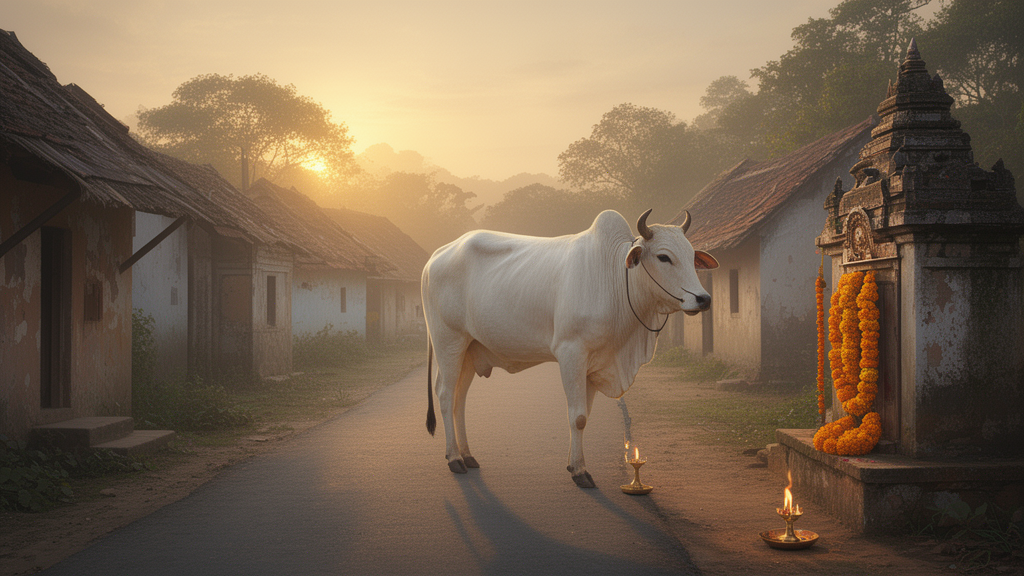
The phrase “holy cow” in the title points to a real and widely discussed feature of Indian life: cows are treated with particular respect in many Hindu communities. That respect, however, is not uniform. It differs by region, community, family, and textual tradition, and it should be explained with care rather than reduced to a single rule or a slogan.
What the book covers
Publication details and the author
The book is credited to Tarun Chopra. The Internet Archive lists the title under the same name, and Amazon, Barnes & Noble, Google Books, and Goodreads all identify the book with that title and author. Goodreads lists it in the nonfiction category, with 168 pages in paperback. These catalog details are useful for identifying the edition, but they do not establish the book’s accuracy on any particular custom or belief. For that, readers need to consult primary sources and reputable scholarship, discussed below.
Edition details can vary. Some listings may show different formats, page counts, or reprints. Before citing this book in a formal paper or relying on a page number, check the specific edition in your library or with the publisher.
How the book is described
The Google Books and Goodreads descriptions present the book as a collection that brings together “the sights, sounds, and spirit of India through witty observations, quirky anecdotes, and colorful characters.” The Goodreads listing names several themes: culture, humor, urban life, diversity, and reflection. It describes the book as written for travelers, expatriates, and readers who want to understand India beyond stereotypes. These are the publisher-style and bookseller descriptions, so they reflect how the book is marketed as much as what every chapter contains.
A separate Google Books description says the collection gives readers answers to questions such as why cows roaming city streets are considered sacred animals, and it describes the book as covering beliefs, philosophies, and ideologies practiced in India for generations. That wording signals that the book addresses religious and cultural topics, but it does not show that the book is a detailed theological study.
What reader reviews say
Reader reviews on Goodreads offer a useful, if informal, picture of the book’s reception. One reviewer describes the book as devoting a few pages to each of about twenty aspects of Indian culture, including bureaucracy, arranged marriage, the veneration of cows, karma and reincarnation, and the caste system. The same reviewer criticized the editing of that edition. Another reviewer, writing about history and religion, said the book’s photographs were a highlight and expressed personal views about astrology and reincarnation. These reviews are opinions. They tell you how some readers experienced the book; they do not verify the book’s claims.
Notice what the reviews reveal about the book’s approach: it is short-form, anecdotal, and selective. A few pages on karma or caste cannot cover the full range of Hindu and Indian thought. Readers who want depth should pair the book with the primary and scholarly sources listed at the end of this article.
Why “holy cow” needs context
Cow reverence in Hindu life
Cows hold a special place in many Hindu households and communities. In some places, cows are cared for in temples, gaushalas (cow shelters), and village settings, and many families associate the cow with nourishment, dairy, and the rhythms of agricultural life. Devotional language often describes the cow as a symbol of generosity and motherly care. Many Hindus treat cow protection as an important religious and social value, but the strength and form of that commitment differ widely.
It helps to separate three things that are often merged in popular speech. First, there is devotional belief: many Hindus regard the cow as sacred, and that belief shapes daily practice. Second, there is practice: some households and communities refrain from slaughter, feed cows on particular days, or support cow shelters, while others do not follow those customs at all. Third, there is law and politics: the legal status of cow slaughter in Indian states has been debated and varies by state. This article does not take a position on those legal questions. Readers who need the current legal position should consult official state legislation and current news from reliable outlets.
Texts, commentaries, and popular culture
When an English-language book or a travel writer describes the sacred cow, the statement may come from several different levels of authority. A scripture may mention cows in a ritual or ethical context. A commentary may interpret that passage. A community may practice a custom that developed from local history. A journalist or author may summarize the custom for a general audience. Each layer deserves a different kind of evidence.
For example, the statement “cows are sacred in Hinduism” is a broad summary. It is useful for an introduction, but it compresses many textual, regional, and devotional traditions. A more careful statement would be: “Many Hindus regard cows as sacred, and this reverence has roots in religious texts, devotional practice, and rural life, although its expression varies by region and community.” Any stronger claim should be supported by a specific scripture edition, a scholarly study, or a community-level source.
Why this matters for readers
The phrase “holy cow” is also used in English to mean something beyond question or untouchable, sometimes in a joking way. Using that idiom in a book title is a literary choice. It does not tell you how Hindus themselves describe the cow. Many Hindu readers will recognize that difference immediately. Writers and readers who want to respect the tradition should avoid casual mockery and should explain the variety of practices rather than presenting one custom as universal.
Reading the book’s themes alongside Hindu traditions
Karma and reincarnation
The Goodreads reviews mention karma and reincarnation as topics the book touches. In Hindu thought, karma is commonly discussed as action and its consequences, and reincarnation (punarjanma or samsara) is a widely held framework, especially in texts such as the Bhagavad Gita. Yet interpretations differ across schools such as Advaita Vedanta, Vishishtadvaita, Dvaita, and various devotional movements. A short popular account cannot represent these differences fully.
If you read a passage on karma in this book, treat it as the author’s summary or a cultural observation. To understand the teaching, read a scripture edition with a clear translation note and a commentary from a recognized scholar. Compare the translation with the original Sanskrit when possible, and check whether the book names a specific text.
Caste and social practice
One review notes that the book touches on the caste system. Caste is a historical and social institution with religious, economic, and political dimensions. It is not a single doctrine, and it has been questioned and reformed by many Hindu thinkers and social movements, as well as by constitutional and legal changes in modern India. A responsible account distinguishes between textual claims about varna, historical caste practices, and present-day social realities, and it avoids collapsing them into one statement.
Arranged marriage and family life
Arranged marriage is another theme mentioned in reader reviews. Practices vary widely by region, religion, class, and family. Many marriages in India are arranged in some form, but the degree of family involvement and the meaning of consent differ greatly. An author’s anecdote about one family or city cannot describe the whole country.
Urban life and the everyday sacred
The Goodreads summary highlights urban life, traffic, and the presence of spirituality in unexpected places. This is a strength of the book as cultural observation. Everyday religious life often appears in shrines at bus stops, small household altars, and festival processions. These details are real and widely observed, but they should be described as examples rather than as proof of a single national belief system.
How to read a popular culture book responsibly
- Identify the genre. A humorous travel-and-culture book is written to entertain and inform a general reader. It is not a reference work on scripture.
- Separate observation from explanation. A scene in a city or a comment from a shopkeeper is an observation. It may be accurate for that place, but it does not define a whole tradition.
- Check the claim. If a book says that a practice is required, ask which text, community, or authority says so. If no source is named, treat the claim as unverified.
- Notice regional differences. Customs differ between North, South, East, and West India, between cities and villages, and between communities and families.
- Look for a second source. Compare the book with a scripture edition, a university study, or an account by a practitioner from the community being described.
These habits help readers enjoy the humor and observation of a book like this without taking every line as a complete account of Hinduism.
Examples of how to restate a claim accurately
Consider a common statement: “In India, cows are worshipped everywhere.” This is too broad. A more accurate version would say that cows are honored in many Hindu communities, that some people perform devotional acts toward cows on particular occasions, and that cow protection is a value that different groups emphasize to different degrees. Another example is “the sacred cow is a Hindu law.” That is not an accurate description of how Hindu tradition works. Hinduism has no single central legal code binding all Hindus, and different texts, communities, and legal systems address cows in different ways.
For readers who write about the book, a useful pattern is: name the source, describe what it says, mark whether it is a personal observation or a documented custom, and identify where the evidence is limited. This approach respects both the book and the tradition it describes.
Related reading on HindusGod.com
The following HindusGod.com drafts discuss related cow, holy-book, and cultural topics. They are currently WordPress drafts and may not be publicly visible until the owner publishes them, so check the link status before sharing.
- Read the draft on Holy Cow an Indian Adventure for a related travel-and-culture angle.
- See Holy Cow Book for another draft on the subject of cow-focused books.
- The article on Myth of the Holy Cow is a relevant companion for questions about popular beliefs and their origins.
- For Hindi-language readers, The Myth of Holy Cow in Hindi covers the same theme in that language.
- A memoir-based angle appears in Sarah Macdonald Holy Cow, which may help readers compare different authors’ accounts of India.
- For a personal narrative about cows and faith, see Holy Cancer How a Cow Saved My Life.
- The draft on David Duchovny Holy Cow discusses a different cow-related book and its reception.
- Readers interested in that book can also review Holy Cow Book David Duchovny.
- For a general explanation of the term “holy book” and how scripture differs from popular writing, see Holy Book Meaning.
- The Holy Book draft offers a broader overview of sacred and religious texts.
Frequently asked questions
Is The Holy Cow and Other Indian Stories a religious book?
No. Based on its catalog descriptions, it is a nonfiction collection of cultural observations and anecdotes about India. It discusses religious and cultural subjects, but it is not presented as a scripture or a systematic guide to Hindu doctrine.
Why are cows considered sacred in many Hindu communities?
Reasons include devotional belief, scriptural and ritual associations, and the historical role of cows in rural household and agricultural life. The emphasis varies by region, family, and community. A reader who wants a text-based explanation should consult specific scripture editions and scholarly commentary, rather than relying on a single popular summary.
Do all Hindus avoid beef or regard cows the same way?
No. Hindu practice is diverse. Some Hindus avoid beef and support cow protection, while others do not follow these customs, and some communities have different food traditions. Statements about the entire religion should be qualified.
Where can I verify a claim from the book?
Start by identifying the specific claim and the tradition it refers to. Then check a reputable scripture translation, a scholarly study, or a community-based source. The sources and further reading list below can help you begin.
Takeaway
The Holy Cow and Other Indian Stories is best read as an entertaining and observant collection about modern and traditional India. Its title draws attention to the sacred cow, a real and important symbol for many Hindus, but a popular book cannot settle questions of scripture, history, or regional practice on its own. Read it for its humor and observation, then check its claims against primary sources and scholarship. That combination gives a more accurate picture of Hindu life than any single slogan.
Sources and further reading
- The Holy Cow and Other Indian Stories, Internet Archive listing. Supports the title, author name, and availability of a catalog record. It does not establish the accuracy of the book’s content.
- Amazon product listing for The Holy Cow and Other Indian Stories. Supports the ISBN 9788172340421 and the book’s listing as a book. Marketing copy on this page is not independent verification of the book’s claims.
- Google Books description of The Holy Cow and Other Indian Stories. Supports the publisher-style description of the book as a collection of observations, anecdotes, and characters. This was not fully inspected in the research record.
- Goodreads page for The Holy Cow and Other Indian Stories. Supports the listed themes, page count, first publication date, and reader reviews. Reviews are personal opinions, not verified facts.
- Barnes & Noble product page for The Holy Cow And Other Indian Stories. Supports the ISBN and the retail listing of the book.
- Google Books listing for an edition of The Holy Cow and Other Indian Stories. Supports a description that the book addresses cultural and religious practices. This was not fully inspected in the research record.
Primary and scholarly sources for further reading should be added and verified before publication. Recommended categories include a recognized scripture translation with a clear edition note, an academic introduction to Hinduism from a university press, and a reputable study of cow protection and sacred animals in South Asia. Each must be checked for accurate citation details before it is listed here.