The Taittiriya Upanishad is one of the principal Upanishads of Hinduism, belonging to the Krishna Yajurveda. It is a short prose scripture divided into three sections called vallis: the Shiksha Valli, which begins with phonetics and ethical instruction; the Brahmananda Valli, which teaches the five sheaths (pancha kosha) and defines Brahman; and the Bhrigu Valli, which narrates a student’s progressive inquiry into Brahman. This guide explains what the text contains, how its main teachings are usually read, and where translations and traditions differ.
Direct answer: what the Taittiriya Upanishad teaches

The Taittiriya Upanishad teaches that learning, ethical conduct and contemplation prepare a seeker to understand Brahman, the ultimate reality. Its most cited formula is satyam jnanam anantam brahma, usually rendered as Brahman is truth, knowledge and infinity. It also describes the human being as layered into five sheaths, from the physical body to the blissful Self, and invites the reader to look past each layer in turn. Those are the core points most commentators and translators agree on, although the precise interpretation belongs to particular Vedanta schools.
Where the Taittiriya Upanishad fits
The Upanishads are usually grouped as the concluding portions of the Vedas, and they are part of the shruti, the body of texts traditionally regarded as revealed. The Taittiriya Upanishad belongs to the Yajurveda, and specifically to the Taittiriya school of the Krishna Yajurveda. Shlokam, a digital Sanskrit text resource, describes it as one of the ten principal Upanishads that form the core of Advaita Vedanta. Vedapath, an online study platform, describes it as a principal (mukhya) Upanishad of the Krishna Yajurveda. These are useful descriptions, but they are modern classifications and reflect a tradition of study rather than a single universal verdict. Readers encountering a Yajurveda attribution should note that the Yajurveda exists in several recensions, and the Taittiriya school is one of them.
The Wikipedia article on the Upanishad places it among the Yajur-vedic Upanishads in its scripture listing, alongside the Brihadaranyaka and Katha Upanishads. Readers who want a broad overview of the Upanishads can start with our site’s scripture resources, and then return to the text itself. For a general guide to the Vedas and their divisions, see our overview of the Taittiriya Upanishad, which is the central draft for this topic.
The three vallis
The text is usually divided into three vallis, a word meaning a section or chapter. Different editions and translations count sections differently, so it is more reliable to refer to the valli name and the anuvaka or section number than to a single total.
- Shiksha Valli deals with phonetics, correct recitation, study, teacher-student relations and ethical instruction.
- Brahmananda Valli (also called Ananda Valli in some sources) contains the definition of Brahman, the five-sheath teaching, and the analysis of bliss.
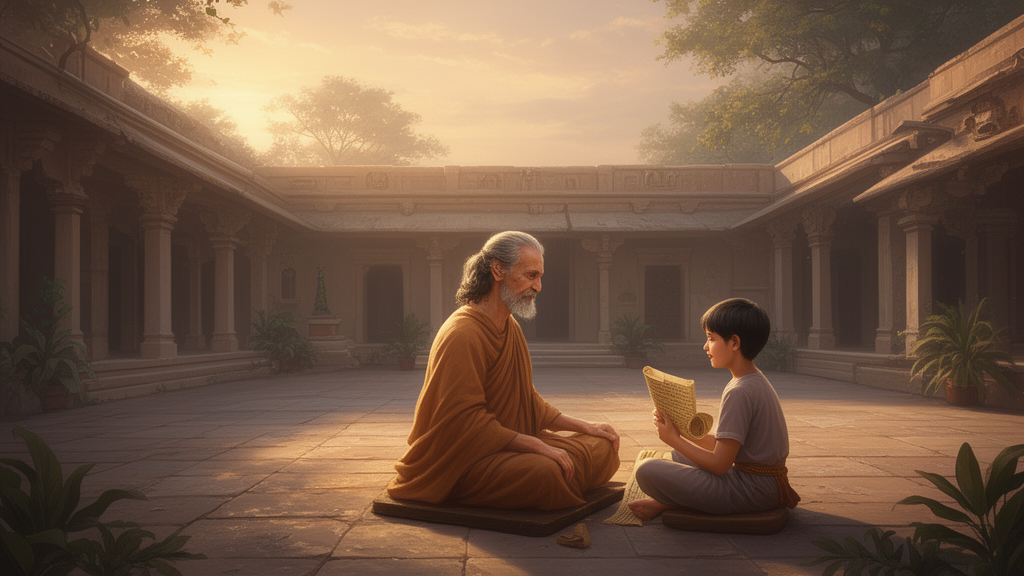
- Bhrigu Valli narrates the sage Bhrigu’s inquiry into Brahman under the guidance of his father Varuna.
The hinduwebsite.com translation by Jayaram V gives a different division: a Shiksha Valli of thirteen sections, a Brahmananda Valli of nine sections, and a Bhrigu Valli of ten sections, for thirty-two sections in all. Wikipedia’s structure section lists twelve anuvakas in the Shiksha Valli and then organizes the Ananda Valli into kosha-based subsections. Vedapath, which divides the text by verse count, assigns 36 verses to Valli 1 and 32 verses to Valli 2. These numbers do not contradict each other so much as reflect different numbering systems, so readers comparing editions should check the valli and anuvaka labels first.
Shiksha Valli: learning, speech and conduct
The Shiksha Valli opens with a peace invocation. In the Shlokam translation, the first passage asks that Mitra, Varuna, Aryaman, Indra, Brihaspati and Vishnu be favorable, offers salutation to Brahman and to Vayu, and declares the visible Brahman, truth and right speaking. The passage ends with the threefold peace formula, shanti, repeated three times. Translators render these lines differently, and devotional readers often use the invocation as a prayer before study. The text itself is presented as part of the Vedic recitation tradition, so the invocation is best understood within that liturgical setting.
Phonetics as a branch of Vedic study
The name Shiksha refers to phonetics, the discipline that governs the pronunciation of Vedic sounds. Hinduwebsite.com describes the first chapter as dealing with the study of phonetics or pronunciation, an important branch of Vedic studies. The Upanishad’s attention to sounds, combinations and connecting elements is part of this tradition. Vedapath describes the valli as presenting phonetics as the foundation of Vedic transmission. For a general reader, the key point is that correct sound was treated as a serious religious discipline, not a minor technicality.
Ethical instruction at the end of study
Several sections of the Shiksha Valli are often read as a teacher’s counsel to students. The Wikipedia outline describes a convocation address to graduating students about living ethically, and a graduating student’s acknowledgment in the final anuvaka. Vedapath summarizes the ethical injunctions as truthfulness, dharma, self-control, generosity and non-negligence. The Upanishad’s own wording on these matters is brief, and most modern readers see it as a guide to conduct that accompanies knowledge rather than a complete legal code. Translators differ on how literally to read terms such as dharma in these passages, so it helps to compare at least two translations.
Brahmananda Valli: Brahman and the five sheaths
The second valli is the best known. It contains the most quoted definition of Brahman, the analysis of the five sheaths, and a discussion of bliss. Readers meeting these ideas for the first time should keep in mind that the Upanishad uses concrete images to point toward a reality it describes as beyond ordinary perception.
Satyam jnanam anantam brahma
The formula satyam jnanam anantam brahma is the Upanishad’s most famous definition. Shlokam renders it as Brahman is truth, knowledge and infinity, and notes that the phrase has generated centuries of commentary. Vedapath lists the same triad as satyam, jnanam and anantam, describing them as reality, consciousness or knowledge, and infinitude. Advaita Vedanta commentators have treated this definition as a touchstone for understanding Brahman as non-dual. Other schools read the same words in ways that do not reduce Brahman to a single philosophical system. The formula is therefore best presented as a shared textual statement, with differing traditions of explanation.
The five sheaths, or pancha kosha
The pancha kosha teaching describes the person as layered in five overlapping sheaths. Shlokam lists them as the physical body (annamaya kosha), the energy body (pranamaya kosha), the mental body (manomaya kosha), the intellectual body (vijnanamaya kosha) and the bliss body (anandamaya kosha). Shlokam adds that the Upanishad invites the seeker to look past each layer in turn, asking whether any of them is the Self, and that the Self is understood as what underlies and illumines all five. Vedapath describes the same progression as a ladder from the gross to the subtle.
The sheath teaching is often used in modern self-help and yoga writing, but readers should separate the text’s philosophical argument from later popular uses. In the Upanishad, the sheaths are a method of inquiry into the Self. They are not a diagnostic system for health, and they are not a promise of any particular personal result.
Ananda mimamsa and the analysis of bliss
Vedapath uses the term ananda-mimamsa, a graded analysis of bliss, to describe the later part of the Brahmananda Valli. The Wikipedia outline lists the Ananda Valli sections in the same region of the text. This part of the scripture moves from ordinary happiness toward the bliss that is identified with the highest fulfillment. Because the wording and the sequence are interpreted differently by translators and commentators, readers who want precise verse-level claims should consult a scholarly edition with a commentary.
Bhrigu Valli: learning by reflection
The third valli is a narrative. The sage Bhrigu approaches his father Varuna and asks about Brahman. Varuna does not simply give a complete answer. According to the Vedapath summary, he tells his son to contemplate that all beings arise from something, live by it and return to it. Bhrigu then practices successive periods of meditation or austerity (tapas), and each stage reveals a deeper understanding. Vedapath lists the stages as food (anna), life-force (prana), mind (manas), knowledge (vijnana) and bliss (ananda). The Shlokam summary describes the same progression and notes that each realization deepens the previous one.
This valli is useful for readers because it shows how the Upanishad expects understanding to grow. It does not present Brahman as a single fact to memorize. It presents a sequence of contemplation and verification. Many teachers therefore read the Bhrigu Valli as a model for study, while others read it primarily as a theological narrative. Both readings are found within the tradition.
Translation and naming differences
Readers will encounter variant spellings and names. Taittiriya is sometimes spelled Taittirīya in scholarly transliteration and Taittiriya in everyday English. The second valli is called Brahmananda Valli in Shlokam and Vedapath, Brahmandavalli in hinduwebsite.com’s description, and Ananda Valli in the Wikipedia outline. Hinduwebsite.com also uses the spelling Sikshavalli and Bhriguvalli in its contents. These variants refer to the same textual divisions. On this site, the standard names used in this guide are Shiksha Valli, Brahmananda Valli and Bhrigu Valli, with the alternative names noted where they help readers compare sources.
Translations also differ in tone and vocabulary. Some translations use a devotional register, some use an academic register, and some explain Sanskrit words in notes. Hinduwebsite.com’s translation by Jayaram V includes Sanskrit text, transliteration and notes. Vedapath offers an interactive reading format with audio and questions. Each serves a different reader. The important point is to identify the translator and the edition, because a phrase such as ‘Brahman is truth’ may be rendered in different ways in different versions.
Belief, text, tradition and scholarship
It helps to separate four kinds of statements when reading about the Taittiriya Upanishad. The first is what the text says, which can be checked against Sanskrit editions and reliable translations. The second is traditional belief, such as the view that the Upanishads are revealed and authoritative for Vedanta. The third is commentary by named teachers, such as the interpretations developed in Advaita Vedanta. The fourth is modern scholarship, including questions about how the text was composed, transmitted and dated.
On dating, this guide does not give a specific century, because the sources reviewed here do not provide a verified date that would justify one. Wikipedia includes a chronology section, but the portion inspected for this guide did not provide a dated claim that could be relied on. Readers who want historical dating should consult a university or reference publication that discusses the Yajurveda recensions and the Upanishadic period.
Scholarship also distinguishes between ritual and philosophical portions of the Vedic corpus. The Taittiriya tradition includes ritual texts, and the Taittiriya Brahmana is a related but separate work. Wikipedia’s article on that Brahmana includes an English translation excerpt, but that excerpt is not a passage from the Upanishad and should not be used as evidence for Upanishadic claims. Keep the Brahmana and the Upanishad separate when citing sources.
How to read the Taittiriya Upanishad today
Readers who approach the text for study or devotion can follow a simple sequence. The steps below are suggestions, not a required ritual path, and traditions of study differ.
- Read a translation that identifies its translator and includes the Sanskrit or transliteration.
- Begin with the Shiksha Valli invocation and note how the text connects learning with ethics.
- Read the Brahmananda Valli slowly, marking the definition of Brahman and the five sheaths.
- Compare at least two translations of the same section, especially for terms such as dharma, Brahman and ananda.
- Read the Bhrigu Valli as a narrative of progressive inquiry, and note the sequence from food to bliss.
- Consult a commentary or a teacher within your own tradition before drawing doctrinal conclusions.
For related reading on the same Upanishad, our site has several drafts that cover language and editions. The English reading guide and the meaning overview are useful next steps once the basic structure is clear. Readers looking for the original text can consult our Sanskrit version page, and those who prefer regional-language study can see our Hindi edition notes, Bengali edition notes or Tamil edition notes. These links point to target drafts, so they may not be public until the owner publishes them.
Connected valli topics
The Taittiriya Upanishad is often studied alongside the Bhrigu and Brahmananda sections, which are sometimes read as separate teaching units. Readers who want a focused look at one valli may find the following drafts useful: the Bhrigu Valli guide and the Brahmananda Valli guide. For readers interested in the Yajurveda background, the Krishna Yajurveda and Taittiriya Brahmana overview provides a broader context, though it should be read alongside the Upanishad itself rather than in place of it.
Some readers search for a commentary associated with Adi Shankara. The Advaita Vedanta tradition associated with Shankara is an important interpretive lens for the Taittiriya Upanishad, but attribution of specific commentaries should be checked in a scholarly source before it is repeated as fact. Our draft on the Taittiriya Upanishad and Adi Shankara covers this relationship in more detail once it is published.
Frequently asked questions
Is the Taittiriya Upanishad a Krishna Yajurveda text?
Yes. Shlokam and Vedapath both place it in the Krishna Yajurveda, and the Taittiriya school is part of that Yajurveda tradition. Readers should note that Yajurveda recensions have their own schools and divisions.
What is the main teaching of the text?
The text teaches that Brahman is truth, knowledge and infinity, and it guides the seeker to look past the five sheaths to the Self. It also emphasizes learning, ethical conduct and progressive contemplation. Different schools interpret these teachings in different ways.
Which translation should a beginner use?
A beginner should choose a translation that identifies the translator, explains Sanskrit terms and includes notes. Comparing two translations is helpful, because phrases such as dharma and ananda are rendered in different ways.
Summary and takeaway
The Taittiriya Upanishad combines phonetic discipline, ethical instruction, a famous definition of Brahman, the five-sheath teaching and a narrative of progressive inquiry. Its three vallis are best read together, but each has its own emphasis. A careful reader distinguishes what the text says from later commentary, traditional belief and modern scholarship. Study the Sanskrit or a reliable transliteration where possible, compare translations, and consult a teacher or scholarly commentary when the meaning matters for practice or doctrine.
Sources and further reading
- Taittiriya Upanishad, Wikipedia: used for the outline of the Shiksha, Ananda and Bhrigu sections and for the placement of the text among the Yajur-vedic Upanishads.
- Taittiriya Upanishad, Shlokam: used for the Krishna Yajurveda attribution, the three-valli summary, the satyam-jnanam-anantam formula, the five-sheath list and the Shiksha Valli invocation translation.
- The Taittiriya Upanishad, Complete English Translation, Hinduwebsite.com: used for the section counts given in the translator’s introduction and the description of the Shiksha Valli as a phonetics chapter.
- Taittiriya Upanishad in English, Vedapath: used for the description of the valli, the ananda-mimamsa term and the Bhrigu Valli progression.
- Taittiriya Upanishad, Wisdom Library: listed for further reading on the Sanskrit, transliteration and translation; this page was not fully inspected for this guide.