The Taittiriya Upanishad is one of the principal Upanishads of the Yajurveda, divided into three sections called valli: Shiksha Valli, Brahmananda Valli, and Bhrigu Valli. Adi Shankara (often called Shankaracharya) is among the most influential commentators on it. His bhashya, or commentary, reads the text within the Advaita Vedanta framework, where the highest teaching is that Brahman, the ultimate reality, is truth, knowledge, and infinite, and that the individual self is not separate from it. This article explains what the text contains, how Shankara’s commentary approaches it, which editions readers can consult, and where tradition, textual evidence, and scholarship need to be kept apart.
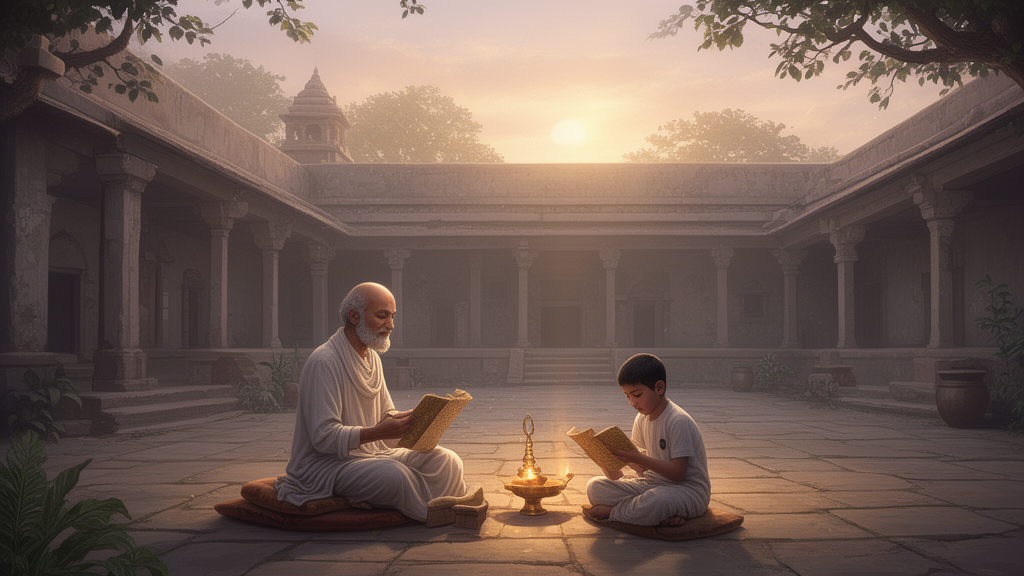
What the Taittiriya Upanishad Is

The Upanishads are philosophical texts that form the concluding portions of the Vedic corpus and are often called Vedanta, meaning the end or culmination of the Vedas. The Taittiriya Upanishad belongs to the Yajurveda. A preface to a 1903 edition reproduced on Scribd explains that its name comes from the recension (shakha) of the Krishna Yajurveda to which it is appended. The same preface says it was among the best-known Upanishads in the region it describes, where many Brahmins studied the Taittiriya recension, and that it was still recited with regulated accent and intonation. The English-language summary on Wisdom Library likewise places it among the older, primary Upanishads of the Yajur Veda.
Readers will encounter several spellings. Common forms include Taittiriya Upanishad, Taittirīya Upaniṣad, and Taittirīyopaniṣad. This article uses the simple form Taittiriya, while retaining diacritics in cited titles and Sanskrit terms where the source uses them. Wikipedia’s list of Upanishads places the Taittiriya among those associated with the Yajurveda, alongside the Katha, Shvetashvatara, Maitri, and others.
It helps to separate three things. The first is the Upanishad itself, the scriptural text. The second is commentary, such as Shankara’s bhashya and the works of his disciple Sureshvara. The third is modern interpretation and scholarship, which may study the text’s language, history, and context. Each is valuable, but each answers a different question.
Who Adi Shankara Was and Why His Commentary Matters
Adi Shankara is traditionally associated with the Advaita Vedanta school. The Scribd preface describes Shankaracharya and his disciple Suresvaracharya as writers of the highest authority within what is now called the Advaita school of Vedanta. According to the same preface, Shankara wrote commentaries on the classical Upanishads, the Bhagavad Gita, and the Brahma Sutras, along with other manuals on Vedanta philosophy.
The Taittiriya Upanishad is among the texts for which Shankara’s commentary is traditionally cited. The website shankaracharya.org lists the Taittiriya Upanishad among the most important Upanishads on which Adi Shankara gave bhashyas. The Scribd preface also names a Taittiriya-Upanishad-bhashya-Vartika among the works of Suresvara, which it describes as a commentary on Shankara’s work. A vartika is a sub-commentary that expands and defends the bhashya. Readers should note that attribution of specific commentaries is a matter both of tradition and of manuscript and edition evidence, so the attribution is best described as traditional and as supported by the editions that bear his name.
The Wisdom Library entry for a 1903 edition states that it contains the original Sanskrit, IAST transliteration, and English translation of the text together with the commentaries of Shankaracharya, Sureshvara, and Sayana, the last also known there as Vidyaranya. Scholars and readers may want to check the identification of Sayana with Vidyaranya in academic sources, since such identifications are often debated.
The Structure: Three Valli
The Upanishad is traditionally divided into three valli, a term often rendered as chapter or section. The Wisdom Library summary identifies them as Shiksha Valli, Brahmananda Valli, and Bhrigu Valli. Wikipedia’s article uses the same three divisions, and breaks the first two into anuvakas, or subsections. The Wikipedia outline lists twelve anuvakas in the Shiksha Valli and five subsections in the Ananda Valli, which is the common name for the Brahmananda Valli.
Shiksha Valli: Study, Sound, and Discipline
The first valli takes its name from shiksha, the study of phonetics and pronunciation. Shiksha is one of the six Vedangas, or auxiliary disciplines of the Vedas, which were developed to protect the correct recitation of sacred texts. The Wisdom Library summary says the Shiksha Valli deals with this discipline. Wikipedia’s outline gives a sense of its shape, with headings for a student’s promise, phonetics and the theory of connecting links, a teacher’s prayer, a theory of oneness with holy exclamations, parallelism in knowledge and the meaning of Om, ethical duties of human beings, and a convocation address to graduating students.
The lesson titles used in Shankara’s commentary, as listed on Wisdom Library, show the same range. They include an invocation to God, the study of phonetics, contemplation of the samhita, prayers for health and wealth, contemplation of the vyahritis, contemplation of Brahman, contemplation of Brahman in the visible, contemplation of Pranava (Om), the duties of an upasaka or devotee, the illumination, the exhortation, and a concluding thanksgiving. The inclusion of prayers for health and wealth is a notable feature of the text. In traditional study, such passages are read as part of a sacred discipline and are not presented as guarantees of material results.
For many readers, the Shiksha Valli is the least familiar part. Its emphasis on pronunciation, study, and conduct reflects the setting of a Vedic school. It also contains passages on ethical life that many readers find accessible even without the technical background.
Brahmananda Valli: Brahman and the Layered Self
The second valli is often called the Brahmananda Valli, or the section on the bliss of Brahman. The Wisdom Library summary says it teaches about Brahman and tries to define it as truth, omniscient, and infinite. This three-part description is one of the best-known phrases associated with the Taittiriya Upanishad, and Shankara’s commentary gives it considerable attention. The Advaita reading treats Brahman as the single, non-dual reality underlying all experience.
Wikipedia’s outline of this valli is organized around five sheaths, or koshas, which are presented as successive layers of the self. Its headings are Annamaya (the food-sheath), Pranamaya (the breath or vital-sheath), Manomaya (the mind-sheath), Vijnanamaya (the sheath of discernment or understanding), and Anandamaya (the sheath of bliss). The Scribd preface likewise describes the Upanishad as important for explaining the five sheaths of the self.
The sheath teaching is a useful example of the difference between scripture and commentary. The Upanishad presents the sheaths as layers that a seeker moves through in understanding the self. Commentators, including Shankara, interpret these layers as stages of inquiry that lead toward the recognition of Brahman as the inner self. Readers who approach the text directly should be careful not to treat a later interpretation as the only meaning of the passage. A translation that includes the commentary lets readers see where the interpretive choices lie.
Bhrigu Valli: The Quest for Brahman Through Tapas
The third valli is the Bhrigu Valli. The Wisdom Library summary describes it as the account of Bhrigu, son of Varuna, who obtained realization of Brahman through repeated tapas under his father’s guidance. Tapas, often translated as austerity or disciplined effort, here refers to sustained inner discipline and inquiry rather than only physical hardship.
The Bhrigu Valli is structured as a teaching given by a father to a son. The Wisdom Library lesson list for Shankara’s commentary includes sections on how to investigate Brahman, the realisation of Brahman, some minor contemplations, and final attainment. The narrative form makes it one of the most accessible parts of the Upanishad, which is one reason readers often approach it first.
The story of Bhrigu and Varuna is presented in the text as a teaching narrative. Devotional readers may relate it to the broader Vedic tradition of seeking knowledge through discipline, while scholars may analyze how the narrative builds an argument about Brahman. Both approaches can be respectful, provided each is labeled clearly.
Shankara’s Commentary: Method and Themes
A bhashya is not simply a word-for-word translation. It explains the sense of each passage, anticipates objections, defends a philosophical position, and connects the text to other scriptures. Shankara’s commentary on the Taittiriya Upanishad follows this method. In the Advaita reading, the Upanishad’s teaching on Brahman is treated as consistent with the non-dual understanding that the self and Brahman are one, and that apparent multiplicity is understood through the lens of knowledge.
The Scribd preface notes that Shankara’s commentaries on the classical Upanishads are concerned with presenting a rational exposition of the Vedic religion. It also observes that different Upanishads treat their subjects differently, and that the Brihadaranyaka receives unusually detailed treatment. A reader can therefore expect the Taittiriya commentary to focus on careful definition, the meaning of key terms, and the relationship between ritual, study, and knowledge, rather than on narrative description alone.
Two practical points follow for readers. First, Shankara’s commentary is a theological and philosophical interpretation. It reflects the Advaita tradition, which is one of several Vedanta schools. Other Vedanta traditions, such as Vishishtadvaita and Dvaita, read the same scriptures differently. Second, the commentary often explains a passage by referring to terms used elsewhere in the Upanishads and the Gita. Readers who want to see how the argument is built should look for the cross-references in the edition they use.
Editions, Translations, and What to Check
Several editions and translations are available, and they differ in purpose and quality. The following points can help readers choose:
- Edition with commentary. Editions that include the Sanskrit text, transliteration, and Shankara’s bhashya give the clearest view of the Advaita interpretation. A 1903 edition with the Sanskrit, IAST transliteration, and English translation, together with the commentaries of Shankara, Sureshvara, and Sayana, is described on Wisdom Library.
- Public-domain scans. The Internet Archive hosts scanned editions. One item is titled The Taittiriya-upanishad by Sankaracarya, and another is an English edition titled Aitareya and Taittiriya Upanishads with Shankara Bhashya by Sitarama Sastri. Scanned editions are useful for study, but readers should check the title page, publisher, and date, and compare the Sanskrit with a modern critical or reliable edition where possible.
- Modern translations. The Scribd preface states that the Upanishad has been translated by several scholars, including Max Muller, and that a translation by Mead and J. C. Chattopadhyaya was published by the Blavatsky Lodge of the Theosophical Society in London. These translations differ in approach and vocabulary. A reader who wants a traditional Advaita reading should look for a translation of the bhashya itself, not only of the root text.
When comparing translations, look at how key terms are handled. Words such as Brahman, atman, tapas, and Om are often left in Sanskrit or explained in a glossary. Translators sometimes choose different English equivalents, and the choice can shape the reader’s understanding. Note also whether the translation is labeled as a translation of the root text, of the commentary, or of both.
For readers who prefer other languages, HindusGod.com has target drafts on Taittiriya Upanishad translations in several Indian languages. Links to these drafts appear below and will only be publicly visible if the owner publishes them.
Tradition, Scripture, and Scholarship: Keeping the Categories Clear
Discussion of the Taittiriya Upanishad involves several kinds of claims, and it helps to keep them apart. Some claims describe what the text says. Some describe what a commentator, such as Shankara, argues it means. Some describe how a community recites, studies, or uses the text today. Some describe historical evidence about its composition or transmission. Scholarly work, including the Wikipedia article’s chronology section and academic studies, addresses dating and textual history. This article does not give a specific date for composition, because the sources reviewed here do not support one with enough precision.
Devotional belief is also distinct from textual analysis. For a practicing Hindu, the Upanishad may be a sacred revelation, a guide to meditation, or a text recited at specific times. For a historian, it may be an artifact of a particular community’s intellectual life. Both perspectives are legitimate, and readers do not need to choose one to benefit from the text.
Recitation and ritual practice also vary. The Scribd preface notes that the Taittiriya was recited with regulated accent in the region it describes. Other communities may use different recensions, different prayers, or different ritual settings. Where a practice is tradition-specific, it should be described as such rather than presented as universal.
A Practical Way to Begin Reading
Readers who are new to the Taittiriya Upanishad can use the following steps. The order is a suggestion for study, not a ritual requirement.
- Read an overview first. Understand the three valli and the basic terms, such as Brahman, Om, and the five sheaths. An overview article such as the Taittiriya Upanishad page on HindusGod.com, once published, can help.
- Start with the Bhrigu Valli. Its narrative structure makes it a useful entry point before moving to the more technical Shiksha Valli.
- Read the Brahmananda Valli slowly. Take the sheath teaching one layer at a time and note how each is defined.
- Compare two translations. Read a translation of the root text and then a translation that includes Shankara’s bhashya, noting where the explanations differ.
- Consult a teacher or community where possible. Traditional study often happens under a guru or in a study group, particularly for Sanskrit pronunciation and for the recitation of the Shiksha Valli.
- Record which layer each claim belongs to. When you summarize a passage, note whether the statement comes from the scripture, from Shankara, from a modern translator, or from your own reflection.
Common Questions About the Taittiriya Upanishad and Shankara
Did Adi Shankara write a commentary on the Taittiriya Upanishad?
Yes, according to the tradition and the editions cited here. Shankaracharya.org lists the Taittiriya among the Upanishads on which Adi Shankara gave bhashyas, and a 1903 edition described on Wisdom Library includes Shankara’s commentary alongside the text. Readers who need scholarly confirmation of attribution should consult academic editions and studies of Shankara’s works.
Is the Taittiriya Upanishad part of the Vedas?
It is an Upanishad associated with the Yajurveda, specifically with the Krishna Yajurveda recension known as Taittiriya. Upanishads are traditionally regarded as the concluding portions of the Vedic corpus, and they are often studied as the Vedanta. The Taittiriya is therefore connected to the Veda but is considered one of the Upanishads in traditional classification.
Where should a beginner start?
A beginner can start with the Bhrigu Valli, which is narrative, and then read the Brahmananda Valli, which teaches the definition of Brahman and the sheaths. The Shiksha Valli, which focuses on phonetics and conduct, is often easier to appreciate after the reader has some familiarity with the rest of the text.
Summary
The Taittiriya Upanishad is a Yajurvedic text divided into three valli: the Shiksha Valli on study, sound, and conduct; the Brahmananda Valli on Brahman and the five sheaths of the self; and the Bhrigu Valli, a narrative of seeking Brahman through tapas. Adi Shankara’s bhashya, together with Sureshvara’s vartika, gives the text an Advaita reading that is central to how many students have studied it. The best way to read it is to keep the scripture, the commentary, the translation, and the modern interpretation distinct. For many readers, this clarity makes the text more useful, not less devotional.
Related Reading on HindusGod.com
The following HindusGod.com pages are target drafts. Their links will only be public if the owner publishes them. Each link is included because it relates directly to a part of this article.
- For an introductory overview, see Taittiriya Upanishad.
- For the meaning of the title and the word Taittiriya, see Taittiriya Upanishad Meaning.
- For a broader look at Shankara’s commentaries on the Upanishads, see Adi Shankara Upanishads.
- For the meaning of the word Upanishad, see Meaning of Upanishad.
- For the Bhrigu narrative, see Bhrigu Valli Taittiriya Upanishad.
- For the teaching on Brahman and the sheaths, see Brahmananda Valli Taittiriya Upanishad.
- For English-language reading, see Taittiriya Upanishad English.
- For the Sanskrit text, see Taittiriya Upanishad Sanskrit.
- For online reading options, see Taittiriya Upanishad Online.
- For Hindi-language reading, see Taittiriya Upanishad in Hindi.
- For Tamil-language reading, see Taittiriya Upanishad in Tamil.
- For Telugu-language reading, see Taittiriya Upanishad in Telugu.
- For Bengali-language reading, see Taittiriya Upanishad in Bengali.
Sources and Further Reading
- Taittiriya Upanishad, Wikipedia. Used for the three-part structure, the anuvaka outline, the sheath headings, and the list of Yajurvedic Upanishads. Readers should check the article’s chronology and translation sections for further references.
- Taittiriya Upanishad, Wisdom Library. Used for the summary of the three valli, the description of Brahman as truth, omniscient, and infinite, the account of Bhrigu, and the list of lessons in Shankara’s commentary and the note on the 1903 edition.
- Taittiriya Upanishad with Commentaries, reproduced by Sri Rama Ramanuja Achari, Srimatham, 2013. Used for the preface’s description of the recension, the regional recitation, the status of Shankara and Suresvara, Suresvara’s Taittiriya vartika, and the mention of translations. This is a reproduction of a 1903 work, and readers should compare it with a current edition.
- Upanishads, Shankaracharya.org. Used for the statement that Adi Shankara gave bhashyas on the Taittiriya Upanishad among other principal Upanishads.
- The Taittiriya-upanishad by Sankaracarya, Internet Archive. Listed as an available scanned edition. Its contents were not reviewed in full for this article, so readers should verify the edition before relying on it.
- Aitareya and Taittiriya Upanishads with Shankara Bhashya, English, Internet Archive. Listed as an English edition with Shankara’s commentary. Its contents were not reviewed in full for this article.
Readers are encouraged to consult the editions above, academic studies of Shankara and the Upanishads, and translations by scholars with Sanskrit training. Where a claim in this article is not supported by one of these sources, it should be treated as a general introduction rather than a verified statement.