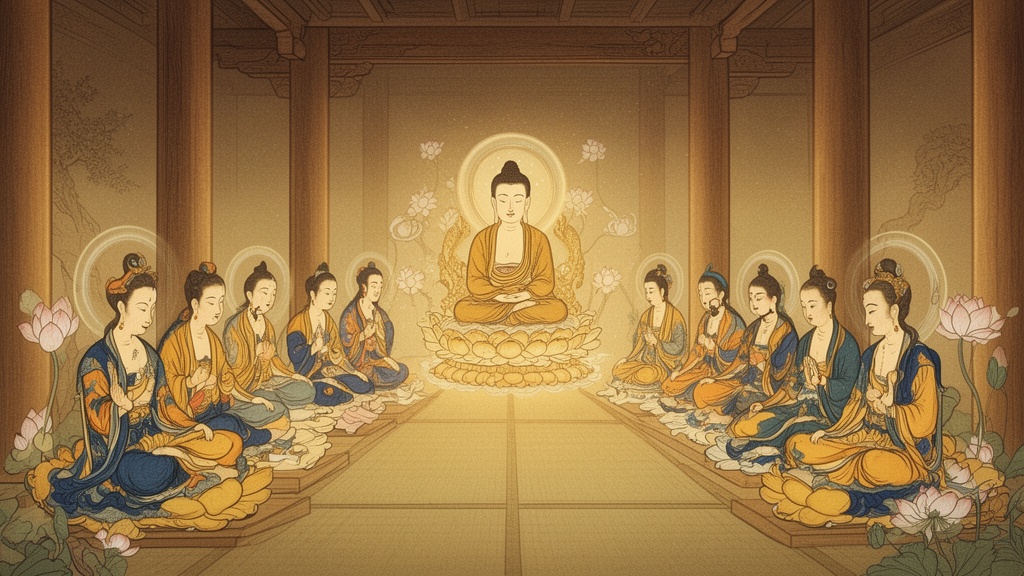
The Sutra of Perfect Enlightenment (Chinese: Yuanjue jing, 圓覺經) is a short Mahāyāna Buddhist scripture that presents the Buddha’s teaching on the nature of awakening, the original buddhahood of all beings, and the practice of meditation. It is written as a dialogue between the Buddha and twelve bodhisattvas, each of whom asks a set of questions. It is not part of the early Pali canon, and it is not a Hindu scripture, although readers coming from Hindu backgrounds sometimes encounter it while studying Buddhist philosophy, meditation, or the wider Indian and East Asian religious world.
Quick answer: what is the Sutra of Perfect Enlightenment?

The sutra is a Chinese Mahāyāna text that became especially influential in Chan (Zen), Seon (Korean Zen), and related East Asian Buddhist traditions. Its central claim is that the enlightened nature, sometimes described as Buddha-nature, is already present in all beings and is not something newly produced by practice. The text then explains how ignorance appears to arise, why ignorance is considered unreal, and which meditative approaches suit practitioners of different capacities. Its traditional structure is an introduction followed by twelve chapters.
The sutra is best understood as a text of Buddhist doctrine and meditation guidance. Its teachings are presented in the text itself, but the claims about its authorship, date, and influence are historical and scholarly questions that are discussed below.
Names and spellings
Readers may meet several forms of the title. In Chinese it is Yuanjue jing (圓覺經 in traditional characters; 圆觉经 in simplified characters). A pure-land Buddhism article gives the full Chinese title as Dafangguang yuanjue xiuduluo liaoyi jing (大方廣圓覺修多羅了義經), which it translates roughly as the Great Vaipulya Sutra on the Perfect Enlightenment, and it gives a Sanskrit form as Mahāvaipulya pūrṇabuddha-sūtra prasannārtha-sūtra. The Japanese reading is Engaku-kyō, as listed by Buddhism Guide. A Korean and English-language literature also uses the form Sutra of Complete Enlightenment, which is a different title that should not be confused with the same text in every source.
Because the Sanskrit form appears in some modern summaries rather than in a surviving Sanskrit manuscript that these sources describe, readers should treat the Sanskrit title as a reconstruction or a secondary attribution unless they consult a scholarly edition. The Taishō catalogue number given by Buddhism Guide is T 842, in volume 17, pages 913 to 922. Those citations should be checked against the Taishō edition itself before being used in academic work.
HindusGod.com also has a separate post on the Sutra of Complete Enlightenment, which may help readers compare the naming issue: Sutra of Complete Enlightenment (URL to confirm; target draft, may not be public yet).
Origins and attribution
Most accounts agree that the sutra is a Chinese composition rather than a translation of a known Indian Sanskrit original. Buddhism Guide describes it as a Chinese Mahāyāna sutra that was probably written in the early eighth century CE. The Wikipedia article on the sutra and a Grokipedia entry on Muller’s English translation both place its composition in China within Chan and Huayan circles around the early eighth century. Those are secondary encyclopedic summaries, so the dating should be read as the scholarly consensus reported by these sources rather than as a precise date from a manuscript.
The traditional attribution is different. A Pure Land Buddhism article states that the Chinese translation was traditionally attributed to Buddhatrāta, an Indian monk, who was said to have translated the work from Sanskrit in 693 at the White Horse Temple in Luoyang. This is a traditional attribution. It is presented in that source as tradition, and modern readers should note that the claim of a Sanskrit original conflicts with the view that the text was composed in China. Credible sources disagree or leave the question open, so this post treats the Sanskrit-origin story as devotional and traditional material rather than settled history.
The distinction matters for readers from Hindu backgrounds, who may be used to scriptures that are described as revealed or as the words of a named sage. In Mahāyāna Buddhism, a sutra can be regarded as the teaching of the Buddha even when historians consider it a later composition. Both views can be held by different communities, and this post reports them without choosing between devotional belief and historical analysis.
Structure: an introduction and twelve chapters
The sutra is arranged as a short introductory section followed by twelve chapters. According to Buddhism Guide, the introduction describes the setting, which is a deep state of meditative concentration (samādhi), and lists the main participants. The audience includes the Buddha and one hundred thousand great bodhisattvas, among whom twelve eminent bodhisattvas serve as spokesmen. Each one rises in turn and asks the Buddha questions about doctrine, practice, and enlightenment.
The Pure Land Buddhism article and the Sutras and Mantras translation both name the opening figures, including Mañjuśrī and Samantabhadra, and both describe the scene of an assembly in which the Buddha teaches through the questions of the bodhisattvas. Mañjuśrī asks about the Dharma actions of a Tathāgata on the cause ground, and the Buddha’s reply, as summarised by these sources, begins with the idea of a great dhāraṇī door called perfect enlightenment, from which the teachings on true suchness, bodhi, nirvāṇa, and the pāramitās are said to flow.
The first two chapters, associated with Mañjuśrī and Samantabhadra, are commonly described as the most sudden and essential in tone. The third chapter introduces a more gradual view, and the chapters that follow mix the two approaches. The final chapters are generally described as the most gradualist. These descriptions come from the Buddhism Guide summary, which is a secondary account, so readers who want to verify the chapter order should consult a critical edition or translation.
Sudden and gradual approaches
The contrast between sudden and gradual enlightenment is one of the central organising ideas of the sutra’s interpretation in East Asia. A sudden view holds that direct awakening to the non-dual nature of reality is possible without a long process of goal-oriented training. A gradual view stresses stages of practice, training, and the gradual removal of obstacles. The sutra is often read as containing both, with its early chapters emphasising the sudden view and its later chapters emphasising more practical methods.
Buddhism Guide reports that the Korean monk Gihwa (己和) grouped the chapters according to three capacities of practitioners: superior, middling, and inferior. In his scheme, the first three chapters are for those of superior capacity, the next seven for those of middling capacity, and the final two for those of inferior capacity. The same source notes an important caution: this grouping does not mean the later chapters are simply easier. Some of the most difficult discussions appear later in the text, including a long treatment of the four traces of self.
In practice, this means a reader should not assume that the final chapters are an introductory course that can be skipped to. Many readers begin with commentary, or with a teacher who can explain the logic of the text.
Core teachings
Original buddhahood and the question of ignorance
The sutra emphasises the original buddhahood of all sentient beings. According to the Wikipedia summary and the Grokipedia summary of Muller’s translation, the text stresses that the enlightened nature is already present, and that the apparent ignorance that produces suffering and rebirth is illusory. Buddhism Guide describes the sutra’s themes as including the meaning and origin of ignorance, sudden and gradual enlightenment, and original buddhahood, all of which the sutra connects with the earlier text known as the Awakening of Faith (大乘起信論).
A Pure Land Buddhism article gives a clear example of this reasoning. It presents the question that many readers ask: if Buddha-nature is originally pure, how does it give rise to a thought of ignorance that generates all phenomena and saṃsāra? The article reports the sutra’s answer that such a question is itself misdirected, because a thought of ignorance is fundamentally unreal. It uses two images from the sutra’s tradition. One is a person with a diseased eye who sees a flower in the sky, which is unreal. The other is a person who stares at the moon too long and sees a second moon, which is also unreal. The attachment to these false appearances is what keeps beings bound in rebirth.
These are analogies, not factual claims about the physical world. They are presented to help a reader understand a doctrinal point, and they should be read as teaching devices rather than as scientific explanations. The same article notes that, in the sutra’s logic, a person who has not left the cycle of rebirth and then tries to understand Buddha-nature may still be reasoning from within that cycle. This is a claim about doctrinal method, not a claim that the reader will achieve any specific result.
Meditation and the four traces
The sutra is also a meditation manual in its later sections. Grokipedia’s summary of Muller’s translation lists practical instruction covering śamatha (calming), samāpatti (equanimity), and dhyāna (meditative absorption). It also addresses how to select a teacher, how to conduct a retreat, how to remove karmic hindrances, and how to avoid what it calls meditation maladies. Because these are summaries of the text, readers who wish to follow the specific instructions should consult a full translation with commentary.
The idea of the four traces is especially significant. Wikipedia and Grokipedia both list the four traces as self, person, sentient being, and lifespan. Buddhism Guide describes the discussion of the four traces of self as one of the most notable and difficult passages in the later chapters. These traces are conceptual marks that the sutra says must be seen through in practice. They are not physical entities, and the sutra’s treatment of them belongs to Buddhist doctrine and meditative analysis.
Relations to other texts
The sutra is connected with several other texts and schools. Buddhism Guide and Grokipedia both say it draws on concepts from the Awakening of Faith, from Huayan thought, from Tiantai, and from indigenous East Asian thought. A Pure Land Buddhism article also says the sutra assembles teachings found in the Śūraṅgama Sūtra. Scholars and practitioners may describe these relations in different ways, so readers should treat them as scholarly and traditional connections rather than as a single agreed genealogy.
The Huayan connection is especially important for understanding the structure of the text. Buddhism Guide explains that the arrangement of the sutra reflects a Huayan motif in which the Buddha is said to have taught the Avataṃsaka Sūtra first, to awaken those whose roots of virtue were already mature. Readers who want to explore that background can read HindusGod.com’s post on the Avatamsaka Sutra, which is a target draft and may not yet be public: Avatamsaka Sutra (URL to confirm).
East Asian reception and the Korean commentary
The sutra has been especially important in Korean Buddhism. Grokipedia reports that the sutra has held a prominent place in Korean monastic education for more than a thousand years and that it forms part of the curriculum of the Jogye Order. This claim is presented in that source, but it should be verified against Jogye Order materials or a scholarly account before being repeated as established fact. HindusGod.com has not independently confirmed the curriculum claim.
A central figure in this history is Hamhŏ Kihwa (1376–1433), a Korean Sŏn monk whose commentary is widely discussed. Grokipedia states that Kihwa’s amendments to the text were adopted by A. Charles Muller in his translation, because Muller believed they corrected perceived inconsistencies in received versions. The same source describes Kihwa’s commentary as praised for its lucidity and poetic quality, and says it integrates doctrinal study (Kyo) with meditative practice (Sŏn). It also reports that Kihwa gave guidance for practitioners of superior, middling, and inferior capacities, and that his approach reflects broader Korean tendencies seen in figures such as Wŏnhyo and Chinul.
Muller’s 1999 English edition
The most accessible modern English-language study is the 1999 translation by A. Charles Muller, published by the State University of New York Press. Grokipedia identifies the book as The Sūtra of Perfect Enlightenment: Korean Buddhism’s Guide to Meditation, and it says the volume includes Kihwa’s full commentary. The edition is described as presenting the sutra text, commentary, notes, and the original Chinese in parallel, which makes it useful for comparing translation choices. Readers should consult the book directly for the translator’s notes, since summaries cannot replace the full edition.
Chan, Seon, Zen, and Pure Land readings
Readers should not assume that every Buddhist tradition reads this sutra in the same way. In Chan, Seon, and Zen contexts, the sutra is often valued for its direct approach to the nature of mind and its meditation instructions. Grokipedia describes it as a concise guide to meditation practices across Chan, Seon, and Zen. Within those communities, teachers may emphasise different passages, and the sutra may be used alongside other texts.
A Pure Land Buddhism article presents the sutra from a Pure Land perspective. It discusses the text as an account of Buddha-nature, perfect enlightenment, and the cycle of rebirth, and it compares those ideas with the reasoning of Pure Land practice. This is one tradition’s reading of the sutra, not a neutral account of all readings. HindusGod.com is presenting both perspectives so that readers can see how the same text is described differently.
Readers who are interested in Pure Land texts may also find the HindusGod.com post on the Amida Sutra useful as a comparison of text, practice, and interpretation: Amida Sutra (URL to confirm; target draft, may not be public yet). A companion explanatory piece is also available as a target draft: Amida Sutra Meaning (URL to confirm).
Text, tradition, and scholarship
This sutra raises several different questions, and they should be kept separate. The first is what the text says. The second is how particular traditions use and interpret it. The third is what historians can establish about its composition, translation, and reception. A fourth question concerns personal faith, which is not a matter that a historical article can settle.
- Text: The sutra’s teachings on original buddhahood, ignorance, four traces, and meditation are attributed to the text itself, as summarised by the sources cited here.
- Tradition: Chan, Seon, Zen, and Pure Land communities read the sutra differently, and the Jogye Order’s use of it is a community-specific practice that should be described as such.
- Scholarship: Dating, authorship, translation history, and the reliability of traditional attributions are matters for historians and philologists, who often treat the sutra as a Chinese composition.
- Belief: Whether a reader accepts the sutra’s claims about buddhahood or the possibility of awakening is a matter of faith and personal conviction.
Because these levels are different, the post avoids presenting the Sanskrit-origin story, the Korean curriculum claim, or any particular meditation outcome as established fact. Those statements are either traditional, secondary, or in need of further verification.
How to approach the sutra as a reader
A reader approaching this text for the first time may find it easier to begin with the framework of the introduction and the first chapters, because those set out the central claims about the nature of enlightenment. A useful approach is to read with a commentary, such as Kihwa’s commentary in the Muller edition, and to note which passages are doctrinal statements and which are practical instructions.
- Read a summary of the sutra’s setting and structure, such as the Buddhism Guide overview.
- Read the opening chapters for the central claims about original buddhahood and the nature of ignorance.
- Compare those claims with a commentary, noting where the commentator’s interpretation differs from the text.
- Read the later chapters for practical instruction, noting that these chapters also contain some of the text’s hardest discussions.
- If you intend to practise meditation, seek guidance from a qualified teacher in a tradition that uses the text. The sutra itself emphasises the importance of selecting a teacher.
A reader who is interested in related Mahāyāna bodhisattva literature may also want to consider HindusGod.com’s post on the Brahmajala Sutra, which discusses bodhisattva conduct and precepts in a different text. That article is a target draft and may not yet be public: Brahmajala Sutra (URL to confirm). For a broader view of bodhisattva stages, the Dasabhumika Sutra post may help: Dasabhumika Sutra (URL to confirm).
Examples: reading the moon analogy carefully
The analogy of the second moon shows how the sutra uses everyday observation to explain a doctrinal point. A person who presses on the eye or looks too long at the moon may see a second moon. The second moon is not a real object. The sutra’s point, as summarised in the Pure Land Buddhism article, is that the mistaken perception is produced by an impaired condition of seeing and then sustained by attachment. A reader can use the analogy to understand why the sutra treats ignorance as unreal, without concluding that the text is describing physics or making a claim about a particular person’s experience.
The flower-in-the-sky analogy works in the same way. It explains why a perception that seems to appear before the mind may still lack a real object. In both cases, the analogy is a teaching device that connects ordinary experience with a more difficult philosophical claim.
Frequently asked questions
Is the Sutra of Perfect Enlightenment an Indian scripture?
Most sources describe it as a Chinese Mahāyāna sutra probably composed in the early eighth century CE, within Chan and Huayan circles. The traditional attribution to an Indian monk named Buddhatrāta, who was said to have translated it from Sanskrit in 693, is presented by at least one source as tradition rather than as established history. Readers should distinguish the traditional account from scholarly dating.
Is this sutra part of the Pali canon?
No. The sutra is a Mahāyāna text, and it belongs to the Chinese Buddhist canon. The sources reviewed here describe it as a Chinese composition rather than as a text preserved in the Pali canon.
Who wrote the commentary most often cited in English?
The English-language study most often cited is A. Charles Muller’s 1999 translation published by SUNY Press, which includes Kihwa’s commentary. Kihwa was a Korean Sŏn monk who lived from 1376 to 1433. Readers should consult the book itself for the translation’s notes and the commentary.
Does reading the sutra guarantee enlightenment?
No source reviewed here supports a claim that reading the sutra produces a guaranteed result. The sutra and its commentaries describe a path of study and practice, and different traditions understand that path differently. A reader should approach the text as a teaching to be studied, and should consult a teacher within a tradition that uses it.
Closing summary
The Sutra of Perfect Enlightenment is a concise and influential Chinese Mahāyāna text that presents the original buddhahood of all beings, explains ignorance as unreal, and offers meditation guidance organised in twelve chapters. Its significance lies in its role in Chan, Seon, and Zen, and in the commentary tradition that developed around it in Korea. Its traditional attribution to an Indian translator, its claimed place in Korean monastic education, and its composition date should each be read with care, because the sources differ in how firmly they establish them.
For readers who want to continue, the most useful next step is to read a full translation with commentary, to compare the Buddhism Guide overview with the primary text, and to consult a teacher within a tradition that uses the sutra. HindusGod.com’s related posts on other Mahāyāna texts are listed below as target drafts.
Sources and further reading
- Sutra of Perfect Enlightenment, Wikipedia: general overview of the sutra, its chapter structure, its Chinese title, and its place among Mahāyāna sutras. Used for the title, the Chinese characters, and the general description of the sutra.
- The Sutra of Perfect Enlightenment: Korean Buddhism’s Guide to Meditation (book), Grokipedia: secondary summary of Muller’s 1999 translation and Kihwa’s commentary. Used with caution, and claims drawn from it (including the Jogye curriculum claim) should be verified against stronger sources.
- Sutra of Perfect Enlightenment: Overview, Context and Key Themes, Buddhism Guide: secondary overview of the twelve-chapter structure, the sudden and gradual distinction, Gihwa’s three-capacity grouping, the Huayan motif, and the Taishō reference.
- The Sutra of Perfect Enlightenment 圆觉经, Pure Land Buddhism: a Pure Land perspective on the sutra, including the Chinese title, the traditional attribution to Buddhatrāta, and the analogies of the flower in the sky and the second moon. Presented as one tradition’s reading.
- Mahavaipulya Sutra of Perfect Enlightenment, Buddha Sutras Mantras: a web presentation of the Chinese title and the opening of the sutra, including the names of the twelve bodhisattvas and the opening setting. Used for the assembly and the bodhisattva list.
Related HindusGod.com posts (target drafts; URLs to confirm and may not yet be public):