The Surya Upanishad in Telugu is a Telugu-script edition of the Sanskrit Surya Upanishad, a short text devoted to the sun god Surya (Aditya). It presents Surya as the source of creation, sustenance, and dissolution, describes his form and the mantras associated with him, and ends with instructions about japa and sun-facing worship. Telugu editions are widely circulated online and in print, and the text is read both as scripture and as devotional literature. This article explains where the text sits in the Vedic literature, how its Telugu editions are organized, what the text itself says, and how readers can approach it with care.

The short answer: the Surya Upanishad is attached to the Atharvaveda in traditional classification, it is written in Sanskrit, and the Telugu version is a script edition of that same Sanskrit text, often with a Telugu-language introduction. Readers should separate what the text says, what later devotional traditions add, and what modern websites claim about benefits.
What the Surya Upanishad Is
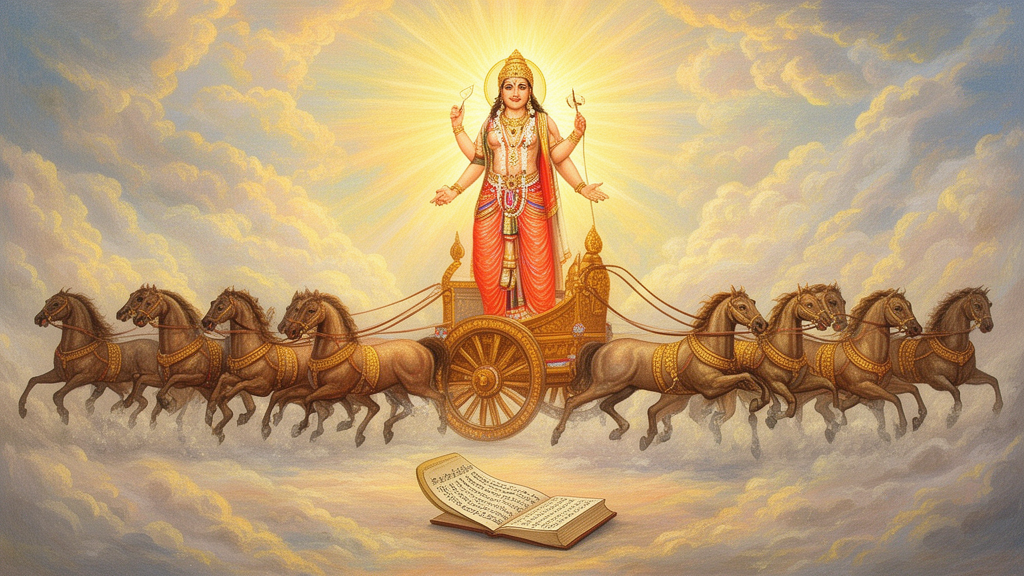
Upanishads are texts usually placed at the end of the Vedas and are associated with philosophical and meditative teaching. The Surya Upanishad is one of the shorter texts in the Upanishadic tradition and belongs to the group of works centered on a particular deity rather than on the broader questions of Brahman and self that dominate the older Upanishads. Its focus is Surya, the sun, understood both as a visible deity and as the inner light of the self.
The Telugu Wikipedia entry for the text describes it as belonging to the Atharvaveda. This classification is consistent with the Sanskrit opening of the text, which begins with a phrase identifying the teaching as Atharvanika and Angirasa in character. However, the Wikipedia excerpt available in our research record was not fully inspected, so the Atharvaveda attribution should be treated as provisional until the page is re-checked.
Names and Spellings Readers Will Encounter
Readers may see several forms of the title, and all of them refer to the same text:
- Surya Upanishad: the common English form used in most online editions.
- Sūryopaniṣad: the IAST transliteration of the Sanskrit title.
- సూర్యోపనిషత్ and సూర్యోపనిషద్: two Telugu spellings found in different editions. The first is common in headings and stotra collections; the second appears in some formal editions.
Sanskrit words in this article follow a simple IAST-style transliteration, and Telugu words are given in their Telugu script where useful. Small differences in spelling and diacritics between editions do not indicate different texts, but they do mean that readers comparing two websites should check the Sanskrit or Telugu wording rather than relying only on headings.
The Telugu Editions and What They Contain
Several Telugu-language sites publish the text in Telugu script. The Stotra Nidhi page, for example, presents the Telugu script version with a title block, language selector, and navigation, and places it in its Upanishads section. ShlokMantra presents a Telugu-script version with a note about Telugu and Sanskrit scripts and a set of related texts. BhaktiVed presents a Telugu introduction followed by the Telugu-script text and describes the Upanishad as a text on Surya’s glory, form, and essence.
These editions broadly agree on the opening invocation, the ritual framing, the central statements about Surya, the Gayatri-linked material, and the closing lines. Minor differences in punctuation, sandhi, and accent marks appear, which is normal in manuscript-derived print and digital texts. Where editions differ in wording rather than spelling, readers should consult a critical or scholarly edition before quoting a specific line.
The Opening Peace Invocation
Like many Upanishads, the Surya Upanishad begins with a shanti invocation, a prayer for peace and well-being. In the Telugu editions reviewed, the invocation asks the gods to let the ears hear what is auspicious, to let the eyes see what is auspicious, and to allow the body and life span to serve the gods. It ends with the threefold call for peace, shanti.
This opening is widely used in Upanishadic recitation across different texts. Its presence here places the Surya Upanishad within a shared liturgical habit rather than marking it as an isolated text. Readers should note that the invocation’s prayers for protection and long life are part of the devotional framework of the recitation; they are not a measurable promise that reciting the text produces a specific outcome.
The Ritual Framing: Rishi, Meter, Deity, and Seed
After the invocation, the text gives a short ritual framework common in Sanskrit mantra literature. Telugu editions present these elements as follows:
- Rishi (seer): Brahma is named as the seer of the teaching.
- Chhandas (meter): the Gayatri meter is named.
- Devata (deity): Aditya, the sun, is named as the deity.
- Bija (seed syllable): the seed is described with the words hamsah so’ham, linked with a phrase referring to Agni and Narayana.
- Shakti (power): the power is named as the hrillekha, a term used for a subtle syllabic power in later mantra practice.
- Kilaka (pin or core): the core is described with a phrase about the cosmic emanation beginning with space.
- Viniyoga (application): the application is stated as the attainment of the four goals of human life.
These framing elements are typical of mantra-oriented texts. Their precise technical meaning is debated by commentators and by practitioners within different lineages. For a general reader, the important point is that the framing tells the reader who the teaching is attributed to, what meter and deity it uses, and what aim the text assigns to its recitation. Whether a given lineage uses these elements in formal practice varies, and readers should follow their own teacher or community guidance on technical usage.
Surya as Source of Creation and Inner Light
The core of the text is a series of statements that identify Surya as the living source of visible and invisible realities. Telugu editions state that Surya is the self of the moving and unmoving world, that beings are born from Surya, that they are sustained by Surya, and that they dissolve back into Surya. The text also states that sacrifice, rain, food, and the self arise from Surya.
The Telugu text then addresses Surya directly. It repeatedly says, in the form of a direct address, that the sun is the visible action-doer, the visible Brahma, the visible Vishnu, the visible Rudra, the visible sacrificial formula, and the visible Veda. The text describes Surya as the source of air, earth, water, light, space, directions, the gods, and the Vedas. Finally it describes the sun as the inner self that appears as the sense organs, the mind, intellect, breath, speech, and sensory experience.
These statements can be read in more than one way. In devotional readings, they affirm the sun as a supreme manifestation of the divine and as an object of worship. In philosophical readings, they resemble other Upanishadic statements in which a visible or outward principle is identified with an inner, universal reality. Both readings are attested in the broader tradition. The text itself does not explain which reading a reader should adopt; that interpretation belongs to commentary, teaching lineage, and personal devotion.
Identifying Surya With Other Deities
A notable feature of the text is its identification of Surya with figures who are otherwise worshipped separately in Hindu practice, including Brahma, Vishnu, and Rudra. This kind of identification is a recurring pattern in devotional Sanskrit texts. It does not mean that all Hindus treat these deities as identical in every temple or family. Readers from Vaishnava, Shaiva, Shakta, or Smarta backgrounds may understand such statements differently, and the text should be described as one voice within a plural tradition.
Surya and the Heavenly Cycle
The Telugu editions also describe the sun as the one who shines over the cosmic mandala and as the presence through which the world is maintained. Readers who study the text alongside Vedic and Puranic material will find that solar imagery appears widely in Hindu sources. The Surya Upanishad condenses this imagery into a litany of statements, which is why readers often use it as a short devotional recitation rather than as a long narrative.
The Savitri Gayatri and the Eight-Syllable Mantra
The Telugu text contains the Gayatri-related verse that begins with the words tat savitur varenyam, commonly known as the Savitri Gayatri. Within the Surya Upanishad this verse is placed among the solar prayers, and the text uses the Gayatri meter in the framing noted above. The Savitri Gayatri is also widely recited in many Hindu communities outside this text, so readers should not assume the Surya Upanishad is the only source of this verse.
The text also describes an eight-syllable mantra of Surya. It breaks the mantra into parts: the syllable Om, the words ghrini (one part with two syllables), surya (two syllables), and aditya (three syllables). Adding these gives eight syllables. The text presents this as the eight-syllable mantra of Surya and says that one who recites it daily becomes a brahmin, a phrase that in the text refers to a person qualified in sacred knowledge and conduct rather than only to a caste identity. Modern readers should understand this statement in its textual and devotional context and recognize that caste identity and social status are not defined by recitation alone.
Japa, Sun-Facing Worship, and the Claims in the Text
The concluding portion of the text gives instructions about recitation. It says that one who recites the mantra facing the sun is freed from fear of major disease, that misfortune is removed, and that certain impurities, including those related to food, relationships, and speech, are purified. It also says that the teaching should be recited in the morning and at midday facing the sun, and that certain serious sins are removed by reciting it at sunrise.
These claims are part of the text’s own devotional framework. They are not the same as a medical, financial, or legal guarantee. The Hindu tradition contains many views on how sacred recitation relates to health, purity, and fortune, and not all practitioners interpret such statements in the same way. Some readers take them as literal promises; others read them as descriptions of the spiritual effect of devotion, or as encouragement to discipline. This article reports the claims as statements made in the text and does not endorse any specific material outcome.
The Telugu text also contains a restriction: the teaching of the Savitri Gayatri should not be praised indiscriminately to everyone. Translators and commentators often read such restrictions as reflecting a traditional view that sacred knowledge is best taught within a qualified relationship with a teacher. Readers who wish to learn to recite the text correctly should seek guidance from a teacher or established community rather than relying only on online recordings.
Scripture, Commentary, and Modern Interpretation
It helps to distinguish four layers when reading the Surya Upanishad in Telugu:
- The text itself: the Sanskrit or Telugu words of the Upanishad as preserved in editions.
- Traditional attribution: the classification of the text within the Atharvaveda and the naming of Brahma as seer, Aditya as deity, and Gayatri as meter.
- Commentary and lineage practice: explanations given by teachers, commentators, and communities that use the text in ritual.
- Modern websites and devotional summaries: introductions that describe the text’s benefits, purpose, or significance in general terms.
A modern introduction such as the BhaktiVed page describes the Upanishad as a text that glorifies Surya’s form and essence and teaches that the sun is the source of creation, maintenance, and dissolution. This is a fair summary of the content of the text, but it is a summary written for devotional readers and not a critical study. Likewise, claims that reciting the text brings health, prosperity, or success are found in devotional materials. Such claims should be attributed to the text or to the devotional source, not presented as verified fact.
Historical Dating and Scholarly Caution
Because the Surya Upanishad is a short devotional text whose origins and transmission are not documented in the same way as the major principal Upanishads, dating claims should be made cautiously. Traditional classification places it in the Atharvaveda corpus, and the text’s language and style are consistent with later Sanskrit Upanishadic composition. Scholars generally caution that many shorter Upanishads were composed, edited, and transmitted over long periods, and that their precise dates are uncertain. This article does not assign a specific date of composition to the text, since the research record did not include a verified scholarly dating source.
How to Read the Telugu Text Respectfully
Readers who want to study or recite the Surya Upanishad in Telugu can follow a simple, respectful approach:
- Choose a reliable edition: compare two or three Telugu-script editions and check for differences in wording before memorizing a passage.
- Read the introduction first: note the rishi, meter, deity, and seed, and understand what each term means in the text.
- Separate the text from commentary: when a website explains a verse, check whether the explanation is attributed to a teacher, a commentary, or the editor.
- Learn pronunciation from a teacher where possible: Vedic and Upanishadic recitation has accent and pronunciation traditions, and recordings may differ.
- Treat health or outcome claims with care: if you have a medical concern, consult a qualified health professional. Devotional recitation can be part of a spiritual life but is not a substitute for medical care.
Regional and Community Differences
Surya worship is found across India, and the sun appears in many regional customs, including dawn offerings and solar festivals. In Telugu-speaking households, practices may include reciting stotras, offering water to the rising sun, and reciting solar mantras, but there is no single pattern that applies to every family. Some households recite the Surya Upanishad in the morning, others include it in a broader set of Upanishads or stotras, and others do not recite it at all. Readers should avoid assuming that one community’s practice represents all Telugu Hindus.
Readers from Vaishnava, Shaiva, Shakta, or Smarta traditions may approach solar worship differently, and some lineages have specific instructions about which mantras may be recited by whom and at what times. Where practices vary, the most accurate guidance comes from the family’s own teacher or lineage.
Connecting the Surya Upanishad to Other Upanishads on HindusGod.com
Readers who want to explore the Upanishadic tradition further can compare the Surya Upanishad with other texts. The following pages on HindusGod.com cover other Upanishads in Telugu or provide general context. Several are currently drafts, so their links may not be publicly available until the owner publishes them.
- For another short Upanishad with a focus on the sacred syllable, see Mandukya Upanishad in Telugu.
- For a larger prose Upanishad that discusses many teachings, see Brihadaranyaka Upanishad in Telugu.
- For a Sama Veda Upanishad with extended teaching on meditation and knowledge, see Chandogya Upanishad in Telugu.
- For a Krishna Yajurveda Upanishad, see Taittiriya Upanishad in Telugu.
- For a Krishna Yajurveda Upanishad with a dialogue about death and self, see Katha Upanishad Telugu.
- For an Upanishad from the Shukla Yajurveda with a short philosophical structure, see Ishavasya Upanishad Telugu.
- For an Atharvaveda Upanishad on the sacred syllable and the stages of the self, see Mundaka Upanishad in Telugu.
- For a Upanishad centered on the teaching of Dattatreya, see Dattatreya Upanishad in Telugu.
- For a text on the Garbha stages of development, see Garbha Upanishad Telugu.
- For a short Upanishad on Narayana, see Narayana Upanishad in Telugu.
- For a Upanishad on Kena and the question of the source of action, see Kena Upanishad Telugu.
- For a general explanation of the word Upanishad, see Meaning of Upanishad.
- For a collection of Telugu Upanishad texts, see Upanishad Ratnakaram Telugu.
- For a Rama-centered Upanishad, see Rama Rahasya Upanishad Telugu.
- For a text on the Atma and the inner self, see Adhyatma Upanishad.
Because the list of Upanishad topics is extensive, readers may find it useful to begin with the meaning of the term Upanishad and then move to a specific text. The Surya Upanishad is best read alongside the broader Upanishadic literature rather than as an isolated devotional text.
Frequently Asked Questions
Is the Surya Upanishad in Telugu the same text as the Sanskrit version?
Yes, the Telugu editions reviewed present the same text in Telugu script. Differences in spelling, punctuation, and sandhi can appear between editions, so readers who need an exact wording should compare a scholarly Sanskrit edition with a Telugu transcription.
Which Veda is the Surya Upanishad associated with?
Traditional classification associates the text with the Atharvaveda, and the Telugu Wikipedia entry in our research record describes it this way. The attribution should be checked against a scholarly reference before being used in formal citation.
Does reciting the Surya Upanishad guarantee health or success?
The text itself describes benefits of recitation in devotional terms, and some devotional sources repeat these claims. This article does not present them as guaranteed outcomes. Readers with health, financial, or legal concerns should seek qualified professional advice, and they can pursue devotional practice as a personal matter within their own tradition.
Summary and Practical Next Steps
The Surya Upanishad in Telugu is a Telugu-script edition of a short Sanskrit text devoted to Surya. It begins with a peace invocation, gives a ritual framing with Brahma as seer, Gayatri as meter, and Aditya as deity, presents Surya as the source and inner light of creation, includes the Savitri Gayatri and an eight-syllable mantra, and ends with instructions about recitation that are phrased as devotional claims. Readers should use a reliable edition, separate scripture from commentary and modern promotion, and follow the guidance of a teacher or community where technical practice is involved.
For a next step, compare two Telugu-script editions, read the opening framing carefully, and then explore related Upanishads on HindusGod.com. If you are learning recitation, find a qualified teacher who can correct pronunciation and explain how your tradition uses the text.
Sources and Further Reading
- సూర్యోపనిషత్తు, Telugu Wikipedia: used for the Atharvaveda classification; the page was not fully inspected in our research record, so re-check before formal citation.
- Surya Upanishad – సూర్యోపనిషత్, Stotra Nidhi: used for the Telugu-script edition, the opening invocation, and the ritual framing as presented on the page.
- శ్రీ సూర్యోపనిషద్, ShlokMantra: used for a second Telugu-script edition and for confirming the rishi, meter, deity, and seed passages.
- Surya Upanishad In Telugu – సూర్యోపనిషత్, BhaktiVed: used for the devotional summary describing Surya as the source of creation, maintenance, and dissolution, and for the description of worship practices as devotional framing.
Readers are encouraged to consult a scholarly Sanskrit edition and a teacher from their own tradition for formal study and recitation.