Upanishad Ratnakaram is a Telugu-language collection associated with the Upanishads, the concluding portions of the Vedic literature. Searches for upanishad ratnakaram telugu usually come from readers who want to find a Telugu text, understand what the collection contains, or compare it with other Telugu Upanishad resources. This guide explains what the name refers to, where Telugu Upanishad material is available, how the Upanishads are grouped, and how to read a compilation like this with care. It does not reproduce any text from the book. The short answer is this: treat Upanishad Ratnakaram as a Telugu study resource whose exact contents and authorship must be checked against the specific printed or digital edition you use.
Quick answer: what Upanishad Ratnakaram is

The phrase refers to a Telugu compilation titled in Telugu script as ఉపనిషద్రత్నాకము, transliterated as Upanishadratnakaramu. A Telugu spiritual website, Telugu Bharath, lists a free e-book of this title and tags it with the name Swami Vidya Prakashananda Giri (Telugu Bharath, Om Upanishadratnakaramu). A Scribd page for a 506-page Upanishad Ratnakaram PDF lists the work as an upload with that title, but the page does not provide a verified publisher, edition year, or full table of contents (Scribd, Upanishad Ratnakaram).
Because the name appears on several unofficial upload and download sites, readers should not assume that every copy is the same edition. Page counts, pagination, commentary, and Telugu orthography can differ. The safest approach is to identify the publisher, edition, and year printed in the copy you hold, then compare it with another edition or a reputable Telugu Upanishad source before relying on a specific passage.
The Upanishads as a body of literature
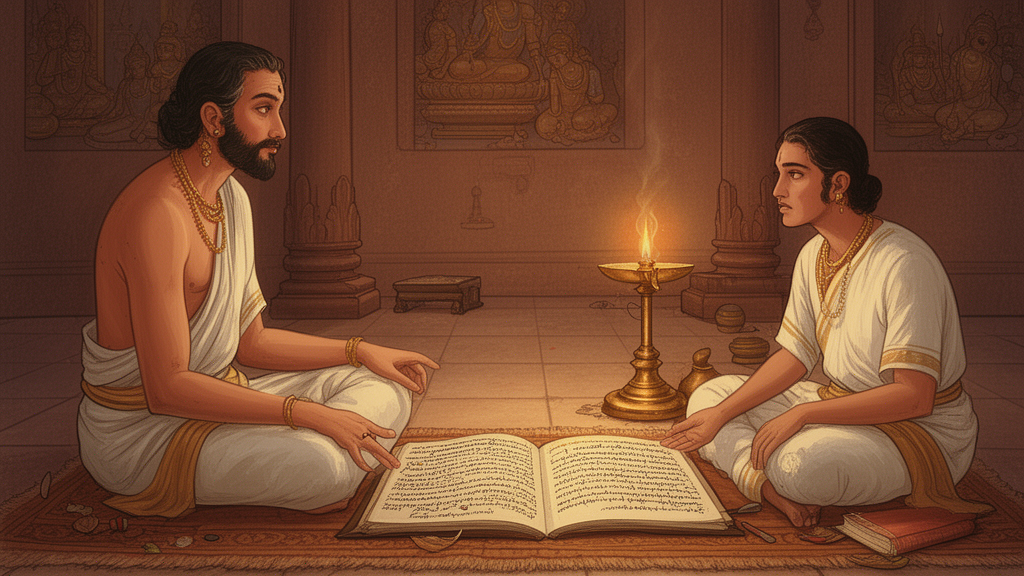
The word Upanishad is traditionally explained as “sitting near” a teacher. One Telugu Upanishad resource describes the Upanishads as the concluding portions of the Vedas, known as Vedanta, meaning the “end of the Vedas” (Vedapath, Upanishads in Telugu). That etymology is a traditional explanation offered by a modern educational site; it is useful context rather than a scholarly consensus on the word’s origin.
The Upanishads are commonly discussed through themes such as the nature of the self (Atman), ultimate reality (Brahman), the relation between the individual and the cosmos, and liberation (moksha). The same Vedapath page describes the Upanishads as dialogues between teachers and seekers and notes that the collection includes principal texts recognized by Adi Shankaracharya as well as later sectarian Yoga, Shaiva, Vaishnava, and Shakta texts. Readers should therefore not assume that “the Upanishads” means a single, fixed set of twelve or any other number unless the source specifies which list it uses.
This distinction matters for Upanishad Ratnakaram. A Telugu compilation may follow one list, combine several traditions, or present material that other editions group differently. Checking which texts are included is the first step in using the book responsibly.
Where to find Telugu Upanishad texts
Several Telugu-language sites publish Upanishad material. Each serves a different purpose, and none should be treated as a replacement for a critical edition or a teacher’s guidance.
Stotranidhi: a text-oriented index
Stotranidhi publishes Telugu stotra and scripture texts and includes an Upanishads section. Its Upanishads page lists Telugu titles including Ishavasya, Aitareya, Katha, Kumara, Kena, Kaivalya, Sri Ganapatyatharvashirsha, Ganesha Tapini, Jabala, Chakshusha, Narayana, Panchabrahma, Sri Bala, and Bilva, with further entries beyond the visible list (Stotra Nidhi, Upanishads in Telugu). Its page is a reading and index resource. It is useful for locating a title in Telugu script, but the page snippet reviewed here did not establish the edition or commentary behind each text.
Vedapath: structured study with categories
Vedapath presents Upanishads in Telugu with Sanskrit, transliteration, translation, and multilingual support. It groups texts by category, including Mukhya (Principal), Yoga, Shaiva, Sannyasa, Shakta and Vaishnava, and Vedic (General), and by Veda, such as Atharva Veda, Yajur Veda, Rig Veda, and Krishna Yajur Veda. The site states that it covers 60 texts (Vedapath, Upanishads in Telugu). Its category labels are helpful for beginners, but they are a modern organizing system. Readers should compare them with the traditional lists they encounter in their own community.
Telugu Bharath and Sri Suka Brahmashram: downloadable Telugu books
Telugu Bharath describes itself as a Telugu spiritual web journal and lists a free e-book for the Upanishadratnakaramu under Downloads and Tags (Telugu Bharath, Om Upanishadratnakaramu). Sri Suka Brahmashram lists 56 Telugu books related to the Upanishads as free PDFs, including several titles connected with the Ishavasya, Kena, Katha, Mandukya, Taittiriya, and Aitareya Upanishads (Sri Suka Brahmashram, Upanishat Free Telugu Books). Its titles are useful leads, but a listing does not confirm the copyright status, translation quality, or authorship of each file. Download pages can change, so check that the source is still available before recommending it to others.
How to read a compilation like Upanishad Ratnakaram
A compilation can be valuable because it brings many texts into one volume. It can also mix several layers at once: the Upanishad text, a translation, a commentary, and the compiler’s own explanations. Readers benefit from separating these layers.
- Identify the layers. Note which parts are the Upanishad text, which are Telugu translation, which are commentary, and which are editorial introductions.
- Check the edition. Record the title, publisher, year, editor or translator, and any stated commentary tradition. A PDF without these details should be treated cautiously.
- Compare with another source. For an important passage, read the same Upanishad in another Telugu edition or in a Sanskrit text with translation.
- Mark tradition-specific interpretations. A commentary written within a particular school may explain a text differently from another school.
- Read for context. Many Upanishads are short and dense. Read the surrounding section rather than a single sentence taken out of context.
Principal texts and themes
Among the Upanishads most often studied in Telugu, several connect with themes that recur across the corpus. The examples below are drawn from source descriptions, not from a verified reading of every edition.
Aitareya Upanishad: creation and consciousness
The Telugu page on the Aitareya Upanishad, as shown on Vedapath, describes it as associated with the Rig Veda and preserved within the Aitareya Aranyaka. It describes a sequence in which creation is presented as a teaching order: the self first, then worlds and protective powers, and finally consciousness entering the human body. The same description says the Upanishad distinguishes the senses, breath, mind, and intelligence, and it cites the phrase prajnanam brahma as a great saying in Telugu commentary on the text (Vedapath, Upanishads in Telugu; Stotra Nidhi, Upanishads in Telugu). Readers should note that this is how the Telugu summary presents the text. Anyone studying the phrase closely should consult the Sanskrit text and a reliable translation to understand its grammar and context.
Within the Aitareya Upanishad, the same summary says that moksha is presented as knowledge rather than as the result of ritual action. That is a doctrinal interpretation found in the Upanishad’s teaching and summarized by a modern commentator. Other traditions read liberation in different ways, so the statement should be attributed to the text and tradition described, not to all Hindus.
Adhyatma Upanishad: inward knowledge
The Adhyatma Upanishad, described on Vedapath as a short Vedanta text associated with the Yajur Veda, emphasizes inner self-knowledge over outward ritual. The Telugu summary says it teaches that the self is Brahman and that the false identification of the self with body, senses, and mind is the basis of bondage. The page lists 70 verses and a reading time of about 16 minutes (Vedapath, Upanishads in Telugu). The same description refers to methods of inquiry such as neti neti (“not this, not this”), analysis of five sheaths, and examination of waking, dream, and deep sleep states. These are important teaching methods in Advaita-oriented readings, but the Telugu summary presents them as part of the text’s teaching rather than as a complete account of later schools.
Adhwayataraka Upanishad: yoga and liberating knowledge
Vedapath describes the Adhwayataraka Upanishad as a short text connected with the Atharva Veda and placed within the Yoga Upanishads. It says that yoga practices such as breath and mind regulation, sense restraint, meditation, and absorption are helpful means, while the highest aim is recognition of the self. The page lists 19 verses (Vedapath, Upanishads in Telugu). This is a useful example of how a Yoga Upanishad can be read within a knowledge-centered framework. Readers interested in practice should distinguish the text’s description of meditation from modern yoga instruction.
Why tradition and scholarship must be separated
Upanishad study involves several kinds of statements that should not be merged. First, there is what a text says. Second, there is what a commentator or community traditionally teaches about that text. Third, there are modern academic or historical questions, such as when a text was composed or how its manuscripts developed. Fourth, there is personal devotion or practice. A Telugu compilation may include all four.
For example, a claim that the Aitareya Upanishad teaches that consciousness is Brahman is a claim about a textual teaching as presented by a particular summary and tradition. A claim that a specific Upanishad was composed in a specific century is a historical claim and needs academic sources. A claim that a reader should recite a passage for a particular benefit belongs to devotional or ritual practice and is outside the scope of this article. Upanishad Ratnakaram may address several of these layers, so readers should identify which kind of claim they are reading.
Telugu readers also encounter differences in terminology. Words such as Atman, Brahman, Jnana, Moksha, and Vedanta may be transliterated in different ways in Telugu, Sanskrit, and English. The same concept may also be explained through different schools. Preserving the Sanskrit term, then giving its meaning in context, is usually more reliable than translating it with one fixed English word.
Copyright, legality, and responsible downloads
Many free Telugu books on Upanishads are circulated on websites, mirror pages, and document-sharing platforms. The Scribd listing for Upanishad Ratnakaram describes the document as uploaded by a user and marks the license as “Attribution Non-Commercial” on the page, but it does not show proof that the uploader owns the rights to the book (Scribd, Upanishad Ratnakaram PDF; Scribd, Upanishad Ratnakaram). Readers should use copies that are published legally, provided by a publisher or institution, or made available with clear permission.
This is also a matter of respect for scholars, translators, and publishers. A devotional text is not automatically public-domain because it is old, and an old printed edition may still have rights attached to its modern typesetting, translation, or commentary. When a source is unclear, it is better to look for an authorized edition, a library copy, or a publisher listing.
A practical study plan
For readers new to Telugu Upanishad study, a simple plan can make the material more manageable. The steps below are a study method, not a religious requirement.
- Choose one short Upanishad. Shorter texts such as the Mandukya, Isha, or Kena Upanishads are often used as starting points in many traditions, though the choice depends on your teacher and tradition.
- Read the Telugu text slowly. Read a few lines at a time and write down the key terms you do not understand.
- Compare two translations. One Telugu translation and one English or Sanskrit-based translation can reveal differences in wording.
- Read a commentary separately. Note when a statement is from the Upanishad and when it is from the commentator.
- Record your sources. Keep the publisher, year, page or section, and translator. This makes later checking much easier.
- Discuss with a qualified teacher. Upanishad study has a long oral and teacher-centered tradition, and a teacher can explain context that a printed book may not cover.
Related HindusGod.com study pages
The following pages are internal drafts in the current WordPress inventory. They may not be public yet. Links should be checked again after publication or before sharing.
- Read the Brihadaranyaka Upanishad in Telugu draft for a longer prose Upanishad and its themes of self and Brahman.
- Compare the Chandogya Upanishad in Telugu draft to see another major Upanishad in the Telugu guide series.
- For a short text often studied early, see the Ishavasya Upanishad Telugu draft.
- The Kena Upanishad Telugu draft covers a text that asks about the source of perception and speech.
- The Katha Upanishad Telugu draft is relevant for readers interested in dialogue, death, and the self.
- The Mandukya Upanishad in Telugu draft connects with the study of the four states of consciousness.
- The Mundaka Upanishad in Telugu draft is useful for readers exploring knowledge and the imperishable.
- The Taittiriya Upanishad in Telugu draft covers a text commonly read in education and recitation contexts.
- For Narayana-associated texts, see the Narayana Upanishad in Telugu draft.
- The Garbha Upanishad Telugu draft addresses a text about the development of the embryo and the self, which should be read with care and context.
- For a general overview of the term, see the Meaning of Upanishad draft.
- Readers comparing lists and counts may find the 10 Upanishad draft and the 108 Upanishad draft helpful, since the number of Upanishads depends on the list used.
- For the Advaita and inward-knowledge themes discussed above, see the Adhyatma Upanishad draft and the Advaita Upanishad draft.
Frequently asked questions
Is Upanishad Ratnakaram a single Upanishad?
No. The title is used for a Telugu compilation. Readers should check the table of contents of the specific edition to see which texts, commentaries, and introductions it includes.
Which Telugu source is the most reliable?
No single website can be treated as the final authority. Reliability depends on edition details, translator or editor information, and whether the text can be compared with other editions. Academic publications, scripture publishers, and established cultural institutions are usually better for verification than unattributed uploads.
Are the Upanishads only for monks or scholars?
Traditions differ on who studies Upanishads and how. Many communities teach them in schools, households, or monastic settings, while others approach them mainly through commentary. Readers should follow the guidance of their own teacher and tradition.
Does reading the Upanishads guarantee spiritual results?
No. Upanishadic texts describe teachings about knowledge, self, and liberation. A sourced summary can explain those teachings, but no reading or recitation should be presented as guaranteeing a particular outcome.
Closing takeaway
Upanishad Ratnakaram Telugu is best approached as a Telugu compilation linked to the wider Upanishad tradition. Its value lies in access to Telugu-language study material, but its exact contents, authorship, and reliability depend on the edition in hand. Read the Upanishad text, the translation, and the commentary as separate layers, verify the edition, and compare important passages with other sources. This approach respects the texts, the traditions that transmit them, and the readers who study them.
Sources and further reading
- Stotra Nidhi, Upanishads in Telugu – Telugu index of Upanishad titles; used for the listed titles and the Telugu Aitareya summary.
- Vedapath, Upanishads in Telugu – Categories, Veda associations, verse counts, and Telugu summaries for selected texts; used for the traditional etymology and category descriptions.
- Telugu Bharath, Om Upanishadratnakaramu – Listing for the Telugu e-book and the attribution tag used on the page.
- Sri Suka Brahmashram, Upanishat Free Telugu Books – Listing of free Telugu Upanishad-related PDFs; used only to describe the availability of such listings.
- Scribd, Upanishad Ratnakaram – Upload page for a 506-page Upanishad Ratnakaram document; used to note the existence of the listing and its licensing label, not the book’s contents.
- Scribd, Upanishad Ratnakaram PDF – Second Scribd listing for the same title; used to show that multiple uploaded copies exist.