The Sukhāvatīvyūha Sūtra is a Mahayana Buddhist scripture that describes Sukhāvatī, the “land of bliss” created by the buddha Amitābha, and the vows through which he made rebirth there available to beings. The title is often written as “Sukhavativyuha Sutra” in English without diacritics, and both spellings refer to the same text. This post explains what the scripture says, how its two main versions differ, how it has been translated, and where it fits in relation to Hindu traditions.
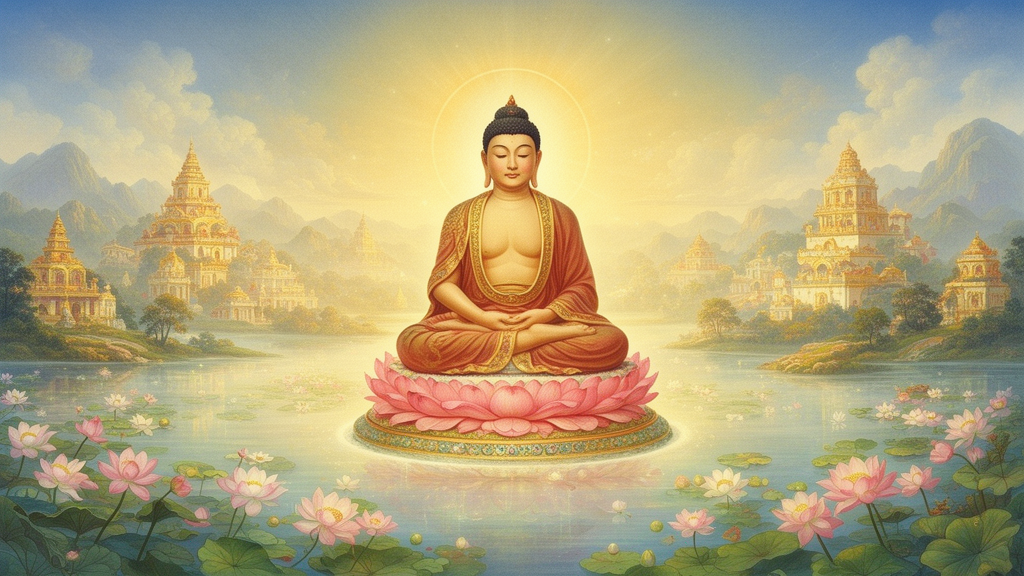
One point needs to be clear from the start. The Sukhāvatīvyūha is a Buddhist scripture. It is not part of the Vedas, Upanishads, Puranas, or the Bhagavad Gita, and it is not a Hindu text in the usual sense. Hindu readers may encounter it through the study of Indian religious history, comparative religion, or interest in Buddhism, which developed in the same subcontinental setting. The discussion below keeps those categories separate.
Direct answer: what the Sukhāvatīvyūha Sūtra is
The Sukhāvatīvyūha Sūtra is a Mahayana sutra that presents Amitābha Buddha, a buddha of immeasurable light, and his western pure land, Sukhāvatī. The text describes the land’s beauty and the conditions for being reborn there, and it presents Amitābha’s vows as the means by which beings may be saved. The Pure Land Buddhism website describes the longer version as “the most detailed, complete, and longest Pure Land sutra” among the primary Pure Land texts in Chinese tradition, and notes its account of Amitābha’s Forty-Eight Great Vows and the three levels of rebirth in the Pure Land (Pure Land Buddhism, The Infinite Life Sutra).
Two terms help readers navigate the title. Sukhāvatī means something like “possessed of bliss” or “land of bliss.” Vyūha means “array” or “arrangement,” so the title is often rendered as “Array of the Land of Bliss” or as a description of Amitābha’s pure land. The Wikipedia entry on the Amitāyus Sutra gives the alternative titles “Larger Sukhāvatīvyūha Sūtra” and “Amitābhavyūha” (Array of Amitābha), and it describes the text as one of two Indian Mahayana sutras surviving in Sanskrit that describe Amitābha’s pure land (Wikipedia, The Amitāyus Sutra; snippet reviewed, full page not inspected).
Two versions: the Larger and the Shorter Sūtra
Readers commonly encounter two Sukhāvatīvyūha texts, and confusion between them is frequent. Their relationship is central to understanding the tradition.
The Larger Sukhāvatīvyūha Sūtra
The Larger version is the longer and more narrative text. It describes the story of a monk who, after hearing the Buddha teach, makes forty-eight vows to create an ideal buddha-land. The Pure Land Buddhism page presents this as the core of the longer sutra and describes the vows, the rebirth levels, and the qualities of the land in detail (Pure Land Buddhism). The Wisdom Library’s English edition, titled “The Larger Sukhavativyuha Sutra,” is listed at about 17,317 words and is described on the site as Shakyamuni Buddha’s discourse revealing Amida Buddha as savior of all beings through the power of his great vows (Wisdom Library, The Larger Sukhavativyuha Sutra).
The Larger text is also known as the Amitāyus Sūtra, or “Sutra of Immeasurable Life,” in some references. Its emphasis on Amitāyus, or Immeasurable Life, and on Amitābha, or Immeasurable Light, shows how the names of the buddha are used in the same tradition.
The Shorter Sukhāvatīvyūha Sūtra
The Shorter version, often called the Amitābha Sūtra, is much briefer. Wikipedia’s entry on the Amitābha Sūtra notes that the shorter text circulated widely in East Asia, with manuscripts and printed copies appearing in Korea, Vietnam, and Japan, including a Japanese edition published in 1773 (Wikipedia, Amitābha Sūtra; snippet reviewed, full page not inspected). Because of its brevity, the Shorter text is often the first Pure Land scripture that lay practitioners learn, while the Larger text offers the fuller narrative.
Readers searching for a specific version should check which edition they are reading. A short summary of the Amitābha Sūtra is not a full account of the Larger Sūtra’s vows, and an English translation of the Larger text does not automatically describe the Shorter one.
The Sukhāvatīvyūha in Chinese Pure Land tradition
The Pure Land Buddhism website describes the Sukhāvatīvyūha as one of three primary Pure Land sutras in Chinese tradition, along with the Amitābha Sūtra and the Amitāyurdhyāna Sūtra, or Visualization Sutra. It also says the Larger text is one of five Pure Land sutras recognized in Chinese Pure Land Buddhism. This is a tradition-specific count. Other Buddhist communities classify and prioritize these texts differently, and the page should be read as a presentation from one Pure Land perspective rather than as a neutral census.
The same page states that between 147 and 713 CE the sutra was translated more than a dozen times from Sanskrit into Chinese, that seven of these translations are lost, and that five remain in the Chinese Buddhist Canon. It names several translators and dates, including Lokakṣema, who is described as arriving in Luoyang in 164 CE, and Saṅghavarman, whose translation is dated to 252 CE. These dates come from the Pure Land Buddhism page. Readers who need scholarly confirmation of exact translation dates should check academic histories of Chinese Buddhist translation, because the transmission history of these texts is complex and the figures are often reported with uncertainty.
The same page also says that some scholars believe the Longer Sukhāvatīvyūha was compiled during the Kushan period, in the first and second centuries, and became popular in the Gandhāra region. The phrasing signals that this is a scholarly view, not an established consensus. Readers should treat the composition date as an open question.
Core teachings in the Sukhāvatīvyūha
The scripture’s teachings center on Amitābha’s compassion and on the possibility of rebirth in his pure land. The following themes appear in the Pure Land summary and the Wisdom Library description. Each is presented as the teaching of the text or of the tradition that reveres it.
Amitābha and the pure land
Sukhāvatī is described as a land free of suffering in which conditions favor the practice of the Dharma. The land is presented as a place where beings can progress toward awakening without the obstacles of the present world. This is a description of the scripture’s vision, not a physical location that can be visited or mapped.
The Forty-Eight Vows
The vows are the structural core of the Larger Sūtra. According to the Pure Land Buddhism summary, Amitābha’s forty-eight vows define the qualities of his land and the conditions under which beings may be reborn there. The Wisdom Library describes the text as revealing Amida as savior through the power of these vows. In Pure Land teaching, the vows are understood as expressions of a compassionate intention, and they are central to why devotees trust in Amitābha rather than in their own achievements alone.
Rebirth and the three levels
The Pure Land summary notes that the Larger Sūtra describes three levels of rebirth in the pure land. Interpretations of these levels vary across Pure Land schools, so readers who want the exact classification should consult the English translation they are using and the commentarial tradition connected to it.
Devotion and recitation
In the Pure Land traditions that rely on these texts, recollection and recitation of Amitābha’s name is a central practice. This practice is described in many Pure Land communities as an expression of trust and gratitude, not as a mechanical technique that guarantees a result. Practitioners in different schools describe it in different ways, and the sutra’s own instructions should be distinguished from later commentarial teaching.
Translations and reading editions
Readers in English have several options. The Wisdom Library provides an online English presentation of the Larger Sukhavativyuha Sutra, and its page states that the full text is publicly accessible, while also recommending purchase of a book edition for the latest scholarly version (Wisdom Library). The Internet Archive hosts a scanned text titled “Sukhāvatīvyūha Sutra” in a Gomez volume, and a catalog entry for “The Sukhavativyuha Sutra” by Hoshu Y. Matsubayashi (Internet Archive, Gomez text; Internet Archive, Matsubayashi edition). The archived pages were reviewed for their titles and availability, but the scanned text itself should be checked against a modern edition before quoting it, because OCR and scanning can introduce errors.
When comparing translations, pay attention to three things:
- Translator and edition. Identify who translated the text, when, and from which Sanskrit or Chinese base.
- Version. Confirm whether the edition is the Larger or Shorter text.
- Commentary. Separate the translated scripture from introductions, notes, and commentary.
Because translations vary, avoid treating any single English rendering of a phrase as the only correct meaning. Where the wording of a key term matters, consult more than one edition.
Sanskrit and Chinese transmission: why it matters
The Sukhāvatīvyūha survives in Sanskrit in the two versions described above, and it also survives through an extensive Chinese translation history. The Pure Land Buddhism page describes the Chinese translation line in detail and notes that many translations were lost. This means that a reader of the Chinese canon is reading texts that have been transmitted through translation, while a reader of the Sanskrit editions is reading a different witness to the same tradition.
For example, the Pure Land page names several Chinese titles for the Larger text, including versions with Sanskrit-derived terms such as “Amitābha” and “Sukhāvatī” rendered in Chinese characters. Such titles show that the scripture’s name and identity have been expressed in more than one language. A reader who sees “Infinite Life Sutra” in one source and “Sukhāvatīvyūha Sūtra” in another is often looking at the same tradition under different names.
Relation to Hindu traditions and Indian religious history
The Sukhāvatīvyūha Sūtra is a Buddhist text, and its authority is recognized by Mahayana Buddhist communities. Its place in Indian religious history is therefore a matter of Buddhist development in the subcontinent and its later spread across Asia. It should not be presented as a Hindu scripture, nor should its teachings be merged with Hindu devotional theology.
There are, however, points of comparison that some readers find useful for study:
- Devotional grace. Pure Land teaching presents Amitābha’s vows as a source of salvation. Some readers compare this with bhakti traditions in Hinduism, where grace (prasāda or anugraha) and devotion to a deity are central. Such comparison should be framed as a scholarly observation, not as an identity of doctrines.
- Named deities and buddhas. Both traditions describe divine or semi-divine beings with particular qualities, names, and realms. Hindu readers may find that the naming of Amitābha, Amitāyus, and the pure land invites comparison with Vaishnava or Shaiva descriptions of heavenly abodes, but these comparisons do not show a shared origin.
- Sanskrit vocabulary. Many terms in the text, such as vyūha, are part of the wider Sanskrit religious vocabulary. Their meanings in Buddhist texts may differ from their uses in Hindu sources.
For readers who want to explore Mahayana material more broadly, related HindusGod.com content can be useful. The Sukhavativyuha post is a target draft on this site that may be used for related reading after review, and the Amida Sutra and Amida Sutra Meaning drafts cover the Shorter Amitābha text. Readers interested in the wider Mahayana sutra literature may also look at the Avatamsaka Sutra and the Dasabhumika Sutra. These links are to target drafts that may not yet be public.
Visualization and meditation in Pure Land practice
The Sukhāvatīvyūha belongs to a group of Pure Land texts that also includes the Visualization Sutra, which describes meditative methods for envisioning Amitābha and his land. The Pure Land Buddhism page names the Visualization Sutra as one of the three primary Pure Land texts in Chinese tradition. Meditation on Amitābha and the pure land appears in several Mahayana sources, and practitioners approach these practices in different ways.
Readers who want to learn about meditation methods should look for practice instructions from a recognized teacher or tradition. The sutra text is a source of teaching, not a manual that can be applied without guidance. The Dhyana Sutra draft on HindusGod.com may be helpful for background on meditative terms, subject to review.
Common misunderstandings
“The sutra is a Hindu text”
This is not accurate. The Sukhāvatīvyūha Sūtra is a Mahayana Buddhist text, and it is recognized as such in the sources reviewed here, including the Pure Land Buddhism and Wisdom Library pages.
“There is only one Sukhāvatīvyūha”
There are at least two major versions, the Larger and the Shorter, and multiple translations and editions. Readers should identify which one they are reading.
“Reciting Amitābha’s name guarantees rebirth”
The scripture and Pure Land tradition describe devotion and recitation as part of a path rooted in trust and in Amitābha’s vows. Interpretations differ across schools, and no source reviewed here presents a material or guaranteed outcome from a particular practice. Readers should not treat any devotional act as a promise of a specific result.
“All Buddhists read the same sutra list”
Buddhist canons and sutra lists differ among traditions. The Chinese Pure Land count of five Pure Land sutras, for example, belongs to a particular tradition and is not a universal Buddhist classification.
How to study the Sukhāvatīvyūha Sūtra
A careful reader can approach the text in several stages:
- Identify the version. Decide whether you are reading the Larger or Shorter Sūtra, and check the translator and edition.
- Read a full translation before relying on summaries. Summaries and blog posts, including this one, compress the narrative and may omit details that matter.
- Compare two translations for key terms such as “land,” “vow,” “rebirth,” and “light.” Note where translators differ.
- Consult a commentary or academic introduction. Commentaries show how Pure Land schools have read the text, which is different from what the text itself says.
- Keep a record of sources. When you write about the sutra, distinguish what the scripture says, what a tradition teaches, and what scholars argue.
Frequently asked questions
Is the Sukhāvatīvyūha Sūtra the same as the Amitābha Sūtra?
They are closely related but not identical. The Amitābha Sūtra is generally identified as the Shorter Sukhāvatīvyūha, while the Larger Sukhāvatīvyūha is a longer text with the forty-eight vows and a fuller narrative. Both describe Amitābha and his pure land.
Why does the title appear as “Sukhavativyuha” without diacritics?
Online and library catalogs often omit diacritical marks such as the macron and underdots. The spellings “Sukhavativyuha” and “Sukhāvatīvyūha” refer to the same term. This post uses the diacritical form in the body for accuracy, and the ASCII form for search and catalog matching.
Is it used in Hindu worship?
The sources reviewed for this post present the sutra as a Buddhist scripture used in Mahayana and Pure Land communities. They do not describe it as part of Hindu worship, and this post does not make such a claim.
Where can I read it in English?
The Wisdom Library and Internet Archive pages mentioned above provide online access to English presentations or scanned texts. Before relying on any online text, confirm the translator, edition, and completeness, and consider purchasing or borrowing a critical edition.
Sources and Further Reading
- The Infinite Life Sutra, Pure Land Buddhism: used for the description of the Longer Sukhāvatīvyūha, the Forty-Eight Vows, the three levels of rebirth, the translation history, and the Chinese Pure Land count of five sutras. This is a tradition-specific devotional and educational source.
- The Larger Sukhavativyuha Sutra, Wisdom Library: used for the summary of the text as Shakyamuni’s discourse on Amida Buddha and for the listed length and online availability. Confirm the edition before quoting.
- Full text of Sukhāvatīvyūha Sutra, Internet Archive: a scanned text listing. Used only to identify that a full-text scan exists; the scan was not used for doctrinal claims.
- The Sukhavativyuha Sutra, Hoshu Y. Matsubayashi, Internet Archive: a catalog record for an edition by Matsubayashi. Used only to identify the edition; verify details on the record page.
- The Amitāyus Sutra, Wikipedia: used for the alternative titles and the description as one of two surviving Indian Mahayana sutras in Sanskrit on Amitābha’s pure land. Snippet reviewed; full page not inspected.
- Amitābha Sūtra, Wikipedia: used for the note on the Shorter Sukhāvatīvyūha’s circulation in East Asia. Snippet reviewed; full page not inspected.
Summary
The Sukhāvatīvyūha Sūtra is a Mahayana Buddhist scripture that describes Amitābha’s pure land of Sukhāvatī and the vows through which beings may be reborn there. It exists in a Larger and a Shorter form, has a complex translation history in Chinese and other languages, and remains central to Pure Land traditions. For Hindu readers, the text is most useful as a window into Buddhist and Indian religious history rather than as a Hindu scripture. Before quoting or applying its teachings, identify the version and translation, separate the scripture from commentary, and consult a recognized tradition or scholarly edition.