The Sukhavati Sutra is a group of Mahayana Buddhist scriptures that describe Sukhavati, the “Land of Great Bliss,” a Pure Land presided over by the Buddha Amitabha. The texts are not Hindu scriptures. They belong to the Buddhist tradition, but they are widely read by Hindus interested in comparative religion, the history of Indian religious thought, and the devotional dimensions of Buddhism. This guide explains what the sutra is, how its main versions differ, what its central story says, and how to read it responsibly.
The short answer
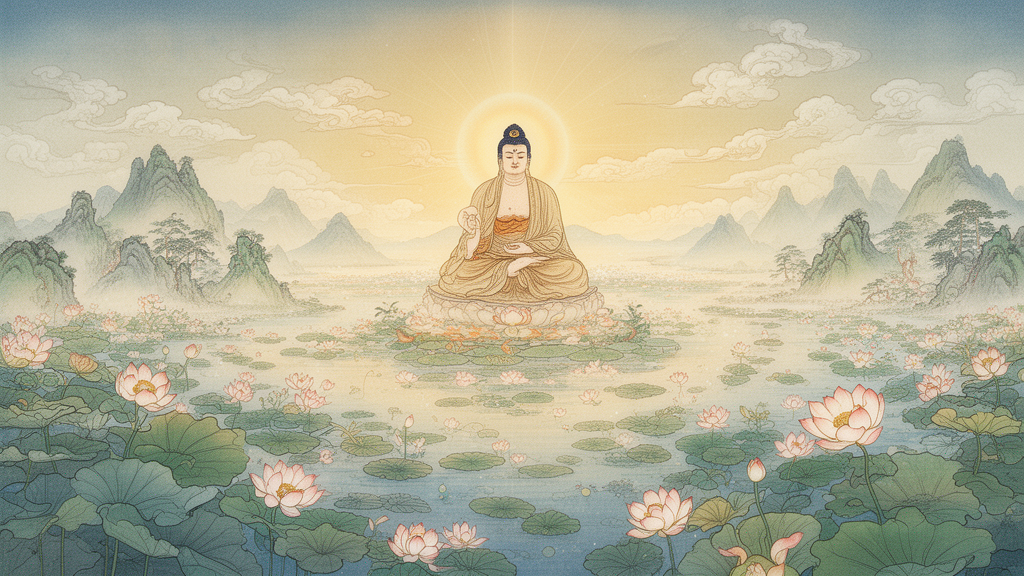
The Sukhavati Sutra teaches that a Buddha named Amitabha has established a pure realm, Sukhavati, where beings can be reborn and continue their path toward awakening. According to the Amitayus Sutra, the story of this realm begins with a past-life tale of Dharmakara Bodhisattva, who later becomes Buddha Amitabha. Dharmakara’s “Original Vows” are presented as the basis for the creation of the Pure Land. In Pure Land Buddhist practice, devotion to Amitabha, often expressed through recitation of his name, is central to the text’s message.
Sources: The Amitāyus Sutra (Wikipedia overview); Plum Village, Discourse on the Land of Great Happiness.
What “Sukhavati” means
Sukhavati is a Sanskrit term commonly rendered as “blissful” or “land of bliss.” Its English translations vary across editions. The Plum Village edition of the Taisho-period text is titled Discourse on the Land of Great Happiness, which reflects another common rendering. Readers will see several forms in print and online, including Sukhavati, Sukhāvatī, and Sukhāvatīvyūha.
The term vyuha is often translated as “arrangement” or “array,” so Sukhavativyuha is usually read as a description of the blissful realm. Translators and scholars do not always agree on the best English rendering, so readers should check the translation they consult.
Main texts in the Sukhavati tradition
The Sukhavati literature is often discussed in terms of a longer and a shorter text. This distinction appears in the references used for this article.
The Larger Sukhavativyuha
The longer text is known in English as the Larger Sukhavati-vyuha, or the “Description of Sukhavati, the Land of Bliss.” A public archive copy of an English-language translation identifies it with that heading. It contains the narrative of Dharmakara and the vows that lead to the creation of Sukhavati. Readers who want the full narrative should begin with a complete translation rather than a summary, because abbreviated versions can omit important details.
The Shorter Sukhavativyuha, also called the Amitabha Sutra
The shorter text is widely known as the Amitabha Sutra and as the Shorter Sukhavativyuha Sutra. The Wikipedia article on the Amitabha Sutra notes that the shorter text has appeared in many forms across East Asia, including Japanese sutra books, Korean illustrated editions, Vietnamese copies, and texts written in katakana, Siddham script, and kanji. This shows how the text traveled and was copied in different scripts and regions.
The shorter text is generally more concise. It describes the beauty of Sukhavati and invites devotion to Amitabha. Because it is shorter, it is often used in liturgy and daily recitation, though practice varies among communities.
Why the two versions should not be treated as identical
Although they share the figure of Amitabha and the Pure Land theme, the longer and shorter texts differ in length, narrative detail, and how they are used. Scholars and practitioners may emphasize different passages. A reader should not assume that a statement from one version applies automatically to the other without checking the actual text.
The story of Dharmakara and the Original Vows
The Amitayus Sutra, as summarized in a standard reference source, contains the past-life tale of Dharmakara Bodhisattva. In this narrative, Dharmakara later becomes Buddha Amitabha. The story explains how he makes what are called the Original Vows, which lead to the creation of the Pure Land of Sukhavati.
For readers new to Buddhist narrative, the important point is structural. The Pure Land is not presented as a place that simply exists by chance. In the text’s framework, it is connected to a bodhisattva’s vows and his path toward Buddhahood. The narrative therefore links the cosmic realm to a moral and spiritual resolve.
How to read the vow narrative responsibly
- Scripture: The story is told within the sutra. Readers should cite the specific translation and section they use.
- Commentary: Many explanations of the vows come from later commentators and teachers. These are interpretations, not the sutra itself.
- Devotional practice: Pure Land communities often treat the vows as a source of faith. This is a belief within those communities, not a historical claim that can be tested in the same way.
The Sukhavati setting in the Plum Village translation
The Plum Village page presents a translation of the Sukhavati-vyuha sutra from the Taisho Revised Tripitaka, number 366. Its opening states that the Buddha was staying at the Anathapindika Monastery in the Jeta Grove. It says he was accompanied by a Sangha of 1,250 bhikshus, all described as arhats and as among his most well-known senior disciples. The list includes Shariputra, Mahamaudgalyayana, Mahakashyapa, and Ananda. The same page also says bodhisattvas of great stature were present, naming Manjushri and Ajita among them.
These details matter because they set the frame of the teaching. The sutra is presented as a discourse given to a large assembly, with monastic disciples and bodhisattvas present. Readers should note that this is the framing given in one translation. Other editions may present the opening differently.
Why the assembly matters
The presence of numerous disciples and bodhisattvas signals that the teaching is meant to be shared widely. Pure Land texts are often read as accessible teachings within a broader Buddhist community, rather than as secret knowledge limited to specialists. This is a general observation about how the frame functions in the text. It is not a claim about every devotional setting.
Core themes of the Sukhavati teaching
The Pure Land as a place of bliss
The name Sukhavati points directly to bliss, and the texts describe the realm in terms of beauty, peace, and the absence of the suffering associated with ordinary worlds. Readers should understand these descriptions as religious imagery. They express the tradition’s vision of an awakened environment rather than a geographical location that can be found on a map.
Amitabha as the central Buddha
Amitabha is the Buddha associated with the Pure Land. In Pure Land practice, devotion to him is central. The sutras give his name and the Pure Land its significance, and later traditions developed many forms of worship around him. For Hindu readers, a helpful comparison is with devotional traditions that center a particular deity’s grace and name, but the doctrinal frameworks are different and should not be merged.
Devotion, vows, and the bodhisattva path
The vow story shows that the Pure Land has a relationship to the path of a bodhisattva. Dharmakara’s resolve is presented as the source of the realm. In devotional teaching, this is often read as an encouragement to trust the Buddha’s vows. Scholars, however, may analyze the same passages as literary and doctrinal constructions within the history of Mahayana thought. Both approaches can be discussed, but they should be labeled clearly.
Practice in Pure Land communities
The sutra is studied and recited in many Buddhist communities. Practices differ by country, school, monastery, lay group, and personal teacher. Some people read the text, some recite it, some study commentaries, and some use it in liturgy. Because the tradition is diverse, a single description of “how to practice” would be misleading.
Common forms of engagement
- Reading a complete translation to understand the narrative and its frame.
- Studying commentaries from a particular school or teacher.
- Participating in recitation in a temple or community that follows Pure Land practice.
- Comparing editions to see how terms like Sukhavati are translated.
Readers who wish to take part in a specific ritual should consult a teacher or community within that tradition. Practice instructions in this article are general descriptions, not a prescribed method.
Historical and textual questions
The history of the Sukhavati texts is studied by scholars, but this article does not present a fixed date of composition, because the sources retrieved for this post do not establish one with enough precision. The texts are preserved in multiple languages and versions, including Chinese translations and later East Asian editions. Historians therefore study manuscripts, translations, and transmission patterns rather than relying on a single origin story.
Readers should distinguish three kinds of claims:
- What the text says: the narrative, names, and descriptions found in a translation.
- What a tradition believes: the devotional meaning given by Pure Land communities.
- What scholars conclude: historical, linguistic, and comparative interpretations based on evidence.
Keeping these separate helps prevent overstatement. For example, a community may teach that devotion to Amitabha leads to rebirth in Sukhavati. That is a tradition’s teaching about its own practice. It is not a result that can be verified by historical research.
Relevance for Hindu readers
HindusGod.com readers often encounter Buddhist texts while exploring Indian religious history, shared vocabulary, and the relationship between Buddhism and Hinduism. The Sukhavati Sutra is one example. It uses Sanskrit terms and draws on Indian religious imagery, but it belongs to Buddhist tradition and should be read on its own terms.
Readers who want a Hindu context may also be interested in devotional and scriptural overviews on this site, such as the Bhakti Sutra draft, which discusses devotion as a theme. Comparison can be useful when it respects differences. It should not assume that Amitabha and Hindu deities function in the same way, or that Buddhist and Hindu doctrines share identical meanings.
Reading the sutra with care
Choose a reliable translation
A reliable translation should identify its source text, edition, and translator or translation team. For the Sukhavati literature, readers should check whether the edition is a complete translation, whether it includes notes, and whether it distinguishes the longer and shorter texts. Public archive copies can be useful for reference, but readers should confirm the edition and copyright status before relying on them.
Use commentary as commentary
A commentary can help explain the context of a passage, but it is not the same as the sutra. When citing a commentary, identify the author and tradition. This is especially important for devotional readings, where a teacher’s explanation may be central to a community’s faith.
Avoid overgeneralization
Phrases such as “all Buddhists believe” or “the sutra promises” can mislead. Pure Land traditions differ, and the sutra’s meaning is shaped by translation, commentary, liturgy, and regional history. A careful article or study should state whose interpretation is being described.
Examples of useful comparisons
The following examples show how a reader can connect the sutra to related topics without treating them as identical:
- Bodhisattva vows: The Dharmakara story can be compared with other Buddhist narratives about vows and the bodhisattva path. Each text has its own framing.
- Named Buddhas: Amitabha can be compared with other Buddhas named in Mahayana literature, such as Avalokiteshvara, who is discussed in a related Avalokiteshvara Sutra draft.
- Disciples in the assembly: The list of named disciples in the Plum Village translation can be compared with other sutra openings, including the Ananda Sutra draft, which discusses a disciple named in many Buddhist texts. Readers should check the specific text before drawing connections.
Related reading on HindusGod.com
Readers who want to compare this subject with other sutra topics can explore the following pages. Several of these are currently draft entries and may not yet be public.
- Sukhavati Vyuha Sutra for a closer look at the Sanskrit term and its variants.
- Amida Sutra for another name used for the Amitabha-centered texts in East Asia.
- Amida Sutra Meaning for a focused explanation of the shorter text.
- Dhyana Sutra for meditative themes in Buddhist scripture.
Summary
The Sukhavati Sutra is a Buddhist scripture tradition centered on Sukhavati, the Land of Great Bliss, and on Buddha Amitabha. Its longer and shorter texts share the Pure Land theme but differ in length and use. The Amitayus narrative of Dharmakara explains how the realm is connected to vows and bodhisattva practice. Its practice and meaning vary across Pure Land communities, so readers should use reliable translations, separate scripture from commentary, and identify the tradition behind any devotional claim.
Frequently asked questions
Is the Sukhavati Sutra a Hindu text?
No. The Sukhavati literature is Buddhist. It is discussed on this site for comparative and educational reasons, and it should be read within its own tradition.
What is the difference between the Larger and Shorter Sukhavativyuha?
The Larger Sukhavativyuha contains the fuller narrative of Dharmakara and the vows. The Shorter Sukhavativyuha, also known as the Amitabha Sutra, is more concise and is used widely in East Asian Buddhist contexts. Readers should consult the specific translation to compare details.
Does the sutra promise a particular result for devotees?
The sutra describes the Pure Land and Amitabha’s vows in religious terms. Whether and how a devotee receives a particular outcome is a matter of belief and interpretation within Pure Land traditions. It is not a historical claim that can be tested.
Which edition should I read first?
Choose a complete translation that identifies its source text and translator. Compare it with a second edition or a scholarly introduction when possible. The Plum Village page is useful for a translation based on the Taisho text, and the archive copies can help with reference.
Sources and further reading
- The Amitāyus Sutra: summary of the Dharmakara past-life narrative and the Original Vows connected with Sukhavati. Used for the narrative overview.
- Amitābha Sūtra: overview of the shorter Sukhavativyuha and its transmission in East Asian and other editions. Used for the shorter-text distinction and manuscript variety.
- Full text of Sukhavativyuha Sutra, Archive.org: a digitized copy consulted for reference. The inspected page content was largely site navigation, so it is listed for further reading and not used for specific doctrinal claims in this draft.
- The Sukhavativyuha Sutra, Hoshu Y. Matsubayashi, Archive.org: a catalog record for a scholarly-era English edition. Consult the book itself for translation details.
- Discourse on the Land of Great Happiness, Plum Village: a translation of the Sukhavati-vyuha sutra from the Taisho Revised Tripitaka, number 366, including the opening scene and assembly.
- The Larger Sukhavati-vyuha, Huntington Archive: listed as a source for the longer text. This URL was not inspected in this draft, so readers should verify its content before relying on it.
Publishing notes for the owner
Verify that the Archive.org and Huntington Archive links still resolve before publication. Confirm the public status of the HindusGod.com draft pages before the post goes live, because the internal links currently point to drafts that may not yet be public. Review the copyright status of any translation you quote, and keep quotations short or avoid them.