The phrase sri rama raksha sutra most often refers to the Sri Rama Raksha Stotram, a Sanskrit hymn of protection addressed to Lord Rama. The word raksha means protection, and stotram means hymn of praise. The text is also known as the Rama Kavacham, or armour of Rama. Many readers search with the word “sutra” because it is familiar from other Indian and Buddhist texts, but in this context the correct Sanskrit genre name is stotra (or stotram). This article explains the hymn’s attribution, its structure, its verse-by-verse protective pattern, its traditional benefits, and the differences among editions and communities.
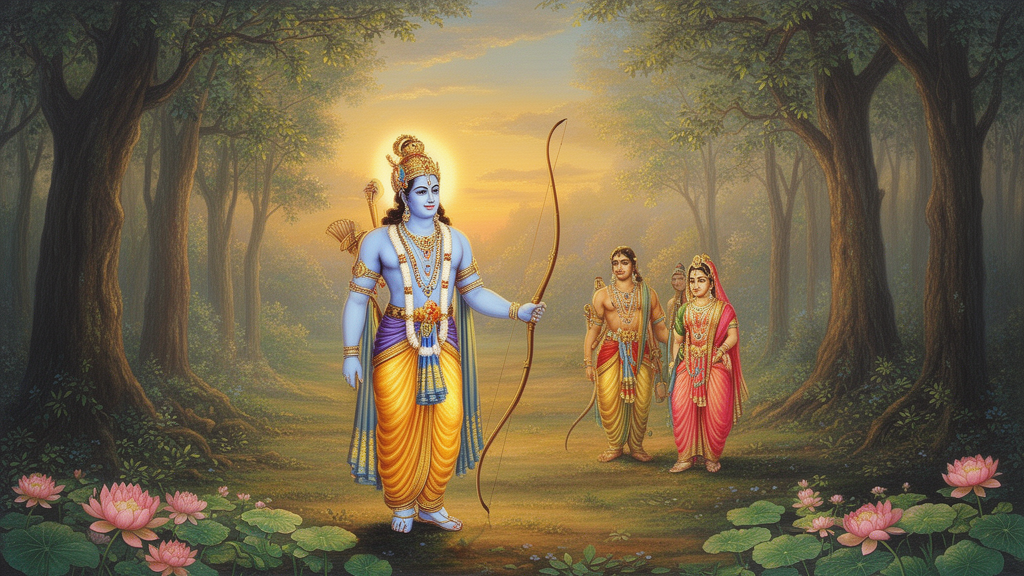
The main point to understand is that this is a devotional hymn with a long reception history. Its authorship, dating, and ritual use are described in traditional sources and in modern devotional websites. Where those accounts differ, this article says so.
What the Sri Rama Raksha Stotram Is
The Sri Rama Raksha Stotram is a prayer for protection that invokes Rama, the seventh avatar of Vishnu in the Vaishnava understanding, along with Sita, Lakshmana, and Hanuman. A widely used English presentation by Shlokam describes it as a hymn of praise dedicated to Lord Rama and used as a prayer for protection, and notes that it is also called Rama-Kavacham, a shield of protection by Lord Rama.[1]
The word kavacha (armour) explains its popular character. In devotional practice, the hymn is recited as a protective shield, with each verse naming a part of the body and asking Rama to guard it. The text is therefore both a praise poem and a kind of spiritual armour in the minds of its devotees.
Why the word “sutra” appears in searches
In classical Sanskrit, sutra usually means a thread, a concise aphorism, or a condensed rule in works on grammar, ritual, philosophy, or law. It is also used for Buddhist scriptures and in several modern titles. The Rama hymn is not generally classified as a sutra. Readers who search for “Rama Raksha Sutra” are usually looking for the same text, so this article uses the term to connect the search to the hymn. Other HindusGod.com articles discuss related terms, such as Raksha Sutra, Raksha Sutra Meaning, and Raksha Sutra in English, which address the broader “raksha sutra” search pattern.
Readers may also encounter spellings such as Ram Raksha, Rama Raksha, Shri Ram Raksha Stotra, and Sri Ram Raksha Stotra. These are transliteration variants of the same Sanskrit title. This article uses “Sri Rama Raksha Stotram” for the hymn and keeps the search phrase where it helps readers find the page.
Attribution: Budha Kaushika and the Legend Behind the Hymn
Traditional sources name the sage Budha Kaushika as the composer, or rishi, of the hymn. Shlokam states that the composer was Budha Kaushika, and that this name is said to be another name of Rishi Vishvamitra.[1] The Sanskrit header of many editions also lists “budhakaushika” as the rishi, and a Sanskrit text archive lists budhakauShika as the author in its metadata.[2]
The hymn’s own invocation, as rendered in several editions, identifies the author, the deity, the meter, and the purpose of recitation. For example, the English-transliterated header in a temple-published PDF lists the sage as Budha Kousika, the deity as Sri Sita Ramachandra, the meter as Anushtup, the power as Sita, the protector as Hanuman, and the usage as chanting for the devotion of Sri Ramachandra.[6]
The Shiva tradition
Shlokam reports the devotional account that Lord Shiva instructed Sage Budha Kausika to compose this protective shield for devotees, and that the sage wrote the hymn under that instruction.[1] A separate popular account, summarised by Dr. Amit Ray’s website, describes the hymn as revealed in a dream by Lord Shiva.[5] That website is a personal teaching and course site, and its claims about chakras and energy effects are not supported by the scriptural or scholarly sources reviewed for this article, so it is not used here for doctrinal or historical claims.
A reference to the Rig Veda: a claim to check
Shlokam also says there is a reference to this divine hymn in the Rig Veda.[1] That is a traditional or devotional claim as presented on that page. This article did not verify the specific Rig Veda passage, and it should not be read as a confirmed textual reference. Readers who want to pursue the claim should consult a Rig Veda edition and a scholarly study of the Rama hymn’s reception, rather than relying on popular summaries.
Belief, tradition, and scholarship
It helps to separate four kinds of statement. The first is devotional belief: Shiva revealed the hymn, or the hymn protects the devotee. The second is the textual claim: what the hymn’s verses say. The third is community practice: how families and temples recite it. The fourth is scholarship: when, where, and how the text took its present form. The traditional attribution to Budha Kaushika is a claim the tradition makes. The sources reviewed here do not establish a verified historical date for the composition, so this article does not give one.
Structure of the Hymn
Most editions organise the hymn into several parts. Shlokam describes the general arrangement in this way: the first few verses are introductory and dhyana (meditation) verses. From the second line of the fourth verse, a passage beginning with the words “sirome raghavah patu bhalam dasarathatmajah” through the ninth verse forms the core protective hymn. Verses 10 to 15 are the phala shruti, the section describing the benefits of recitation. Verses 16 to 38 are described by Shlokam as appended from other epics and from Mantra Shastra texts.[1]
This arrangement is useful for understanding the text, but it is an account given by one publisher. Other editions may number verses differently, include or omit appended verses, or present the sections with different headings. Readers should compare the edition they use with a reliable source before reciting it in a formal setting.
The opening invocation
The invocation begins with salutation to Lord Ganesha, a common opening in Hindu ritual and devotional texts. The introduction then names the rishi, deity, meter, power, protector, and purpose of recitation. Shlokam’s English rendering summarises the purpose as devotion to Lord Shri Ramachandra.[1] In practice, many people recite the invocation before the protective verses, but some traditions do not use the full invocation, and families sometimes follow a shorter form.
Dhyana: meditating on Rama
The meditation verses describe Rama in visual terms. A translation published by HinduShlokas presents the devotee meditating on Rama, whose complexion is compared to a blue lotus, and who is accompanied by Janaki (Sita) and Lakshmana, with matted hair crowned by regal splendour.[3] The same translation describes Rama as holding a sword, quiver, bow, and arrows, and as the destroyer of the demons who roam in darkness.[3] These verses teach the reader to hold a clear image of the deity before reciting the protective lines.
The Protective Verses: How the Body Is Named
The core of the hymn is a sequence of verses in which each part of the body is named, and a specific form of Rama or a related figure is invoked to guard it. The pattern is central to why the text is called a kavacha. The sequence moves from the head downward. A translation by HinduShlokas renders the early lines as asking Raghava, the scion of the Raghu dynasty, to protect the head, and the son of Dasharatha to protect the forehead.[3]
The same translation continues through the body, with lines asking that the eyes, ears, nose, mouth, tongue, throat, shoulders, arms, hands, heart, middle, navel, waist, thighs, and lower body be protected by named forms of Rama. For example, the son of Kausalya is invoked for the eyes, the friend of Vishvamitra for the ears, the one who loves Lakshmana for the mouth, and the husband of Sita for the hands.[3] The translation notes that the verses name the qualities and deeds of Rama, such as his breaking of Shiva’s bow and his defeat of Parashurama, as reasons he is trusted to protect.
Why the body-part pattern matters
For devotees, the sequence makes the hymn easy to remember and gives a concrete form to prayer. Each line ties an abstract wish for protection to a specific part of the body. The verses also recall episodes from the Ramayana, so reciting the hymn can also be a way of recalling the story. Readers who do not know the Ramayana well may find it helpful to read a summary of the epic before reciting, so that the references are understood.
A concrete example
Take the pair of lines describing the forehead and head. The translation by HinduShlokas renders them as asking Raghava to protect the head and the son of Dasharatha to protect the forehead.[3] A devotee who recites these lines with the translation in mind can connect the words to the image of Rama as a protective presence over the head. This is a devotional reading, not a scholarly claim about the text’s original purpose. It shows how the verses function in practice.
Phala Shruti: The Benefits Described in the Text
The phala shruti is the section that describes what the hymn is said to accomplish. Shlokam places the phala shruti in verses 10 to 15.[1] The translation by HinduShlokas states that the wise person who recites this Rama Raksha destroys sins and fulfils desires.[3] These are the text’s own promises as rendered in the translation.
It is important to read these promises as the claims of the devotional text and tradition, not as guaranteed material or physical outcomes. HindusGod.com’s editorial standards require that devotional acts not be presented as guarantees of health, wealth, success, or protection in the material world. The hymn’s protection is primarily understood within devotion: a relationship between the devotee and Rama, and a spiritual confidence in divine grace. Some devotees also report personal experiences of comfort or courage, but these are personal accounts, not verified results.
Sins and desires in devotional language
The phrase about destroying sins is connected to the broader Hindu idea that remembering or praising the divine can purify the mind. Another verse in the same translation describes the story of Rama as having the power to destroy even great sins when each syllable is heard or recited.[3] This is a theological statement within devotion. It does not replace the practice of ethical conduct, study, or seeking guidance from a teacher, which many Hindu traditions consider essential.
Recitation Practices and Variations
There is no single recitation practice that all Hindus follow for this hymn. Families, temples, and sampradayas (lineages) differ in how they chant it, how often, and in what setting. Some people recite it each morning. Others recite it on specific days or during festivals such as Rama Navami, a festival dedicated to Rama’s birth that is observed on a date that depends on the regional calendar. Readers should check the current festival date in their region rather than relying on a fixed date. For the broader festival context, see the article on Sri Rama Navami 2022 Telugu Calendar, which is a target draft and may not yet be public.
Pronunciation and transliteration
The Sanskrit text is written in Devanagari, and most transliterations use a mix of diacritics and simplified spellings. Shlokam presents the hymn in Devanagari with transliteration and English, and uses diacritics such as ā and ṣ for long vowels and retroflex sounds.[1] Other sites, including HinduShlokas and temple-published PDFs, use simplified transliterations without diacritics, such as “shriiraama” or “Shri Ram.”[3][6] These differences affect how words are pronounced when people read aloud. Learners should choose one transliteration system and keep to it, and if possible, learn the correct pronunciation from a teacher or a trusted audio recording.
Using a translation
Many devotees recite the Sanskrit and read a translation to understand it. A translation helps with meaning, but it is always an interpretation. HinduShlokas presents its own English rendering,[3] and a temple-published PDF presents another.[6] Where a translation departs from another, readers should consider the translator’s choices and, for serious study, consult a scholarly edition or commentary. This article does not reproduce any copyrighted translation at length.
Tradition-specific guidance
Some communities place the hymn within a broader sadhana or daily prayer routine. Others use it in group recitation, in temple settings, or during family rituals. Where a custom belongs to a specific family, region, or community, that context should be respected. If you are unsure how to recite it in your family or temple, the most reliable guidance comes from the local priest, teacher, or community.
Text Versions and Editions
Editions of the Sri Rama Raksha Stotram differ in several ways. The most visible differences are the number of verses included, the presence or absence of the appended verses from other epics, the transliteration system, and the translation. Shlokam explicitly states that verses 16 to 38 were appended from other sources,[1] which means that a reader using a shorter edition may not see those verses at all.
When comparing editions, readers should check four things: whether the invocation is included, whether the verse numbering matches the reference being used, whether the Sanskrit text is printed in Devanagari, and whether the translation is attributed. A reliable edition will usually state its source or publisher. The Sanskrit text archive Sanskrit Documents lists the work as a popular version of rAmarakShA with the file name rraksha.itx, and its metadata identifies the subject as philosophy and Hinduism.[2] That archive page is useful for locating a text, but readers should verify the version they use against a printed or trusted digital edition.
Where to find a dependable text
- Shlokam offers the Sanskrit text in Devanagari with transliteration, word-meanings, and an English rendering, and explains the verse structure.[1]
- HinduShlokas presents the Sanskrit alongside transliteration and an English translation, with the meaning of each verse.[3]
- Sanskrit Documents hosts Sanskrit texts with metadata, which helps identify the version and author.[2]
- A temple-published PDF offers an English-transliterated text with an invocation and translation, and is useful for families who prefer romanised text.[6]
These are reference points, not endorsements of every claim on each site. The pages were inspected only as far as the research record shows, and some of the sources listed were not fully inspected in this process, as noted in the Sources and Further Reading list below.
Comparison with the Hanuman Chalisa and Other Protective Texts
Shlokam states that the Rama Raksha Stotram, together with the Sri Hanuman Chalisa, is considered among the two most powerful protective mantra shields by many devotees.[1] That is a devotional claim, and it reflects how popular devotion ranks texts. Other traditions have their own protective hymns and practices, and devotees choose texts according to their personal bond with a deity, their family’s tradition, and their teacher’s guidance.
For readers who want to explore Hanuman-related devotion alongside Rama devotion, the article on Hanuman Raksha Sutra covers a related protective practice, and it is a target draft that may not yet be public. The article on Sri Rama Sita Laxman Hanuman gives context for the figures named in the hymn, and it is also a target draft.
The Rama Story Behind the Verses
The Sri Rama Raksha Stotram refers to episodes that are part of the Ramayana, including Rama’s relationship with Sita and Lakshmana, his encounters with sages, and his victories over demons. Many verses assume that the reader knows these episodes. For example, the invocation of Rama as the husband of Sita or as the conqueror of Parashurama presupposes the story of the marriage and of the encounter with Parashurama, which the epic narrates in detail.
Readers who want to understand these references should read the Ramayana or a scholarly summary of it. The version of the epic and its episodes varies among regional and linguistic traditions, so the story as told in one region may differ in detail from another. The hymn itself reflects a devotional reading of the epic, which emphasises Rama’s protective role.
Why Rama is also called Raghava and Dasharathatmaja
Several names in the hymn are titles of Rama. Raghava refers to the Raghu dynasty, to which Rama belongs. Dasharathatmaja means the son of Dasharatha. The translation by HinduShlokas uses these names in the verse about the head and forehead.[3] Recognising these titles helps readers follow the sequence of invocations.
Belief, History, and Scholarly Questions
The traditional account says that Budha Kaushika composed the hymn under Shiva’s instruction, and that it has been recited widely for a long time. The sources reviewed for this article do not provide a verified historical date for the composition, nor do they establish the process by which the hymn acquired its present form, including the appended verses. Claims about the hymn’s date should therefore be treated as uncertain unless supported by academic publications.
For readers interested in the scholarly question, a useful step is to compare several critical editions, look for manuscript evidence, and consult studies of the Rama devotional literature in Sanskrit and in regional languages. Those approaches go beyond the devotional summaries that dominate online sources. HindusGod.com does not present the traditional attribution as settled historical fact, and it recommends that readers keep devotional attribution and academic dating separate.
How to Approach the Hymn as a Reader
A practical way to begin is to read the invocation, then the dhyana verses, then the protective verses in a translation, and finally the phala shruti. If you are learning to recite, listen to a trusted recording or learn from a teacher. Many people find that understanding the meaning of each line deepens the practice, but there is no requirement that every reader understand Sanskrit before reciting.
- Choose one reliable edition with the Sanskrit text and a clearly attributed translation.
- Read the invocation and note the rishi, deity, meter, and purpose.
- Read the dhyana verses and form a clear image of Rama, Sita, and Lakshmana.
- Read the protective verses and identify the body parts named in each line.
- Read the phala shruti, and reflect on it as devotional language, not as a guarantee.
- If you recite regularly, keep to the same edition and transliteration so that your practice remains consistent.
Practical examples of study
Suppose you want to understand one verse in depth. Start with the Sanskrit line, then compare the transliteration in two editions, then compare the translations. Check the names in a dictionary or a reliable glossary, and look up any episode the verse refers to in the Ramayana. This method keeps the text, translation, and tradition distinct, and it helps you see where translators differ.
Another example is comparing the hymn with the related article on Rama Raksha Sutra Kannada, which is a target draft. Comparing a regional-language presentation with an English one shows how the same hymn can be understood through different linguistic and devotional frames. This is a useful exercise, but readers should confirm the content of each page when it is published.
Common Questions About Sri Rama Raksha Sutra
Is Sri Rama Raksha Sutra the same as Sri Rama Raksha Stotram?
In most search contexts, yes. The searched term “sutra” is used loosely for the hymn that is correctly called the Sri Rama Raksha Stotram. The Sanskrit genre name is stotra or stotram, meaning hymn of praise.[1]
Who wrote the Rama Raksha Stotram?
The traditional attribution is to the sage Budha Kaushika, whom Shlokam identifies as another name of Rishi Vishvamitra in the tradition it describes.[1] This is a traditional attribution. The sources reviewed for this article do not establish a verified historical date or authorship process.
Can I recite it without knowing Sanskrit?
Many people recite the hymn with transliteration and translation. Traditions vary in how they approach this. Learning the pronunciation from a teacher or reliable recording and reading a translation are common steps. The owner’s standards for this site ask that practices be described as tradition-specific where appropriate, so the best guidance comes from your family, temple, or teacher.
Does reciting the hymn guarantee protection or results?
No. The hymn’s phala shruti describes benefits within devotional belief.[3] This article does not present those benefits as guaranteed outcomes in health, finances, safety, or any other material matter. Devotion is a personal and spiritual practice, and its meaning is best understood within the tradition that practises it.
Key Takeaways
The Sri Rama Raksha Stotram is a Sanskrit hymn of protection to Lord Rama, attributed in traditional sources to the sage Budha Kaushika. It is structured around an invocation, meditation verses, a body-protecting sequence, and a phala shruti describing benefits in devotional language. Editions differ in verse numbering, appended verses, transliteration, and translation, so readers should choose a reliable text and check its attribution. The hymn is best approached with respect for devotional belief, textual reading, and the practices of specific communities, and with awareness of the uncertain historical questions that scholars still examine.
Sources and Further Reading
- Sri Rama Raksha Stotram: Sanskrit lyrics with English meaning, Shlokam. Used for the attribution to Budha Kausika, the Shiva tradition, the verse structure and phala shruti sections, the Hanuman Chalisa comparison, and the transliteration and word-meaning presentation.
- Shrirama RakshA Stotram, Sanskrit Documents. Used for the metadata identifying the author and text type. The page was not fully inspected in this process.
- Sri Rama Raksha Stotram: Lyrics with Meaning, HinduShlokas.org. Used for the dhyana verses, the body-protecting sequence, the phala shruti translation, and the invocation rendering.
- Sri Rama Raksha Stotram, English PDF, Bhadradri Sri Rama Temple of USA. Used for the romanised invocation and the attribution of the sage, deity, meter, and usage. The PDF was not fully inspected in this process.
- Rama Raksha Stotram: English, Vaidika Vignanam. Listed for further reading on available editions. Not used for specific claims in this article because its content was not inspected.
Further reading in scholarly sources on the Ramayana and on Sanskrit devotional literature is recommended for historical and textual questions. This draft did not verify specific academic publications, so none are cited here.