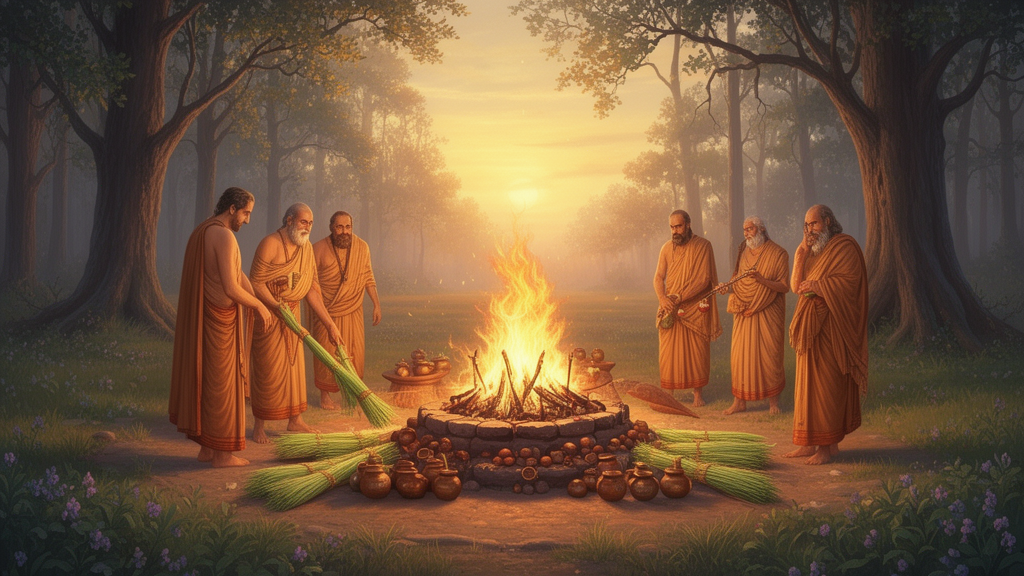
A srauta sutra is a Sanskrit ritual manual that gives step-by-step instructions for the grand Vedic sacrifices. Those sacrifices required three sacred fires and the services of several specialized priests. The word srauta comes from shruti, meaning “revelation” or “that which is heard,” because these manuals are based directly on the older Vedic literature. Britannica describes them as ritual manuals used by priests for these larger sacrifices (Britannica, “Shrauta-sutra”). In short, a srauta sutra is a technical guide to Vedic public ritual, not a story, a devotional hymn, or a general philosophy text.
This article explains what srauta sutras are, where they fit within the Vedic and Vedanga literature, how they are organized, and why readers encounter them today. It also distinguishes what the texts themselves describe from later commentary, modern scholarship, and the practices of present-day communities. You may also see the title spelled Shrauta sutra, Śrauta-sūtra, or Srautasutra. These variants refer to the same class of literature, and this article uses “srauta sutra” for consistency.
What the term “srauta” means

In Hindu usage, the Vedas are classed as shruti, a term usually rendered as revealed or heard knowledge. Britannica notes that the srauta manuals take their name from this concept because they are grounded in the older Vedic corpus. The label therefore points to a textual relationship: the sutra explains how to carry out rites that the Vedic literature already describes.
The word sutra literally means a thread or thread-like aphorism. In the context of Vedic ritual, a sutra is a compact instruction set, often written in short phrases that depend on an oral teacher or commentary to be fully understood. Readers who expect a continuous narrative should adjust their expectations. A srauta sutra is closer to a practical handbook for specialists than to a book meant for general reading.
Srauta and smarta: two different categories
Readers sometimes meet the adjective smarta, which is commonly associated with smriti, or remembered tradition. The srauta category is tied to shruti and to the public sacrificial system. Keeping these categories distinct helps prevent confusion when you read about Vedic ritual, household ritual, or later law codes. The source material for this article does not support a more detailed claim about how these categories were applied historically, so this article does not extend the comparison further.
Where srauta sutras fit within Vedic literature
Srauta sutras belong to a wider group of texts connected with the Vedas. The English Wikipedia article on Kalpa explains that kalpa means “proper, fit” and is one of the six disciplines of the Vedanga, the ancillary sciences connected with the Vedas. This field focuses on the procedures and ceremonies associated with Vedic ritual practice. The major texts of Kalpa Vedanga are called Kalpa Sutras (Wikipedia, “Kalpa (Vedanga)”, which redirects from “Srauta-Sutra”).
The same article divides the Kalpa Sutras into several groups, including Srauta Sutras, Shulba Sutras, Grhyasutras, and Dharmasutras. The Srauta group concerns the grand public rituals, the Grhyasutras concern domestic rites, and the Dharmasutras address social and legal conduct. These categories are useful for orientation, but the boundaries between them are not always sharp, and a single school may contain material that a modern reader would classify differently.
The six Vedangas in brief
The Vedangas are traditionally described as auxiliary disciplines that support correct recitation and performance of the Vedas. Kalpa is one of them. Other Vedangas, such as Shiksha (phonetics) and Vyakarana (grammar), focus on sound and language, while Kalpa focuses on ritual procedure. The Wikipedia article on Vedic scriptures lists these related texts together, which helps readers see why srauta manuals were treated as tools for accurate performance rather than as independent doctrinal works.
How srauta sutras are organized
Srauta sutras are generally concerned with a range of rites grounded in the Brahmana portions of the Veda. Wisdom Library, summarizing the English translation of the Bharadvaja-srauta-sutra by C. G. Kashikar, explains that the term refers to Sanskrit sutra literature dealing with ceremonies based on the Brahmana divisions of the Veda. These include rituals related to the sacred fire, seasonal offerings, full-moon and new-moon observances, and various public and household ceremonies (Wisdom Library, “Bharadvaja-srauta-sutra”).
Because these texts are instructional, their internal arrangement usually follows the sequence of a rite. A reader might find preparation, the choice of materials and place, the roles of priests, the order of offerings, and the mantras or formulas to be recited at specified points. The sources consulted for this article do not provide a verified verse-by-verse outline of any particular sutra, so this article does not reproduce one. Readers who want a specific sequence should consult the critical edition or translation of the text in question.
Fire, seasonal, and full-moon rites
The fire-centered rites are the most prominent category. Britannica’s description of the grander sacrifices, which required three fires, shows why fire altars and fire management occupy so much of the instruction. Wisdom Library’s summary of the Bharadvaja text notes that Fire, seasonal offerings, and full-moon ceremonies are among its subjects. Taken together, these sources indicate that the srauta system was organized around calendrical and fire-based cycles, though the details vary by school and text.
Public and household ceremonies
Wisdom Library also lists public and household ceremonies among the topics covered by srauta-type literature. This matters because it shows that the category is not limited to a single elite event. However, the household rites most often associated with Vedic domestic life are usually discussed in the Grhyasutras, which the Kalpa article places in a separate group. Readers should therefore treat the boundary between public srauta and domestic grhya material as a classification used by scholars, not as a rigid division that every text observes.
Major examples: Baudhayana and Bharadvaja
Two examples are well documented in the sources reviewed for this article. The first is the Baudhayana Shrauta Sutra. According to the English Wikipedia article, it is a Late Vedic text dealing with the solemn rituals of the Taittiriya school of the Krishna Yajurveda. The article states that it was composed in eastern Uttar Pradesh during the late Brahmana period and was transmitted both orally and through manuscript copying (Wikipedia, “Baudhayana Shrauta Sutra”).
The same article reports that the text was printed in 1904–23 by The Asiatic Society, that it was edited by Willem Caland, and that C. G. Kashikar translated part of it in his Srautakosa, with a complete translation appearing later. It also discusses the traditional authorship of Baudhayana and the view, attributed to Caland, that the author shifted from the Kanva school of the White Yajurveda to the Taittiriya tradition. Because this is a secondary summary of scholarly work, readers who need the exact argument should consult Caland’s edition or later academic studies directly.
The second example is the Bharadvaja-srauta-sutra. Wisdom Library presents an English translation by C. G. Kashikar, published in 1964, and describes the text as one of the oldest sources on Hindu rituals and rites of passage. The site states that the text dates to at least the first millennium BCE. That dating is a claim from a secondary web summary, not an independently verified chronology, so this article reports it only as the summary’s view. Wisdom Library also notes that Bharadvaja is a name used as an author for various ancient Indian works, which is a reminder that attributions in this literature can be complicated.
Transmission: from oral recitation to printed editions
Most srauta sutras survived through a combination of oral teaching and manuscript copying. The Baudhayana article explicitly states this pattern. Oral transmission is important in Vedic traditions, where correct sound and procedure were preserved by training rather than by written books alone. Manuscripts then carried the text across generations and regions, and copyists introduced variations that scholars must compare when preparing critical editions.
Modern access depends heavily on printed editions and digitized copies. The Internet Archive hosts a digital copy titled “Baudhayana Srauta Sutra,” which can be useful for readers who want to examine the text directly, although the quality and provenance of any digital copy should be checked before it is quoted (Internet Archive, “Baudhayana Srauta Sutra”). For academic work, the Asiatic Society and Caland editions remain important reference points according to the Wikipedia summary.
Why editions matter
Two different editions may differ in reading, numbering, or translation. A reader who compares a sentence in one translation with a sentence in another may find that the wording, and sometimes the meaning, differs. For this reason, careful readers should note the edition, translator, and page or section when citing a srauta sutra. This practice also helps distinguish what the text says from what a commentator or modern author concludes.
Scripture, commentary, and scholarship
A useful way to read about srauta sutras is to separate four layers. The first is the text itself, which contains instructions and formulas. The second is traditional commentary and ritual practice, which may explain or interpret the instructions for a particular school. The third is historical scholarship, which studies manuscripts, language, and dating. The fourth is contemporary explanation, including devotional, educational, or popular writing. These layers can overlap, but they should not be treated as interchangeable.
For example, a statement that a srauta ritual has a particular spiritual meaning may come from a commentary or modern teacher rather than from the sutra itself. Similarly, a statement that a text is “ancient” needs to be qualified by evidence about the specific manuscript, school, and period. The sources reviewed here support general claims about the category, the Baudhayana text, and the Bharadvaja text, but they do not establish a single authoritative date for all srauta sutras.
Where scholars and traditions differ
Historical dating of Vedic literature is an area of ongoing scholarly discussion, and secondary sources often differ in their estimates. This article does not present one date as settled for the whole corpus. Readers should be cautious about any source that offers a precise year for an unnamed text without citing manuscript evidence or a scholarly study. The same caution applies to claims about who composed a text, because attributions in Vedic literature are sometimes traditional rather than historically verified.
Practice today: study, not automatic performance
Srauta sutras are most commonly studied today by scholars, students of Sanskrit, and readers interested in the history of Hindu ritual. The Vedic traditions that preserve these texts are specific communities and schools, and not every Hindu follows Vedic public ritual. The grand sacrifices described in srauta manuals were complex, demanded specialized priests and materials, and are not performed in most ordinary household or temple worship. Describing these texts as a universal guide to daily Hindu practice would be inaccurate.
It is also important to distinguish the study of a ritual manual from its performance. Reading a srauta sutra can illuminate the structure of Vedic thought and the role of ritual in ancient society. Performing a srauta rite is a tradition-specific undertaking that requires training from qualified teachers within a living lineage. This article does not provide ritual instructions and does not suggest that reading or reciting these texts produces any guaranteed material or spiritual result.
Reading the texts responsibly
- Identify the text, school, editor, and translator before relying on a passage.
- Check whether a statement comes from the sutra, from a commentary, or from a modern author.
- Use scholarly editions and reputable reference works for dates and historical claims.
- Be cautious with online summaries that give precise dates or sweeping claims without sources.
Connecting srauta sutras with HindusGod.com content
Readers interested in the Baudhayana text can begin with the HindusGod.com draft on the Baudhayana Srauta Sutra, which is planned as a companion page on that specific work. A related draft on the Ashvalayana Sutra may be useful for comparing another Vedic ritual manual, though readers should note that the page’s current content should be checked against the sources before relying on it. These pages are WordPress drafts and may not yet be publicly visible.
Because srauta sutras are part of a larger system of Vedic literature, it helps to read them alongside general introductions to the Vedas and Vedangas. Such background explains why the sutras focus so closely on procedure and how they relate to Shruti, Smriti, and later dharma literature. Where a HindusGod.com page on the Vedas or Vedangas is published, it should be linked here; at present, no verified public page of that kind was confirmed, so no link is provided.
Frequently asked questions
Is a srauta sutra the same as the Vedas?
No. The Vedas are the collections of hymns, formulas, and related texts that Hindu tradition regards as shruti. A srauta sutra is a later ritual manual that explains how to perform Vedic rites. It depends on the Vedic literature but is a distinct category of work.
Are srauta sutras the same as Grhya sutras?
No. According to the Wikipedia overview of Kalpa literature, Srauta Sutras and Grhyasutras are listed as separate groups. Srauta texts focus on the public, multi-priest sacrifices, while Grhya texts address domestic rites. Some scholars describe the boundaries as useful but not absolute.
Can someone learn to perform a srauta ritual from a book alone?
Books can explain the structure and terminology of these rites, but actual performance has traditionally required training, a living lineage, and qualified priests. Readers who wish to practice a specific ritual should seek instruction within the relevant tradition rather than relying on a general summary.
Summary and next step
A srauta sutra is a Sanskrit ritual manual for Vedic public sacrifices, grounded in the shruti literature and classified within the Kalpa discipline of the Vedangas. The category includes rites connected with sacred fire, seasonal and full-moon offerings, and public and household ceremonies. Specific examples such as the Baudhayana and Bharadvaja texts show how these works were composed, transmitted, edited, and translated.
For further study, start with a reliable overview, then move to a scholarly edition or translation of a specific text. Check the source of every date and attribution, and keep scripture, tradition, and modern interpretation clearly separate.
Sources and Further Reading
- Britannica, “Shrauta-sutra”: general definition of shrauta manuals and their connection to the grand Vedic sacrifices.
- Wikipedia, “Kalpa (Vedanga)”: overview of Kalpa as a Vedanga discipline and the grouping of Srauta, Shulba, Grhya, and Dharma sutras.
- Wikipedia, “Baudhayana Shrauta Sutra”: summary of the text’s Taittiriya affiliation, composition region, transmission, printing history, and editorial history.
- Wisdom Library, “Bharadvaja-srauta-sutra”: summary of the Kashikar translation and the subjects of srauta-type literature; its dating claim is a secondary summary.
- Internet Archive, “Baudhayana Srauta Sutra”: digitized copy listing; verify edition and provenance before quoting.