The phrase “Sastras Vedas” combines two terms that are closely related but not identical. The Vedas are the oldest scriptures of Hinduism, a collection of hymns, ritual texts, and philosophical writings in Vedic Sanskrit. Śāstra (often spelled sastra or shastra in English) is a broader Sanskrit word meaning precept, rule, manual, compendium, or treatise. In Indian literature it is used for authoritative texts on a defined field of knowledge. This post explains what each term means, how the two are related, and where traditions and scholars differ in how they classify them.

The short answer
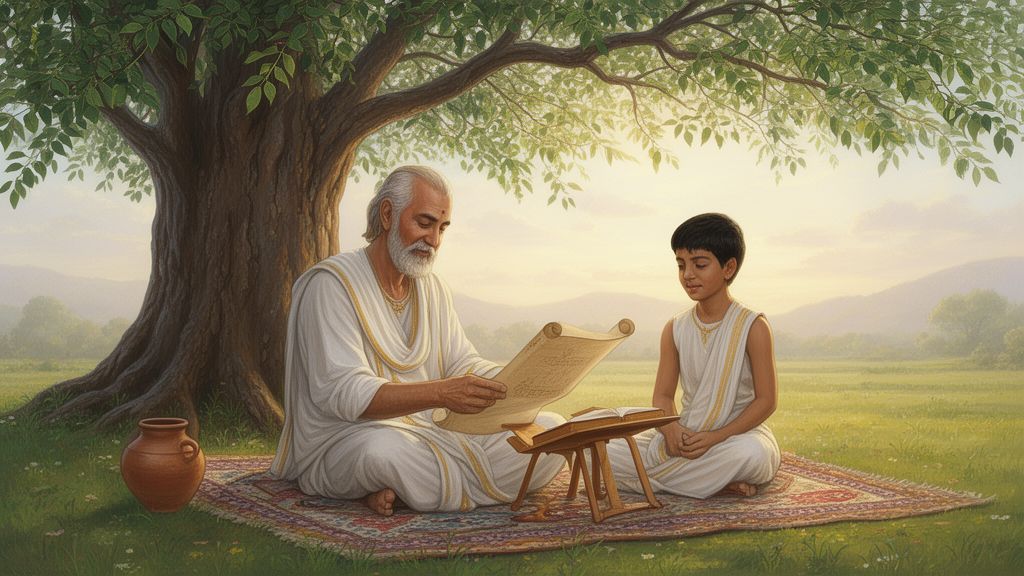
The Vedas are a specific group of texts. Śāstra is a category. The Vedas are often called the foundational śāstra in Hindu tradition, but the category of śāstras also includes many later works on law, statecraft, poetics, philosophy, medicine, dance, and architecture. When someone writes “Sastras Vedas,” they usually mean the body of authoritative Hindu texts as a whole, with the Vedas at the center.
Two points help avoid confusion. First, “Veda” refers to a particular corpus with a defined structure. Second, “śāstra” describes a function or genre: a text that teaches rules, principles, or systematic knowledge. A text can be a śāstra without being a Veda, and a Veda is a śāstra in the wider sense of an authoritative teaching.
Why the spelling varies
Readers will meet several spellings. “Śāstra” is the standard diacritical transliteration. “Shastra” and “sastra” are common in English usage and in search queries, and they refer to the same word. The plural in English is usually written as “Shastras” or “sastras.” This article uses “śāstra” when discussing the Sanskrit term and “Shastras” when referring to the English plural, so that the terms are easy to follow without losing their Sanskrit form.
What the Vedas are
According to Wikipedia’s article on the Vedas, the Vedas are among the oldest scriptures of Hinduism, and the article dates the Rigveda to roughly 1500–1200 BCE and the Yajurveda, Samaveda, and Atharvaveda to roughly 1200–900 BCE, while noting that these dates are scholarly estimates. The same article gives a count of 20,379 mantras across the Vedic texts. Those figures are estimates and counts, so they should be read as scholarly reference points, not as exact historical certainties.
The four Vedas are the Rigveda, Yajurveda, Samaveda, and Atharvaveda. Each contains a Samhita, which is a collection of hymns or mantras. Many Vedic texts also include Brahmanas, which discuss ritual meaning and procedure, and Aranyakas and Upanishads, which deal with more reflective and philosophical topics. Popular summaries often describe these divisions briefly, and Wikipedia’s Vedas article also presents them as the internal structure of the Vedic corpus.
Samhita, Brahmana, Aranyaka, and Upanishad
These four divisions are a useful way to read the Vedas. The Samhitas are the hymns and mantras, many used in ritual. The Brahmanas explain how rituals should be performed and what they mean. The Aranyakas and Upanishads move toward forest-based reflection and metaphysical questions. A reader who starts with the Upanishads without the earlier layers may miss the ritual context that shaped them.
Śruti and smṛti
Hindu tradition commonly distinguishes śruti, “that which is heard,” from smṛti, “that which is remembered.” Wikipedia’s Vedas article includes a section on this distinction. In general terms, śruti refers to revealed texts such as the Vedas, while smṛti refers to traditional texts such as the Dharmaśāstras, Itihasas, and Puranas. The boundary is not universally fixed, and different schools and communities describe it differently, so it is best understood as a traditional classification rather than a single agreed system.
What the Shastras are
The Wikipedia article on Shastra explains that the word means “precept, rules, manual, compendium, book or treatise” in a general sense. It is used as a suffix in Indian literature for technical or specialized knowledge within a defined field. That is why we see titles such as Dharmaśāstra, Arthaśāstra, Natyaśāstra, and Vastuśāstra. Each names a discipline and the texts that teach it.
The Shastra article lists many examples, including Manusmriti, Yajnavalkya Smriti, Arthashastra, Kamasutra, Brahma Sutras, the Yoga Sutras, Charaka Samhita, Sushruta Samhita, and Natya Shastra. This range shows that “Shastra” does not mean only religious scripture. Some works concern law and social duty, some concern political strategy, some concern medicine, and some concern performance arts or architecture.
Dharma Shastra and social conduct
Dharmaśāstra texts discuss duties, rules of conduct, and social order. They are one of the best-known categories of śāstra, and they are often cited in discussions of ritual and social norms. These works are not all the same in tone or authority, and historians and scholars read them in historical context. Readers who want a focused overview can start with our article on Dharma Sastras, which is currently a WordPress draft and may not yet be public.
Philosophical śāstras
Hindu philosophy includes six traditional systems often called Shad Darshana, or six viewpoints. A popular Indian blog summary lists them as Nyaya, Vaisheshika, Samkhya, Yoga, Mimamsa, and Vedanta. The same source describes these as Shastras aligned with Vedic teaching. This is a devotional and popular framing rather than a neutral academic classification, so it should be read as one common presentation. Academic accounts often discuss these systems in more detail, including the differences among them and the sutras and commentaries associated with each.
How the Vedas and Shastras are related
The relationship between the Vedas and the Shastras is best described as one of origin, authority, and scope. In many traditions the Vedas are treated as the highest authority, and other śāstras are judged in relation to them. Some later works claim to derive their authority from the Vedas, while others are read as supplementary. The Dharma literature, Puranas, and philosophical schools each have their own relationship to Vedic authority.
This does not mean every Hindu tradition arranges the texts in the same order. Some communities prioritize certain Puranas or Agamas. Some philosophical schools emphasize particular Upanishads or Sutras. Regional traditions also have their own devotional literature, such as the Tamil Sangam and Bhakti works. Because of this diversity, the most accurate statement is that the Vedas are widely regarded as foundational, and the wider śāstra literature is read in different ways across traditions.
Where the Puranas fit
The Puranas are often grouped separately from the Vedas and Shastras, though the terms overlap in popular usage. Wikipedia’s Vedas article places Puranas among post-Vedic literature. The popular Indian summary cited in this article describes the eighteen Puranas as complementing the Vedas and discussing deities, divine incarnations, cosmic cycles, sacred places, and dynasties. Scholars usually emphasize that the Puranas are a distinct genre with their own history, and that their content varies widely among manuscripts and regions.
Examples of how the terms are used
The following examples show how these terms appear in ordinary use.
- Vedic ritual: A Brahmana text may explain the procedure and meaning of a sacrifice. Within the Vedic corpus, this is a ritual manual embedded in the Vedas.
- Legal and social duty: A Dharmaśāstra text may discuss rules of conduct. This is a śāstra, but it is not one of the four Vedas.
- Philosophical inquiry: A sutra text in the Vedanta tradition may compress Upanishadic ideas into short aphorisms for study, often with commentaries. Here the Vedas are a source of authority, and the sutra is a śāstra on a defined subject.
- Specialized knowledge: Arthaśāstra on statecraft or Natyaśāstra on performance arts shows how the suffix “śāstra” names a field of technical knowledge.
Devotional belief, text, tradition, and scholarship
When studying this topic, it helps to separate four layers. The first is the text itself, meaning the words in a manuscript or edition. The second is the tradition, meaning how a community uses, memorizes, interprets, and ritually recites the text. The third is devotional belief, such as the conviction that the Vedas are eternal or divinely revealed. The fourth is scholarship, which studies dates, authorship, manuscript transmission, language, and historical context.
These layers often overlap, but they are not interchangeable. A statement such as “the Vedas are eternal” is a belief held within many Hindu traditions. A statement such as “the Rigveda is dated to about 1500–1200 BCE” is a scholarly estimate. Both can be discussed respectfully, but they answer different questions. Our readers should not treat one as a substitute for the other.
Why the Vedas are described as śruti
Many Hindu communities describe the Vedas as śruti, a term that emphasizes transmission by hearing and oral recitation. The Vedic texts were preserved through memorization and recitation by specialized schools for many generations. Wikipedia’s Vedas article discusses transmission and Vedic learning, and it notes that the texts were preserved orally and in traditions of recitation. Recitation remains an important practice in many communities, although the details vary by school and region.
This is a devotional and traditional view of authority. Historians also study how the texts were composed and edited, and they may describe the Vedas as human compositions preserved within traditions of memory. Both perspectives are part of the discussion, and a respectful article should describe them without treating one as the only correct view.
Common questions readers ask
Are all Shastras Vedas?
No. The Vedas are one specific corpus, and śāstra is a broader category. A Dharmaśāstra, a Natyaśāstra, and a philosophical sutra are all śāstras, but none of them is one of the four Vedas.
Why do people say “Sastras and Vedas” together?
The phrase often refers to the full body of authoritative Hindu learning. Many traditions treat the Vedas as the foundation, and later śāstras as interpretations, applications, or systematic treatments of Vedic teaching. The exact relationship varies by school and author.
Which text should a beginner read first?
There is no single required order. Many introductions begin with an overview of the four Vedas and then move to Upanishads, Bhagavad Gita, or the Puranas, depending on interest. For a broader orientation, you may find our posts on The Vedas and Hindu Vedas and Upanishads useful, both currently WordPress drafts that may not yet be public.
Do all Hindus accept the same list of texts?
No. Hindu traditions differ in their canons, their priorities, and their regional literature. Some traditions emphasize Agamas and Tantras, some emphasize particular Puranas, and some emphasize devotional works in regional languages. Any single list should be presented as one tradition’s framing.
Reading the texts responsibly
Readers who want to study the Vedas or Shastras should use a clear edition and note the translator and commentary. A translation is an interpretation, and Sanskrit terms often carry more than one meaning. Words such as dharma, karma, and yoga have wide semantic ranges, and English equivalents can narrow them. A good practice is to read a translation alongside a glossary or introduction from a scholar or established tradition.
When reading ritual texts, remember that instructions are tradition-specific. The Brahmanas and later manuals describe procedures that may differ by school, region, and family. A reader should not assume that a ritual described in one text is followed identically everywhere. The same caution applies to devotional practices that are presented as guaranteeing particular outcomes. Religious texts can offer meaning, guidance, and inspiration, but this article does not make claims about material results.
Practical next steps
- Start with a short overview of the four Vedas and their four divisions.
- Learn the difference between śruti and smṛti, and note that these categories are traditional rather than uniform.
- Read a Shastra overview to see how the term names different fields of knowledge.
- Choose one translation and one introduction before moving to commentaries.
- Compare how different traditions describe the authority and order of their texts.
Further reading on related topics
If you are exploring the Vedas and Shastras together, these related HindusGod.com drafts cover narrower questions. Please note that each linked draft may not yet be public.
- Hinduism and Vedas discusses the Vedas in the context of Hindu religious life.
- Oldest Vedas addresses questions about the age and early layers of the Vedic corpus.
- The Vedas and the Upanishads explains how the later Vedic texts relate to the Samhitas.
- Different Vedas and Upanishads compares the Vedic texts and their divisions.
- Four Hindu Vedas introduces the four core Vedas.
- 4 Hindu Vedas offers a brief overview of the four Vedic collections.
- 5 Vedas of Hinduism addresses the common popular phrase about a fifth Veda, which traditions treat differently.
- Bhagavad Gita and Vedas explores how the Gita relates to Vedic authority.
- Hindu Scriptures Vedas places the Vedas among other scriptural categories.
- Hindu Vedas provides a general introduction to the Vedic corpus.
- Hindu Vedas in English covers English-language study resources.
- Shiva in Vedas discusses Vedic references associated with Shiva.
Summary
The Vedas are the oldest and most foundational scriptures of Hinduism, arranged into Samhitas, Brahmanas, Aranyakas, and Upanishads. Śāstra is a wider term for authoritative treatises across many subjects, including law, philosophy, medicine, statecraft, and the arts. When the words “Shastras” and “Vedas” appear together, they point to a larger tradition of learning in which the Vedas hold a central but not the only place. Traditions differ in how they organize and interpret these texts, so careful readers should separate text, tradition, belief, and scholarship, and should use clear translations and sources.
Sources and further reading
- Shastra, Wikipedia. Used for the general meaning of śāstra and examples of śāstra titles.
- Vedas, Wikipedia. Used for the four Vedas, the divisions of the Vedic corpus, approximate dating as stated by the article, and the śruti–smṛti and transmission discussions.
- Vedas, Puranas, Shastras: The Pillars of Sanatan Dharma, Morningnite. A popular devotional blog used only for the traditional listing of the six Shastras and the traditional attribution of compilation to Ved Vyasa.