The Saraswati Upanishad, usually called the Sarasvati-rahasya Upanishad, is a late Sanskrit text in the Shakta tradition of Hinduism. It presents the goddess Sarasvati as speech, knowledge, and the non-dual power of Brahman. Its title means roughly “the secret knowledge of the wisdom goddess.” It is a short text, with about 47 verses in two chapters, and scholars date it to the late medieval period.
This guide gives a direct answer first, then explains where the text sits in Hindu scripture, how it is structured, what it teaches, and where scholars and traditions disagree. It separates what the text says, what later traditions believe about it, and what historians and academic commentators conclude.
Direct answer: what is the Saraswati Upanishad?

The Saraswati Upanishad is one of the minor Upanishads of Hinduism. It is classified as one of the eight Shakta Upanishads and is embedded in the Krishna Yajurveda, according to the summary of the text on Wikipedia.[1] Its main claim is that the feminine principle, Shakti, is energy and power, and that it is also the metaphysical principle of Brahman. The text combines Bhakti vocabulary with Vedanta philosophy.[1][3]
Two points help readers place it correctly. First, it is not one of the older Vedic or early Upanishads commonly associated with the classical period. Second, it is important to Goddess-centred traditions, but it is not a universal text across all Hindu communities. Its status depends on the tradition, lineage, and devotional setting in which it is read.
Where the text fits in Hindu scripture
Upanishad, Yajurveda, and Shakta classification
The word Upanishad is commonly used for a body of texts that discuss the nature of Brahman, the self (Atman), and liberation. Many Upanishads are attached to one of the Vedas. The Saraswati-rahasya is embedded in the Krishna Yajurveda and is grouped among the Shakta Upanishads, which emphasise the Goddess.[1][3]
This classification matters. A reader who expects a text from the earliest Upanishadic period may be surprised by its late date and its focus on mantra, meditation on a goddess, and the vocabulary of power. The text belongs to a different layer of Hindu religious literature, one in which Goddess worship and Vedantic speculation are closely connected.
Other titles and spellings
Readers may meet several spellings. The Vyasa Mahabharata page lists manuscript titles including Sarasvati Upanisad, Saraswati Rahasyopnisad, Sarasvatyupanishad, and Sarasvatirahasyopanisad.[3] The Sanskrit Documents text record uses the form Sarasvatirahasya Upanishad and notes that its transliteration was prepared by Sunder Hattangadi.[2] Spelling differences usually reflect transliteration systems, not different texts.
Date and authorship: what scholars say
The author and the century of composition are unknown. Wikipedia describes the text as a late Upanishad, likely from the late medieval period, and gives a dating range of the 12th to 15th century CE.[1] The same summary also reports that C. Mackenzie Brown, a professor of Religion and writer on Hindu goddesses, dates the text, together with other Shakta Upanishads, to the 16th century.[1]
These are scholarly estimates, not fixed facts. Readers should treat them as the best current academic positions described in secondary sources, not as an authoritative date from a manuscript colophon.
Why the text’s relationship to Shankara matters
Some older scholars connected the text to the Vakyasudha, a treatise on non-dualist Vedanta. Wikipedia notes that many verses of the Saraswati-rahasya appear in later Shakti texts, including the Vakyasudha.[1] Maurice Winternitz and Louis Renou used this link to argue for an earlier date, because they credited the 8th-century philosopher Adi Shankara with a work called Balabodhani, which some scholars, such as Windischmann, considered also titled Vakyasudha and Drigdrishya Viveka.[1]
The Vyasa Mahabharata page reports that 20th-century scholarship doubts that Shankara was the actual author of several secondary works attributed to him. It therefore remains unclear whether the Vakyasudha or this Upanishad existed before the 8th century CE.[3] This is a good example of why a tradition’s attribution should not be presented as settled history.
Sarasvati in older Vedic literature
The Upanishad itself is late, but the goddess Sarasvati has a much longer history. Wikipedia states that Sarasvati as a goddess can be traced to Vedic literature from the 2nd millennium BCE.[1] Readers should keep these two timelines separate: the age of the goddess’s presence in Vedic literature, and the later date of this specific Upanishadic text.
Structure of the text
Wikipedia lists the Saraswati-rahasya as having two chapters and 47 verses.[1] The Vedanta Spiritual Library edition, a translation by Dr. A. G. Krishna Warrier published by the Theosophical Publishing House, begins with a peace invocation and then presents a dialogue. The sages ask the sage Asvalayana how the knowledge that illuminates the meaning of the word Tat can be won.[4]
The structure of the opening is useful for understanding the text’s approach. It is not a narrative about a deity’s miracles. It is a teaching in which the sages ask how truth about Sarasvati is gained, and Asvalayana answers through mantra, meditation, and philosophical description.[4]
The ten-verse Sarasvati mantra
The early part of the Warrier translation describes a ten-verse hymn to Sarasvati. Verse 4 names Asvalayana as the seer of the mantra, the Anustubh as its metre, and the holy Vagisvari as its divinity. It also specifies that the application of the mantra is for pleasing the goddess.[4]
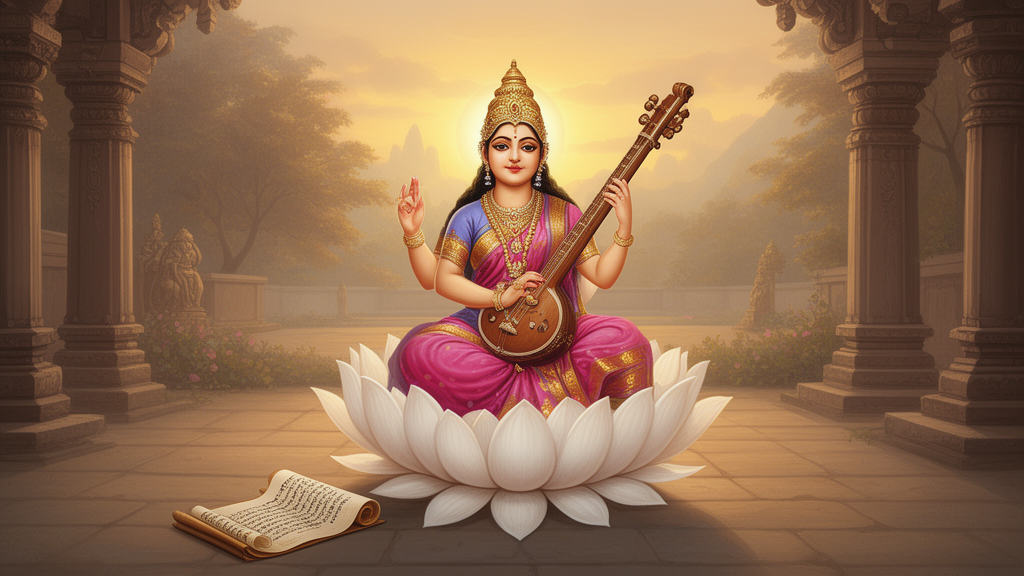
Verse 5 describes the goddess as shining like snow, pearls, camphor, and the moon, as conferring auspicious blessings, and as adorned with golden champaka garlands.[4] These are devotional images used in the translation. Readers should understand them as literary and meditative descriptions, not as a physical portrait that every community uses.
Verse 6 gives another mantra, the “pra no devi” mantra, with Bharadvaja as seer and Gayatri as metre, and notes that the application is for gaining whatever is desired.[4] The phrase “whatever is desired” appears in the translation, but it describes how the mantra’s application is framed in that text. It is not a promise that a practitioner will obtain a particular material result.
Core teaching: Shakti and Brahman
The text is notable for presenting the feminine as Shakti, the power or energy of reality, and as the metaphysical principle of Brahman.[1][3] This is one of its central contributions to Hindu thought. Sarasvati is not treated only as a patron of learning in this text. She is presented as the deeper reality behind speech, sound, and knowledge.
The Warrier translation expresses this in verse 7, where Sarasvati’s nature is described as the essence of the sense of Vedanta and as the Supreme Sovereign, manifest as name and form.[4] Verse 10 describes her in a similar way, as the non-dual potency of Brahman and as the one extolled in the four Vedas and their ancillaries.[4] These statements are part of the text’s theology. They are not a summary of all Shakta belief.
Maya and Brahman
The Vyasa Mahabharata page notes that the verses discuss Maya as changing reality and Brahman as unchanging reality. It cites verses 2.31 to 2.33 and says some verses in this Upanishad also appear in the Vakyasudha.[3] Readers who want to study this teaching should compare the Sanskrit and a translation directly, because the page gives only a short description.
This passage shows the text’s Vedanta orientation. The world of name and form is treated as changing, while Brahman is the underlying reality. The Upanishad expresses this through the goddess, which is why scholars speak of a Shakta Vedanta synthesis.[1][3]
Advaita Vedanta as a scholarly reading
Annette Wilke and Oliver Moebus, as cited on Wikipedia, state that the underlying philosophical premise of this text corresponds to Advaita Vedanta.[1] This is an academic interpretation. It should not be presented as the only reading of the text. Devotees may read the Saraswati-rahasya through a devotional framework, and scholars may read it through textual history, philosophy, or comparative religion.
Scripture, belief, tradition, and scholarship
The Saraswati Upanishad is useful for seeing how Hindu traditions can hold several levels of meaning at once. The text itself is a Sanskrit scripture. Its devotional use is a tradition. Its dates, authors, and relation to Vakyasudha are scholarly questions. Its claim that the goddess is Brahman is a theological teaching within a particular school.
- Text: The Sanskrit Saraswati-rahasya Upanishad, with its chapters, verses, and mantras.
- Tradition: Shakta, Vedanta, and Goddess-centred devotional practice, which vary by lineage and region.
- Belief: The devotional conviction that Sarasvati is the source of speech, learning, and wisdom, and that devotion to her is meaningful.
- Scholarship: Dating, authorship, manuscript history, and the relation to Vakyasudha and Advaita Vedanta.
When readers blend these levels, they can make errors. For example, a scholarly date does not prove a devotional claim false, and a devotional belief does not establish a historical fact about authorship. Clear separation helps readers respect the tradition while also understanding the evidence.
Translations and reading sources
The Warrier translation hosted by the Vedanta Spiritual Library is one English rendering. Its introductory text and verse numbering are useful for orientation, but a reader who wants accurate study should compare it with other translations and with a Sanskrit text.[4] Translations of Sanskrit Upanishads can differ in philosophical emphasis, especially on terms such as Brahman, Maya, and Shakti.
Vyasa Mahabharata’s page includes a Sanskrit link and short commentary on verses and the Vakyasudha connection.[3] The Sanskrit Documents PDF is a transliterated Sanskrit text; its metadata says it is Krishna Yajurveda Shakta Upanishad, transliterated and proofread by Sunder Hattangadi, with the latest update dated April 25, 2000.[2] The PDF was not inspected in full for this draft, so readers should verify its contents directly before relying on its wording.
Common questions readers ask
Is the Saraswati Upanishad a Vedic text?
It is an Upanishad connected to the Krishna Yajurveda, but it is generally described as late, likely from the late medieval period, and not part of the earliest Vedic layer.[1] Readers should distinguish the Vedic goddess Sarasvati, attested in older literature, from the later Upanishadic text.
Does the text focus only on learning and education?
No. Sarasvati is associated with speech, learning, and wisdom, but the Upanishad goes further. It presents her as Shakti and as the non-dual potency of Brahman.[1][4] Reducing the text to a study aid would miss its metaphysical content.
Should the mantras be used as a guaranteed method for success?
The translated text describes the mantras as applied for pleasing the goddess and for gaining whatever is desired.[4] That is the text’s framing, but it should not be read as a promise of material outcomes. Practice, eligibility, and instruction vary by lineage, and a qualified teacher within a tradition is the appropriate guide for ritual use.
Practical reading path for beginners
- Read the short introduction to Upanishads, such as our overview of the meaning of Upanishad, to understand the genre.
- Read the text summary and dating discussion on Wikipedia to understand the scholarly context.[1]
- Read the Warrier translation of the Vedanta Spiritual Library edition to see the mantra structure and philosophical language.[4]
- Compare the Vyasa Mahabharata commentary on Maya, Brahman, and the Vakyasudha connection.[3]
- If you intend to use the mantras in worship, consult a teacher from a living tradition, because ritual instructions vary.
For readers who want to explore related Upanishads, our hub posts on the 10 Upanishad and 108 Upanishad lists can help place this text among others. Those pages are WordPress drafts and may not be public yet, so links should be checked before publication.
Related Upanishads to compare
The Saraswati Upanishad is often studied alongside other texts that discuss Brahman, self-knowledge, and philosophical method. Readers interested in Advaita themes may compare it with the Advaita Upanishad and the Atmabodha Upanishad. The Ashtavakra Upanishad offers another route into non-dual teaching, and the Adhyatma Upanishad addresses inner self-knowledge.
Comparison should be done carefully. Each Upanishad has its own date, school, and literary setting. Similar vocabulary does not mean identical teaching, and a Shakta text should not be merged into a general Vedanta summary without noting the difference.
For a broader Goddess-related context, see also the Annapurna Upanishad and our main guide to the Saraswati Rahasya Upanishad. Note that the latter is a separate draft on a closely related search phrase, so editors should check for overlap before publishing both.
Why the text remains important
The Saraswati-rahasya matters because it shows a different expression of Hindu philosophy. It does not present the goddess only as a figure in stories. It treats her as a path to understanding speech, mantra, and reality. Its use of Bhakti and Vedanta vocabulary shows how devotion and philosophy were combined in later Hindu texts.[1][3]
It is also a useful reminder that a text can be important to a tradition even when its date and authorship are uncertain. Scholars do not dismiss its value because it is late, and devotees do not need academic consensus to honour the goddess. The responsible approach is to hold both perspectives with clarity.
Summary and next step
The Saraswati Upanishad, or Sarasvati-rahasya Upanishad, is a late Shakta Upanishad embedded in the Krishna Yajurveda. It presents Sarasvati as Shakti and as the non-dual potency of Brahman, combining Bhakti and Vedanta language. Its approximate date is late medieval, with scholarly estimates ranging from the 12th to the 16th century CE. Its authorship is unknown, and its relation to the Vakyasudha and to Shankara remains debated.[1][3]
For a next step, read the translation and the scholarly context together, and note which statements are textual, which are traditional, and which are interpretive. If you plan to use the mantras in worship, learn them from a qualified teacher in a tradition that uses this text.
Sources and further reading
- Sarasvati-rahasya Upanishad, Wikipedia: summary of the text, classification, dating, and scholarly attributions.
- Shri Sarasvatirahasya Upanishad PDF, Sanskrit Documents: transliterated Sanskrit text and metadata; full contents not inspected for this draft.
- Sarasvati Rahasya Upanishad, Vyasa Mahabharata: discussion of Maya and Brahman, verses 2.31 to 2.33, and the Vakyasudha connection.
- Sarasvati Rahasya Upanishad, Vedanta Spiritual Library: English translation by Dr. A. G. Krishna Warrier, published by the Theosophical Publishing House, Chennai.