The Sarasvati-rahasya Upanishad, often searched as the Saraswati Rahasya Upanishad, is a short late Sanskrit text that presents the goddess Sarasvati as the supreme principle, identified with Brahman, and as the source of speech, wisdom, and eloquence. Its title is usually rendered as something like ‘the secret knowledge of the wisdom goddess.’ It is classed as one of the minor Upanishads, one of the eight Shakta Upanishads, and it is embedded in the Krishna Yajurveda. Scholars generally place it in the late medieval period, roughly between the 12th and 16th centuries CE, but its author is unknown and the exact date is debated.
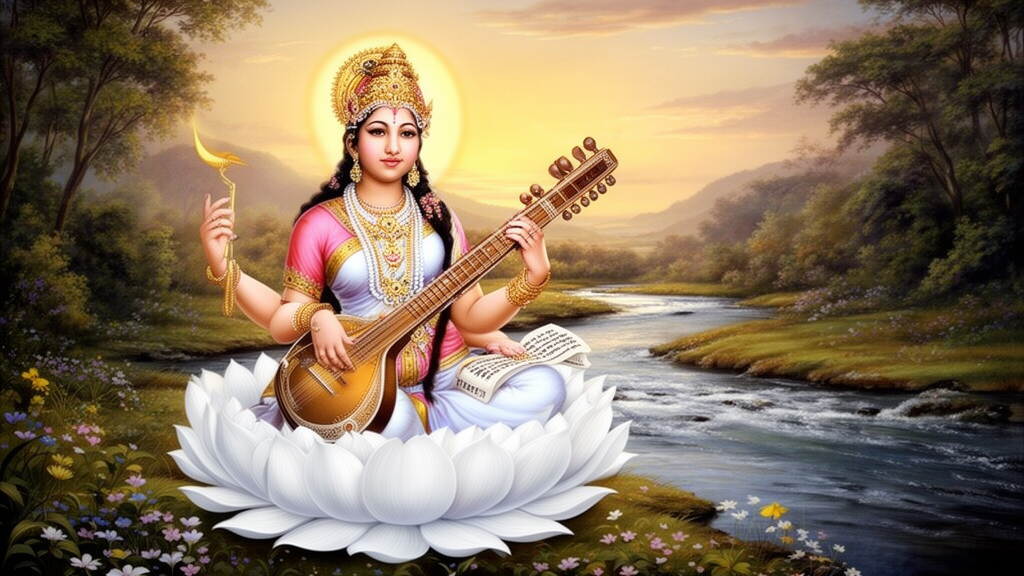
This guide explains what the text says, where it fits among Upanishads and Goddess traditions, why its dating is uncertain, and how devotees and scholars read its teachings. Where sources disagree, the differences are noted rather than resolved by assumption.
What the title means

The Sanskrit title is Sarasvati-rahasya Upanishad. The word rahasya means ‘secret’ or ‘mystery,’ and in this context it points to esoteric knowledge rather than a hidden ritual formula. The first word, Sarasvati, is the name of the goddess. Sarasvati has a long history in the Vedic literature, and sources note that the goddess is traceable to Vedic texts of the second millennium BCE, even though this Upanishad itself is comparatively late.
Readers also encounter the spelling Saraswati, and transliterations such as Sarasvatī-rahasya or Sarasvati Rahasya. These are variant romanizations of the same title. In this article, Sarasvati-rahasya Upanishad refers to the text and Sarasvati to the goddess.
Where the text fits in the Upanishad tradition
The word Upanishad is used for a large body of texts that are often treated as the concluding portions of the Vedas, and that discuss the nature of the self, Brahman, and liberation. Many Upanishads are attached to a particular Veda and school. The Sarasvati-rahasya is linked to the Krishna Yajurveda, which means it is not an independent Vedic text but a later work that claims a place within that Veda’s Upanishadic literature.
It is also classed among the Shakta Upanishads, a group that centres the goddess as Shakti, the divine energy or power. Within the Shakta group, this text is often singled out for glorifying the feminine as Shakti and as the metaphysical principle of Brahman. The sources describe it as using a mix of Bhakti (devotional) and Vedanta (philosophical) vocabulary.
A commonly repeated claim, found in one AI-generated encyclopedia summary, is that the text is the 106th in a traditional list of 108 Upanishads given in the Muktika Upanishad. Because that summary is not a primary or scholarly source, readers should check the Muktika list in a reliable edition before relying on the number. The Wikipedia article does not make this claim in the portion reviewed.
When and by whom was it composed?
The honest answer is that the author and the century of composition are not known. The Wikipedia article describes it as a late Upanishad, likely from the late medieval period. It states that the text was probably composed alongside other Shakta Upanishads between the 12th and 15th centuries CE.
Other scholarly estimates are later. The article reports that C. Mackenzie Brown, a professor of religion who has written on Hindu goddesses, dates the text, together with other Shakta Upanishads, to the 16th century.
Why the dating is disputed
The reason for disagreement is a textual connection. Many verses of the Sarasvati-rahasya appear in later Shakti texts, including the Vakyasudha, a treatise on the non-dual Vedanta school. Maurice Winternitz and Louis Renou used this connection to argue for an earlier, first-millennium date. They relied on the attribution of the Balabodhani to the eighth-century philosopher Adi Shankara, and on the view of some scholars, such as Windischmann, that the Balabodhani was also titled Vakyasudha and Drigdrishya Viveka. The Wikipedia article presents this as the basis for the earlier dating, which means the argument depends on a chain of attributions and identifications that later scholarship has questioned.
For readers, the practical point is simple. The text is late in its present form, and any single year given for it should be treated as an estimate. The relationship between this Upanishad and the Vakyasudha is a line of evidence, not a settled proof.
Structure and contents
The sources do not fully agree on how the text is divided, and this is a useful example of why careful reading matters. The Wikipedia infobox lists two chapters and 47 verses. The AI-generated summary describes about 68 verses in two main sections, with the first section running to verse 45 and the second from verse 46 to verse 68.
Neither count can be confirmed from the material reviewed for this article. Readers who want to verify numbering should consult a critical or traditional edition of the Sanskrit text, and should note that verse numbering can differ between editions and manuscripts. The following overview therefore focuses on content that the sources describe consistently.
The opening dialogue and mantras
The text is framed as a dialogue. In the account given by the AI-generated summary, the sage Asvalayana asks questions about how one attains ultimate knowledge, and the answer is framed around the term ‘Tat,’ which refers to Brahman. The opening portion is also described as containing hymns built from mantras, including ten mantras drawn from the Rigveda, each with bija (seed) syllables such as OM, HRIM, and SRIM.
This detail should be treated with some caution because it appears in a single summary source. Readers who want to see how the mantras are presented should check a primary Sanskrit edition with a commentary. The summary further says that these hymns invoke Sarasvati as the inspirer of eloquence and poetry, and that the text describes consecration rites and promised benefits after a period of recitation. Devotional benefits described in a text are part of the text’s own claims. They are not guaranteed outcomes, and modern readers should present them as the text’s statements rather than as established results.
The goddess’s own teaching
According to the same summary, the second part shifts to Sarasvati speaking in her own voice. She explains metaphysical concepts, describes meditation, and closes with invocations for peace, often called the shanti path. The Wikipedia article’s description is consistent with this picture of a text that moves from question and ritual toward doctrine and meditation, though it does not give the same division.
Core teachings: Shakti, Brahman, and speech
The main theme that both sources emphasise is the identification of Sarasvati with Brahman and with Shakti. The text is notable because it presents a goddess, rather than a male deity or an impersonal principle alone, as the reality behind the universe. The Wikipedia article says the text glorifies the feminine as Shakti (energy and power) and as the metaphysical Brahman principle.
Sarasvati and the four levels of speech
One teaching repeatedly connected to Sarasvati is her relation to speech. The AI-generated summary states that she is described as manifesting in the four levels of speech, named para, pashyanti, madhyama, and vaikhari. In traditional Indian philosophy, these levels describe speech moving from an undifferentiated source to audible sound. Because this model is widely discussed in Sanskrit grammar and philosophy, readers may find it helpful, but they should note that the specific application to Sarasvati comes from this text’s own framing and from the summary’s reading of it.
Prakriti, Ishvara, and maya
The summary also describes Sarasvati as Prakriti, the primordial matter in a state of balance among the three gunas: sattva, rajas, and tamas. It describes her as subordinate to Ishvara, the personal Lord, who is associated with maya, the power of projection and concealment that creates the appearance of duality and binds the individual soul (jiva). Readers should note that the relation of Prakriti, Ishvara, and maya is a technical topic in Vedanta and Samkhya-influenced thought, and that different schools explain these terms differently.
Advaita Vedanta and the non-dual reading
The Wikipedia article reports that scholars Annette Wilke and Oliver Moebus state that the underlying philosophy of the text corresponds to Advaita Vedanta, the non-dual school associated with Adi Shankara. This is an interpretation by scholars, not a statement made by the text in those terms. Advaita is one reading of the Upanishads. Other Vedanta schools, such as Vishishtadvaita and Dvaita, read the same root texts differently, and Shaiva and Shakta traditions have their own theological frameworks.
The AI-generated summary explains liberation (moksha) as attained through mantra recitation, concentration (dhyana) on Brahman’s attributes of being, consciousness, and love, and realisation of non-duality, which it describes as severing the ‘knot of the heart.’ These are the summary’s words. The primary text should be consulted before presenting specific phrases as its teaching. The summary also says the text warns against superficial ritual and stresses inner devotion and transmission to qualified disciples. If this is accurate, it shows a text that combines ritual language with a strong emphasis on knowledge and inner practice.
Devotional use and practice
The Sarasvati-rahasya is studied in several ways. Scholars read it as a text of Shakta and Vedanta thought. Some devotees recite its mantras or passages as part of worship of Sarasvati, especially by students, teachers, writers, and musicians who look to the goddess for learning and eloquence. Practice varies by family, region, lineage, and teacher. There is no single standard method of recitation that applies to all Hindus.
Readers should be careful with any claim that a text or recitation produces a particular material result. Traditional texts often describe benefits, and devotees may believe in them, but these are matters of belief and tradition. The text’s own statements about benefits are not evidence that a practice will bring success, health, or protection. A respectful presentation describes the claim as belonging to the text or to the devotional community, and does not present it as a verified outcome.
Where to learn ritual details
Anyone who wishes to practise should seek instruction from a qualified teacher within a recognised lineage, because the sources note that the text stresses transmission to qualified disciples. Ritual details such as consecration steps, pronunciation, and the proper timing of recitation are tradition-specific. They should not be taken from a general article, including this one.
How to distinguish belief, text, tradition, and scholarship
Several kinds of statements appear in discussions of this text, and they should not be mixed together:
- What the text says: the content of the Sanskrit Upanishad, which should be checked in a reliable edition and translation.
- Traditional belief: what devotees hold about the goddess, the text’s power, and the benefits of recitation.
- Community and regional practice: how particular families, temples, or schools use the text in worship and study.
- Scholarly interpretation: views such as the Advaita Vedanta reading, or the dating arguments of Winternitz, Renou, and Brown.
- Modern explanations: summaries written for general readers, including AI-generated encyclopedia entries, which can be useful for orientation but should not be treated as primary evidence.
The sources reviewed for this article fall mostly into the scholarly and summary categories. They do not provide a primary Sanskrit text or a verified English translation, so this article does not quote the Sanskrit or present translated lines as direct quotations.
Relation to other Goddess and Upanishad texts
The Sarasvati-rahasya is one of several texts that help readers understand how Upanishadic language was adapted in devotional and Goddess-centred contexts. Readers who want to compare it with other Upanishads or related texts can explore these HindusGod.com draft pages, which may not yet be public:
- The Saraswati Upanishad covers a related goddess-focused text and can help readers compare Sarasvati-centred texts.
- The meaning of Upanishad page explains the general term and its context, which is useful before reading any single text.
- The Upanishad Rahasya page discusses the broader theme of secret teachings in this literature.
- The Gayatri Rahasya Upanishad page offers another example of a minor Upanishad with a rahasya title.
- The Ram Rahasya Upanishad and the Rama Rahasya Upanishad in Telugu pages illustrate how the same rahasya naming pattern appears in texts with a different deity focus and language context.
- The 108 Upanishad page explains the traditional collection and its counting, which is relevant to the Muktika list mentioned above.
- The Advaita Upanishad page provides context on the non-dual reading discussed in this article.
- The Ashtavakra Upanishad page offers another example of a non-dual teaching presented in dialogue form.
These pages are WordPress drafts according to the project’s target list and may not be public. Their links should be confirmed before publication.
Frequently asked questions
Is the Saraswati Rahasya Upanishad a Vedic text?
It is attached to the Krishna Yajurveda and classed as an Upanishad, but it is a late text. The sources place its composition in the late medieval period, and its author is unknown. Sarasvati as a goddess appears in much earlier Vedic literature, which is a different question from the date of this particular text.
Why does it matter that it is a Shakta Upanishad?
The Shakta classification tells readers that the text is centred on the goddess as Shakti and as a principle of Brahman. Shakta traditions have their own theology and practices, and this text is an important reference within Goddess-centred Hinduism. Readers should not assume that every Hindu tradition reads it in the same way.
Can I rely on the verse count given online?
Not without checking. The sources reviewed for this article give different counts, and verse numbering can vary by edition. A verified critical or traditional edition is the best way to confirm numbering before quoting or citing verses.
Summary and next step
The Sarasvati-rahasya Upanishad is a late, minor Upanishad in the Krishna Yajurveda tradition and one of the eight Shakta Upanishads. It presents Sarasvati as Shakti and as Brahman, links her to speech and wisdom, and combines devotional language with Vedanta philosophy. Its date and authorship are uncertain, its verse structure is described differently in different sources, and its practical use is tradition-specific.
For further study, read a reliable Sanskrit edition with a translation and commentary, and compare the scholarly sources listed below. Those who wish to recite or practise should seek guidance from a qualified teacher within a recognised lineage.
Sources and further reading
- Sarasvati-rahasya Upanishad, Wikipedia. Used for the title meaning, the Shakta classification, the Krishna Yajurveda link, the 12th to 16th century dating range, the Mackenzie Brown 16th-century dating, the Vakyasudha connection and the Winternitz and Renou argument, and the Wilke and Moebus Advaita Vedanta reading.
- Sarasvati-rahasya Upanishad, Grokipedia. An AI-generated summary used only for the structural description, the mantra and bija syllable details, the Muktika list reference, and the summary of the text’s teachings. Its claims should be verified against a primary edition before reliance.
A primary Sanskrit edition with a scholarly translation and commentary is recommended for verification. Readers should consult a reliable library or academic publisher to identify one, as no such edition was verified for this article.