The phrase Saraswati Sutra is not the name of a single, widely recognized scripture in the sources reviewed for this article. Readers searching for it are usually looking for one of three things: an explanation of the word sutra, a guide to the texts where the goddess Saraswati appears, or information about devotional practices connected with her. This post addresses all three, keeping what the sources say separate from what they do not establish.
In short: sutra is a Sanskrit word for a thread or a concise aphorism, and it is used for many different kinds of texts. Saraswati, a goddess of learning, speech, music and the arts, appears in Vedic hymns, epic and Puranic literature, and in some Buddhist and Jain contexts. If you have a specific text in mind, check its title, edition and tradition before assuming it is a Saraswati-focused work.
Quick answer: is there a ‘Saraswati Sutra’?
The sources consulted here, including the Wikipedia articles on Saraswati and the World History Encyclopedia entry, describe Saraswati through hymns, Puranas, Shakta literature, festivals and iconography. None of them identifies a canonical text titled ‘Saraswati Sutra’ that is recognized across Hindu traditions. That does not prove no such work exists. Local manuscripts, regional compilations, modern devotional booklets and sectarian collections may use the phrase, and a reader who encounters one should identify its publisher, language, date and tradition.
For this reason, this article does not describe a ‘Saraswati Sutra’ as a scripture with chapters or verses. Instead, it explains the word, maps the textual sources where Saraswati appears, and shows how worship developed in different communities.
What ‘sutra’ means in Indian religious literature
The Sanskrit word sutra is commonly translated as ‘thread’ or ‘string’, and by extension as a concise rule or aphorism. In Indian intellectual history, sutra texts were often compressed so that they could be memorized and expanded through commentary. Grammar, ritual, law and philosophy all produced sutra literature.
The same word appears in Buddhist literature, where sutra (Pali sutta) is used for discourses attributed to the Buddha and for later Mahayana scriptures. Jain traditions also use the term for their texts. Because of this range, the word alone does not tell a reader which tradition, genre or period a text belongs to.
Useful distinctions for readers include the following:
- Ritual sutras give procedures for rites. Some Vedic ritual sutras are known by teachers’ names, such as the Ashvalayana Sutra. You can read more about that category in the HindusGod.com draft Ashvalayana Sutra, which is still a target draft and may not yet be public.
- Aphoristic philosophical sutras compress doctrine into short statements, often requiring commentary.
- Buddhist sutras are usually discourses or scriptures in the Buddhist canon or later collections.
- Devotional compilations may use the word loosely for short collections of praise, prayers or teachings. These are often regional or modern and should be checked individually.
For a general explanation of the term, see the HindusGod.com draft Meaning Sutra, which is a target draft that may not yet be public.
Who is Saraswati?
Saraswati, also spelled Sarasvati, is described by Britannica as a Hindu goddess of learning, the arts and music, and by World History Encyclopedia as the goddess of learning, wisdom, music and aesthetics. World History Encyclopedia also lists alternative names such as Bharati, Vedamata, Brahmi, Sarada and Vagisvari, and notes that as Vac she is associated with speech.
Her name is connected in the sources with flowing water. World History Encyclopedia explains that Saraswati’s name is associated with ideas such as ‘elegant’, ‘flowing’ and ‘watery’, and links her to a river of the same name that appears in early Vedic material. Britannica states that the goddess first appears in Vedic sources as the personification of the sacred river Saraswati, which might have been a physical river, though later texts describe it as having disappeared. This is an academic and historical question, not a settled fact, and the article presents it as a question of interpretation.
Hinduism Facts gives a different etymology, explaining that the name can be read as ‘holder of a large water body’ (from saras, lake, and vati), or as ‘goddess of speech’ if saras is taken to mean speech. Hinduism Facts is a popular educational website, so readers who want to test these meanings should consult a Sanskrit dictionary or academic source.
Vedic roots: the hymns and the river
The earliest textual attestations of Saraswati come from the Rigveda. Hinduism Facts states that she is first mentioned in the third hymn of the Rigveda, which is dedicated to the Ashvins, and that she is mentioned around 50 times in the Rigveda. The same source identifies a hymn commonly called the Saraswati Sukta, referenced as RV 6.61, as dedicated to her. Wikipedia’s article on Saraswati also includes a section on Vedic texts, which readers can consult for the broader scholarly discussion.
Because the Rigveda is a large collection of hymns with its own tradition of recitation and interpretation, readers who want the original wording should use a critical or scholarly edition with translation and commentary. Translations differ, and some readers’ devotional traditions treat Vedic hymns as a living practice rather than only a historical text. This article does not quote the Vedic hymns, since the sources reviewed did not include verified translations suitable for quotation.
Scholars and devotees may relate the goddess to the river differently. Britannica treats the physical river as a possibility, not as established history. World History Encyclopedia describes the river as one of the early Aryan boundary rivers and notes that, as with the Ganges, the river later developed into a personified deity. Both descriptions are presented in the sources as interpretation and tradition rather than proven geography.
River and goddess: three ways to read the connection
- Devotional reading: the goddess and the sacred river are one reality, expressed in water and in speech or learning.
- Historical reading: the early river may have been a real geographical feature that later texts remembered and personified.
- Literary reading: the name and its water imagery became a way of describing flow, speech and knowledge.
These readings can coexist. A reader does not need to choose one to appreciate the goddess, but should label which kind of claim is being made.
Epic literature: Mahabharata and Ramayana
Saraswati also appears in later epic literature. Wikipedia’s article on Saraswati has separate subsections for the Mahabharata, including a discussion of her as a river and as a goddess, and a subsection on the Ramayana. The article headings indicate that these sections discuss how the figure is presented in each epic, but the sources reviewed here did not provide verified verse-level references for those passages, so this article does not summarize specific episodes from them.
Readers who want to study epic depictions should use a standard critical edition or a reputable scholarly translation and note the edition and translator. Epic traditions vary across regions and retellings, so one version should not be treated as the only account.
Puranic literature and the stories of origin
The Puranas are a major body of narrative literature in which Saraswati’s relationships and origin stories are developed in detail. Wikipedia’s article on Saraswati lists Puranic sections on origin myths, her association with Brahma, her relation to Savitri and Gayatri, her association with Vishnu, and her river aspect. Hinduism Facts also refers to the Saraswati Purana as a minor Purana dedicated to her.
Origin accounts differ. Hinduism Facts summarizes a Brahmanda Purana account in which Saraswati arises from the mind of Brahma, who then gives her a name and a role, including a place on the tongues of learned people and a presence on earth as a river. This is one account from one text, and it is presented in popular sources with additional, less scholarly details. Readers should treat it as a Puranic narrative, not as a universal or historical account.
World History Encyclopedia notes that Saraswati is usually described as the wife of Brahma, but that the Bengal Vaishnavas considered her first the wife of Vishnu. This is a clear example of regional and sectarian difference. A single family of stories does not settle the matter across all communities.
Shakta and tantric references
Wikipedia’s article on Saraswati includes a section on Shakta texts, and its outline also lists Mahavidya Nila Saraswati under forms and avatars. Shakta traditions focus on the Goddess as supreme, and their texts and practices can differ significantly from Vaishnava or Shaiva approaches. Readers encountering a specific Shakta form should check the text, lineage and initiation context, since some practices are restricted to particular communities.
Forms and names
Saraswati is known by many names, and Hinduism Facts notes that there are more than 1,000 names, listing popular ones such as Sharada, Bharati, Brahmi, Hanswavahini, Vagishwari and Buddhidatri. The number of names is a devotional claim reported by one source, not a verified count. What matters for readers is that names reflect different aspects of the goddess, such as speech, learning, music, wisdom or a particular place of worship.
Wikipedia’s article on Saraswati lists several named forms, including Maha Saraswati, Mahavidya Nila Saraswati, and a Sharada avatar associated with Kashmir. The sources reviewed do not provide enough detail to describe each form in depth, so this article identifies them only as named forms that readers may encounter.
Common name variants
- Saraswati and Sarasvati are both common English transliterations.
- Sharada is used in several regions and is associated with Kashmir in the sources reviewed.
- Vagishwari and Vac relate to speech.
- Bharati is an epithet associated with eloquence.
Symbols and iconography
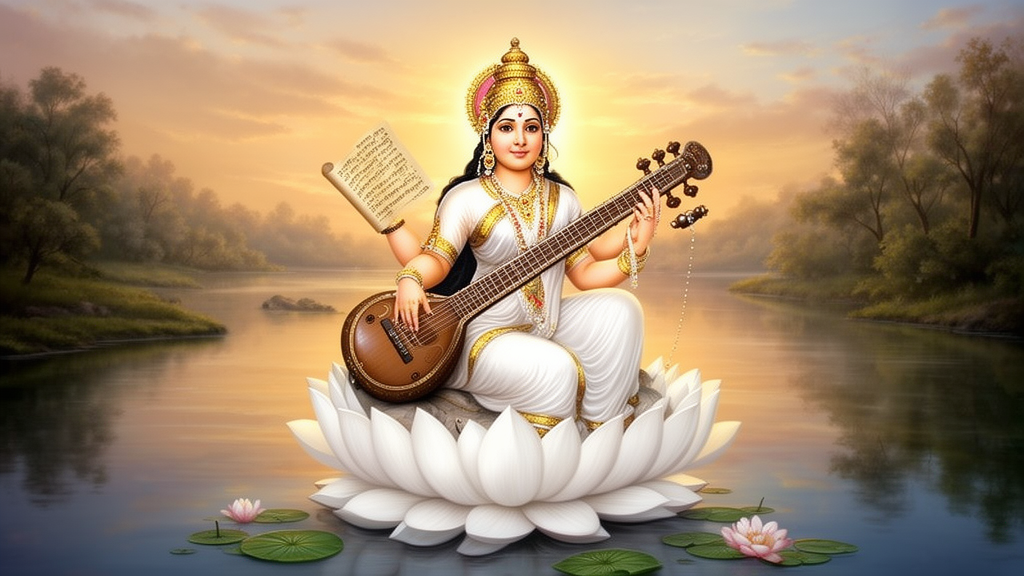
World History Encyclopedia describes Saraswati as a patron of the arts and sciences. Hinduism Facts and Britannica describe her as associated with white garments and a white lotus, and with a swan or peacock in some depictions. These descriptions reflect common iconographic conventions. Specific images may vary by region, workshop and tradition, so readers should not assume one visual form is universal.
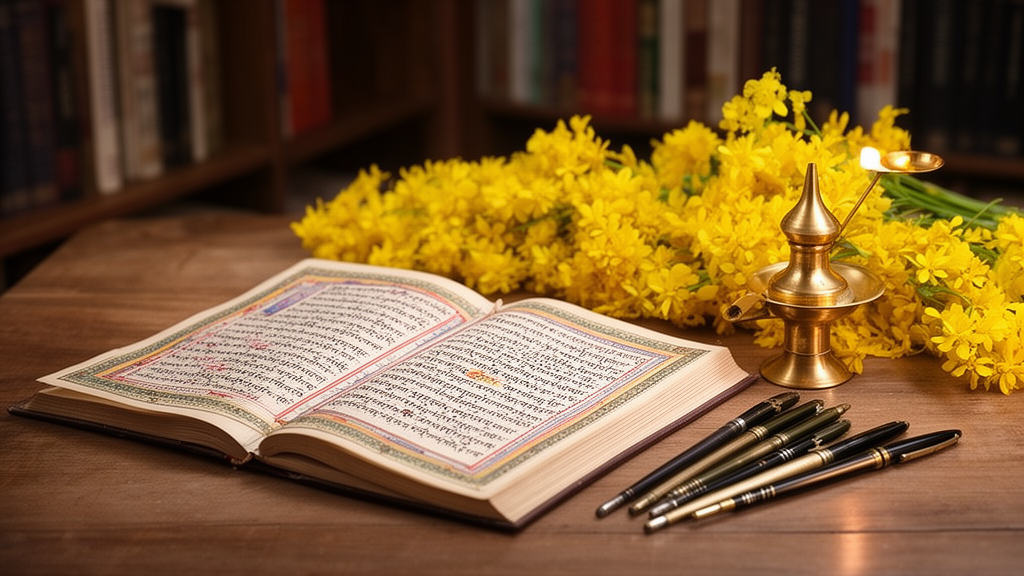
The items most often associated with her in worship are books, pens, musical instruments and, in some contexts, the veena. Their meaning is explained in devotional terms: learning, speech and creative skill are offered to the goddess and blessed by her. These are symbolic and devotional interpretations, not historical proof of any particular object.
Buddhist and Jain contexts
Saraswati is not only a Hindu figure. World History Encyclopedia states that she is worshipped as a goddess of learning in Jainism and by some Buddhist sects. Wikipedia’s article on Saraswati has a dedicated section on Buddhism, including subsections on the Golden Light Sutra, other Indian Mahayana sources, Nepalese Buddhism, East Asian Buddhism, Indo-Tibetan Buddhism and Southeast Asian Buddhism.
This is where the word ‘sutra’ becomes particularly relevant. A Buddhist sutra may include a deity, but a deity’s appearance in a sutra does not make the text a Saraswati text. The Golden Light Sutra, for example, is a Mahayana scripture, and the Saraswati material in it is one part of a larger text. Readers who want to understand the figure in Buddhist literature should consult the sutra in a reputable translation and note the tradition, school and translator.
For HindusGod.com readers exploring other sutra titles, related drafts include the Amida Sutra Meaning page and the Agama Sutra draft. Both are WordPress target drafts that may not yet be public.
Festivals and worship
Saraswati is widely honored through festivals and pujas, and practices vary by region and community. World History Encyclopedia describes Saraswati Puja as held on the first day of spring, and notes that worshippers may wear yellow, that statues may be draped in yellow silk, and that people pray over their pens, books and musical instruments. It also reports that children may be taught to write for the first time during the festival, and that she is worshipped during the pan-Indian Navaratri celebrations.
The date of Saraswati Puja is tied to the calendar used by a community, and it can differ by region. Because this article is not tied to a specific year, readers should confirm the date for their year and locality through a current, reliable panchang or community calendar. Do not infer this year’s date from a previous year’s calendar.
Wikipedia’s article on Saraswati includes sections on festivals and pujas by region: south India, east and northeast India, north, west and central India, Indonesia and Southeast Asia. These headings show that practice is not uniform. Specific observances described in those sections were not verified in full for this draft, so readers should consult regional sources for details.
Temples
Wikipedia’s article includes a section on temples. The sources reviewed here do not provide verified temple histories or visitor guidance, so this article does not describe specific temples. Readers who plan a visit should confirm opening times and customs with the temple or a current local source.
Practical guidance for readers
If you want to explore Saraswati through texts or practice, the following steps can help you work carefully and respectfully.
- Identify the text. Write down the exact title, author or compiler, language, publisher and date. A ‘Saraswati Sutra’ could be a Puranic section, a regional prayer book or a modern compilation.
- Choose a reliable edition. Prefer critical editions, university presses, or recognized publishers with clear translator attribution.
- Separate text from commentary. Note when a statement comes from the scripture, from a later commentary, or from a modern writer.
- Ask about tradition. If you are learning a mantra, puja or recitation, consult a teacher or community that follows that lineage.
- Check dates and calendars. For festivals, confirm the date for your year and region.
Many readers also use Saraswati devotion in study and creative work. Devotional practice may be meaningful in itself, but it is not a guarantee of exam results, creative success or any other material outcome. The sources describe students and musicians praying to her, which is a devotional and cultural practice rather than a verified cause of success.
Common questions about the Saraswati Sutra
Is the Saraswati Sutra a single Hindu scripture?
Not based on the sources reviewed for this article. The term may refer to a regional text, a Puranic section, a Buddhist sutra containing Saraswati material, or a modern compilation. Identify the exact source before treating it as a scripture.
Why does Saraswati appear in Buddhist and Jain sources?
World History Encyclopedia reports that she is worshipped as a goddess of learning in Jainism and by some Buddhist sects. Wikipedia’s article on Saraswati includes sections on Buddhist contexts, including the Golden Light Sutra. These traditions developed their own texts and practices, so readers should consult the tradition in question.
What should I do if I find a Saraswati text online?
Check the source website, author, publisher, date and whether the text is a translation or original. Compare it with a reputable edition and avoid copying long passages without permission. If a claim is not clearly sourced, treat it as unverified.
Summary and next step
The phrase ‘Saraswati Sutra’ is best understood as a search term rather than a recognized, single scripture in the sources reviewed. The word sutra refers to a genre of concise texts, and Saraswati appears across Vedic hymns, epics, Puranas, Shakta literature, Buddhist and Jain contexts, and regional festivals. Her meaning and worship vary across communities.
The most useful next step is to identify the specific text or practice you are researching and then consult a reliable edition, scholarly source or community teacher. Keep the scripture, the commentary, the regional custom and the modern devotional explanation separate in your notes.
Sources and further reading
- Saraswati, Wikipedia: used for the outline of Vedic, epic, Puranic, Shakta, Buddhist, regional festival and temple sections, and for the reference to the Golden Light Sutra. Encyclopedia articles should be checked against primary editions for detail.
- Saraswati, Encyclopaedia Britannica: used for the description of Saraswati as a goddess of learning, the arts and music, and for the note that the Vedic river may have been a physical river.
- Saraswati, World History Encyclopedia: used for the alternate names, the Saraswati Puja description, the Jain and Buddhist references, and the Bengal Vaishnava note.
- Goddess Saraswati, Hinduism Facts: used for the Rigveda references, the Saraswati Sukta reference (RV 6.61), the Saraswati Purana reference, the etymology options and the summary of a Brahmanda Purana origin account. This is a popular educational source, so claims were limited to what it states.
Related HindusGod.com drafts
- Brahma Saraswati: for the relationship between Saraswati and Brahma.
- Devi Sutra: for goddess-centered texts.
- Bhakti Sutra: for devotional traditions in texts.
- Dharani Sutra: for sacred formulas and recitation.
- Dhyana Sutra: for meditation-focused texts.
- Avatamsaka Sutra: for Mahayana sutra context.
All HindusGod.com links above are WordPress target drafts and may not be public until the owner publishes them. The owner should confirm each link before publication.