A sanskrit sutra is a short Sanskrit aphorism, or a collection of such aphorisms, written as a condensed manual. In Hindu literature, a sutra is a compact rule or statement that teachers expanded through commentary on ritual, philosophy, grammar, law, and other fields of knowledge. The word sūtra (सूत्र) literally means “thread” or “string,” and in scholarly usage it is also understood as a “formula” or condensed teaching. This article explains the meaning of the term, how sutras developed in Hinduism, how the same word is used in Buddhism and Jainism, and how readers can approach these texts respectfully and accurately.

What a sutra is, in brief
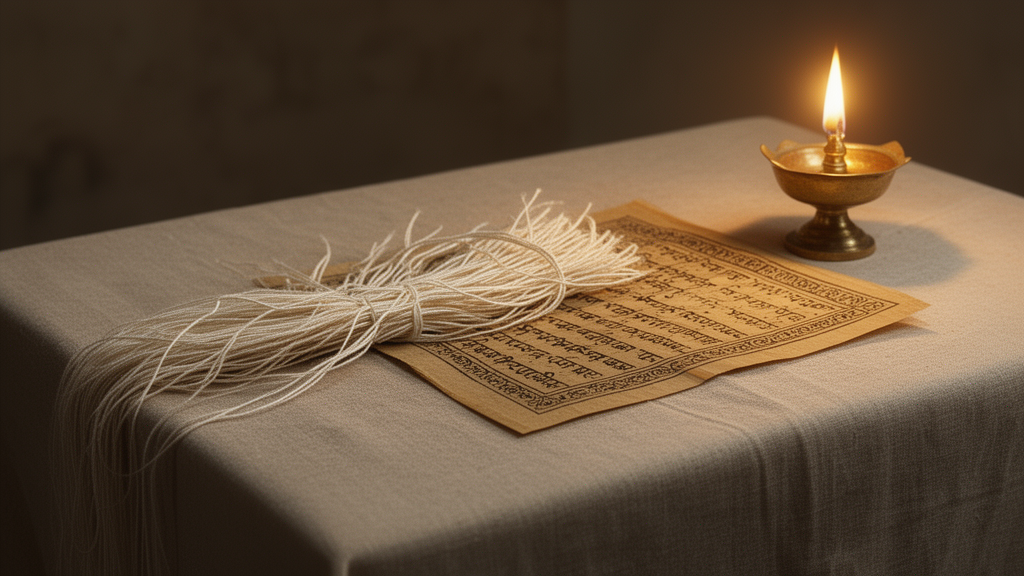
The short answer is that a sutra is a compressed teaching. Its brevity was deliberate. Each sutra is a short rule, similar to a theorem, distilled into a few words or syllables. Later teachers then wove explanation around it. Reference works describe sutras as a genre of ancient and medieval Indian literature found in Hinduism, Buddhism, and Jainism, and note that in Hinduism they are a distinct kind of literary composition built from short aphoristic statements (Wikipedia: Sutra).
So when someone searches for a sanskrit sutra, they are usually looking for one of three things: the meaning of the word, the category of text it names, or a specific famous work. This page covers all three, and links to our related guides where a specific sutra deserves its own treatment.
The meaning of sūtra in Sanskrit
The Sanskrit noun sūtra is commonly rendered as “thread” or “string.” Reference sources also gloss it as “formula” when describing its use in literary contexts (Wikipedia: Sutra). The two senses fit together well. A thread holds beads or fibers in line, and a sutra holds a body of knowledge together in a short, ordered form that a student can memorize and carry.
Thread: the image of a strung line
The thread image helps explain why sutras were valued in oral cultures. A sutra was not meant to be read as a long narrative. It was a tight line of words that a teacher could recite, a student could memorize, and a commentator could unpack. The meaning was not contained in the words alone. It was carried by the living teaching around them.
Formula: the image of a condensed rule
The formula sense points to the sutra’s function. A grammatical rule, a ritual procedure, or a legal principle could be stated in a few words and then applied to many cases. Commentaries did the detailed work of explaining how the rule should be understood and used.
Sutras in Hindu literature
The sutra is one of the major literary forms of Hindu tradition. Its origins lie in the Vedic corpus. According to the general history recorded in reference works, the oldest sutras of Hinduism are found in the Brahmana and Aranyaka layers of the Vedas (Wikipedia: Sutra). These layers are part of the Vedic textual tradition, and scholars generally date them in the period before the later classical sutra literature, though exact dates are debated and should not be treated as fixed.
Vedic roots
Early sutra-style statements often served ritual needs. Priests needed precise instructions for sacrifices, the order of recitation, and the handling of offerings. A concise rule could guide a complex ritual without requiring a full manual at every step.
Philosophy, grammar, and law
Over time, the sutra form spread to many fields. Reference sources state that every school of Hindu philosophy, Vedic guides for rites of passage, various arts, law, and social ethics developed their own sutras, which helped transmit ideas from one generation to the next (Wikipedia: Sutra). The Nyāya tradition is one example. Its foundational text is commonly described as a condensed manual of knowledge in a specific field, around which further teaching developed (Wikipedia: Nyāya Sūtras).
Readers should note that the word “sutra” in this context names a literary form, not a single religious doctrine. A grammar sutra, a legal sutra, and a philosophical sutra have different purposes, even though they share the aphoristic style.
The Yoga Sutras as an example
The Yoga Sūtras, traditionally attributed to Patañjali, are among the best-known Sanskrit sutra texts for general readers. Modern commentaries commonly present the text as 196 aphorisms organized into four chapters, or padas. A secondary summary of one modern edition describes the four padas as Samādhi, Sādhana, Vibhūti, and Kaivalya, and notes that some traditional counts give 195 sutras rather than 196 (Grokipedia summary of Taimni’s edition). Because that is an AI-assisted secondary summary, readers who need the exact count should check a critical Sanskrit edition or a scholarly translation.
A Sanskrit text of the Yoga Sūtra can be read in full on sanskrit-focused sites. One widely used collection opens its Yoga Sūtra text with the heading atha samādhipādaḥ, marking the beginning of the first chapter (sutratalk.org: All the Sūtras in Sanskrit). For a broader introduction to the Yoga Sūtra, see our guide to Heart Sutra Sanskrit English for a comparison of how Sanskrit titles are presented, and the general Meaning Sutra draft for background on the word’s usage.
Niti sutras and everyday wisdom
Not all sutras are philosophical or ritual manuals. Collections of ethical and political maxims also use the form. A digital library of Sanskrit texts lists the Chāṇakya or Kauṭilīya Nītisūtra collection, presented with commentary (Sanskrit Documents: sUtra). Attribution to Chāṇakya (Kauṭilya) is traditional, and the text’s date and authorship should be treated as a matter for scholarly discussion rather than settled fact.
Sutras in Buddhism and Jainism
The word sūtra also appears in Buddhist and Jain literature, but the texts differ in style. Reference sources explain that in Buddhism, sutras, also known as suttas, are canonical scriptures, many of which are regarded as records of the oral teachings of Gautama Buddha. Unlike Hindu sutras, Buddhist sutras are not aphoristic. They are often detailed and sometimes repetitive, which is one reason some scholars link the term to Vedic sūkta (“well spoken”) rather than to sūtra (“thread”) (Wikipedia: Sutra).
In Jainism, sutras (also called suyas in the source’s usage) are described as canonical sermons of Mahāvīra contained in the Jain Āgamas. Readers should treat these as separate canons with their own transmission histories.
This is why a precise answer to “what is a sutra?” depends on the tradition. A Hindu sutra is usually a terse aphorism that needs commentary. A Buddhist sutra is usually a longer discourse. A Jain sutra belongs to a canonical sermon collection. Our guides to Diamond Sutra in Sanskrit, Heart Sutra Sanskrit, and Lotus Sutra Sanskrit discuss Buddhist texts in more detail, while Prajnaparamita Sutra Sanskrit covers a major Mahāyāna family of texts.
How the word is written: transliteration matters
Readers searching for a sanskrit sutra will meet several spellings: sutra, sūtra, sutta, and sūkta. These are not always interchangeable. The long vowel in sūtra is shown with a macron in scholarly transliteration, and the alternative spelling without diacritics is common online.
The International Alphabet of Sanskrit Transliteration (IAST) is a widely used system for representing Sanskrit in the Latin script. It is a subset of the ISO 15919 standard, and it uses diacritics to distinguish sounds that look similar in plain Roman letters. For example, dental and retroflex consonants are distinguished with an underdot in IAST (Wikipedia: Sanskrit transliteration). IAST is also described as losslessly reversible to Devanagari, which is why scholars prefer it for technical work.
On HindusGod.com, we use the transliteration that appears in each source and explain variants when they matter. Readers who want to check a Sanskrit word against a Devanagari edition should look for the script form सूत्र, which is the standard spelling of the word.
How to read a Sanskrit sutra with care
A sutra is short, so it is easy to misread. The following steps help readers stay close to the text.
- Identify the source. Note whether the sutra belongs to Hindu, Buddhist, or Jain literature, and which school, text, or edition it comes from.
- Read the Sanskrit or a reliable transliteration first. Compare a Devanagari text with an IAST transliteration when possible. Sanskrit compounds can be ambiguous, so one reading may not be the only possibility.
- Check the translation’s status. Note whether the translator is a scholar, a practitioner, or a modern commentator. A translation is an interpretation, and good translations explain their choices.
- Read the commentary separately. Commentaries can add important context, but they are not the same as the root text. Keep the sutra’s words and the commentator’s explanation in separate mental columns.
- Compare with other editions. Where a text has variant readings, consult more than one source before drawing a firm conclusion.
An example of a careful reading
Suppose a reader encounters a sutra stating a short rule about ritual procedure. A careless reading would turn it into a universal command. A careful reading asks: which school produced this rule? Does its commentary apply it to all practitioners, or only to a particular lineage? Does the rule describe what the text prescribes, what a later community practices, or what a modern teacher recommends? Each of these is a different kind of claim, and the answer should be stated plainly.
Scripture, tradition, belief, and scholarship
Discussions of sutras often mix four kinds of statements. Keeping them apart improves accuracy and respect.
- What the text says: the words of the sutra, as found in a manuscript or critical edition.
- What a tradition teaches: the meaning given by a lineage, school, or teacher, often through commentary.
- What devotees believe or practice: personal faith, family customs, and community observances, which can vary widely.
- What scholars conclude: historical dating, authorship, textual history, and comparisons, which are often provisional.
For example, a statement that a sutra is “the oldest” text of a category, or that a text is “the words of” a named sage, may be a tradition’s claim, a scholarly hypothesis, or both. Readers should look for the source of each claim.
Regional and sampradaya differences
Sutra study is not uniform across India. Schools, regions, and lineages (sampradāyas) have preserved, commented on, and emphasized different texts. A sutra that is central to one school may be less prominent in another. Ritual sutras are a clear case: different Vedic branches have their own ritual manuals, and local communities may follow practices shaped by family custom.
When writing or reading about a sutra, it is therefore important to name the tradition. Avoid saying that “all Hindus” follow a particular sutra or interpretation. Instead, state which school, text, or community a claim comes from.
Common misunderstandings
Several misunderstandings appear often in online discussions of sutras.
- “A sutra is always a religious rule.” Sutras include grammar, mathematics, law, medicine, and philosophy, so the category is broader than religion.
- “Sutra means a fixed doctrine.” The term names a literary form. What a sutra means depends on its commentary and tradition.
- “Every sutra is short.” Hindu sutras are usually terse, but Buddhist sutras are often long and detailed, as noted above.
- “A sutra guarantees a result.” Reading or reciting a sacred text is a devotional or study practice. Texts do not carry guaranteed material or health outcomes, and sources should not be read as promising them.
Where to read Sanskrit sutra texts
For readers who want to see the Sanskrit itself, several online collections provide texts in Devanagari or transliteration. Sanskrit Documents, for example, presents texts in Devanagari and in ITRANS transliteration, with information and links for each entry (Sanskrit Documents: sUtra). Sutratalk.org presents the Sanskrit sūtras with the Yoga Sūtra beginning in Devanagari (sutratalk.org).
Online texts are useful for reference, but they are not critical editions. For serious study, consult a printed critical edition or a university-published translation, and check the editor’s notes on variants. Our site also covers related texts, such as Sutra Meaning in Sanskrit and Tattvartha Sutra Sanskrit, which address specific works and terms.
Frequently asked questions
Is sutra the same as sutta?
No. Sutta is the Pāli form commonly used in Buddhism for discourses. In Sanskrit Buddhist usage, the form is sūtra. Both refer to Buddhist scriptures, but their styles and literary histories differ, and they should not be treated as identical in every context.
Do all Hindu sutras come from the Vedas?
No. The oldest sutras are found in the Brahmana and Aranyaka layers of the Vedas, but later schools of philosophy, grammar, law, and other fields developed their own sutras (Wikipedia: Sutra).
Why are sutras so short?
Their brevity helped memorization and oral transmission. Teachers expanded each sutra through commentary, so the short text served as a framework rather than a complete explanation.
Should I read a sutra without a commentary?
You can read the root text, but many sutras are difficult without explanation. A reliable commentary or scholarly translation helps readers understand what the words meant within their tradition.
Summary and next steps
A sanskrit sutra is a short Sanskrit aphorism, or a condensed manual, whose name means “thread” and whose function is closer to “formula.” The form appears across Hindu philosophy, grammar, law, ritual, and ethics, and related but distinct forms appear in Buddhism and Jainism. To read sutras well, identify the tradition, separate the root text from commentary, check the transliteration and translation, and avoid treating one school’s interpretation as universal.
Next, you may want to explore our guides to specific Sanskrit texts, starting with Sutra Meaning in Sanskrit, or the Buddhist sutra guides linked above. Where a page is still in draft, treat its link as a planned destination until the owner publishes it.
Sources and further reading
- Sutra, Wikipedia: definition, etymology, and the sutra genre in Hinduism, Buddhism, and Jainism. Used for general definition and historical context, with the note that encyclopedia articles should be checked against primary and scholarly sources.
- Devanagari transliteration, Wikipedia: IAST and its relation to ISO 15919 and Devanagari.
- Nyāya Sūtras, Wikipedia: description of the sutra form as a condensed manual of knowledge.
- Sanskrit Documents: sUtra: index of sūtra texts in Devanagari and ITRANS transliteration.
- sutratalk.org: All the Sūtras in Sanskrit: Sanskrit text of the Yoga Sūtra, beginning with the Samādhipāda heading.
- Grokipedia: The Science of Yoga (I. K. Taimni): secondary summary of one modern edition, including the sutra count and pada structure. Verify against a primary edition before relying on it.