The Shandilya Upanishad (Sanskrit: शाण्डिल्य उपनिषत्, IAST: Śāṇḍilya Upaniṣad) is a minor Upanishad that is best known as a detailed manual of Yoga. It is counted among the Yoga Upanishads, is traditionally attached to the Atharvaveda, and is one of the few texts in that group that lays out a full sequence of Yogic discipline, from ethical restraints to samadhi. In short, it explains how a practitioner should prepare the mind and body through ethical observances, posture, breath control, and concentration, and it also ends with a Vedanta-oriented account of realizing the nondual Brahman as the true self.
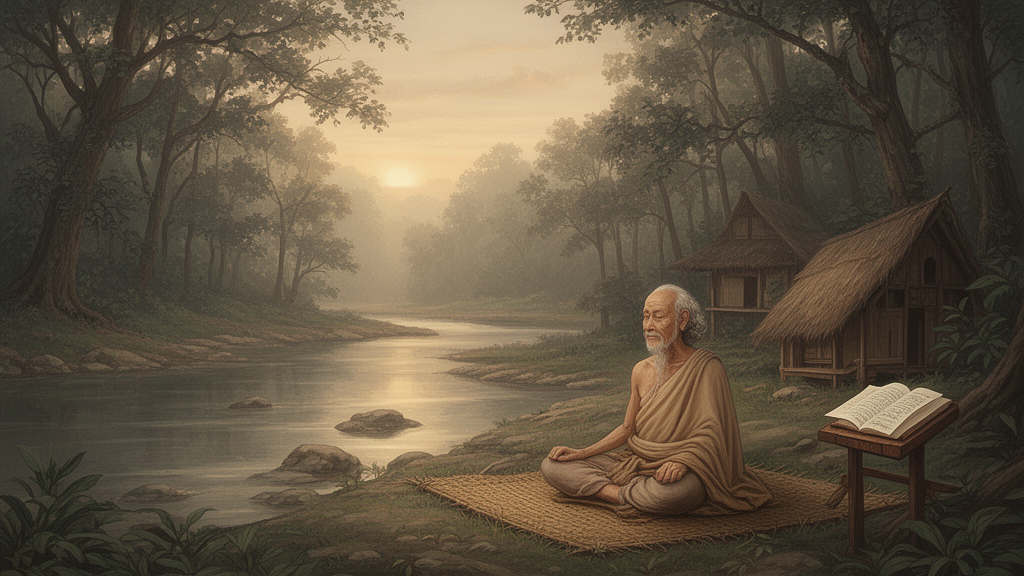
This article explains what the text contains, how it is organized, what scholars say about its date and background, and where the traditional, textual, and scholarly claims need to be kept apart. It is written for readers who want to understand the Upanishad as a religious and philosophical text, not as a guarantee of any particular result.
What the Shandilya Upanishad Explains
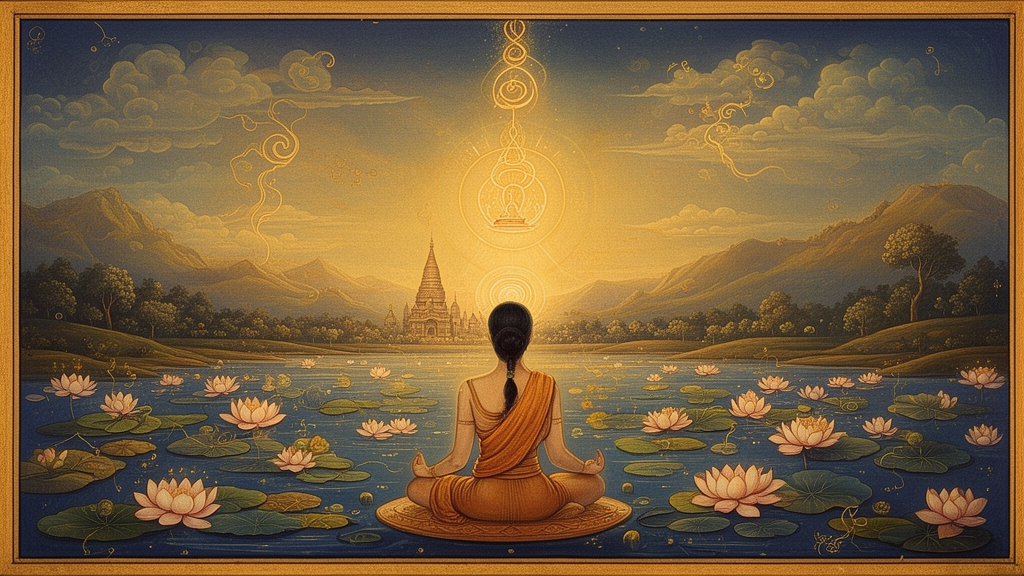
The Shandilya Upanishad presents Yoga as a structured path. Its main subject is the set of disciplines that prepare a person for meditation and, ultimately, for liberation (moksha). Wikipedia summarizes the text as describing ten yamas (ethical restraints), ten niyamas (observances), and eight asanas (postures), along with three pranayamas, five types of pratyahara (withdrawal of the senses), five kinds of dharana (concentration), two types of dhyana (meditation), and one samadhi (absorption).[1]
Most of the text’s practical teaching is in its first chapter. The later chapters move toward Vedanta, the Upanishadic philosophy centered on Brahman and the self (atman). The Upanishad therefore combines two strands that are often discussed separately: disciplined Yogic practice and the metaphysical teaching that the individual self is ultimately not different from Brahman.
Name, Sanskrit Title, and Textual Identity
The Sanskrit title and its spelling variants
The text’s name comes from the sage Shandilya, whom the Upanishad’s title honors. Readers will meet several spellings. The common English forms are “Shandilya Upanishad” and “Shandilya Upanishad,” while the IAST transliteration is Śāṇḍilya Upaniṣad. Some manuscripts carry the title as Śāṇḍilyopaniṣad (शाण्डिल्योपनिषद्), as noted in the Wikipedia article.[1] Sanskrit documents archives also list it under the transliterated title Shandilya Upanishad.[3]
Because spellings differ across editions, readers searching a library or archive should try both the IAST form and the common English form. Variant spellings refer to the same text.
Attachment to the Atharvaveda
The Upanishad is traditionally linked to the Atharvaveda, one of the four Vedas. Wikipedia describes it as one of twenty Yoga Upanishads associated with the four Vedas, and states that it is attached to the Atharvaveda.[1] Vyasa Mahabharata, which also presents the text in English summary, makes the same association and describes it as one of the major instructional Yoga Upanishads.[5]
Readers should understand this as a traditional classification. The attachment to a Veda is part of how the text has been organized in Upanishadic literature. It does not, by itself, settle when the text was composed or who wrote it.
Place in the list of 108 Upanishads
The Shandilya Upanishad is widely known through the modern anthology of 108 Upanishads. Wikipedia states that it is listed at number 58 in the serial order of the Muktika, the list given in the Muktikopanishad in which Rama reveals the Upanishads to Hanuman.[1] Sanskrit Documents gives the same position, labeling the text “58 / 108” and classing it under the Atharva Veda Yoga Upanishads.[4]
The list in the Muktika is a tradition-specific enumeration. Other Hindu communities and scholars count and classify the Upanishads differently, so the number 58 should be read as one authoritative listing, not as a universal ranking.
When Was the Text Composed?
Dating the Shandilya Upanishad is difficult, and the sources disagree. Wikipedia reports several scholarly positions:
- Gavin Flood dates the text to around 100 BCE to 300 CE.[1]
- Roy Eugene Davis suggests that it probably predates Patanjali’s Yoga Sutras.[1]
- Georg Feuerstein suggests that it probably post-dates the Yoga Sutras.[1]
- Thomas McEvilley states that the chronology is uncertain, but that the text was probably composed around the time of the Dhyanabindu Upanishad and before texts such as the Hatha Yoga Pradipika, the Kaulajnananirnaya, and the Shiva Samhita.[1]
These positions are academic interpretations, not facts settled by a single document. The spread between them is itself useful information: the text is not dated by an inscription or a firmly fixed external event. A reader who wants to cite a date should attribute it to a named scholar and note that other scholars disagree.
Wikipedia also reports that Alain Daniélou classes the Shandilya Upanishad with two other texts, the Darshana Upanishad and the Yoga-kundalini Upanishad, as one of three Upanishads in the Hatha Yoga genre.[1] This is another scholarly classification, and it adds to the picture of the text as part of a later Yoga literature.
How the Text Is Structured
Vyasa Mahabharata describes the Shandilya Upanishad as having three chapters, each divided into many sections.[5] The first chapter is the largest and most practical. Its subject is the Yoga discipline itself. The last two chapters integrate Vedanta philosophy, especially the idea of nondual Nirguna Brahman as the ultimate self, and teach the oneness of the atman in all living beings.[5]
The text’s thematic progression can be summarized as follows, following the description in the Vyasa Mahabharata and the Sacred Texts of Hinduism presentation:[5][6]
- Ethical preparation and self-discipline, including the yamas and niyamas.
- Posture (asana) and bodily steadiness.
- Breath regulation (pranayama).
- Withdrawal of the senses, concentration, and meditation.
- Absorption (samadhi) and the realization of the self in Vedantic terms.
This sequence matches the classical Yoga structure found in Patanjali’s Yoga Sutras, although the Shandilya Upanishad expands on several parts in more detail. Wikipedia notes that it is among the most detailed texts in the Upanishadic corpus devoted to Yoga.[1]
The Ten Yamas and Ten Niyamas
The text begins its Yoga teaching with ethical disciplines. Wikipedia describes ten yamas, which it renders as ethical “don’ts” or restraints, and ten niyamas, which it renders as ethical “to-do” observances.[1] The opening Sanskrit line of the first chapter, as reproduced on Wikipedia, names the yamas, beginning with ahiṃsā (non-violence), satya (truthfulness), asteya (non-stealing), and brahmacarya (chastity or disciplined conduct).[1]
The Vyasa Mahabharata summary states that a practitioner must have self-restraint and must take delight in truth and virtue toward oneself and others. It also says that a successful yogin has overcome anger and is skilled in both Yoga theory and practice.[5] These qualities are presented as preparation. They are not treated as rewards to be earned through ritual.
Readers should note that the exact list of ten items, and the Sanskrit names used for each, can vary in translation and commentary. When citing the list in a reading or course, check the Sanskrit text and a translation that names each item.
Why ethics come first
In the Shandilya Upanishad, ethical discipline is placed before posture or breath. The text’s first chapter treats conduct and inner state as the ground on which Yoga practice stands. A practitioner who is agitated by anger or who lacks truthfulness is described as unready for deeper practice. This is a textual teaching about discipline, not a claim about any specific psychological or physical effect.
Asanas and the Eight Postures
Wikipedia states that the Upanishad describes eight asanas, or postures.[1] One of them, gomukhasana, the cow-face posture, is named in the article’s description of the text.[1] A secondary summary, Grokipedia, names padmasana and mayurasana among the postures, but the Wikipedia text reviewed here does not provide the full list in its visible excerpt, so readers should consult the Sanskrit text or a verified translation for the complete sequence.[2]
In the Yoga context, asana is primarily about steadiness and comfort in a seated position suitable for meditation. The Vyasa Mahabharata summary describes a peaceful, pleasant place for practice, such as a river bank, a temple, a garden with fruit trees, near a waterfall, a place of silence, or a place where Vedic hymns are recited, away from distraction.[5] These environmental details describe the text’s ideal setting and should be read as textual guidance rather than as a fixed requirement for every practitioner today.
Tradition-specific practice
Modern postural yoga, as taught in studios and schools, developed through many later lineages and reforms. The Shandilya Upanishad’s postures are part of a classical textual framework. Anyone who wants to practice an asana described in the text should learn it from a qualified teacher within a tradition, especially because the text itself describes advanced practices that should not be attempted without guidance.
Pranayama, Pratyahara, Dharana, Dhyana, and Samadhi
Breath regulation
The text describes three pranayamas, or breath disciplines.[1] Wikipedia’s summary indicates that these are part of the Upanishad’s structured method, which moves from bodily stability to the regulation of breath and then to the mind.[1] The Vyasa Mahabharata summary also lists breath regulation as one of the core subjects of the text.[5]
The pranayama techniques are not described in detail in the English summaries reviewed for this article. Readers who want the specific steps, counts, or ratios should consult the Sanskrit edition or a scholarly translation, and should not treat a summary as a complete instruction set.
Withdrawal of the senses
Wikipedia lists five types of pratyahara, the withdrawal of the senses from external objects.[1] In the Yoga framework, pratyahara prepares the mind for concentration by reducing its dependence on sensory stimulation.
Concentration and meditation
The text describes five kinds of dharana, or concentration, and two types of dhyana, or meditation.[1] Dharana is commonly understood as fixing the mind on a single object or point. Dhyana is the more continuous flow of attention that follows. The Upanishad’s classification distinguishes these stages, which is typical of the classical Yoga model.
Samadhi
The text describes one samadhi, or absorption.[1] Samadhi is the culminating stage of the eightfold Yoga framework in classical texts. In the Shandilya Upanishad, the Vedanta chapters connect this absorption to the realization of the self as Brahman, which is the subject of the next section.[5]
Vedanta Teaching: Nirguna Brahman and the Oneness of the Self
The later chapters of the Shandilya Upanishad, as summarized by the Vyasa Mahabharata, integrate Vedanta. They present the nondual Nirguna Brahman, or Brahman without attributes, as the ultimate self. They also teach that the atman, or individual self, is one in all living beings and that everything is Brahman.[5]
Grokipedia’s summary describes Brahman as both formless (nirguna) and attributive (saguna), and states that the text portrays Paramatman as embodied in the deity Dattatreya.[2] This Grokipedia summary is a secondary source and is not authoritative enough to present as a verified reading of the Upanishad. Readers should confirm any claim about Dattatreya or saguna Brahman against the Sanskrit text or a scholarly translation.
Why this matters for readers
The Vedanta chapters explain the purpose of Yoga within Upanishadic thought. In this view, meditation and discipline are not ends in themselves. They are means to understand the self’s nondual nature. This is a philosophical and religious claim within Vedanta, and it is presented as the teaching of the text, not as an empirical result that can be measured.
Where the Shandilya Upanishad Fits in the Yoga Literature
Wikipedia describes the Shandilya Upanishad as one of twenty Yoga Upanishads and as one of the more detailed among them.[1] Readers who want to compare it with other texts can look at the way each one handles the same classical elements.
- The Shandilya Upanishad is strongly structured, with explicit counts for yamas, niyamas, asanas, pranayamas, and other stages.[1]
- Its later chapters connect Yoga with Vedanta, which places it in a dialogue between practice and philosophy.[5]
- Its dating is debated, and its relationship with the Yoga Sutras is described differently by different scholars.[1]
Within HindusGod.com, readers who want wider context on the Upanishadic corpus may also find related posts on the broader topic. The list of verified target drafts for this article is given in the internal links section below.
Tradition, Belief, Text, and Scholarship
When reading the Shandilya Upanishad, it helps to separate four kinds of statements:
- What the text says: for example, that it describes ten yamas, ten niyamas, and eight asanas.[1]
- Traditional attribution: for example, that the text is linked to the Atharvaveda and to the sage Shandilya.[1][5]
- Scholarly interpretation: for example, the various dating proposals by Gavin Flood, Roy Eugene Davis, Georg Feuerstein, and Thomas McEvilley.[1]
- Devotional or community practice: how a particular teacher, lineage, or community uses the text in worship or study. This varies and is not uniform across Hinduism.
The Upanishads are studied in many ways. Some readers approach them as sacred scripture in a living tradition. Others study them as historical texts within the development of Indian philosophy. Both approaches are legitimate, and this article does not claim that one is the only valid reading.
A note on modern yoga
The Shandilya Upanishad is an ancient text about Yoga as discipline and realization. Modern yoga practice, including exercise classes and wellness programs, may draw on some of its vocabulary, but it is a different context. This article does not make health, weight, or stress-related claims about the text. If a reader is considering practice for health reasons, a qualified medical professional and an experienced teacher should be consulted.
Frequently Asked Questions
Is the Shandilya Upanishad a text about yoga?
Yes. Wikipedia describes it as a Sanskrit text primarily focused on Yoga techniques, and as one of the most detailed texts in the Upanishadic corpus on Yoga.[1] It also contains Vedanta teaching in its later chapters.[5]
How many chapters does it have?
The Vyasa Mahabharata summary describes three chapters, each divided into many sections.[5] Editions and translations may organize the sections differently, so check the edition you are reading.
Is it the same as the Yoga Sutras?
No. The Yoga Sutras are attributed to Patanjali and are a separate text. Wikipedia reports that scholars disagree about whether the Shandilya Upanishad predates or post-dates the Yoga Sutras.[1] It is also sometimes called the Shandilya Yoga Sutras, which can cause confusion, so readers should distinguish the two texts carefully.[1]
Which Veda is it associated with?
The text is traditionally attached to the Atharvaveda.[1][3]
Related Upanishads on HindusGod.com
The following HindusGod.com pages are currently WordPress drafts. Their links will become public only if the owner publishes those target posts. Readers who find a link inactive should check again after publication.
- For a general introduction to the term, see Meaning of Upanishad.
- For the wider count of Upanishads, see 108 Upanishad and 10 Upanishad.
- For other texts traditionally linked to the Atharvaveda, see Atharva Upanishad and Atharvashikha Upanishad.
- For another Yoga-related text in the same group, see Atmabodha Upanishad and Avadhuta Upanishad.
- For readers interested in Vedanta and nondual teaching, see Advaita Upanishad and Adhyatma Upanishad.
- For broader Upanishadic background, see Aranyaka Upanishad and Ashtavakra Upanishad.
- For a text in the same Upanishadic corpus associated with a different Veda, see Aitareya Upanishad.
- For another text with a distinct theme, see Bahvricha Upanishad.
Summary and Takeaway
The Shandilya Upanishad is a Yoga Upanishad attached to the Atharvaveda and listed as number 58 in the Muktika’s enumeration of 108 Upanishads. Its teaching moves from ten yamas and ten niyamas through eight asanas, three pranayamas, withdrawal of the senses, concentration, meditation, and samadhi. Its later chapters present Vedanta, including the teaching of nondual Brahman and the oneness of the self.[1][5]
Its date is debated, and its relationship with other Yoga texts is described differently by different scholars. The most useful way to read it is to note what the text says, what the tradition attributes to it, and what scholars have proposed. For readers who want to go further, the Sanskrit text, a scholarly translation, and a qualified teacher offer the best next steps.
Thank you for making religious and cultural knowledge accessible to a wider audience. Keep up the good work!