The Rudraksha Jabala Upanishad is a Sanskrit Upanishad devoted to the rudraksha, a seed traditionally used as prayer beads and regarded as sacred to Shiva. It is classed as a Shaiva text, is associated with the Samaveda, and is counted among the 14 Shaiva Upanishads. It is presented as a dialogue in which Kalagni Rudra, a form of Shiva, explains the origin, types, and uses of rudraksha. This guide explains what the text says, how to read its claims, and where its teachings sit within wider Shaiva practice.

Short answer: the scripture teaches that rudraksha arose from Shiva’s tears, ranks beads by size, form, and condition, assigns colours to the four varnas, describes how beads should be worn, and makes large claims about the merit of seeing, touching, and wearing them. Those are claims within the text. They are not guarantees of material or health results, and Hindu communities differ in how literally they read them.
What the Rudraksha Jabala Upanishad Is
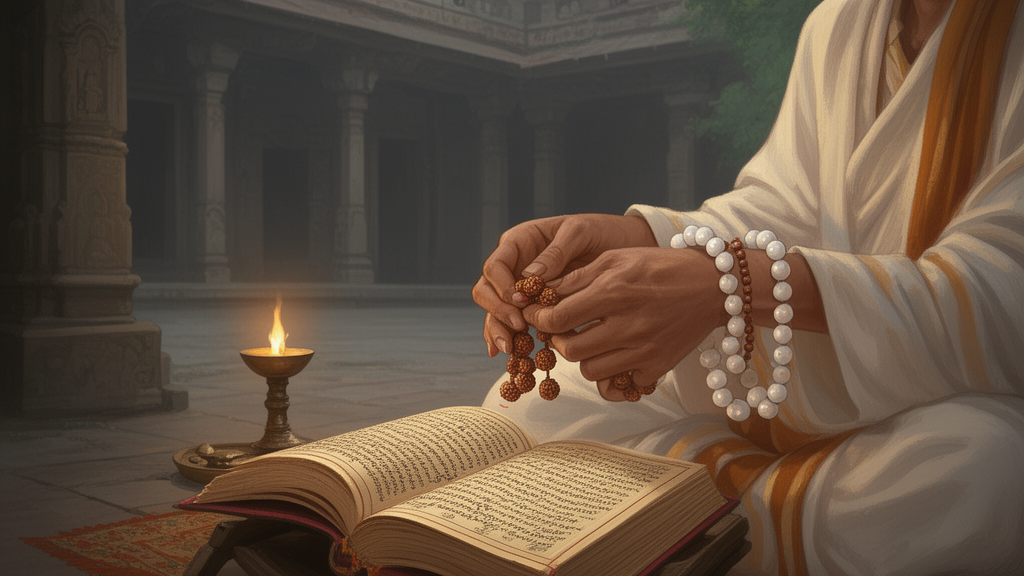
The text is also known as the Rudraksha Upanishad, Rudrakshopanishad, Rudraksha Jabalopanishad, and Rudrakshajabala Upanishad. Readers will see several spellings in print and online. The Sanskrit title is written in Devanagari as रुद्राक्षजाबाल उपनिषत्. The variants refer to the same work, although some publishers and websites use them loosely.
The Upanishad belongs to the broader group of Upanishads, the later Vedic texts that are often called the philosophical portion of the Vedas. Wikipedia lists it among the 108 Upanishads and notes that it is linked to the Samaveda. For readers exploring how the Upanishad category is organised, our overview of the meaning of Upanishad (URL status: target draft, may not be public yet) gives background on the term itself, and our guide to the 108 Upanishad collection (target draft, may not be public yet) explains how the canon is usually listed.
A Shaiva scripture
The text is Shaiva in orientation, meaning it centres on Shiva as the supreme focus of devotion. Wikipedia describes it as one of the 14 Shaiva Upanishads. Its subject, the rudraksha, is connected to Shiva in the text itself. The dialogue presents Kalagni Rudra, a form of Shiva, as the speaker, so the scripture’s authority is framed through Shiva’s own voice.
It is important to separate the scripture from the wider Shaiva world. Shaivism includes many schools, philosophies, and temple traditions, from Shaiva Siddhanta to Kashmir Shaivism and Veerashaivism. Not every Shaiva community gives the Rudraksha Jabala Upanishad the same weight, and many devotees who wear rudraksha know the text only through teachers, temples, or popular summaries.
The dialogue form
The Upanishad is written as a conversation. In the English translation by R. A. Sastri, hosted by the Vedanta Spiritual Library, the questioner is named as Bhusunda. Wikipedia, by contrast, identifies Sage Sanatkumara as the interlocutor, and some popular summaries give the sage as Sanatkumara, also called Bhusunda. The difference is a matter of how the names are read and transmitted, and it is worth knowing when comparing sources.
The Origin Story: Rudra’s Tears
The central myth is simple and vivid. In the translation, Kalagni Rudra says that he closed his eyes for the sake of destroying the Tripura Asuras. Drops of water fell from his closed eyes onto the earth, and these drops became rudrakshas. The name itself is often explained through this origin: rudra refers to Shiva in his fierce aspect, and aksha is commonly rendered as eye or as the seed-like form associated with the tears.
The Upanishad then says that Shiva closed his eyes for a thousand celestial years. Drops fell from his eyelids and became fixed in a state of immobility, so that they could bless devoted people. This is the story most readers encounter first, and it explains why rudraksha is treated as a gift that came from Shiva rather than an ordinary seed.
The myth is a scriptural account. It is not a historical claim about how rudraksha trees came to grow in the world, and modern botanical knowledge treats the seed as a natural product of trees in the genus Elaeocarpus. Devotional belief and botany can coexist without contradicting each other, as long as the two are kept distinct.
Size, Form, and Quality of Beads
After the origin story, the text turns to practical guidance. It ranks beads by size. According to the Vedanta Spiritual Library translation, a bead as large as the amalaka, or Indian gooseberry, is considered the best. One the size of the badari fruit is considered medium. One the size of chana, or Bengal gram, is considered the least desirable. Some readers take these comparisons as literal measurements. Others read them as a way of describing preferred beads in terms that ancient listeners would have recognised.
The text also describes quality. Beads should be nice, handsome, strong, big, auspicious, and thorny, which here appears to mean that the natural ridges or spines on the bead’s surface are prized. Beads eaten by worms, broken, without thorns, or with sores should be avoided. The self-holed bead, which has a natural hole, is called the best variety. A bead drilled by human effort is considered inferior.
Natural and drilled beads
The preference for self-holed beads is one of the most practical points in the text. Many buyers and devotees still look for naturally pierced beads, although how a bead is judged and sold is a commercial and craft matter that the scripture itself does not settle in modern terms. Readers should be cautious about sellers who claim that a particular bead has a specific effect. The text describes a preference; it does not provide a testing method.
Threading
The translation says the best beads should be strung in white thread. This is a tradition-specific instruction within the text. Many devotees today use other materials, and practice varies by region, lineage, and personal preference.
Colours and the Four Varnas
One of the most discussed passages is the assignment of colours to the four varnas. The translation states that the four kinds of people, Brahmins, Kshatriyas, Vaisyas, and Sudras, are born as a worthless burden on the earth unless they associate with the proper beads. It then assigns the white rudraksha to the Brahmin, the red to the Kshatriya, the yellow to the Vaisya, and the black to the Sudra.
This passage needs careful reading. It is a textual claim about ritual classification, and it reflects the social framework of the time in which the text was composed or edited. Wikipedia’s critique section and general academic discussion of the Upanishads recognise that texts of this kind can reflect hierarchical social assumptions. Contemporary Hindu teachers and communities do not all agree on how this passage should be applied today. Many reject birth-based hierarchy altogether, and many devotees wear rudraksha without reference to varna at all.
For readers, the useful approach is to name the passage accurately, note that it appears in the translated text, and avoid presenting it as a universal rule for all Hindus. The scripture is one voice within a wide tradition.
How the Text Describes Wearing Rudraksha
The Upanishad gives a detailed account of where and how many beads a worshipper of Shiva should wear. According to the Vedanta Spiritual Library translation, a devotee should wear one bead on the crest, three hundred around the head, thirty-six around the neck, sixteen around each arm, twelve around the chest, and five hundred around the waist. The text then describes a sacred thread arrangement, which the translation introduces as a yajnopavita of a specified number of beads.
These numbers are part of the scriptural instruction. Few devotees follow them literally, and the text itself is not a manual for everyday dress. Many traditions wear a small number of beads on a mala, a string used for japa, which is a repetitive recitation practice. Others wear a single bead in a pendant or bracelet. The Upanishad’s full-body prescription should be read as an expression of the scripture’s devotional ideal, not as the only correct practice.
Japa and the mala
The translation also connects rudraksha with japa. It says that the benefit becomes far greater when the devotee performs japa with rudraksha and wears it at all times. In many traditions, japa is performed with a mala of 108 beads, although the number and arrangement differ by lineage. Readers interested in japa practice may find our guides on mantra and mala use helpful once they are published, but they should check the tradition they follow before adopting a specific method.
Benefits the Text Claims
The Rudraksha Jabala Upanishad makes strong claims about merit. In the translation, merely uttering the name rudraksha is said to give the merit of giving ten cows in charity. Seeing and touching the bead are said to double that benefit. The text also says that wearing rudraksha destroys sins committed by night and day, and that the benefit of wearing it is multiplied far beyond the benefit of simply seeing it.
These are scriptural statements of religious merit. They should be presented as what the text says, not as verified outcomes in ordinary life. Our editorial standard is clear on this point: devotional acts can express faith and discipline, but they are not guarantees of health, wealth, protection, or success. Readers who wear rudraksha for devotional reasons are encouraged to approach it that way, and anyone seeking medical advice should consult a qualified professional.
Some commercial websites present rudraksha as a source of specific health or financial results. Those claims are not stated in the sources used for this article and should be treated with caution. A scripture describing merit is different from a seller describing a product outcome.
The Opening Invocation
Like many Upanishads, the Rudraksha Jabala Upanishad begins with a short peace invocation. The English translation on the Vedanta Spiritual Library site opens with the words, in English rendering, that the speaker’s limbs, speech, breath, eyes, ears, vitality, and senses should grow in strength. The passage then affirms that all existence is Brahman, and asks for peace in oneself, in one’s surroundings, and in the forces that act upon one.
This opening belongs to a type of invocation found across Upanishadic literature. It is best understood as a devotional and recitational opening, placed before the main dialogue. Readers can compare it with the openings of other Upanishads in the Rudraksha Upanishad (target draft, may not be public yet) and related entries on this site.
Textual Differences and Editions
The Rudraksha Jabala Upanishad exists in several versions, editions, and translations. Differences can include the names of speakers, the sequence of passages, the wording of numbers, and the way bead categories are described. Because of this, a claim about the text should always identify the edition or translation being used.
- Sanskrit text. The Sanskrit original is listed on Sanskrit Documents, a digital library that describes its transliteration and proofreading credits. The listing was not inspected in full for this article, so the Sanskrit text should be checked directly before any verse-level citation is added.
- English translation. The R. A. Sastri translation on the Vedanta Spiritual Library site was inspected for this article, and it is the basis for the passages summarised here. It is a translation, so wording is the translator’s, not the Upanishad’s exact Sanskrit.
- Print and PDF editions. A Spiritual Minds PDF of the Rudraksha-Jabala Upanishad exists, but its full content was not inspected for this article.
- Hindi and regional editions. Our separate post on the Jabala Upanishad in Hindi (target draft, may not be public yet) can help readers who want to read in Hindi, though it covers a different Jabala text and should not be read as the same work.
Readers should also be careful not to confuse this text with other works with similar names. The Jabala Upanishad (target draft, may not be public yet) is a different scripture. The Jabala Darshana Upanishad (target draft, may not be public yet) is also a separate title and should be distinguished from the Rudraksha Jabala Upanishad in any discussion.
Scripture, Tradition, Belief, and Scholarship
Discussions of rudraksha often mix four kinds of statement. It helps to separate them:
- What the scripture says. For example, the text says rudraksha arose from Shiva’s tears and ranks beads by size and form.
- Traditional belief and practice. For example, many devotees wear rudraksha during japa or worship, and some believe in its protective or spiritual benefits.
- Regional and community custom. Bead choice, number, threading, and mantra practice vary between temples, families, and sects.
- Scholarly interpretation. Historians and textual scholars study dating, transmission, social context, and the relationship between this Upanishad and other Shaiva texts. They do not generally treat its mythic claims as historical events.
Wikipedia’s article on the text notes its Shaiva affiliation and Samaveda link, and it includes a critique section that discusses how the text has been evaluated. A reader who wants fuller academic context should look for peer-reviewed or university-press studies on the Upanishads and Shaiva literature, rather than relying on commercial product pages.
How Devotees Use Rudraksha Today
In practice, the use of rudraksha varies widely. Some devotees wear a single bead as a reminder of Shiva. Others use a mala for japa, often reciting a mantra such as Om Namah Shivaya, which is widely used in Shaiva practice. Some wear beads in a sacred thread or bracelet. Some Shaiva temples and monastic lineages have their own rules about who may wear rudraksha, how beads are blessed, and when they are removed.
Because of this variety, the most accurate guidance is to follow a qualified teacher, temple, or lineage that you trust. If a text says that a bead should be worn in a particular number or position, that is a tradition-specific instruction. Many devotees treat it as an ideal rather than a daily obligation.
Practical notes for readers
- Read the Sanskrit or a clearly attributed translation before quoting the text.
- Identify whether a claim is scriptural, traditional, community-specific, or commercial.
- Ask a teacher or temple about local practice before following a numerical or ritual prescription.
- Be cautious of sellers who promise health, wealth, or guaranteed protection from rudraksha.
- Respect the sacred status of rudraksha, even if you do not wear it yourself.
Frequently Asked Questions
Is the Rudraksha Jabala Upanishad part of the Vedas?
It is an Upanishad, a later text that is linked to the Samaveda according to Wikipedia. Upanishads are often associated with particular Vedic branches, and this one is classed as a Shaiva text. Readers should not treat the Upanishad as a separate Veda.
Who speaks in the Rudraksha Jabala Upanishad?
The main speaker is Kalagni Rudra, a form of Shiva. The questioner is named differently across sources. The English translation on the Vedanta Spiritual Library site names Bhusunda, while Wikipedia identifies Sage Sanatkumara. The difference should be noted when citing the text.
Does the text say that rudraksha guarantees results?
The text makes strong claims about merit, protection from sin, and spiritual benefit. These are scriptural statements within a devotional framework. They are not verified guarantees of material results, and they should not be presented as such.
Summary and Takeaway
The Rudraksha Jabala Upanishad is a Shaiva scripture that explains the origin of rudraksha beads, ranks them by size and quality, assigns colours to the four varnas, and describes how devotees of Shiva may wear them. Its claims about merit are presented as scripture. Its practical instructions are tradition-specific. Its social passages require careful historical and contemporary reading.
For a respectful reading, start with a clearly attributed translation or Sanskrit edition, compare it with other sources, and ask a trusted teacher about local practice. Our related pages on the Rudraksha Upanishad (target draft, may not be public yet) and the Jabala Upanishad (target draft, may not be public yet) can help you explore neighbouring texts once they are published.
Sources and Further Reading
- Rudrakshajabala Upanishad, Wikipedia. Used for the text’s alternative names, Shaiva classification, Samaveda link, membership in the 108 Upanishads and the 14 Shaiva Upanishads, and the identification of Kalagni Rudra and Sage Sanatkumara.
- Rudraksha Jabala Upanishad, Vedanta Spiritual Library. English translation attributed to R. A. Sastri. Used for the origin story, bead size and quality rules, varna colours, wearing instructions, benefit claims, and the opening invocation.
- RudrakShajabala Upanishad, Sanskrit Documents. Sanskrit text listing with transliteration and proofreading credits. Listed for reference; the full text was not inspected for this article.
- Rudraksha-Jabala Upanishad, Spiritual Minds PDF. Print-style edition listed for further comparison; the full PDF was not inspected for this article.
Readers seeking academic study should look for university-press editions and peer-reviewed work on the Upanishads and Shaiva literature, and should verify any scholarly citation directly before relying on it.
Spiritual knowledge becomes more valuable when it inspires us to treat others with dignity and kindness. Great post!