The Rudrahridaya Upanishad is a medieval Sanskrit text, classified among the minor Upanishads and attached to the Krishna Yajurveda. Its central claim is that Rudra (a form of Shiva) and Uma (Parvati) are inseparable and together constitute the ultimate reality, Brahman. The text presents this unity as the source of all deities and all of creation, and it closes with a path of knowledge and meditation leading to the realization of the individual self as one with that reality.
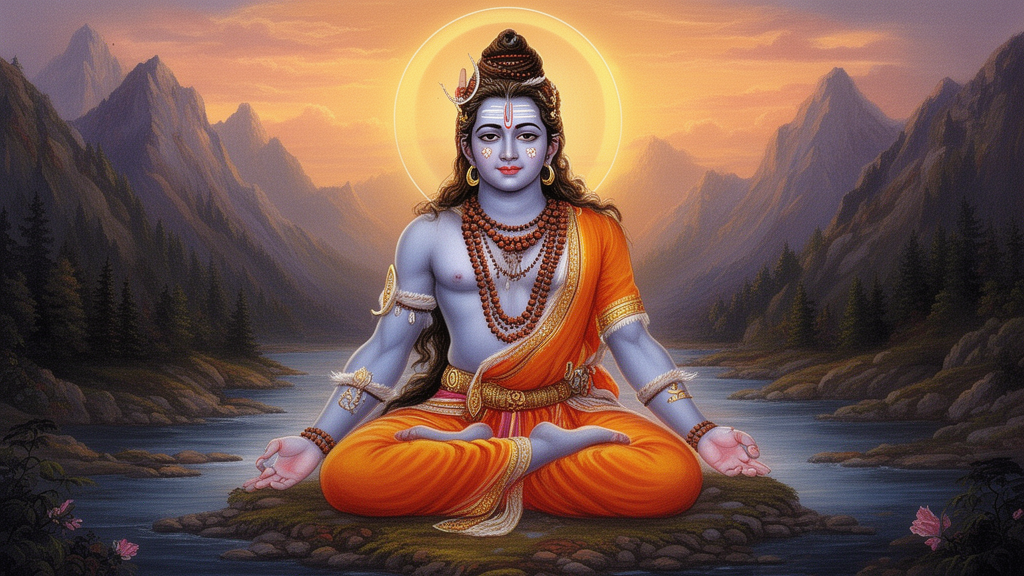
This guide explains what the text says, how it is organized, which parts are scripture and which are later interpretation, and where traditions and sources differ. Titles such as this one are often searched for by readers who want a clear overview before reading the text itself, so the sections below move from basic facts to the teaching and then to the practical and scholarly context.
Quick answer: what the Rudrahridaya Upanishad teaches
The Rudrahridaya Upanishad is a short Shaiva Upanishad that teaches the non-dual unity of Rudra and Uma. According to the widely available English rendering published by the Vedanta Spiritual Library, the text opens with a dialogue in which the sage Suka asks his father Vyasa who the real God of gods is, and Vyasa answers that Rudra is the embodiment of all devas and that all devas are manifestations of Rudra himself. The text then describes Uma as the complementary form of the same reality, and it presents the two as forever united.
The Upanishad also says that worshipping Vishnu is worshipping Shiva, and worshipping Shiva is worshipping Vishnu. The English rendering on the Vedanta Spiritual Library site attributes this to the text’s own words. That claim is central to how the work is read: it is a Shaiva text that nevertheless uses a unifying vocabulary that includes Vishnu, Brahma, and the other major deities.
What the Rudrahridaya Upanishad is
The Upanishads are a broad body of texts within Hinduism, often treated as the philosophical part of the Vedic literature. The Rudrahridaya Upanishad belongs to a later group that is commonly described as minor. Wikipedia describes it as a medieval-era Sanskrit text and one of the minor Upanishads of Hinduism, attached to the Krishna Yajurveda and classified as one of the Shaiva Upanishads (Wikipedia, Rudrahridaya Upanishad). The Sanatan Hindu Dharma site uses similar language and describes it as a mediaeval-era text attached to the Krishna Yajurveda (Sanatan Hindu Dharma, Upanishads/Rudrahridaya Upanishad).
Name and meaning
The Sanskrit title is रुद्रहृद्य उपनिषत्, transliterated in IAST as Rudrahṛdaya Upaniṣad. Wikipedia gives the meaning of the title as “the heart of Rudra” (Wikipedia). In English you will see several spellings, including Rudrahridaya, Rudra Hridaya, and Rudrahrdayopanisad. The Vyasa Mahabharata website notes that manuscripts are also found under the title Hridaya Upanishad, which is a useful reminder that a single text may appear under more than one name in catalogues and collections (Vyasa Mahabharata, Rudra Hridaya Upanishad).
Place among the Upanishads
Sources do not agree on one fixed count of Shaiva Upanishads. Wikipedia and the Sanatan Hindu Dharma site both place the text among 14 Shaiva Upanishads. The Vyasa Mahabharata page refers to 12 Shaiva Upanishads in the same classification sentence. Readers encountering different numbers should treat the count as a matter of which list a particular editor or publisher uses, not as a settled fact. The same source also says that in the Telugu anthology of 108 Upanishads associated with the Muktika canon, narrated by Rama to Hanuman, the text is listed at number 85 (Vyasa Mahabharata). The Muktika list is a traditional enumeration, and the position of a text in one anthology does not by itself establish its date or authority.
Date, authorship, and manuscripts
The date and authorship of the Rudrahridaya Upanishad are uncertain. The Vyasa Mahabharata page states that the date or author is unknown (Vyasa Mahabharata). Wikipedia calls it a medieval-era text, which is a broad period label rather than a precise date. Grokipedia, an AI-generated encyclopedia that is not a primary or peer-reviewed source, discusses authorship and manuscript variations in its article, but its claims on those points should not be treated as verified without checking the manuscript scholarship it cites. This guide does not give a specific composition date because the sources reviewed do not establish one.
The Grokipedia article also refers to historical Sanskrit manuscript catalogues, including Aufrecht’s Catalogus Catalogorum, as places where the text is recorded (Grokipedia, Rudrahridaya Upanishad). Readers who want to pursue this should consult the catalogue directly, since the reference supports only the claim that the text is catalogued there, not any claim about its date.
The opening: invocation and dialogue
The English rendering on the Vedanta Spiritual Library site begins with a peace invocation and a refuge formula, then introduces the setting. Suka, the son of Vyasa, is described as having prostrated before Rudra in the heart, adored the sacred ash (bhasma) and rudraksha, and recited the mahavakya-mantra before asking his question. This framing matters for the text’s practice-oriented message: the teaching begins with worship, symbols, and a settled mind before it moves to metaphysics.
The dialogue format is shared by many Upanishads, where a student or family member asks a question and a teacher answers. The Grokipedia article describes the text as a dialogue between Suka and Vyasa, and the Vedanta Spiritual Library rendering supports that structure directly (Vedanta Spiritual Library, Rudra Hridaya Upanishad).
Core teaching: Rudra and Uma as one reality
The main theme is that Rudra and Uma are not two separate powers but one reality in two aspects. Wikipedia states that the Upanishad says Rudra and Uma are the ultimate reality, Brahman, and that the two are inseparable and together manifest as all gods and goddesses and all animate and inanimate reality (Wikipedia). The Vyasa Mahabharata page makes a similar point, stating that the Upanishad glorifies Shiva and Uma as inseparable and presents them as manifesting all of creation (Vyasa Mahabharata).
The paired forms of Rudra and Uma
One of the clearest passages is a list of paired statements. In the Vedanta Spiritual Library rendering, the text says that Rudra is man and Uma is woman, Rudra is Brahma and Uma is Sarasvati, Rudra is Vishnu and Uma is Lakshmi, Rudra is the sun and Uma is its shadow, Rudra is the moon and Uma is the star, Rudra is day and Uma is night, and so on through several more pairs. Each pair is followed by the instruction to bow to both. The Vyasa Mahabharata page gives an abridged version of the same passage and cites it as verses 17 to 22 of the Rudrahridaya Upanishad (Vyasa Mahabharata; Vedanta Spiritual Library).
These pairings are best understood as a teaching device. They show that the masculine and feminine, the light and the dark, the sacrifice and its altar, are not opposed in this text but complementary aspects of one reality. The Vyasa Mahabharata page also quotes Shakya to the effect that this is the only Upanishad that presents the composite merged form of Rudra-Uma as all truth and reality, and that it emphasizes the union by presenting other combinations such as Brahma-Vani and Vishnu-Lakshmi. Readers should note that this is a secondary claim reported by that website and should be checked against the scholarly work it cites before being repeated as fact.
The cosmic tree and the three forms of Rudra
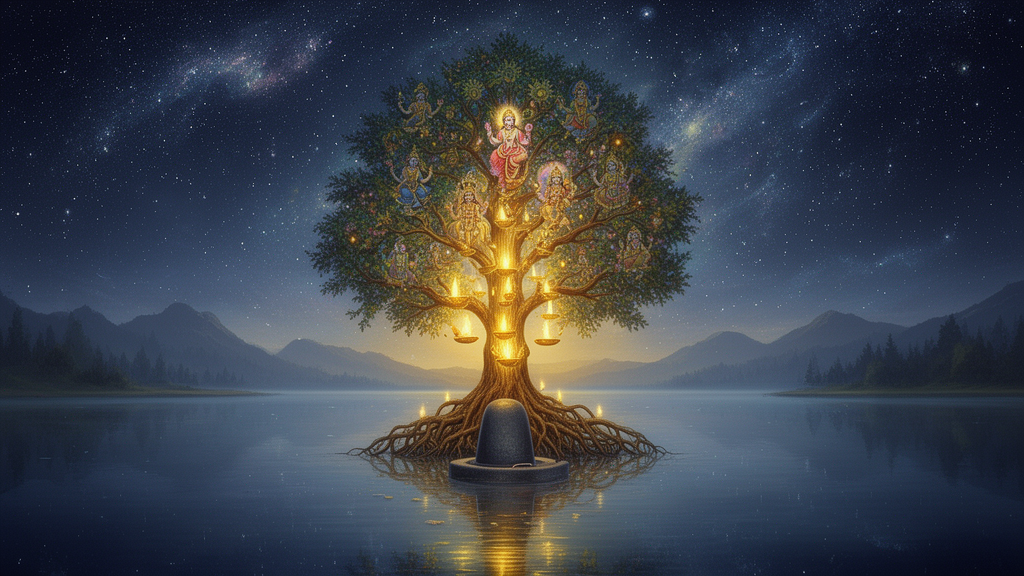
The text uses the image of a cosmic tree to describe the relationship among the gods. In the Vedanta Spiritual Library rendering, the whole creation of the heavenly, mortal, and netherworld realms is described as a great tree. Vishnu is the branches, Brahma is the stem, and Shiva is the root. The same passage uses a causal vocabulary: the root is the cause, the stem is the action, and the branches are the effect. The rendering then says that Rudra has taken these three forms for the benefit of the worlds, and it identifies Rudra with dharma, Vishnu with the world, and Brahma with knowledge (Vedanta Spiritual Library).
The Grokipedia article summarizes the same metaphor, describing Vishnu as the branches, Brahma as the trunk, and Mahesvara as the root (Grokipedia). The two accounts agree on the image, though the English wording differs. For a reader, the key idea is interconnection: each deity is presented as a part of one living structure rather than as a rival source of power.
Vishnu, Brahma, and Shiva in the same text
The Upanishad repeatedly joins Shiva with Vishnu. The Vedanta Spiritual Library rendering says that those who worship Lord Vishnu worship Shiva himself, and that those who worship Shiva worship Vishnu in reality. It also says that those who envy or decry Rudra are in effect decrying Vishnu. Wikipedia and the Vyasa Mahabharata page both report the same general theme of inseparable deities (Wikipedia; Vyasa Mahabharata).
This is where tradition matters. Shaiva readers may read the passage as an exaltation of Shiva that also includes Vishnu within it. Vaishnava readers may read the same verses differently, and some will not regard the text as making Shiva and Vishnu identical in every sense. Neither reading is the only possible one. The text itself supports the claim that it treats Vishnu and Shiva as inseparable, and the Shaiva classification shows the tradition from which it comes.
Advaita and the individual self
The Upanishad also uses the vocabulary of Vedanta nondualism. Wikipedia states that the text, like other Shaiva Upanishads, is presented in Vedanta nondualist terms and says that the individual Atman, or soul, is identical with the supreme reality Brahman (Wikipedia). The Vedanta Spiritual Library rendering includes statements that distinguish the Atman, Paramatman, and Antaratman, and it says that Vishnu is the eternal Atman of the universe and that Siva is the Paramatman (Vedanta Spiritual Library).
Threefold character of the self
The Vyasa Mahabharata page reports that the later part of the text presents the Advaita theory through a threefold character of the Atman and states that the absolute truth is nirguna, or without attributes. The same page is a secondary summary, so readers who want to examine the exact wording should compare it with a full translation. This is a good example of where a summary is useful for orientation but should not replace the text.
What Advaita means in this context
In Advaita Vedanta, the nondual teaching holds that the individual self and the ultimate reality are not ultimately different. The Rudrahridaya Upanishad uses this framework within a Shaiva vocabulary. Grokipedia describes the text as teaching that the individual soul and Paramatman are ultimately one, and that liberation comes through knowledge under a guru’s guidance. The distinction it draws between lower knowledge concerned with ritual and worldly affairs and higher knowledge of the imperishable, formless Brahman is a familiar Upanishadic idea (Grokipedia). Because Grokipedia is an AI-assisted encyclopedia, these points should be confirmed against a translation or scholarly commentary before being presented as the text’s own wording.
Practice: mantra, devotion, and meditation
The text includes practical instructions alongside its philosophy. The Vedanta Spiritual Library rendering recommends singing the name of Rudra, repeating “Rudra, Rudra,” and says that doing so destroys sins. The Grokipedia article also describes mantra-based devotion of this kind (Vedanta Spiritual Library; Grokipedia).
Repetition of the name
Japa, or the repeated recitation of a name or mantra, is a widespread devotional practice in Hinduism. The Upanishad’s instruction is simple: sing or recite the name of Rudra. The text itself does not give a fixed count, schedule, or ritual setting in the English rendering reviewed. Any practical routine built on this passage is therefore a matter of tradition and personal discipline, not a rule stated in the text. Readers should also understand that the claim that repeating the name destroys sins is a devotional assertion as stated in the scripture; it is not a guaranteed outcome that can be verified empirically.
Meditation with Om
Grokipedia states that the text concludes with meditation using the Pranava, Om, presented as a bow with which the Atman is united with Brahman, leading to realization of sat-chit-ananda, or existence, consciousness, and bliss (Grokipedia). Because this summary is not a direct translation, readers should check the closing sections of a full translation before treating the bow imagery as settled wording. The general association of Om with Brahman appears widely in Upanishadic literature, but the exact closing verses should be read in a verified edition.
Symbols of Shiva in the text
The Vedanta Spiritual Library rendering mentions the sacred ash (bhasma) and rudraksha as objects of adoration in the opening. These symbols are associated with Shaiva worship in many communities, and the text presents them as part of a devotional setting. Their use in daily life varies widely across regions, sects, and families. A reader should not assume that every Shiva devotee uses them in the same way.
How to read the text: scripture, commentary, and interpretation
A useful way to read the Rudrahridaya Upanishad is to separate three layers. The first is the text itself: the Sanskrit verses and their translation. The second is the tradition of commentary and devotional explanation that has grown around the text over time. The third is modern scholarly and popular interpretation, including summaries like those on Wikipedia and AI-assisted encyclopedias. Each layer is valuable, but they serve different purposes.
- Scripture: The Sanskrit text and its verses, such as the paired-form passage and the cosmic tree image, as found in a verified edition or translation.
- Tradition: Shaiva readings that treat Rudra-Shiva as the supreme focus and Uma as inseparable, and Vaishnava or other readings that may interpret the unity of deities differently.
- Scholarship: Discussions of date, classification, manuscripts, and relationships to other Shaiva texts, which should be checked against academic sources rather than summaries alone.
Translations of this text are not identical. The Vedanta Spiritual Library rendering is an English version that includes some explanatory wording within the passage. The Vyasa Mahabharata page provides an abridged version. When quoting the text, readers should note which translation they are using and whether it is abridged. This article does not quote long passages from any copyrighted translation and instead describes the content in its own words, citing the source for each claim.
Where sources disagree
Sources differ on the number of Shaiva Upanishads, as noted above. They also differ in emphasis. Wikipedia describes the text in general terms of Shaiva Vedanta, while the Vyasa Mahabharata page and the Vedanta Spiritual Library rendering focus on the specific passages of Rudra-Uma pairing and the Vishnu-Shiva relationship. The Grokipedia article gives a more detailed thematic outline but is not a peer-reviewed or primary source. Where those differences matter, this guide has tried to say so rather than merge them into one confident account.
The Rudrahridaya Upanishad within Shaiva tradition
The text belongs to a family of Shaiva Upanishads that emphasize Shiva as supreme and bring Vedantic terminology into Shaiva devotion. Wikipedia lists Shaiva philosophy and its many schools and texts, and places the Upanishad within that wider context. Readers interested in how this text relates to Shaiva Siddhanta, Kashmir Shaivism, or other schools will find that those traditions developed their own vocabularies and practices, and that the Rudrahridaya Upanishad is not a complete summary of any one school.
For readers who want to explore related Upanishad content on HindusGod.com, the site has drafted articles on the meaning of the term Upanishad (Meaning of Upanishad, URL to confirm as live) and on the 108 Upanishads (108 Upanishad, URL to confirm as live). Both are currently WordPress drafts and may not yet be public. The Advaita Upanishad draft (Advaita Upanishad, URL to confirm as live) may also help readers who want to compare the nondual vocabulary of other Upanishads.
Frequently asked questions
Is the Rudrahridaya Upanishad a Vedic text?
It is attached to the Krishna Yajurveda and is classified among the Upanishads, but Wikipedia describes it as a medieval-era text rather than one of the earliest Vedic texts (Wikipedia). Its association with the Yajurveda is a classification, and readers should not take that as a precise date.
Does the text say that Vishnu and Shiva are the same?
The text says that worshipping Vishnu is worshipping Shiva and that worshipping Shiva is worshipping Vishnu, and it presents the two as inseparable within its own framework (Vedanta Spiritual Library). Different traditions interpret this statement differently, and the text should be read in its own Shaiva context.
Who is the text meant for?
The Upanishad is a philosophical and devotional text that presents teaching through dialogue. Its readers are often students of Shaiva philosophy, devotees of Shiva, and those interested in Upanishadic thought. Because it is a textual teaching, reading it with a teacher, commentary, or a reliable translation is recommended.
Short takeaway
The Rudrahridaya Upanishad offers a concise statement of Rudra-Uma unity within a Shaiva Upanishad framework. Its core teaching, that Rudra and Uma together constitute the ultimate reality and manifest as all gods and all of creation, is stated clearly in the text and supported by multiple sources. Its claims about dates, counts, and later interpretation are less settled, and readers should distinguish scripture, tradition, and scholarship when they study it.
Sources and further reading
- Wikipedia: Rudrahridaya Upanishad (general overview, classification, Rudra-Uma unity, Advaita framing; secondary)
- Vedanta Spiritual Library: Rudra Hridaya Upanishad (English rendering of the text, including the paired-form passage and cosmic tree image; translation, check edition)
- Vyasa Mahabharata: Rudra Hridaya Upanishad (summary, manuscript titles, Muktika list position, date unknown; secondary, abridged passages)
- Sanatan Hindu Dharma: Rudrahridaya Upanishad (classification as a Shaiva Upanishad attached to the Krishna Yajurveda; secondary)
- Grokipedia: Rudrahridaya Upanishad (AI-assisted thematic summary; use only as a pointer to verify against primary translations and scholarship)
Readers who want a fuller scholarly treatment should consult a critical edition of the Upanishad, academic studies of Shaiva Upanishads, and the Aufrecht catalogue cited in secondary summaries. Verify any new source before quoting it.
A meaningful article that encourages readers to think deeply about faith, purpose, and personal growth.