The Rosary to the Holy Wounds is a Catholic devotion that uses the form of the rosary to meditate on the five wounds Jesus Christ suffered during his crucifixion. In the Catholic tradition, these are often called the Five Holy Wounds, and the devotion is sometimes described with related names such as the Chaplet of the Five Wounds or the Chaplet of the Holy Wounds. This article explains what the five wounds are, how the devotion relates to the standard Rosary, where its history and variations come from, and which claims are supported by sources and which are matters of tradition.
Because this is a Christian devotion, it is not part of Hindu worship. HindusGod.com readers who are curious about how other faiths practice prayer with beads or structured repetition may find it useful for comparison. The aim here is accurate description, not a claim that the devotion is universal or that it guarantees any result.
Short answer: what is the Rosary to the Holy Wounds?
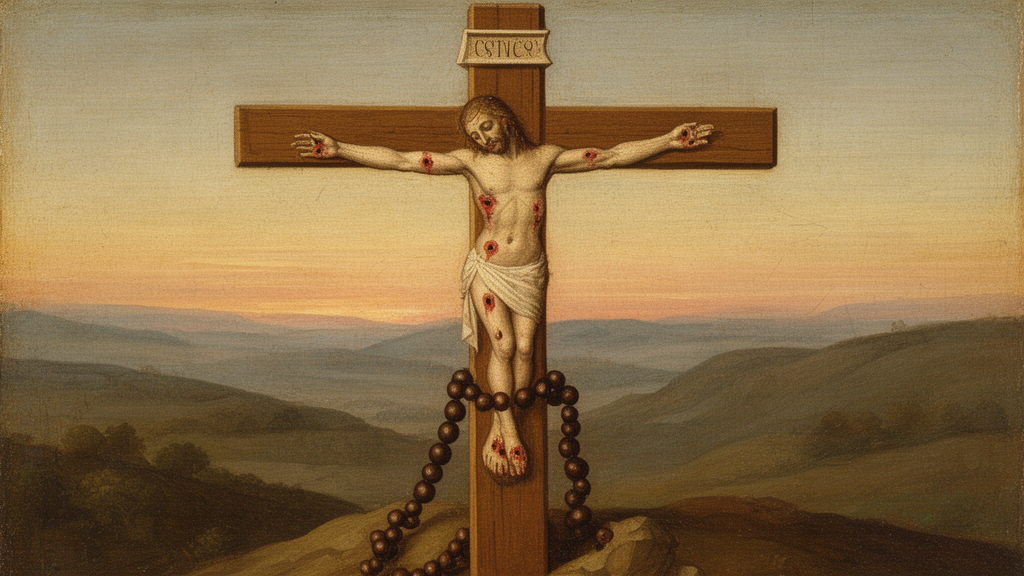
The Five Holy Wounds are, in the usual Catholic enumeration, the nail holes in Jesus’ right hand, his left hand, his right foot, and his left foot, along with the wound to his side made by a spear. The Wikipedia article on the Five Holy Wounds lists these five wounds and notes that they have been the focus of particular devotions, especially in the late Middle Ages, and that they often appear in church music and art [1]. The Rosary to the Holy Wounds is a prayer form built around meditating on these wounds, usually in a sequence of repeated prayers that follows the rhythm of the rosary.
The devotion is not a single, fixed prayer book that every Catholic uses in the same way. Sources describe several related chaplets and practices, and the exact prayers and order can vary by author, religious community, or printed booklet. The sections below separate the historical facts, the Catholic teaching about the Rosary itself, and the devotional traditions that surround the wounds.
The Five Holy Wounds of Jesus
The Five Holy Wounds are defined in the Wikipedia article on the subject as five piercing wounds Jesus suffered during the crucifixion [1]. Each one is tied to a specific part of the Gospel account of the passion, and each has a traditional place in the devotion.
The wounds in the hands and feet
Four of the five wounds are the nail holes: the right hand, the left hand, the right foot, and the left foot [1]. These wounds are the ones most directly connected with the crucifixion itself, because the nails were used to fix Jesus to the cross. The Wikipedia article notes that two of the wounds were through the hands or wrists, where nails were inserted to attach Jesus to the crossbeam of the cross [1].
The article also reports a forensic view associated with Frederick T. Zugibe. According to that account, the most plausible site for the nail entry in the case of Jesus is the upper part of the palm angled toward the wrist, because this area could support the weight of the body and was less likely to involve bones being broken [1]. This is a modern forensic interpretation, not a statement from scripture, and it is one view among those discussed in historical and medical literature. Readers should treat it as a scholarly or forensic claim rather than a devotional teaching.
The wound to the side
The fifth wound is the wound to Jesus’ torso caused by the piercing of the spear [1]. In Catholic devotion, this wound is especially associated with the Sacred Heart, which is a separate and widely practiced devotion. The Wikipedia list of Catholic devotions to Jesus includes both the Holy Wounds and the Sacred Heart as distinct entries in a larger series [1]. The two devotions overlap in imagery and themes, but they are not identical, and sources do not treat them as interchangeable.
Wounds that are not counted
Some readers ask why the wounds from the crown of thorns and the lash marks from the flagellation are not included in the five. The Wikipedia article answers that these wounds do not qualify because they did not occur on the cross [1]. This is a definitional distinction within the devotional tradition. It does not mean that the other wounds are unimportant. Catholic teaching and many devotional books still reflect on the crowning with thorns and the scourging, and both appear among the Sorrowful Mysteries of the Rosary, as discussed below [3][5].
How the wounds fit into Catholic devotion
The devotion to the wounds of Christ belongs to a broader group of Catholic practices that focus on the humanity and suffering of Jesus. The Wikipedia article places the Five Holy Wounds in a series of devotions to Jesus that includes the Sacred Heart, the Holy Face, Divine Mercy, the Stations of the Cross, and the Precious Blood, among others [1]. This placement shows that the devotion is part of a wider family of prayers rather than an isolated practice.
The article also states that the wounds were the focus of particular devotions, especially in the late Middle Ages [1]. The source does not claim that the devotion had a single origin or founder, and sources should not be read as saying so. What can be said with support is that the medieval period saw growing attention to the physical sufferings of Christ, and that this attention was reflected in art, music, and devotional writing. The Wikipedia article notes that the wounds have often been reflected in church music and art [1].
Art and the showing of the wounds
Art history gives concrete examples of how the wounds were portrayed. The Wikipedia article includes an image caption describing the risen Christ showing his wounds, the ostentatio vulnerum, in an Austrian work from around 1500 [1]. In that tradition, the risen Jesus displays his wounds to the disciples, which is a scene taken from the Gospel accounts of the post-resurrection appearances. Images of this kind help believers reflect on the wounds as signs of Christ’s suffering and of his identity after the resurrection. Readers who want to see more examples can consult museum and art-historical resources, and the Wikipedia article’s image collection is a starting point rather than a complete survey.
The Rosary: the framework behind the devotion
To understand the Rosary to the Holy Wounds, it helps to understand the standard Rosary, because the wound-focused chaplets borrow its structure. The Wikipedia article on the Rosary describes it as a Christian sacramental and Marian devotion [2]. The Rosary is a sequence of prayers, usually counted on beads, that moves through a set of mysteries drawn from the life of Christ and of his mother Mary.
The USCCB explains that the Rosary is a Scripture-based prayer. It begins with the Apostles’ Creed, which summarizes the great mysteries of the Catholic faith. The Our Father, which introduces each mystery, is taken from the Gospels. The first part of the Hail Mary is presented as the words of the angel announcing Christ’s birth and Elizabeth’s greeting to Mary, and the USCCB states that St. Pius V officially added the second part of the Hail Mary [4]. The repetition is described as a way to lead the one praying into restful and contemplative prayer related to each mystery [4].
The four sets of mysteries
The Rosary is divided into four traditional sets of mysteries. The Rosary Center lists them as the five Joyful Mysteries, the five Luminous Mysteries, the five Sorrowful Mysteries, and the five Glorious Mysteries, with a schedule that assigns each set to certain days of the week [3]. The USCCB notes that the Luminous Mysteries were added by Saint John Paul II in 2002 [4].
The Catholic Answers guide lists the mysteries within each set. The Sorrowful Mysteries are the Agony in the Garden, the Scourging at the Pillar, the Crowning with Thorns, the Carrying of the Cross, and the Crucifixion [5]. Because the Sorrowful Mysteries center on the passion of Jesus, they are the set most closely connected to the Holy Wounds. The Rosary Center states that the Sorrowful Mysteries are said on Tuesday and Friday, and that they may be said on the Sundays of Lent as an exception [3].
Why the Rosary uses these twenty mysteries
A common question is why the Rosary considers only twenty events from the life of Christ and Mary. The Rosary Center answers that the mysteries are based on incidents celebrated in the liturgy, and that there is a parallel between the main feasts honoring the Lord and his mother in the liturgical year and the twenty mysteries [3]. This is the explanation given in that source, and it is a Catholic explanation of the Rosary’s structure. Other Christian traditions do not use the Rosary in this form, and Catholic sources present it as a Catholic practice.
The Rosary to the Holy Wounds and the Sorrowful Mysteries
The Rosary to the Holy Wounds does not replace the standard Rosary in every source. Many accounts present it as a meditation on the wounds that can be prayed with the beads, often with reflections on the Sorrowful Mysteries or on the wounds themselves. The Wikipedia article on the Five Holy Wounds lists several related chaplets and devotions, including the Chaplet of the Five Wounds of Jesus, the Chaplet of the Five Wounds, and the Chaplet of the Holy Wounds, with a separate subsection on private revelations and another on the format of the chaplet [1]. The article’s table of contents shows these subsections, but the text available for this article did not include their full content. For that reason, this post does not describe the exact prayers or count of each chaplet. Readers who want a specific format should use a printed, approved prayer book from their parish or religious community.
The link between the wounds and the Sorrowful Mysteries is clear in the content of the mysteries themselves. The Scourging at the Pillar and the Crowning with Thorns both involve injuries that the Wikipedia article distinguishes from the five wounds counted in the devotion [1][5]. The Carrying of the Cross and the Crucifixion lead directly to the nail wounds and the wound of the spear. Many people who pray the wound-focused devotion therefore use the Sorrowful Mysteries as a meditative frame, while holding the wounds as the particular focus of each decade.
Basic steps for praying a rosary with a wound focus
The steps below follow the general pattern of the Rosary as described by the Rosary Center and the USCCB. Because wound-focused chaplets vary, the steps for the specific devotion should be checked against the prayer booklet you are using. The general structure is useful for understanding how the beads and prayers fit together.
-
Make the Sign of the Cross and pray the Apostles’ Creed, as described in the Rosary Center’s steps for praying the Rosary [3][4].
-
Pray the Our Father, then three Hail Marys for faith, hope, and charity, and then the Glory Be [3].
-
Announce the first mystery, then pray the Our Father. Pray ten Hail Marys while meditating on that mystery, and then pray the Glory Be [3][4].
-
Repeat the pattern for the remaining decades. The Rosary Center notes that some people add the prayer O my Jesus, forgive us our sins, which was requested by Mary at Fatima, after each decade, and that this addition is optional [3][4].
-
After the five decades, pray the Hail, Holy Queen and the closing prayer. The USCCB gives the dialogue and closing prayer used in its guide [4].
A few practical notes help readers who are new to the beads. The Rosary can be prayed privately or in a group [4]. Some people hold a crucifix at the beginning, as the USCCB guide describes [4]. A focus on the wounds does not require any special equipment beyond the usual rosary, but the choice of prayers and the order of meditations should follow the chosen devotion.
Devotional traditions and variations
Catholic devotion to the wounds has several strands, and it helps to separate them. The Wikipedia article identifies the First Thursdays Devotion and the Sacred Heart as related devotions, and it lists the Holy Wounds among other devotions to Jesus [1]. Each strand has its own history, its own prayers, and its own community of practice.
The Chaplet of the Five Wounds and related chaplets
The Wikipedia article lists three chaplet-related subsections under Devotions: the Chaplet of the Five Wounds of Jesus, the Chaplet of the Five Wounds, and the Chaplet of the Holy Wounds [1]. These titles suggest closely related devotions, but the source excerpt available here does not describe the prayers of each one. The overlap in names can cause confusion for readers who encounter printed booklets. Before using a particular chaplet, check its source, its approval history, and whether it is the version used by your parish or community.
Private revelations
The Wikipedia article includes a subsection on private revelations related to the Chaplet of the Holy Wounds [1]. In Catholic usage, private revelations are reported experiences that the Church does not require the faithful to believe. Catholic sources generally distinguish them from public revelation, which is contained in Scripture and Tradition. Readers should treat any account of a private revelation as a matter of devotional tradition rather than as a teaching of Scripture, and should consult a priest or a trusted Catholic resource if they want to understand its status.
The First Thursdays and the Sacred Heart
The First Thursdays Devotion and the Sacred Heart are listed as separate subsections in the Wikipedia article on the Five Holy Wounds [1]. Both are widely practiced in Catholic life, but they are distinct. The Sacred Heart devotion focuses on the love of Christ symbolized by his heart, while the First Thursdays devotion is a practice associated with a specific day and set of intentions. People who pray the wound-focused rosary may also practice one or both of these devotions, but the source does not say they are required to be combined.
Prayer, belief, and history: keeping the categories separate
Readers often encounter devotional material that mixes scripture, tradition, history, and personal testimony. A careful reading separates these categories. The wounds described in the Five Holy Wounds article are derived from the Gospel accounts of the passion and from the tradition that counts them [1]. The forensic claim about the nail placement comes from a modern expert, not from scripture [1]. The historical claim that the devotion grew in the late Middle Ages comes from a general historical overview [1]. The statement that the Rosary uses twenty mysteries and their liturgical basis is a Catholic explanation given by the Rosary Center [3].
These categories matter because they affect how a claim should be used. A scripture-based claim can be checked against the biblical text and the translation used. A historical claim should be checked against historical scholarship. A devotional claim, such as the belief that a particular prayer brings a particular grace, belongs to the believer’s faith and should be presented as belief, not as a verified fact. The Catholic sources reviewed for this article describe prayer as a way of entering into contemplation and reflection, and do not promise material results [4].
Art and music connected with the wounds
The Five Holy Wounds have been reflected in church music and art, according to the Wikipedia article [1]. The article’s image of the risen Christ showing his wounds, from an Austrian work of about 1500, illustrates how artists portrayed the wounds in the late medieval and early modern periods [1]. Readers who visit churches or museums may encounter images of the wounds in paintings, sculptures, stained glass, and devotional prints. These works are useful for reflection, and they are also important cultural records of how Christians have understood the passion.
Music is another channel. The Wikipedia article notes that the wounds appear in church music, though the excerpt available for this article does not list specific compositions [1]. Readers who want to explore the musical tradition should consult music history resources and church music collections rather than relying on general claims.
Examples of how the devotion might be used
The devotion can be used in several ways, depending on the person and the community. A parish group may pray the wound-focused chaplet together on a Friday in Lent, when the Sorrowful Mysteries are traditionally said [3]. A person preparing for the Easter season may use the Sorrowful Mysteries and the wounds as a way to reflect on the events leading to the crucifixion. A family may read a short passage from the Gospel before each decade, following the USCCB’s suggestion that a brief reading from Scripture may accompany the announcement of each mystery [4].
A reader who is new to the Rosary might begin with the standard Rosary, learn the mysteries and prayers, and then explore the wound-focused devotion once the basic rhythm is familiar. This sequence is one possibility, not a requirement. Catholic guides differ on how to introduce devotions, and a priest or spiritual director can give guidance suited to the person’s situation.
Scope and limitations of this article
This article is based on the sources listed below, and it does not claim to describe every chaplet, prayer booklet, or local custom associated with the Holy Wounds. The Wikipedia article on the Five Holy Wounds contains more subsections than the excerpt reviewed here, and the full text of those sections should be checked before publication. The Rosary Center, USCCB, and Catholic Answers pages were reviewed for the structure of the Rosary and the mysteries, and they do not, in the excerpts available, provide the full prayer text of a wound-focused chaplet. Readers should therefore use this article as an introduction and consult a Catholic prayer book or priest for the exact text and order of a particular devotion.
Frequently asked questions
Is the Rosary to the Holy Wounds the same as the standard Rosary?
No. The standard Rosary is a sequence of prayers that moves through twenty mysteries, and it is divided into four sets [3][4]. The Rosary to the Holy Wounds uses a rosary-style form with a focus on the five wounds, and its prayers and order can vary by source [1]. The two practices share a basic structure of beads and repeated prayers, but they are not the same devotion.
Are the five wounds the same as the wounds from the crown of thorns?
No, according to the Wikipedia article on the Five Holy Wounds. The article lists the five wounds as the four nail wounds and the spear wound, and it states that the wounds from the crown of thorns and the lash marks do not qualify because they did not occur on the cross [1]. Catholic devotion still reflects on those other wounds, especially within the Sorrowful Mysteries [5].
Do I need to be Catholic to pray this devotion?
The sources reviewed describe the Rosary and the Holy Wounds as Catholic devotions. The Rosary is described as a Christian sacramental and Marian devotion [2]. Readers who are not Catholic can learn about the devotion for educational purposes. Anyone who wishes to pray it as part of a faith community should ask a priest or a local parish how the practice is used there.
Is there a fixed prayer text for the chaplet?
The sources reviewed do not provide one fixed text for every version. The Wikipedia article identifies several chaplets and subsections, and the USCCB and Rosary Center provide the standard prayers of the Rosary [1][3][4]. Readers should use the text in an approved prayer book or parish resource for the specific chaplet they plan to pray.
Does praying this devotion guarantee a particular result?
No source reviewed for this article supports a guarantee of a material or supernatural result. The USCCB describes the repetition of the Rosary as a way to lead into restful and contemplative prayer [4]. Catholic teaching on prayer generally emphasizes relationship with God and the reception of grace, not guaranteed outcomes. Claims of specific results should be treated as devotional belief rather than verified fact.
Closing thought
The Rosary to the Holy Wounds brings together two long-standing elements of Catholic devotion: the rosary as a prayer of repetition and meditation, and the Five Holy Wounds as a focus for reflection on the passion of Jesus. The historical and artistic record shows that the wounds have been important in Christian art and devotion, especially in the late Middle Ages [1]. The Rosary itself is a Scripture-based prayer that uses the mysteries of Christ’s life, and its Sorrowful Mysteries link naturally with the wounds [3][4][5].
For readers who want to go further, the most useful next step is to compare a printed prayer booklet for the wound-focused chaplet with the standard Rosary guides listed below, and to ask a priest or parish community about the form used locally. For readers who want to understand the wider context of Catholic prayer with beads, related HindusGod.com resources on the Holy Rosary may help, including The History of the Holy Rosary and The Holy Rosary with Scripture.
Related reading on HindusGod.com
Readers who want to compare the Five Holy Wounds with other parts of the Holy Rosary tradition may find these related drafts helpful. Some of these pages may not yet be public, so please check their status before sharing.
-
For the promises associated with the devotion, see Rosary of the Holy Wounds Promises, which should be read alongside the caution in this article that devotional promises are belief, not verified outcomes.
-
For an overview of the four sets of mysteries, see 20 Mysteries of the Holy Rosary.
-
For the set of mysteries that focuses on Jesus’ public ministry, see Light Mysteries of the Holy Rosary.
-
For a guide on the Holy Rosary in a book format, see Holy Rosary Book.
-
For a reflection on Thursday prayers in the Rosary tradition, see The Most Holy Rosary Thursday.
Sources and further reading
-
Five Holy Wounds, Wikipedia. Used for the list of the five wounds, the note on the wounds not counted, the forensic view attributed to Frederick T. Zugibe, the medieval devotional context, the art and music references, and the list of related chaplets and devotions. Some subsections were not fully available in the excerpt reviewed.
-
Rosary, Wikipedia. Used for the description of the Rosary as a Christian sacramental and Marian devotion, and for the general structure of the Rosary.
-
How to Pray the Rosary, Rosary Center and Confraternity. Used for the step-by-step structure, the four sets of mysteries and their days, the optional Fatima prayer, and the explanation of the twenty mysteries.
-
How to Pray the Rosary, United States Conference of Catholic Bishops. Used for the Scripture basis of the Rosary, the history of the Hail Mary’s second part, the addition of the Luminous Mysteries in 2002, and the closing prayers.
-
How to Pray the Rosary, Catholic Answers. Used for the list of the mysteries in each set, including the Sorrowful Mysteries.
Readers should consult a parish, a Catholic prayer book, or a priest for the exact text, order, and approval status of any chaplet they intend to pray.