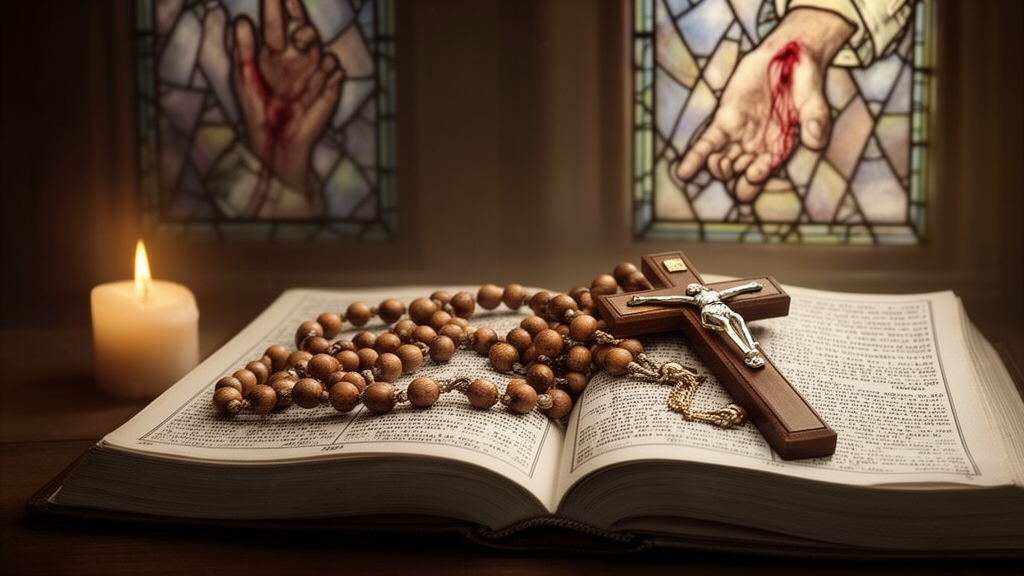
The Rosary of the Holy Wounds is a Catholic devotional prayer that meditates on the wounds of Christ. The promises attached to it come from devotional literature rather than from the standard Rosary, and this guide has not yet verified their original sources. This draft explains the ordinary Rosary structure that is documented, describes how the Holy Wounds devotion relates to it, and marks the promise claims that still need checking before publication.
Short answer

The Rosary of the Holy Wounds is a Catholic devotion, not a separate Hindu practice. It uses the familiar Rosary framework of prayers counted on beads, but its focus is the wounds of Jesus. The specific promises associated with it are traditionally presented in devotional writings and are not established here by a verified primary source. Readers should treat them as devotional tradition unless a named source is confirmed.
What the standard Rosary is
The Rosary is a Catholic prayer built around the Our Father, the Hail Mary, and the Glory Be, meditated on through a set of mysteries from the life of Christ and his mother. According to the Rosary Center & Confraternity, the prayers are said with reflection on mysteries that are divided into the Joyful, Luminous, Sorrowful, and Glorious sets, with the Luminous Mysteries marked as optional in the Rosary Center’s guidance (Rosary Center & Confraternity, How to Pray the Rosary).
The USCCB describes the same four sets and notes that Saint John Paul II added the Luminous Mysteries in 2002 (USCCB, How to Pray the Rosary). Catholic Answers lists the mysteries and their assigned days in its step-by-step guide (Catholic Answers, How to Pray the Rosary).
Basic sequence
- Make the Sign of the Cross and pray the Apostles’ Creed.
- Pray one Our Father, three Hail Marys, and a Glory Be.
- For each of the five decades, announce the mystery, pray an Our Father, ten Hail Marys, and a Glory Be while meditating on it.
- Close with the Hail, Holy Queen and a final prayer.
The USCCB and Rosary Center both present this structure, with some variation in optional additions (USCCB; Rosary Center).
Where the Holy Wounds devotion fits
Devotion to the wounds of Christ is a Catholic devotional theme, and the Holy Wounds Rosary applies that theme to the Rosary’s meditative structure. For a general overview of the Rosary’s history and forms, see Wikipedia’s article on the Rosary, which describes the Rosary as a Christian sacramental and Marian devotion, though it is a secondary reference.
Readers who want the Holy Wounds devotion itself should begin with our related post, Rosary to the Holy Wounds (URL status: WordPress draft; public only if the owner publishes it). For the Rosary’s mysteries, see 20 Mysteries of the Holy Rosary (draft), and for a wider historical view, The History of the Holy Rosary (draft).
The promises: what is and is not verified
Devotional promises are commonly attached to prayers of this kind. In this case, the promises are traditionally described in devotional writings, but this draft has not located and inspected a primary source that states them, names their origin, or dates them. For that reason, this post does not list specific promises, quote them, or attribute them to any saint or revelation.
Three distinctions matter for readers:
- Devotional belief: Many Catholics pray this devotion with trust in its promises as a spiritual encouragement.
- Textual source: A named prayer book, approved edition, or historical document would be needed to state what the promises say and where they come from. None has been verified here.
- Scholarly and ecclesial assessment: Any historical judgment about the origin of such promises requires scholarly sources, which are not yet collected.
Prayer does not carry a guaranteed material or supernatural outcome in Catholic teaching as presented in the sources reviewed here, and readers should not read the promises as a guarantee of any particular result.
How to approach the devotion
Catholics pray the Rosary privately or in groups, and the USCCB notes that it can be said either way (USCCB). A reader new to the Holy Wounds devotion can:
- Learn the standard Rosary sequence from one of the sources above.
- Choose an approved prayer text for the Holy Wounds devotion from a parish, diocesan, or established Catholic publisher.
- Compare the promises stated in that text with the original source before relying on them.
Devotional practices vary among parishes, religious orders, and regions, so local guidance from a priest or parish is a reasonable next step.
Frequently asked questions
Is the Rosary of the Holy Wounds the same as the standard Rosary?
It uses the Rosary’s bead-based structure, but its meditation centers on the wounds of Christ. The standard Rosary meditates on the mysteries of his life and his mother’s role in them.
Is this a Hindu practice?
No. It is a Catholic devotion. HindusGod.com covers it for readers who want to understand Christian devotional practices in general.
Summary
The Rosary of the Holy Wounds is a Catholic devotion built on the standard Rosary sequence. The general Rosary structure is documented by the sources above. The specific promises attached to the Holy Wounds devotion remain unverified in this draft and should be confirmed against a named source before publication.
Sources and further reading
- Rosary Center & Confraternity, How to Pray the Rosary: the Rosary sequence and mystery schedule.
- USCCB, How to Pray the Rosary: the four sets of mysteries and the 2002 addition of the Luminous Mysteries.
- Catholic Answers, How to Pray the Rosary: the mysteries and their assigned days.
- Wikipedia, Rosary: general background (secondary source).