Rig Veda verses are the individual lines, called mantras or ṛcs, that make up the Ṛgveda, the oldest of the four Vedas and the first sacred text in the Hindu canon. The collection contains 1,028 hymns and 10,552 verses, arranged in ten books called maṇḍalas. Most verses praise deities such as Agni, Indra, Soma, Uṣas and the Ashvins, and many were used in ritual. This guide explains how the verses are organised, how scholars and readers cite them, what a single verse looks like in translation, and where belief, textual evidence and scholarly interpretation differ.
What Rig Veda verses are
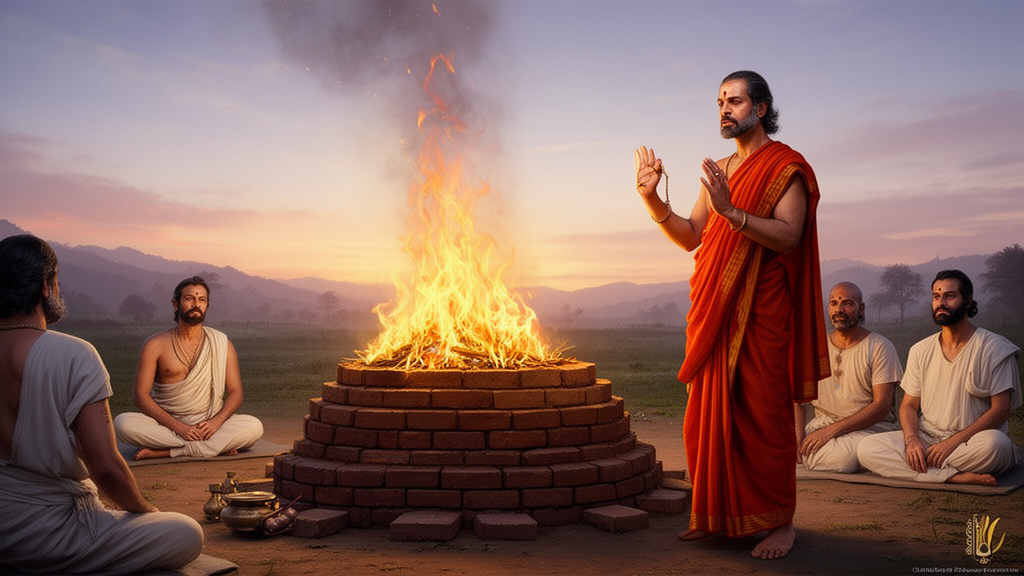
The Rigveda is a collection of Vedic hymns. Wikipedia describes it as the first sacred canonical text of Hinduism, composed in Vedic Sanskrit. The same article gives the collection 10 maṇḍalas and 10,552 mantras, and places the Vedic period it belongs to at roughly c. 1500–1000 BCE, a range that scholars discuss rather than treat as settled. A verse is the smallest unit most readers encounter: a short metrical line or group of lines addressed to a god or describing a rite.
Because the Rigveda is a poetic and liturgical text, a verse is best understood in its hymn. A single line may read as a call to a deity, but the hymn around it usually places that call in a sacrifice, a request for wealth or protection, or a description of cosmic order. Reading one verse alone can distort its meaning.
Hymns, maṇḍalas and verses
The Rigveda has three levels of organisation that readers should keep separate:
- Maṇḍala (book): the text is divided into ten books. Wikipedia’s article describes these as mandalas and notes the structure of the collection.
- Sūkta (hymn): a group of verses addressed to one or more deities. The Rig Veda Book 1 page on Hinduwebsite.com presents the first hymn, to Agni, as the opening hymn of the collection.
- Ṛc or mantra (verse): a single metrical unit within a hymn. The 10,552 figure counts these verses.
Different sources count hymns and verses in slightly different ways depending on the edition and on how refrains or divisions are treated. Treat the totals as the figures given by the cited sources, not as absolute counts across all manuscripts.
The deities praised in the verses
Many Rig Veda verses address the gods of fire, storm, dawn and Soma. Rigveda.live describes the Rig Veda as hymns of praise to the gods of fire, storm, dawn and Soma. Hinduwebsite.com’s index of the first book lists hymns to Agni, Vayu, the Ashvins and Indra, which gives a concrete sense of the range. These hymns are not organised as a single systematic theology, and readers should not assume a fixed hierarchy of gods from the verses alone.
How verses are cited
Scholarly and devotional readers commonly cite Rig Veda verses by book, hymn and verse number. Wikipedia’s article uses the form RV 1.1.1a for the first pāda of the first verse of the first hymn of the first book. The letter after the number refers to a quarter-verse, or pāda, of the metrical line. Citation systems can differ between editions, so when you cite a verse, name the edition or translation you used.
A basic citation pattern is:
- RV 1.1.1: book 1, hymn 1, verse 1
- RV 1.1.1a: the first pāda of that verse
- RV 1.1: the whole hymn, used when the reference covers several verses
Before quoting a verse in a blog, post, or study note, check the number against a reliable edition. Verse numbering is a common place for error, especially when a translation labels lines differently from the Sanskrit text.
A worked example: the opening verse of RV 1.1
The first pāda of the Rigveda, as quoted by Wikipedia from a manuscript, reads agniṃ iḷe puraḥ-hitaṃ yajñasya devaṃ ṛtvijaṃ. Wikipedia translates it as “I praise Agni, the chosen Priest, God, minister of sacrifice.” The same article notes that the manuscript marks pitch accent in its image caption, which is a reminder that the Vedic text was recited with melodic accent.
Ralph T. H. Griffith’s nineteenth-century English translation, reproduced on Hinduwebsite.com, renders the opening of the hymn as “I Laud Agni, the chosen Priest, God, minister of sacrifice, The hotar, lavishest of wealth.” Griffith’s wording is older and more archaic than many modern translations. The Sanskrit word hotar refers to a priest who calls the gods to the rite; the translation keeps this term rather than replacing it with a modern equivalent.
This short example shows three things useful for any reader:
- The verse is a direct address to a deity, not an abstract statement.
- Its meaning depends on ritual roles, such as the priest and the sacrifice.
- Different translators choose different English words for the same Sanskrit, so comparing two translations often clarifies a difficult line.
The rest of the hymn continues with requests and praise: Agni is described as dispeller of the night, as ruler of sacrifices, and as one who brings the gods. The hymn is therefore a useful entry point for seeing how a Rig Veda verse links praise, ritual and petition.
Dating and composition: what the sources say
The Rigveda is widely discussed as one of the earliest texts of Indo-Aryan religious literature, but its exact dates and place of composition remain debated. Wikipedia’s article presents a dating section and a historical and societal context section, and it gives the Vedic period as c. 1500–1000 BCE. That range is a scholarly estimate for the period and should not be read as a precise date for each hymn.
Readers should distinguish three kinds of statement:
- Textual evidence: what the verses say, such as references to sacrifice, soma, or specific gods.
- Historical estimate: when scholars think the hymns were composed, based on linguistic, textual and other evidence.
- Tradition: the Hindu view that the Vedas are śruti, revealed or heard knowledge, which is a theological position rather than a historical finding.
These claims operate at different levels. A devotee may accept the tradition that the Veda is eternal or revealed, while a historian asks how and when the hymns were composed and preserved. Both views can coexist, but they should not be presented as the same kind of evidence.
Oral transmission and recensions
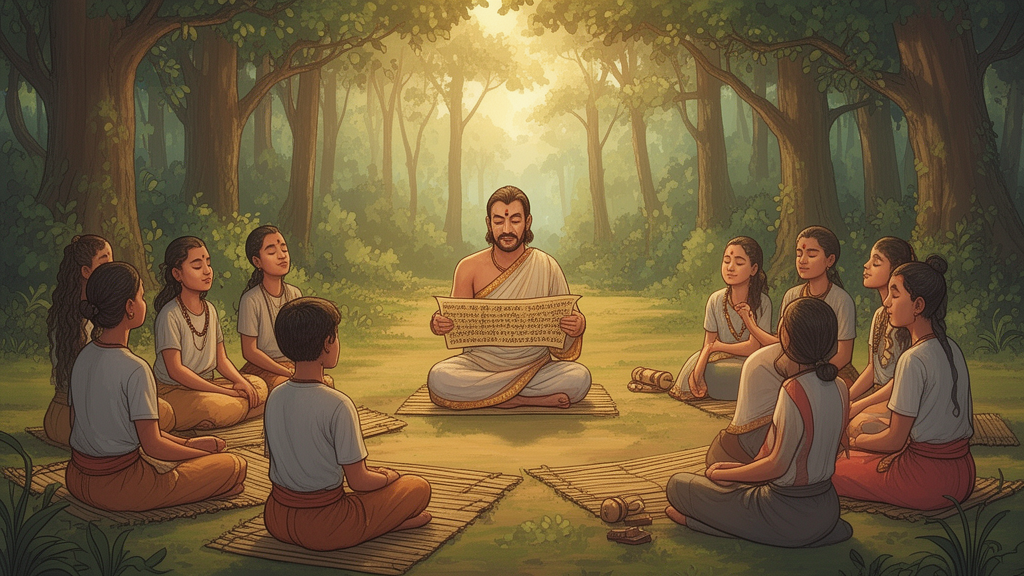
The Rigveda was preserved orally for a long time before manuscripts were made. Wikipedia’s article includes sections on transmission, recensions and manuscripts, indicating that the text survives in more than one recension and in several manuscript traditions. Oral transmission in Vedic learning was highly disciplined: students learned to recite the text with accent and sound patterns and to check it through fixed recitation methods.
Because of this, a verse may exist in several recited forms or written forms. The Pada text separates words for study, while the Saṃhitā text presents the continuous recitation. The Wikipedia caption on the manuscript image refers to a padapāṭha manuscript, which is one such form. When you quote a verse, indicate whether your source is a continuous text, a word-separated text, a translation, or a commentary.
Verses in Hindu tradition
The Rig Veda is part of śruti, the body of scripture regarded in much of Hindu tradition as heard or revealed. Wikipedia’s article includes a section on Rig Veda in Hinduism, covering the reception of the text across Sanskrit grammarians, medieval Hindu scholarship, reform movements such as the Arya Samaj, and contemporary Hinduism. The article also covers Hindu nationalism as a modern use of the text, which is one of several reception contexts rather than a summary of Hindu belief.
Verses also have a ritual life. Some hymns were recited in the Soma sacrifice and other rites, and the Sama Veda consists mostly of verses drawn from the Rig Veda and set to melodies for chant at the Soma sacrifice, according to Rigveda.live. Ritual use was tradition-specific: it depended on the school of Vedic learning, the rite, and the priestly role.
In modern Hindu practice, people often recite Vedic verses in homes, temples or study groups, but practice varies widely. Some families recite the Gāyatrī mantra from the Rig Veda, others use Purāṇic or devotional prayers, and some do not recite Vedic mantras at all. Avoid presenting any one practice as universal. Where a recitation or rite belongs to a particular community or lineage, say so.
Related HindusGod.com guides
For background on the Rig Veda as a whole, read Hindu Rig Veda, which covers the text’s place among Hindu scriptures. For how the Rigveda relates to later Hindu thought, see Rig Veda in Hinduism. Readers interested in the philosophical texts that grew from the Vedas can continue with Rig Veda and Upanishads. These pages are currently WordPress drafts; their public links become active only if the owner publishes them.
Verses across the four Vedas
The Rig Veda is the oldest of the four Vedas, but it is not the only Veda with verses. Rigveda.live gives the following broad counts, which are useful for orientation rather than as a final census:
- Ṛgveda: 1,028 hymns and 10,552 verses, hymns of praise to gods of fire, storm, dawn and Soma.
- Yajurveda: 40 adhyāyas and 1,975 mantras, described as the formulas of sacrifice spoken by the priest who performs the rite.
- Sāmaveda: about 1,875 verses, most drawn from the Rig Veda and set to melodies.
- Atharvaveda: 731 hymns and 5,933 mantras, described as hymns of everyday life, including healing, protection, marriage and kingship.
These differences matter when a reader sees a verse quoted online. A line that appears in the Sāmaveda may be a Rig Veda verse set to music, and an Atharvaveda charm addresses a different range of concerns. For a related comparison of Vedic texts, see Sama Veda Upanishad and Yajur Veda Upanishad, both currently drafts on this site.
Translations and reading choices
Every translation of a Rig Veda verse is an interpretation. Vedic Sanskrit is difficult, some words occur rarely, and translators differ on how to render ritual terms, names and metaphors. Griffith’s translation is one of the most widely available older English versions, and the Hinduwebsite.com page reproduces it for the first book. The Internet Archive also lists a digitised English edition titled Complete Rig Veda in English (Sakala Shakha). Check that edition’s translator, notes and numbering before quoting from it, because the catalogue entry alone does not verify its content.
When you compare translations, look for these points:
- Whether the translator explains ritual terms such as hotar or soma.
- Whether the verse numbering matches the Sanskrit text you cite.
- Whether the translation is a scholarly edition, a devotional rendering, or a modern paraphrase.
- Whether commentary is separated from the translated verse.
A devotional rendering can help a reader feel the spirit of a verse, but it should be labelled as such when it is used as evidence for what the text says.
Modern reception and devotional use
The Rig Veda is read in many contexts today: scholarly study, temple and home practice, reform movements, and popular media. Grokipedia’s entry on a 2000s audio production by Deepak Chopra, titled Sacred Verses, Healing Sounds, describes Volume II as presenting Rig Veda hymns that praise creation, the elements, gods and immortality, with Chopra’s English renderings and traditional Indian instrumentation. That entry is an AI-generated wiki page and is weaker evidence than a primary edition or academic source. Use it, if at all, as an example of modern reception, and check the production details against the publisher before citing them.
Modern reception should be described as reception. Presenting a verse as a healing tool, for example, is a claim about contemporary use, not a finding of what the verse was composed to do. The HindusGod.com guide to Veda Verses and the broader Hindu Verses guide can help readers see how verses are discussed in devotional and general contexts, once those drafts are reviewed and published.
How to read Rig Veda verses responsibly
Readers who want to study verses can follow an ordered approach:
- Choose an edition. Use a scholarly text or a clearly labelled translation, and note its publisher and date.
- Start with a single hymn. RV 1.1 is a common starting point because it is short and well known, and its Agni hymn is widely translated.
- Read the whole hymn. Look for the deity addressed, the request or praise, and the ritual setting.
- Compare two translations. Note where they differ and why. Word choice often reflects interpretation.
- Separate the layers. Mark what the verse says, what a translator or commentator says, and what later tradition or modern devotional practice says.
- Respect the practice. If you wish to recite verses, learn from a teacher or community that follows the same tradition, because pronunciation and recitation style vary.
This approach keeps study separate from claims about spiritual results. Verses can be read as literature, scripture, ritual text or personal devotion, and each use has its own standards.
Frequently asked questions
How many Rig Veda verses are there?
The Wikipedia article gives 10,552 mantras, and Rigveda.live gives 1,028 hymns and 10,552 verses. Counts can vary with the edition and the method of division, so cite the edition you use.
Where should a beginner start?
Many readers start with Book 1, Hymn 1, dedicated to Agni. It is short, widely translated, and shows the structure of praise, ritual and request in a single hymn.
Are Rig Veda verses only used in temples?
No. Verses are used in Vedic schools, in ritual contexts such as the Soma sacrifice in historical and scholarly descriptions, in home practice, and in modern study and reform movements. Practice differs by community, so avoid assuming a single usage.
Can a verse guarantee a specific result?
The sources reviewed here do not support guaranteed material or supernatural outcomes from reciting a verse. Presenting recitation as a devotional act or a means of study is more accurate.
Summary
Rig Veda verses are the metrical units of a text containing 1,028 hymns and 10,552 verses across ten maṇḍalas. They are best read within their hymns, cited by book, hymn and verse, and compared across translations. Their dating is a scholarly estimate, their status as śruti is a tradition held by many Hindus, and their modern uses are a matter of reception. Start with a single hymn such as RV 1.1, check the numbering against a clear edition, and keep scripture, tradition, history and modern interpretation distinct.
Sources and further reading
- Rigveda, Wikipedia: overview, maṇḍala and verse counts, the RV 1.1.1a citation form, the opening pāda, transmission and reception sections. Used for general orientation and for the cited verse count.
- The Vedas Online, rigveda.live: counts for the four Vedas and the description of the Sāmaveda as mostly Rig Veda verses set to melody. Used for comparative counts; treat as a secondary online resource.
- The Rig Veda, rigveda.live: description of the 1,028 hymns and 10,552 verses. Used for the same counts.
- Rig Veda, Book 1, Hymns 1-10, Hinduwebsite.com: Griffith’s English translation of RV 1.1 and the list of opening hymns to Agni, Vayu, the Ashvins and Indra.
- Complete Rig Veda in English (Sakala Shakha), Internet Archive: a digitised English edition listing. Verify the translator and content before quoting.
- Sacred Verses, Healing Sounds, Grokipedia: an AI-generated summary of a modern audio production. Use only as an example of reception; verify with the publisher.