This article explains what the Book of Acts says about people receiving the Holy Spirit, focusing on the Samaritan believers in Acts 8, and why Christian commentators read these accounts in different ways. The topic belongs to Christian scripture and theology. It is not a Hindu teaching, so readers from Hindu backgrounds should be careful when comparing it with concepts such as ātman or prāṇa, which do not map neatly onto the Christian idea of the Holy Spirit.

Direct answer: what the Acts passages show
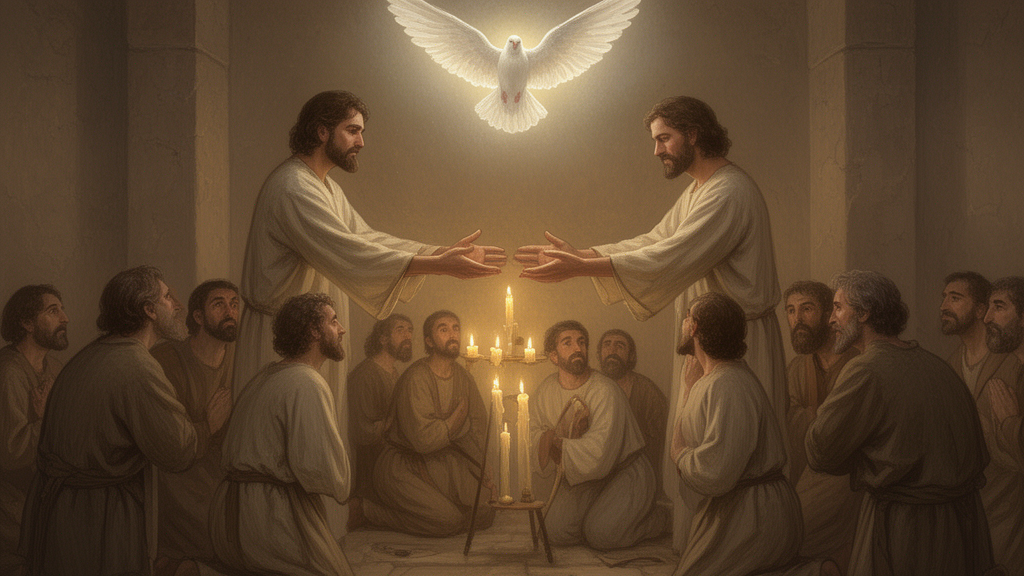
In Acts, people receive the Holy Spirit in more than one way. On the day of Pentecost, the Spirit comes upon the first believers in Jerusalem (Acts 2). In Caesarea, the Spirit falls on Cornelius and his household while Peter is still speaking (Acts 10:44). In Samaria, however, believers who had been baptized in the name of the Lord Jesus had not yet received the Spirit. Acts 8 says the Spirit came only after the apostles Peter and John arrived, prayed, and laid hands on them.
Because the accounts differ, commentators disagree about what should be treated as a general rule. Some argue that the Samaritan sequence is a unique historical event tied to the early church’s transition and unity. Others argue that the passage describes a visible, observable reception of the Spirit that Peter and John could confirm. Many Christians believe that the Spirit is received at conversion, a view that one commentary bases on 1 Corinthians 12:13. The sections below separate the text, the interpretations, and the traditions.
The key passages in Acts
Several passages in Acts link belief, baptism, and the Spirit. Reading them side by side helps explain why Acts 8 raises questions.
Acts 2:38 and the promise of the gift
In Acts 2:38, Peter tells the crowd to repent and be baptized, and says that they will receive the gift of the Holy Spirit. One Bible study resource reads this as a sequence of repentance, baptism, and then reception of the Spirit. The passage is short, but it is often cited as a general pattern of Christian initiation in Acts.
Acts 10:44–46 and the Spirit falling on Gentiles
In Acts 10, the Spirit falls on Cornelius and those with him while Peter is still speaking. The Bible study site Bible Verse Study quotes Acts 10:44 as, “the Holy Spirit fell upon all those who heard the word,” and notes that the Gentile listeners were heard speaking in tongues and praising God. Peter then says that these people had received the Holy Spirit just as the apostles had, which leads him to permit their baptism (Acts 10:47). This is the reason Acts 10 is often compared with Acts 8. In Caesarea, the Spirit comes before baptism. In Samaria, baptism comes first and the Spirit comes later.
Acts 8:14–17 and the Samaritan believers
Acts 8 describes Philip’s preaching in Samaria. Verse 12 says that the Samaritans believed Philip’s message about the kingdom of God and the name of Jesus Christ, and that they were baptized, both men and women. Verses 14–17 then describe the arrival of Peter and John. The verses that matter most for this question are:
- Acts 8:15: Peter and John came down and prayed for them that they might receive the Holy Spirit.
- Acts 8:16: The Spirit had “fallen upon none of them”; they had only been baptized in the name of the Lord Jesus.
- Acts 8:17: Peter and John laid hands on them, and they received the Holy Spirit.
These wordings come from the translations quoted by Bible Verse Study and BibleHub, which differ slightly in phrasing. The core sequence is consistent across them: baptism, a delay, the apostles’ arrival, prayer, and the laying on of hands.
Why did the Samaritans wait for Peter and John?
The question is that Acts 8 seems to separate baptism from the gift of the Spirit. GotQuestions.org addresses this directly and states that Christians receive the Spirit at salvation, based on 1 Corinthians 12:13. It then reasons that the Samaritan account should be taken as an accurate record of what happened in that case, not as a rule for every case. This is one interpretation, and it is offered by a particular ministry. It is worth reading the passage in its wider context before adopting it.
The same commentary gives three reasons why God may have waited until Peter and John were present. These are interpretive suggestions, not statements that the text itself makes explicit.
1. The keys given to Peter
GotQuestions.org points to Matthew 16:19, where Jesus gives Peter the “keys to the kingdom.” The commentary notes that Peter was the main spokesman at Pentecost, when the Spirit was given to Jews (Acts 2). It then says Peter was present in Samaria, where the Spirit was given to Samaritans, and in Cornelius’s house, where the Spirit was given to Gentiles (Acts 10). On this reading, Peter’s presence at each of these events marks a new group entering the church.
2. The apostolic foundation
The commentary cites Ephesians 2:20, which describes the church as built on the foundation of the apostles and prophets. It notes that Philip was a deacon and evangelist, not one of the twelve apostles. According to this view, Peter and John were needed in Samaria for the official beginning of the Samaritan church, much as they had been in Jerusalem for the Jewish church.
3. Unity between Jews and Samaritans
GotQuestions.org also stresses the hostility between Jews and Samaritans, citing John 4:9 and John 4:20. It argues that a Samaritan church started without any link to the Jerusalem church would likely not have been accepted there. Peter and John, as Jewish apostles from Jerusalem, could witness the gift of the Spirit and confirm that the Samaritan believers belonged to the same church.
Bible Verse Study offers a related point. It suggests that the Lord kept the growing church united by ensuring that the Samaritan believers did not receive the Spirit through someone outside the Jerusalem leadership, which could have allowed them to claim independence.
What does “receive the Holy Spirit” mean in Acts 8?
The phrase “receive the Holy Spirit” can be read in more than one way. Two readings are common in the commentary literature.
The observable gifts reading
Bible Verse Study argues that the context suggests something visible happened. In Acts 8:18, Simon “saw” that the Spirit was given through the apostles’ laying on of hands. The commentary notes that the Greek word translated “fallen” in Acts 8:16, epipeptokos, shares a root with the verb translated “fell” in Acts 10:44. Because Acts 10:46 describes speaking in tongues and praising God, the site suggests that tongues could have been among the manifestations Simon saw. It presents this as a likely reading, not a certainty, since the text of Acts 8 does not name the gifts.
The conversion reading
GotQuestions.org and other evangelical commentators tend to distinguish between the Spirit’s inner work in conversion and any visible sign that accompanies it. Bible Verse Study makes a similar observation: the conversion of the human heart, which only the Holy Spirit can accomplish, is not immediately visible. On this view, the visible signs in Acts 8 are a particular event in the church’s history, not the marker of conversion itself.
The difference matters. The first reading treats Acts 8 as describing an observable gift. The second treats the passage as describing a historical sequence in which the Spirit’s arrival was confirmed by the apostles. Both readings take the text seriously, and both are held by Christians.
Different Christian readings of Acts
Christian traditions do not agree on how Acts should be applied to later believers. The sources reviewed here show at least three broad approaches. They describe views from particular commentators and ministries, not the official teaching of every church.
- Reception at conversion. GotQuestions.org holds that Christians receive the Holy Spirit at salvation and treats Acts 8 as an exceptional historical case.
- Distinct, observable reception. Some readers see Acts as showing a pattern in which the Spirit’s coming can be a separate, visible experience, as the Samaritan and Gentile accounts may suggest. Bible Verse Study leans toward observable gifts in Acts 8 but does not turn this into a universal formula.
- Historical and unity-focused readings. BibleHub’s commentary emphasizes the unity of Jewish and Samaritan believers, apostolic authority, and God’s sovereignty in establishing the church across cultural lines. It treats the passage as a turning point in the church’s history rather than a model for every conversion.
Readers should note that these are interpretations. The Greek and English wording of Acts is a matter of text. Whether Acts 8 is normative, exceptional, or instructive is a matter of theology and hermeneutics. Scholars and ministers disagree on this, and a fair study presents the range of views.
Why Acts 8 is not treated as a universal pattern
A common mistake is to read one passage as the template for all cases. GotQuestions.org explicitly warns against this, arguing that the Samaritan manner of receiving the Spirit is an accurate account of what happened in that case and should not be construed as normative in every case. BibleHub also describes Acts 8 as “distinctive” compared with Acts 2:38 and Acts 10:44–46.
This approach has practical value. It allows readers to see that Acts includes different accounts, each with its own setting: a Jerusalem crowd at Pentecost, a Samaritan community with a difficult history with Jerusalem, and a Gentile household in Caesarea. Each account addresses a different question about who belongs to the church and how that belonging is confirmed.
For a broader overview of how Acts treats the Spirit in different settings, you may find this draft useful: Holy Spirit in the Book of Acts. Note that this and other internal links point to WordPress drafts that may not yet be public.
Key themes to track when reading Acts
When studying the passages on receiving the Spirit, several themes recur. Tracking them can help readers avoid reading one account in isolation.
- Sequence. Note whether the Spirit comes before, during, or after baptism, and whether the text states the order explicitly.
- Who is present. Acts repeatedly mentions apostles, elders, and witnesses. Ask who is involved and why their presence might matter.
- Visible signs. Acts sometimes mentions tongues, prophecy, or praise (Acts 2, Acts 10:46). Decide whether the text names a sign, or whether a reader is inferring one.
- Community context. The Samaritan story is shaped by long-standing tensions with Jerusalem. Pay attention to how the text handles social and religious divisions.
- Translation differences. Compare several English versions. The core wording of Acts 8:15–17 is similar across translations, but phrases such as “fallen upon” and “received” merit careful reading.
How to study these passages carefully
A balanced study of Acts 8 usually follows a sequence of steps:
- Read Acts 8:12–17 in at least two translations and note the verbs for belief, baptism, prayer, the laying on of hands, and receiving the Spirit.
- Compare Acts 2:38, Acts 8:14–17, and Acts 10:44–47, listing the order of events in each account.
- Read a commentary that states its theological tradition, and then read one that holds a different view.
- Separate what the text says from what the commentator infers. For example, the claim that tongues were among the signs Simon saw is an inference from Acts 10 rather than a statement in Acts 8.
- Decide whether your question is historical (what happened), theological (what it means), or practical (how churches should act today). These questions require different kinds of evidence.
For readers who want a more devotional approach, a related draft is Seven Vital Steps to Receiving the Holy Spirit. Its title suggests a practical framework, and readers should check that its claims are tied to the text of Acts rather than assumed to be guaranteed outcomes.
Reading Acts in a comparative setting
Readers at HindusGod.com may come to this topic through an interest in comparative religion. A few cautions are helpful. The Christian Holy Spirit is described in Christian scripture as a person of the Trinity, and Acts describes the Spirit’s coming to communities in specific historical moments. Hindu traditions describe divine presence and the self in many different ways, depending on the school, deity, and practice. A simple equation between “receiving the Spirit” and a Hindu concept would likely distort both traditions. A careful comparison would begin with the texts and then examine how each tradition frames divine presence.
For example, a Hindu reader may ask whether “receiving the Spirit” resembles the experience of divine grace or devotion described in a bhakti text. Such a comparison can be illuminating, but it should be presented as a comparison of categories, not as a claim that one tradition explains the other.
Frequently asked questions
Do all Christians receive the Holy Spirit in the same way?
No. Christian traditions differ on this. Some hold that believers receive the Spirit at conversion. Others distinguish between the Spirit’s inner work and visible signs, or describe a separate experience of the Spirit after conversion. The Acts passages are read differently by different commentators, and it is accurate to say that the question is contested.
Did the Samaritans become believers without the Spirit?
The text says that the Samaritans believed and were baptized, and that the Spirit had not yet fallen on any of them (Acts 8:12, 16). It then describes the Spirit coming through the prayer and laying on of hands by Peter and John (Acts 8:17). Commentators differ on what the delay meant, and GotQuestions.org argues that the Samaritans did have a true faith before the Spirit’s arrival.
Why are the Samaritans significant in Acts?
Acts 1:8 names Judea and Samaria as places where the apostles would be witnesses. BibleHub notes that Acts 8 marks a groundbreaking outreach to the Samaritans, who were religiously and ethnically distinct from mainstream Judaism. The Samaritan account therefore carries a theme of the church crossing cultural and religious boundaries.
Summary
Acts describes several ways that people received the Holy Spirit. At Pentecost, the Spirit is promised to those who repent and are baptized (Acts 2:38). In Caesarea, the Spirit falls on Gentile listeners before baptism (Acts 10:44–47). In Samaria, believers are baptized but do not receive the Spirit until Peter and John come, pray, and lay hands on them (Acts 8:14–17). Commentators offer different explanations for these accounts, including the apostles’ authority, the unity of the church, the observable nature of the gift, and the point that Acts records particular events rather than a fixed formula.
The most accurate way to study the topic is to read the texts closely, separate the text from interpretation, and acknowledge where Christian traditions differ. Readers who want to explore further can start with the sources below.
Sources and further reading
- GotQuestions.org, “Why had the believers in Samaria not received the Holy Spirit (Acts 8)?”: A Christian ministry’s answer that believers receive the Spirit at salvation and that the Samaritan account is an exceptional historical case. Use it for that interpretation and for the three reasons it gives for Peter and John’s presence.
- BibleHub, “Why do believers in Acts 8:14-17 only receive the Holy Spirit through the apostles’ laying on of hands?”: A commentary that discusses immediate and delayed reception, the Jewish-Samaritan context, and the role of the apostles.
- BibleHub, Acts 8:15 (multiple translations): A parallel display of translations of Acts 8:15, useful for comparing how different English versions render the phrase “receive the Holy Spirit.”
- Bible Verse Study, “’Receive the Holy Spirit’ – What Does It Mean?”: A commentary that discusses the Greek word epipeptokos, the possibility of observable gifts, and the unity of the church.
- Bible Gateway, Acts 2, 8, 10, 19 (NIV): A scripture resource for reading the passages in context. The page was inspected, but its text in the captured result was mostly navigation, so readers should consult the passages directly.
Related HindusGod.com drafts for further reading (not yet confirmed public): Acts of the Holy Spirit, Encountering the Holy Spirit, and Anointing of the Holy Spirit.