The phrase raja sutra does not name one well-known, established scripture in the sources reviewed for this post. In practice, readers who search it are usually looking at one of three things: the Raja Yoga system associated with Patanjali’s Yoga Sutras, the Buddhist Samadhiraja Sutra (the “King of Samadhis” sutra), or a general question about what the two words mean in Sanskrit. This article separates those meanings, shows which sources support each claim, and points to related HindusGod.com reading where it fits.
The short answer
In the sources reviewed, raja is linked to the idea of a “royal” path, and sutra is a term for a short aphoristic statement. The best-documented connection is Raja Yoga, a name given to the system of yoga that Patanjali organised in the Yoga Sutras. The Divine Life Society describes Patanjali as formulating the science “under the name of Ashtanga Yoga or Raja Yoga” (see the Divine Life Society source in the Sources section). Psychology Town describes Raja Yoga as meaning the “royal path” of yoga and notes that the term signals an emphasis on mastery of the mind, not only the body.
If you were searching for a separate text called the Raja Sutra, the reviewed sources do not confirm that one exists under that title. This post therefore does not present such a text as established. It explains the closest documented material instead.
What the two words mean
Raja: king or royal
Psychology Town explains that Raja Yoga is often read as the “royal path,” a phrase that points to mastery of the mind rather than mastery of the body alone. This is a interpretive gloss used in a modern explanatory article, so readers should treat it as a common explanation rather than a line from the earliest Sanskrit text. Traditional and scholarly sources do not all use the “royal” translation in the same way, and some teachers simply use Raja Yoga as the name of the system without elaborating on it.
Sutra: aphorism or concise statement
The Wikipedia article on the Yoga Sutras describes the sutras as aphorisms on the practice of yoga and gives a count of 195 sutras (according to Vyasa and Krishnamacharya) or 196 sutras (according to others, including B. K. S. Iyengar). The Yogitimes article likewise describes the work as a compilation of aphorisms that distill yoga philosophy and practice. A sutra, in this usage, is a compact statement meant to be expanded by a teacher or commentary, which is why the Yoga Sutras are almost always studied alongside commentaries.
Why transliteration matters
Sanskrit words appear with several spellings online. Patanjali is sometimes written as Patañjali, and the text may appear as Yoga Sutras, Yogasutras, or Pātañjalayogaśāstra. The Wikipedia article notes that the work is also associated with a commentary called the Yogabhashya, traditionally attributed to Vyasa, and possibly forming a joint work called the Pātañjalayogaśāstra. Readers who see different spellings are usually looking at the same tradition, but they should check which text a page actually describes.
Raja Yoga and the Yoga Sutras of Patanjali
The Yoga Sutras are the best-documented text linked to the term Raja Yoga. The Wikipedia article describes them as a compilation “from a variety of sources” of sutras on the practice of yoga. It states that they were compiled in India in the early centuries CE by the sage Patanjali, who collected and organised knowledge from Samkhya, Buddhism, and older Yoga traditions, and that another compiler may have added the fourth chapter.
Dating is a point where sources disagree, and the disagreement should be shown rather than hidden. The Wikipedia article gives the early centuries CE as the compilation period. Psychology Town says most scholars estimate that Patanjali lived between the 2nd and 4th centuries CE, while noting that some traditional sources place him much earlier. Yogitimes says scholars believe Patanjali lived around the 2nd century BCE but that exact dates are difficult to pin down. The Divine Life Society describes Patanjali as the formulator of the system without giving a date in the excerpt reviewed. The Divine Grace Yoga page gives a compilation range of 500 BCE to 400 BCE. Because these dates differ, this post does not give a single firm date for the text.
The four chapters
The Yoga Sutras are commonly divided into four chapters, called padas. The Wikipedia article and Psychology Town both list them:
- Samadhi Pada, the chapter on concentration and the nature of consciousness, which opens with the basic definition of yoga.
- Sadhana Pada, the chapter on practice, which includes Kriya Yoga and the eightfold path (Ashtanga Yoga).
- Vibhuti Pada, the chapter on powers (vibhuti) and inner mastery, which discusses attainments that practitioners may encounter.
- Kaivalya Pada, the chapter on liberation or isolation of the self.
Readers should note that the Vibhuti Pada is often discussed in traditional commentaries with caution about powers. A teacher who presents these attainments as guaranteed rewards is going beyond what the text itself is usually read to claim.
The eight limbs
Raja Yoga is commonly associated with the eight limbs of yoga, known as Ashtanga Yoga. The Divine Grace Yoga page lists the main areas of the text as the ethics of yoga (yamas and niyamas), asanas (physical postures), pranayama (control of breath and vital energy), pratyahara (withdrawal of the senses), dharana (concentration), dhyana (meditation), and samadhi (a superconscious state). The Divine Life Society describes the system as a practical path of sadhana.
These limbs are often presented as a sequence, but the sources do not all treat them as strictly linear. The most useful reading is that the practice is layered: ethical discipline, bodily steadiness, breath, sense withdrawal, and then the progressively subtler stages of concentration and meditation.
Philosophical background
The Divine Life Society excerpt states that Yoga, in allegiance to Samkhya, holds that there is an eternal and omnipresent inert Prakriti and a plurality of conscious Purushas, and that Yoga accepts a third principle, Ishvara. It describes Yoga as Sa-Ishvara Sankhya, meaning Samkhya with Ishvara added. The same source calls Yoga one of the Shad-Darsanas, or classical systems of Hindu philosophy.
Wikipedia also describes the Yoga Sutras as drawing from Samkhya, Buddhism, and older yoga traditions. This is one reason scholars treat the text as part of an intellectual conversation rather than a standalone invention. The Wikipedia article also notes that the Yoga Sutras include a Samkhya-dualism discussion and a treatment of God, which some readers take as theistic and others read differently.
The Samadhiraja Sutra: a different tradition
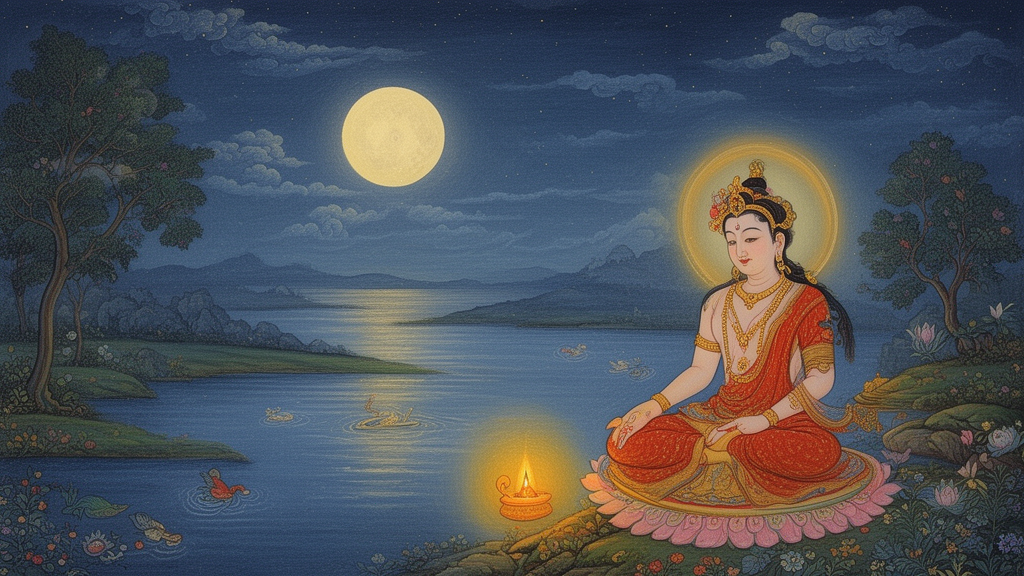
Readers searching for raja sutra sometimes encounter the Samadhiraja Sutra. This is a different text from a different religious tradition. The Wikipedia article identifies it as a Buddhist Mahayana sutra and gives its common title as King of Samadhis Sutra, also known as the Candrapradipa Sutra or Moonlamp Sutra after its main bodhisattva.
The Wikipedia article reports that some scholars have dated its redaction from the 2nd or 3rd century CE to the 6th century, the date of the earliest manuscript found, while others argue its date cannot be determined. It is described as a very important source for the Madhyamaka school and as cited by Indian authors including Chandrakirti and Shantideva. A commentary called the Kirtimala, composed by Manjushrikirti, survives in Tibetan.
The title itself is translated in different ways. The Wikipedia article gives several English renderings, including “The King of Samadhis, the Revealed Equality of the Nature of All Phenomena” and “the samadhi that is manifested as the sameness of the essential nature of all dharmas.” These differences reflect the translators’ choices, which is a reason to check the translator and edition when reading any English version.
The term “samadhi” appears in both the Buddhist sutra title and the Yoga Sutras’ final limb. The overlap is a matter of shared vocabulary, not evidence that the two texts are the same or that one is the source of the other. Keeping the traditions separate is the most accurate approach.
Belief, tradition, and scholarship
Discussion of Raja Yoga and the Yoga Sutras involves several kinds of claims, and it helps to separate them:
- Textual claims, such as the number of sutras, the four chapters, and the eight limbs, can be checked against the text and reputable reference works.
- Scholarly claims, such as the dating of Patanjali and the composition of the text, are contested and should be presented as ranges or disputes.
- Traditional claims, such as Patanjali as a semi-divine figure associated with Sheshanaga, belong to devotional and mythological tradition. Psychology Town describes this as a framing that reflects reverence, not as historical fact.
- Modern interpretations, such as presenting the Yoga Sutras as a psychology of consciousness, are valuable readings but are not the only ones.
Some modern articles describe the Yoga Sutras as a complete science of consciousness, a phrasing that is reasonable as an interpretation but should not be mistaken for a claim made by the text itself. Likewise, the claim that Hiranyagarbha was the original propounder of classical yoga appears in the Divine Life Society excerpt as a traditional view, not as a scholarly finding.
Why the term causes confusion
Several factors make the phrase raja sutra hard to interpret. First, raja is a common Sanskrit word meaning king or royal, and it appears in many compounds. Second, Raja Yoga is a name for a system, not a title of a sutra text in the sense the phrase might suggest. Third, online pages sometimes describe Raja Yoga in ways that mix Patanjali’s system with later or modern practices. Fourth, Buddhist and Hindu texts share some vocabulary, including samadhi, which can lead readers to assume a connection that a source does not establish.
When a page uses the phrase raja sutra, check three points: whether it refers to the Yoga Sutras or the Samadhiraja Sutra, which translation or commentary it uses, and whether it labels its claims as text, tradition, or interpretation.
A practical reading path
Readers who want to explore the Raja Yoga material in a structured way can follow a simple sequence. This is an educational approach, not a required practice, and different teachers and communities arrange their study differently.
- Read a general overview of the Yoga Sutras, such as the Wikipedia article, to learn the author, the four chapters, and the number-of-sutras question.
- Read a translation with a commentary, and note the translator. Compare at least two translations on the opening definition and on the eight-limb sequence.
- Study the ethical limbs (yamas and niyamas) before moving to more advanced material, since the sources describe them as foundational.
- Keep a note of which statements come from the text, which come from a commentator, and which are your own reflections.
- If you plan to practise asana, pranayama, or meditation, consider guidance from a qualified teacher within a lineage you trust, and be cautious of any claim that a practice guarantees a specific result.
The Divine Grace Yoga page offers an audio study of the Raja Yoga Sutras with a named teacher, and the Divine Life Society offers a text titled Raja Yoga by Sri Swami Sivananda. Both are teacher-led resources from specific organisations, and this post does not endorse either one. Their presence here shows that the text is studied in organised communities, not that either is the only valid approach.
Connections to related HindusGod.com topics
Readers interested in the meditative and devotional themes in this article may also want to explore related HindusGod.com content. The following are draft destinations in the current WordPress inventory and may not be public yet. Links will only work for readers once the owner publishes those posts.
- For the Sanskrit sense of meditation in a general sense, see Dhyana Sutra (URL to confirm as public).
- For devotional path language that often appears alongside yoga discussions, see Bhakti Sutra (URL to confirm as public).
- For a general overview of the word sutra and its meanings across traditions, see Meaning Sutra (URL to confirm as public).
- For Mahayana texts that discuss stages of the bodhisattva path, see Dasabhumika Sutra (URL to confirm as public).
- For another Mahayana sutra with a title that includes meaning, see Diamond Sutra Meaning (URL to confirm as public).
- For the Avatamsaka Sutra, a Mahayana text in a different tradition from the Yoga Sutras, see Avatamsaka Sutra (URL to confirm as public).
- For another Pure Land text with a similar naming pattern, see Amida Sutra Meaning (URL to confirm as public).
Other target drafts in the inventory were not linked because they concern texts or topics that did not match the content of this article.
Frequently asked questions
Is there a text called the Raja Sutra?
The sources reviewed for this post do not establish a text with that exact title. The closest documented material is the Yoga Sutras, which describe the system called Raja Yoga, and the Buddhist Samadhiraja Sutra. Readers should check any source claiming a separate Raja Sutra for its textual evidence.
Is Raja Yoga the same as the Yoga Sutras?
Not exactly. The Divine Life Society describes Patanjali as formulating the system under the name Ashtanga Yoga or Raja Yoga, and the Yoga Sutras are the text most closely associated with that system. Raja Yoga is best understood as the name of the path described in the Yoga Sutras, rather than as a separate scripture.
Are the Yoga Sutras and the Samadhiraja Sutra connected?
Both use the word samadhi, but the sources reviewed describe them as belonging to different traditions: the Yoga Sutras to Hindu philosophy and the Samadhiraja Sutra to Mahayana Buddhism. Shared vocabulary does not by itself show a direct textual link.
Summary
The phrase raja sutra is best read as a search term that points to the Raja Yoga system of Patanjali’s Yoga Sutras, to the Buddhist Samadhiraja Sutra, or to a general question about Sanskrit vocabulary. The Yoga Sutras contain 195 or 196 aphorisms, organised into four chapters and describing an eight-limbed path. Their date is disputed across sources, and the text is read in different ways by different traditions. The Samadhiraja Sutra is a separate Buddhist text with its own title, translations, and scholarly debate. Readers who study either should note translator, tradition, and whether a claim is textual, traditional, scholarly, or interpretive.
Sources and further reading
- Wikipedia, Yoga Sutras of Patanjali. Supports the sutra count, the four-chapter structure, compilation from multiple sources, the Yogabhashya attribution, and the dating discussion.
- Wikipedia, Samadhiraja Sutra. Supports the Buddhist Mahayana identification, alternative titles, dating disagreement, Madhyamaka influence, and translation variants.
- Psychology Town, Exploring Patanjali’s Yogasutra: The Foundations of Raja-Yoga. Supports the interpretive gloss of Raja Yoga as the royal path, the four padas overview, and the traditional Sheshanaga framing. Treat as a secondary explanatory source.
- Divine Grace Yoga, Raja Yoga Sutras. Supports the 196-sutra count as stated by that organisation, its compilation range, and the list of topics covered. Its dating differs from other sources.
- The Divine Life Society, Raja Yoga. Supports the description of Raja Yoga as Patanjali’s formulation, the Samkhya and Ishvara framework, and the Shad-Darsana classification. This is a devotional and teaching organisation’s presentation of the text.
- Yogitimes, Yoga Sutras Explained: What They Are & Why They Matter. Supports the description of the sutras as aphorisms and the 2nd-century BCE dating view it reports. Treat as a popular explanatory source; its dating differs from other sources.
Readers seeking primary scholarly editions or academic translations should consult a university library or reputable academic publisher. Those works were not retrieved or verified for this draft and are not cited here.