An online Upanishad is a digital edition of one of the Upanishads, the philosophical texts that close the Vedas and form the core of Vedanta. Reading them online is easy now, but the quality of a digital text depends on whether it gives the Sanskrit, a transliteration, a translation with the translator named, and some context. This guide explains what the Upanishads are, how their numbers are counted, what to check in an online edition, and how to read them with care.
In short: start with a reliable Sanskrit-and-translation edition, read one short text at a time, and note whether a claim comes from the scripture itself, from a commentary, from a living tradition, or from modern scholarship. Several online sources in this guide use different counts and descriptions, so the rest of this article explains those differences rather than choosing one as universal.
What the Upanishads are

The meaning of the name
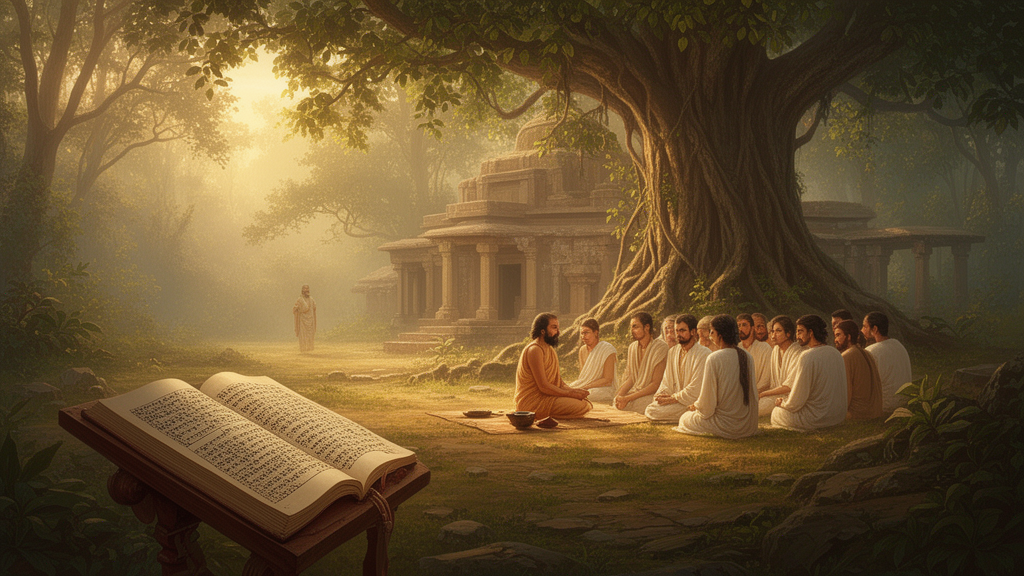
The Upanishads are described by several reference sites as the concluding portions of the Vedas, which is why they are also called Vedanta, meaning the end of the Vedas. The Vedapath reading site explains that the word is commonly understood to mean “sitting near” a teacher, and it presents the texts as dialogues between teachers and seekers on questions such as the nature of the self (Atman), ultimate reality (Brahman), and liberation (moksha). [1]
The Religions.app introduction adds that these teachings were transmitted orally from guru to student before being fixed in writing, and that the texts form a foundation for Vedanta and Hindu metaphysics. [4] This oral setting matters for reading online. A printed or digital page is a later form of a teaching that was originally heard, memorized, and discussed.
Scripture, commentary, and tradition
The Upanishads are regarded as part of shruti, the revealed or heard scripture in many Hindu traditions. The Mahakavya reading platform states this directly, and it also notes that Adi Shankaracharya, according to that page, described the main meaning of the Upanishad as Brahmavidya, or knowledge of Brahman. [5] That statement is a traditional interpretation presented by a devotional reading site. It is not a neutral historical finding, and readers who want to study the idea should compare it with academic translations and with Shankara’s own commentaries where available.
This distinction is useful throughout the post. When a website says that a text “teaches” something, ask whether the statement is a translation of the Sanskrit, a summary by an editor, a commentator’s reading, or a devotional explanation.
How many Upanishads are there?
The answer depends on the list being used. This is one of the most important points for anyone searching for an online Upanishad, because a website may present a list of 60, 108, 112, or more texts.
- Sixty texts: The Vedapath site presents 60 Upanishads, grouped into categories such as Vedic (General), Mukhya (Principal), Shaiva, Sannyasa, Shakta and Vaishnava, and Yoga. [1]
- 108 texts: The VedaSeek collection describes a set of 108-plus texts and provides a “canonical Muktika list” with associated Vedas and classifications. [2] The Mahakavya site also states that the total number is 108. [5]
- 112 texts: The Internet Archive lists a two-volume edition titled as 112 Upanishads with Sanskrit text, English translation, and an index of verses. [3] Its listing confirms the title and edition format; it does not by itself establish which canon the compilers used.
These numbers are not contradictions that one site has to be declared wrong about. Different editors and traditions have counted different sets. The Muktika list, associated with the 108 count, is one widely cited enumeration. Readers should treat any total as a description of a particular collection.
The principal Upanishads
Many introductions focus on a smaller group of principal, or Mukhya, Upanishads. Mahakavya notes that most scholars consider 13 Upanishads to be the main ones and lists them, including Isha, Kena, Katha, Prashna, Mundaka, Mandukya, Taittiriya, Aitareya, Chandogya, Brihadaranyaka, Shvetashvatara, Kaushitaki, and Maitrayani. [5] Religions.app also presents a set of principal Upanishads, including Isha, Kena, Katha, Mundaka, Mandukya, Taittiriya, Aitareya, Chandogya, Brihadaranyaka, and Prashna. [4]
The two lists overlap heavily, but they are not identical. For a beginner, the principal Upanishads are a practical starting point because many translations, commentaries, and academic surveys concentrate on them. The list should still be cited as the list used by a specific website or scholar.
Yoga, Shaiva, Shakta, and Vaishnava Upanishads
Vedapath groups the Upanishads into several categories, including Yoga, Shaiva, Sannyasa, and Shakta and Vaishnava texts. [1] This grouping reflects the way many later Upanishads are associated with particular concerns or traditions. The Adhwayataraka Upanishad, for example, is presented on the Vedapath site as a Yoga Upanishad associated with the Atharvaveda. [1]
The Devi Upanishad, listed on VedaSeek, presents the Goddess as the form of Brahman and describes her as the source of the world. [2] A reader who comes to this text from Shakta devotion should treat that description as a devotional and textual claim within the Upanishad. A reader studying the history of Upanishadic literature should also ask how and when such texts entered their categories.
What to check in an online Upanishad edition
Sanskrit, transliteration, and translation
A useful online edition should show the source language, a transliteration system, and a translation. Vedapath describes its texts as including Sanskrit, transliteration, translations, and enrichment in multiple languages. [1] Those features help readers compare words and check how a translator has rendered technical terms such as Atman, Brahman, and moksha.
Transliteration can differ from site to site. Words such as Upanishad, Atman, and Brahman may appear with or without diacritics, and some editions use alternate spellings for the same term. Before trusting a line, compare the Sanskrit word and its transliteration with another edition. If a translation is shown without the Sanskrit, look for the translator’s name, the year, and whether the text is an abridgement.
Verse numbering and section divisions
Upanishads are divided into sections, chapters, khandas, valli, or verses depending on the text and edition. A page with no reference system makes it hard to cite a passage. When you discuss a passage, record the edition, translator, and section number. Do not assume that numbering is the same across websites, because counts can differ.
The VedaSeek listing for the Taittiriya Upanishad, for example, identifies sections such as Shiksha Valli, Ananda Valli, and Bhrigu Valli in its title-level description. [2] That is a useful reminder that a single “Taittiriya Upanishad” may be read in named parts, and that a reader should cite the part being discussed.
Recitation and listening
Some online platforms offer recitation with translation. Vedapath lists recitation with translation as a feature. [1] Recitation is important in many Vedic and Upanishadic traditions, because the sound, pronunciation, and rhythm of the text are part of its transmission. A written translation cannot replace a teacher’s recitation, though it can help a reader follow the meaning.
Examples from the Upanishads
Examples help readers see how the texts are arranged and what kinds of questions they ask. The following examples are drawn from the sources cited here and are presented as summaries, not as direct quotations from a specific translation.
Isha Upanishad and the first text on many lists
Several lists place the Isha Upanishad first. VedaSeek lists Isha Upanishad as number one, also known as Ishavasya Upanishad, and describes it as an ancient Sanskrit text that is part of the Vedas. [2] Readers who begin with Isha can compare it with a short introduction before moving to longer texts. For a guided reading, see 10 Upanishad for a list-style overview of the number of texts, and 108 Upanishad for a fuller discussion of the 108-text count.
Adhyatma Upanishad and inward knowledge
Vedapath describes the Adhyatma Upanishad as a concise Vedanta treatise that turns the seeker from external ritual toward inward self-knowledge. Its central claim, as summarized there, is that Atman is Brahman. The same summary says that bondage arises from superimposition, where the mistaken “I” is placed upon body, senses, and mind. [1] This is a presentation of the text’s teaching according to a reading site, so a reader should compare it with the Sanskrit and a scholarly translation. For more on this text, see Adhyatma Upanishad.
Adhwayataraka Upanishad and discernment
The Adhwayataraka Upanishad, described by Vedapath as a Yoga Upanishad associated with the Atharvaveda, treats yoga as a path that culminates in saving knowledge. The summary says that breath, sense restraint, meditation, and samadhi are presented as supports for inner purification, but that discernment, or viveka, is treated as decisive. [1] This is a helpful example for readers who expect Upanishads to be only about meditation technique. According to the summary, the text subordinates technique to insight.
Taittiriya Upanishad and the description of Brahman
VedaSeek’s listing for the Taittiriya Upanishad includes a passage that says the knower of Brahman attains the Supreme, and that Brahman is truth, knowledge, and infinity. [2] Because this is an online summary and excerpt, it should be checked against the full Sanskrit and a translation before being quoted at length. For a related reading, see Taittiriya Upanishad Online.
Dating and scholarly disagreement
Readers often want a date for the Upanishads, but the evidence supports only broad and debated ranges. Mahakavya reports that modern western scholars place the Upanishads roughly between 700 and 600 BCE, while Lokmanya Balgangadhar Tilak is reported there to have argued from astronomy for a much earlier date of about 1900 BCE. [5] These are different positions in an ongoing debate. They should be presented as opinions with their evidence and methods, not as settled facts.
Mahakavya also says that the Upanishads are considered part of the Vedas, so the time of the Vedas is often treated as the time of the Upanishads in traditional thinking. [5] This is a traditional view. Scholars may distinguish the composition of different Upanishads, their redaction, and their later compilation. Because the texts developed over time, a single date for “the Upanishads” can be misleading.
Why the dating question matters
Dating affects how a text is read. A historian may ask what social and ritual setting produced a passage. A devotee may read the same passage as eternal revelation. A philosopher may focus on the argument. Each approach is valid for its own purpose, but they should not be merged without saying so.
Belief, tradition, and scholarship: a reading method
The Upanishads are often described as philosophical, and many readers come to them seeking answers about the self and ultimate reality. Religious readers may also treat them as scripture within a living tradition. Academic readers may study their language, structure, and historical context. Online pages often mix these approaches without saying so.
A practical method is to label each note as one of four types:
- Text: what the Sanskrit or a named translation says.
- Commentary: what a named commentator, such as Shankara according to a cited source, says about the text.
- Tradition: what a community, teacher, or lineage teaches or practices.
- Scholarship: what historians, philologists, or philosophers argue on the basis of evidence.
This method is especially important for Upanishadic concepts such as Atman and Brahman. Different schools of Vedanta interpret these concepts in different ways. A single website summary may present one interpretation. It is respectful to acknowledge that interpretation and also note that other readings exist.
Regional and language differences
Online editions are available in many languages. Vedapath states that its texts are enriched in 31 languages. [1] Mahakavya also has Hindi and Gujarati reading resources listed in its navigation. [5] Language choice affects how a reader meets technical terms. A Hindi or Gujarati translation may explain a term with a local word that is not an exact equivalent to the Sanskrit. Readers who want to study a particular term should keep the Sanskrit term beside the translation.
Regional reading communities may also have their own customs for reciting or studying the texts. Because the sources cited here do not describe a single universal practice, this article does not assume one. Where a local or community practice matters, ask a teacher, temple, or community center in that tradition.
A practical reading path
- Choose one edition with the Sanskrit text, transliteration, and a named translator or clear attribution.
- Begin with a short text, such as one of the principal Upanishads listed by Religions.app or Mahakavya, rather than the longest text on the list.
- Read one section at a time and write down the section number, edition, and translator.
- Look up unfamiliar Sanskrit words in a glossary or dictionary, and compare translations where terms differ.
- Separate what the text says from what commentators, teachers, or modern writers add.
- After reading, compare your notes with a scholarly introduction. For a broader view, see Meaning of Upanishad.
This path is slower than scrolling through a list, but it helps readers avoid mistaking a website summary for the text itself.
Related Upanishad guides on HindusGod.com
Readers who want to continue can explore individual text guides. The Chandogya Upanishad is one of the principal texts and has its own page at Chandogya Upanishad Online. The Brihadaranyaka Upanishad is also a principal text and is covered at Brihadaranyaka Upanishad Online. The Mandukya Upanishad, which is short and often studied for its structure, is covered at Mandukya Upanishad Online. Readers who prefer Hindi can start with Online Upanishad in Hindi.
Other related guides include Svetasvatara Upanishad Online, Aitareya Upanishad, Advaita Upanishad, and Ancient Upanishad. Each page should be checked for its current status before publication, because these are WordPress draft destinations and may not be public yet.
Common questions when reading online
Is every online Upanishad translation reliable?
No. Reliability depends on the edition. Look for the Sanskrit text, a transliteration, the translator’s name, and a clear statement of what the page includes. Compare key terms with another edition before relying on them in study or teaching.
Should I read the Upanishads in order?
There is no single required order for beginners. Many readers start with a principal Upanishad or a short text, then move to longer or later texts. Because the counts differ, choose a list and state which one you are following.
Can reading an Upanishad online replace a teacher?
Online editions can help with access to texts, translations, and comparison. Many traditions treat study with a qualified teacher and recitation under guidance as important. The sources cited here describe the Upanishads as teachings transmitted from teacher to student, so a teacher remains a valuable resource for readers who want guidance.
Closing takeaway
An online Upanishad can be a practical doorway into one of the foundational bodies of Hindu philosophical literature. The most useful habit is precision: know which text, which edition, which translator, and which section you are reading. Keep the scripture separate from commentary, tradition, and scholarship. When the counts or dates differ, present the differences clearly rather than choosing one as the only answer.
Sources and Further Reading
- Vedapath: Upanishads in English. Used for the description of the Upanishads as Vedanta, the sixty-text categorized listing, the Adhyatma and Adhwayataraka summaries, and the note on Sanskrit, transliteration, and translations. The site is a reading platform, so its summaries should be checked against the Sanskrit and a scholarly translation.
- VedaSeek: The 108 Upanishads. Used for the 108-plus collection description, the canonical Muktika list reference, the Isha Upanishad listing, the Devi Upanishad description, and the Taittiriya Upanishad excerpt.
- Internet Archive: 112 Upanishads, Sanskrit Text and English Translation. Used only to identify the title and format of this two-volume edition listing. The captured page text inspected did not establish the contents or translator details.
- Religions.app: The Upanishads. Used for the description of the Upanishads as foundational texts of Vedanta, the oral transmission from guru to student, and a list of principal Upanishads.
- Mahakavya: 108-Upanishad in English. Used for the 108 count, the traditional statement attributed to Shankaracharya, the list of 13 main Upanishads cited by Mahakavya, and the reported dating positions of western scholars and Tilak.
- Internet Archive: Upanishad (Sarvahitkari). Identified as a related Hindi-language Upanishad item. The captured page text inspected was mainly navigation, so no claim in this article relies on its contents.