The Narayana Upanishad in Tamil is a Tamil-script rendering of a short Sanskrit Upanishad that identifies Narayana as the supreme reality, the source from which gods, sages and all beings arise and into which they return. This guide explains what the text teaches, how the Tamil edition is usually presented, what it says about the eight-syllable Narayana mantra, and how different Hindu traditions read it. It also shows how to check Tamil editions against the Sanskrit original.

In short: the Narayana Upanishad is a Sanskrit text traditionally associated with the Krishna Yajurveda. It is read widely in Vaishnava devotion. Tamil readers usually encounter it as a transliteration or Tamil-script version of the Sanskrit, often with a Tamil translation or explanation. The Tamil form makes the text accessible for chanting and study, but the reliability of any edition depends on how carefully its Sanskrit and Tamil text have been prepared.
Quick answer: what the Narayana Upanishad is
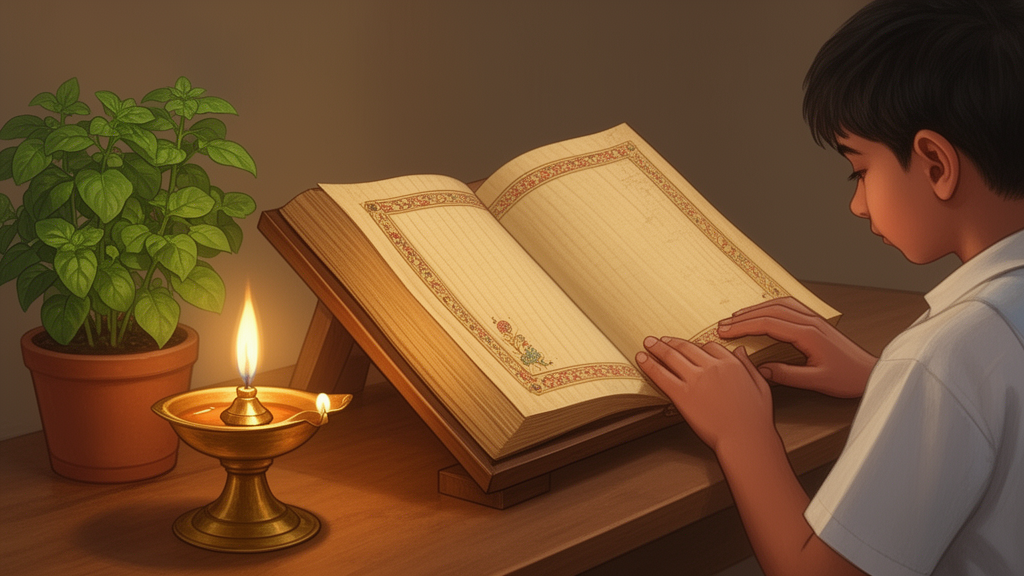
The Narayana Upanishad is one of the shorter Upanishads. Upanishads are commonly understood as the concluding portions of the Vedas and as core texts of Vedanta philosophy, though their exact organization and count vary by source. A stotra-collection page on this text lists it as a Krishna Yajurveda Upanishad and describes it as a foundational scriptural authority for Vaishnava philosophy and devotion.[1]
The central teaching is that Narayana is the supreme Brahman, the ultimate reality from which creation emanates. A devotional-literature website summarizes this point with the statement that all gods, all rishis and all beings are born from Narayana and merge into Narayana.[2] That statement is a translated summary on that site, not a word-for-word academic translation, so readers who need precise wording should consult a scholarly edition.
The text also gives special attention to the eight-syllable mantra Om Namo Narayanaya. The Tamil and Sanskrit texts on the devotional sites examined here present this mantra as a central teaching of the Upanishad.[2][5]
Where the text sits in the Vedic tradition
Krishna Yajurveda association
The Narayana Upanishad is generally linked to the Krishna Yajurveda. Yajurveda texts are known for their prose formulas used in ritual, and Krishna Yajurveda collections include both Samhita and Brahmana material and later Upanishads. The text’s association with this Veda is reported consistently across the sources reviewed here, but readers should note that detailed textual history, dating and manuscript lineage are matters for specialist scholarship and are not settled by devotional websites.[5]
Why the number of Upanishads matters for readers
Many devotional websites describe the Narayana Upanishad as one of the 108 Upanishads, a traditional listing that became popular in later Indian literary culture.[2] This list is useful for devotional and bibliographic purposes, but it should be treated as a tradition-based count rather than a fixed historical catalogue. Scholars distinguish between the principal Upanishads that commentators have long engaged with and the later, shorter texts that appear in extended lists.
Tamil Wikipedia’s description
The Tamil Wikipedia article on the Narayana Upanishad describes it as one of the smaller Upanishads in Hindu literature.[3] The visible portion of that page reviewed for this article did not provide enough text to confirm additional historical claims, so this guide does not rely on it for dating or authorship.
Reading the Tamil text
Transliteration and script
Tamil editions of Sanskrit texts usually use Tamil script with special marks or conventions for sounds that Tamil does not naturally express, such as aspirated consonants and some sibilants. Different websites transliterate the same Sanskrit differently. One Tamil-script edition may show Sanskrit accents, another may use simplified letters, and a third may add a Tamil translation.[2][4][5]
Readers may therefore see the same word spelled in several ways. For example, a devotional page may use a Tamil-script form for the opening syllable, while a English-script page may show the same sound in IAST or a simplified Roman form. These differences affect pronunciation and searchability, but they should not change the meaning of the text when the edition is accurate.
The peace invocation
Like many Upanishads, the Narayana Upanishad begins with a short peace invocation, often called the shanti mantra. The Tamil-script version on the devotional sites examined here opens with an invocation asking for protection, strength, and freedom from mutual hostility.[2][4] This invocation is also used in other Upanishads, so it is a useful example of how ancient texts were framed for recitation. Its exact wording varies between editions.
Choosing a Tamil edition
When comparing Tamil editions, check the following points:
- Source text: Does the edition state whether it follows the Krishna Yajurveda recension and which Sanskrit base text it uses?
- Script and transliteration: Are accent marks, long vowels and sibilants handled consistently?
- Translation: Is the Tamil meaning labelled as a translation, paraphrase or commentary?
- Attribution: Does the page credit the editor, translator or publisher?
- Update date: Is the page dated, so that corrections can be tracked?
Stotra-collection pages in this area often show a Tamil edition alongside versions in other scripts, which can help readers compare wording. A page showing a last-updated date is also useful, because corrections to Tamil and Sanskrit text are common across websites.[4][6]
Main teachings of the text
Narayana as the source of all
The text repeatedly presents Narayana as the origin of beings and powers. The devotional summaries describe Narayana as the source of breath, mind and the senses, and of elements such as space, air, light, water and earth. Brahma, Rudra, Indra, the Prajapatis, the Adityas, the Rudras and the Vasus are also described as coming forth from Narayana in the Tamil-script text reproduced on these websites.[2][4]
Readers should understand this as the text’s theological vision rather than a physical or historical account. It asserts a relationship of ultimate dependence: all things are described as having their origin, sustenance and dissolution in Narayana. This is a central doctrinal claim for Vaishnava readers.
Narayana beyond qualities
The text also describes the supreme reality in terms of negation and unity. Devotional summaries quote phrases indicating that Narayana is without qualities, without taint, without duality and beyond description, and that there is no second being.[2][4] These terms connect the text to the wider Upanishadic concern with non-dual reality. How they are understood depends on the reader’s tradition.
This is one place where traditions differ. Some Vaishnava commentators read such language as affirming Narayana as a personal Lord with auspicious attributes. Advaita readers may read the same statements as pointing toward a non-dual Brahman. This guide does not choose one reading as universal; it simply notes that the text is open to more than one interpretation.
Identification with Vishnu
The text says that the person who understands this teaching becomes Vishnu. In the Tamil-script version reproduced by these sites, the phrase is repeated in the final part of the teaching section.[2][4] Vaishnava readers often understand this as a statement about spiritual identity with, or closeness to, the supreme Lord. A non-devotional reader may read it symbolically or as an expression of knowledge. Neutral study should record the wording and then compare traditional explanations.
The eight-syllable mantra
Structure of the mantra
The eight-syllable mantra is Om Namo Narayanaya. The Tamil and Sanskrit passages on the devotional sites describe its parts: the single syllable Om, the two syllables of Namah, and the five syllables of Narayanaya.[2][5] The Upanishad uses this structure to explain the mantra’s significance.
- Om: described in the text as the single-syllable form of the teaching.
- Namah: described as the two-syllable element of reverence.
- Narayanaya: described as the five-syllable form of the divine name.
Meaning and devotional use
In Vaishnava practice, the eight-syllable mantra is widely recited as an expression of devotion and surrender to Narayana. The Upanishad’s own language describes the mantra as an essential teaching and connects it with liberation and spiritual attainment. The text’s wording on these points should be read as a religious claim within the tradition. It is not a scientific or empirical statement, and it should not be treated as a guarantee of any material result.
Many devotees use the mantra in daily japa, temple worship or private reflection. Teachers may recommend a particular number of recitations or a particular time of day, but such instructions are tradition-specific. Readers should follow guidance from their own lineage or temple.
Benefits described in the text: a devotional claim
The Upanishad contains statements about the spiritual benefit of studying it. In the Sanskrit-based Tamil version on bhaktinidhi, the text says that reciting it in the morning removes sins committed during the night, reciting it in the evening removes sins committed during the day, and reciting it at midday removes certain serious sins, and that the reciter obtains the merit of studying all the Vedas.[2] The same passage also speaks of attaining union with Narayana.
These statements belong to the text’s devotional and theological framework. They describe what the text claims for devotees. They are not promises of worldly success, health or protection, and a modern reader should not treat them as guaranteed outcomes. A respectful way to present them is to say: the text states this, and devotees within this tradition understand it in this way.
How the text is used in devotion
Chanting and study
The Narayana Upanishad is recited in temples, homes and study groups, especially in Vaishnava communities. Some readers chant the Sanskrit; others read a Tamil-script version to follow the meaning. Recitation practice varies by family, lineage and region. Some communities chant with fixed accent patterns learned from a teacher, while others read the text silently or aloud for reflection.
Combining study with the mantra
Because the text highlights the eight-syllable mantra, some devotees begin with the Upanishad and then continue with the mantra in japa. Others keep the two practices separate. Neither approach is universal, and readers should follow the custom of their own household or teacher.
Other texts
Readers interested in Narayana-centred literature may also explore the Maha Narayana Upanishad, which appears as a separate text on Tamil devotional pages.[6] It should not be confused with the shorter Narayana Upanishad. Its opening material, length and contents differ, and it has its own editorial history.
Related HindusGod.com reading
If you are comparing this text with other Upanishads, these HindusGod.com draft articles may be useful once they are published: Upanishad in Tamil gives a general introduction to the category, and Meaning of Upanishad explains the word itself. For the broader collection, see 108 Upanishad and 10 Upanishad, which discuss how different lists are counted.
For other Upanishads in Tamil, readers can compare Brihadaranyaka Upanishad in Tamil, Isha Upanishad in Tamil, Katha Upanishad in Tamil, Kena Upanishad in Tamil, Mandukya Upanishad in Tamil, Mundaka Upanishad in Tamil, Svetasvatara Upanishad in Tamil and Taittiriya Upanishad in Tamil. Each text has its own themes, so comparisons should be made with care.
For the same Upanishad in other languages, see Narayana Upanishad English, Narayana Upanishad in Hindi, Narayana Upanishad in Sanskrit, Narayana Upanishad in Telugu and Narayana Upanishad Gujarati. A Sanskrit or English edition can be useful for checking the Tamil transliteration.
Different traditions, different readings
Hindu traditions do not read every Upanishad in the same way. The Narayana Upanishad is especially important in Vaishnava devotion, where Narayana is worshipped as the supreme Lord or identified with Vishnu. Readers from Shaiva, Shakta, Smarta or other traditions may study it as a historically significant Upanishad, but they may not use it in the same devotional way.
Within Vedanta, commentators have long debated how Upanishadic statements about the supreme reality should be understood. A reader should distinguish three things: what the text says, what a tradition teaches about it, and what modern scholars conclude about its history. Devotional summaries often blend these levels. Careful study separates them.
Historical and scholarly questions
Questions about the Narayana Upanishad’s date, authorship and manuscript history are not fully answered by the sources reviewed for this guide. Devotional pages generally assume a traditional Vedic setting. Academic readers may ask how the text developed, how its manuscripts differ, and how it relates to other Krishna Yajurveda and Vaishnava texts. These are scholarly questions. They should not be answered with confident dates unless a specialist source supports them.
For that reason, this article avoids giving a date for composition. If you need historical detail, consult a critical edition or an academic study of Upanishadic literature.
Practical tips for readers
- Start with a reliable Sanskrit or Tamil edition that names its source and editor.
- Read a translation or explanation next to the Tamil-script text, so you can see which words are translation and which are commentary.
- Note the spelling used in each edition before searching for other versions.
- If you chant, learn pronunciation from a qualified teacher or recognized recording.
- Keep your own study notes separate from quotations and attributed translations.
Frequently asked questions
Is the Narayana Upanishad the same as the Maha Narayana Upanishad?
No. The Narayana Upanishad and the Maha Narayana Upanishad are different texts. Tamil devotional pages present the Maha Narayana Upanishad separately, with a different opening and contents.[6]
Why do Tamil versions look different from one another?
Different editions use different transliteration systems, accent marks, spelling choices and translations. Compare the Sanskrit text, check the editor or publisher, and look for a clear statement about the base text.
Is reciting the text guaranteed to produce a specific result?
No. The text makes devotional and spiritual claims within its tradition, but this guide does not treat them as guaranteed outcomes. Practice is best understood as devotion, study and reflection.
Should women or students use the text?
Access to Vedic and Upanishadic recitation has been regulated differently across communities and periods. Practice today varies by family, temple and lineage. Readers should follow the guidance of their own community or teacher, and personal study of a published translation is widely available.
Summary
The Narayana Upanishad in Tamil presents Narayana as the supreme reality from which all things come and into which they return. It is associated with the Krishna Yajurveda, is widely read in Vaishnava devotion, and gives central importance to the eight-syllable mantra Om Namo Narayanaya. Tamil editions make the text accessible, but readers should compare transliteration, translation and attribution. Devotional claims in the text should be described as traditional teachings, not as guaranteed outcomes, and historical questions should be studied through scholarly sources.
Sources and further reading
- Narayana Upanishad in Tamil, Bhaktinidhi: Tamil-script text, English summary, and the passage on the text’s devotional claims. Used for the text summary, the statement about gods and beings, and the benefit passage as the text’s own claim.
- Narayana Upanishad in Tamil, Stotrams: Describes the text’s Krishna Yajurveda association, its Vaishnava importance, and the eight-syllable mantra.
- Narayana Upanishat, Stotra Nidhi: Tamil-script text and transliteration, used to check the presence of the creation sequence and the Narayana identification passages.
- Maha Narayana Upanishad, Stotra Nidhi: Used only to distinguish the Maha Narayana Upanishad from the shorter Narayana Upanishad.
- Narayana Upanishad, Tamil Wikipedia: Used for the general description of the text as one of the smaller Upanishads; the full page was not inspected for this draft.
- Narayana Upanishad in Tamil, Vaidika Vignanam: Listed as a Tamil-language devotional resource; the page was not inspected for this draft and is not used for specific claims.