Lord Ram, also called Rama or Ramachandra, is one of the most widely worshipped deities in Hinduism. Within Vaishnava tradition he is regarded as the seventh avatar (incarnation) of Vishnu, and he is best known as the hero of the Sanskrit epic Ramayana. Devotees honor him as Maryada Purushottam, the ideal man who keeps his word, respects his duties, and rules with justice. This guide explains who Lord Ram is, how his story is told in the main texts, what his iconography means, and how festivals and temples keep his memory alive across India and beyond.

A short answer: Lord Ram is a central figure of Hindu devotion, the son of King Dasharatha of Ayodhya, and the protagonist of the Ramayana. Many Hindus see him as an embodiment of dharma, the principle of righteous conduct. Others approach him primarily as a historical or literary hero, and scholars treat the Ramayana as a composite literary work. Each of these approaches can be understood on its own terms, and this article keeps them separate.
Who Is Lord Ram?
In the devotional understanding found in many Vaishnava traditions, Rama is a form of Vishnu who descended to restore dharma on earth. The Britannica overview describes him as one of the most widely worshipped Hindu deities and as the epitome of moral virtue and royal conduct. It also notes that the name Rama is associated in Indian tradition with several figures, including Parashurama and Balarama, but that it is specifically linked with Ramachandra, the seventh avatar of Vishnu.
This distinction matters for readers who search for “Lord Ram” and encounter other names. Parashurama and Balarama are separate figures with their own stories, and devotees do not usually confuse them with the hero of the Ramayana. For a broader view of how Vishnu’s avatars are arranged, see the overview on Lord Narayan, which discusses Vishnu as the sustaining aspect of the divine.
Lord Ram is also called Sri Ram or Sriram in many devotional contexts. The honorific Sri is a respectful prefix, and the form Sriram is common in bhajans and in everyday greetings. Readers who want a more general introduction to his identity can also read About God Ram on this site, which covers the basics in a shorter format.
Names, Meaning and Variant Spellings
Rama appears in Sanskrit texts as Rāma, usually written with a long vowel that is simplified in English transliteration. Because English readers encounter several spellings, it helps to know the common variants:
- Rama or Rāma: the standard transliteration in academic and scriptural contexts.
- Ram: a common spelling in devotional English and in Hindi usage.
- Sri Ram or Sriram: a respectful form used in prayer and popular speech.
- Ramachandra: a name that emphasizes his lunar or moon-like associations in some texts and traditions.
Encyclopedic sources such as Wikipedia note that the name Rama has been given different etymological explanations, and that its meanings are discussed in commentaries rather than settled by a single authority. Devotees often associate the name with delight, pleasing presence, or the idea of the one in whom the mind finds rest. These are devotional and interpretive meanings, not a single academic consensus, so they should be read as belief and tradition rather than as proven etymology.
Why the Name Carries Such Weight
In devotional practice the name itself is often considered powerful. Many devotees repeat the name Rama in japa (repetitive recitation), chant it in bhajans, and write it in notebooks as a form of practice. The Ramacharitmanas, discussed below, is especially associated with the chanting of the divine name. Such practices are sincere expressions of devotion, but readers should understand that they are religious practices with tradition-specific meanings, not guaranteed outcomes.
The Story of Rama in the Ramayana
The Ramayana, traditionally attributed to the sage Valmiki, tells the life of Rama in several books (kandas). The outline below follows the widely known narrative as summarized in Wikipedia and in devotional retellings such as Hinduism Facts. Because the epic exists in many recensions and regional versions, details can differ from one telling to another. Where a detail is specific to one version, the article says so.
Birth, Youth and Marriage to Sita
According to the common telling, Rama is the eldest son of King Dasharatha of Ayodhya. Dasharatha had three wives, Kausalya, Sumitra and Kaikeyi, and his sons were Rama, Lakshmana, Bharata and Shatrughna. The Hinduism Facts account describes a ritual for obtaining a son that leads to the birth of the four princes. This ritual detail is recorded in popular retellings and is not a universal feature of every version, so it should be read as part of that particular narrative tradition.
As a young prince Rama is trained in weapons and in philosophy. In many accounts, the sage Vishvamitra asks Dasharatha to send Rama and Lakshmana to protect sacrifices from demonic disturbances. The princes defeat the demoness Tataka and other demons, and they then travel to Mithila. There King Janaka has arranged a swayamvara, a ceremony in which a bride chooses her groom, for his daughter Sita. The condition is that the suitor must string the bow of Shiva. Rama succeeds, and his marriage to Sita is celebrated. In devotional literature this marriage is a central image of an ideal union between husband and wife, and it is often portrayed as the wedding of Rama and Sita together.
Exile and the Abduction of Sita
The story turns when King Dasharatha decides to crown Rama as heir. A queen, Kaikeyi, who is recorded in the narrative as holding a boon from the king, asks that Rama be sent into exile for fourteen years and that her own son Bharata be made king. The Ramayana presents this as a painful conflict between a father’s promise and a son’s loyalty. Rama accepts the exile without protest in order to honor his father’s word. Sita and Lakshmana choose to accompany him to the forest. This choice is one of the reasons Rama is remembered as a model of filial duty and devotion to dharma.
During the exile, the demon king Ravana abducts Sita from the forest. Rama and Lakshmana search for her and form an alliance with Sugriva, the leader of the vanaras (forest beings), whose help includes Hanuman. Devotees often highlight Hanuman’s role as a servant-devotee of Rama, and the relationship is discussed in the article Lord Hanuman with Ram and Sita. For Hanuman’s own story and devotional tradition, see Lord Hanuman.
The War and the Return to Ayodhya
The Ramayana describes a great war in which Rama defeats Ravana and rescues Sita. Accounts differ on details of the battle and its episodes, and devotional retellings often add their own emphasis. After the war, Sita must prove her purity in a trial by fire in some versions. This episode has been read in many ways: some devotees treat it as a test of virtue, while modern readers often find it troubling and discuss it critically. Readers should note that interpretations of this episode vary significantly across traditions and communities.
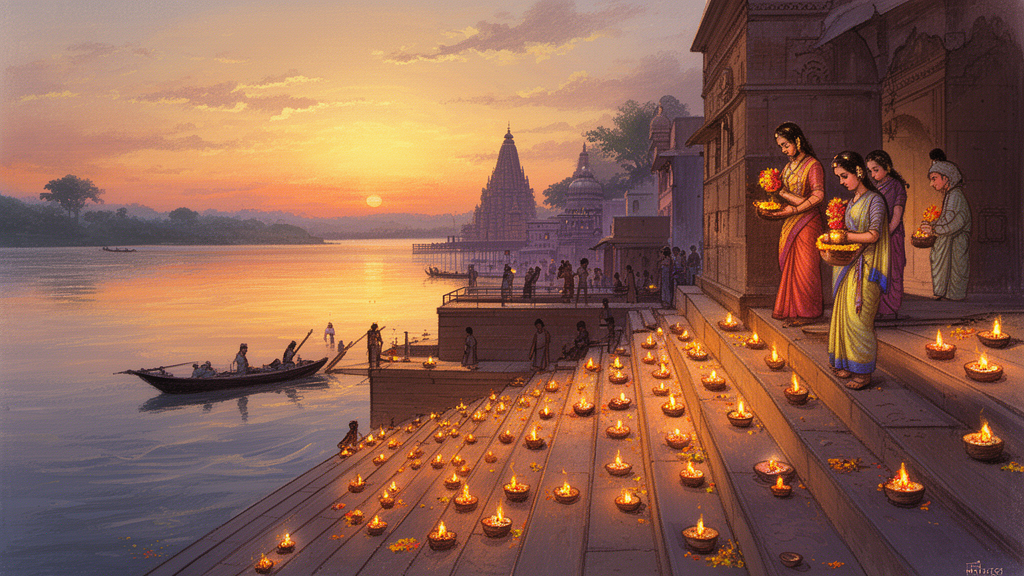
Rama, Sita and Lakshmana then return to Ayodhya. The people celebrate with lamps, and the return is widely connected to the festival of Diwali. Rama is crowned king, and his rule is remembered as Ramrajya, a phrase often used in India to describe ideal governance. Hinduism Facts describes Rama as a king who treated his subjects as his children. The later years of Rama’s life are described differently in various texts, and some traditions give them considerable attention while others focus on the ideal reign.
Variations Across Texts
One of the most important points for readers is that the Ramayana is not one fixed story. Wikipedia’s entry on the Ramayana lists several major sections of the textual tradition, including Tamil literature, the Adhyatma Ramayana, the Ramacharitmanas, the Yoga Vasistha and other Indian and Southeast Asian versions. The Valmiki Ramayana is the most frequently cited Sanskrit version, but other retellings change characters, events and even the ending. A reader who encounters a different version should not assume it is wrong; it may reflect a different textual or regional tradition.
Symbols, Iconography and Attributes
In temple sculpture, paintings and devotional images, Rama is usually shown with specific features that help viewers recognize him. Iconography is a visual language, and its meanings are shaped by scripture, commentary and local custom. The following features are common in many traditions, though not every image includes all of them.
- The bow and arrow: a symbol of his role as a protector and a warrior who defends dharma.
- Blue or dark complexion: often depicted in devotional art, linked to Vishnu’s iconography. Hinduism Facts describes his skin as bluish, a detail that reflects artistic and devotional convention.
- A calm, seated or standing posture: often used to express composure, restraint and righteous authority.
- Companions: Sita is usually beside him, and Lakshmana, often with a bow, is frequently shown at his side. Hanuman, sometimes kneeling in devotion, is a common presence in temple and home images.
- A crown or royal ornaments: indicate his status as the prince and later king of Ayodhya.
Readers who want to compare his artistic representation with other deities can look at Bhagvan Ram, which is one of the related pages on this site. The principle to remember is that iconography communicates meaning, but the specific style of an image can vary by region, school of painting and community.
Dharma and the Ideal of Maryada Purushottam
The title Maryada Purushottam is among the most common ways devotees describe Lord Ram. It is usually translated as the supreme man of honor or the ideal man who keeps the boundaries of proper conduct. The Britannica overview describes Rama as the epitome of moral virtue and royal conduct, and Wikipedia’s introduction identifies him as an embodiment of dharma.
Dharma is a broad term. In the Ramayana it includes duties of a son, a husband, a king and a warrior. Rama’s decision to accept exile in order to honor his father’s word is often cited as an example of filial duty. His loyalty to Sita and his efforts to rescue her reflect marital devotion as it is understood in the text. His treatment of subjects as children is cited as a model of kingship. These are examples that devotees and teachers draw from the narrative, and they are part of how the story has been taught for centuries.
Ethical Lessons Drawn from the Story
Many teachers present Rama’s story as a set of ethical lessons. The most common are the importance of truthfulness, the value of keeping one’s word, respect for elders and teachers, and the need to balance personal loss with duty. Such lessons are not limited to any one community, but how they are applied can differ. Some families emphasize the Ramayana as a source of household morality, while others approach it through temple worship or public performance.
It is also important not to present Rama’s conduct as beyond question. Modern readers, including many Hindus, discuss episodes that raise questions about justice, gender, and the treatment of Sita. Responsible discussion of Lord Ram acknowledges both the devotional reverence the figure inspires and the critical questions that scholars and readers raise about the text.
Worship, Hymns and Devotional Practice
Worship of Rama takes many forms. Some devotees maintain a home shrine with an image of Rama, Sita, Lakshmana and Hanuman. Others visit temples, participate in bhajan sessions, or read the Ramayana during particular months or occasions. Hindu worship is diverse, and there is no single required ritual that every Rama devotee performs.
Hymns and Texts of Devotion
The Ramacharitmanas, composed in Awadhi by the poet Tulsidas, is one of the most influential devotional retellings of the Rama story in North India. Wikipedia lists it among the major literary sources. Many families recite passages from it, and it is especially associated with the devotion to the name of Rama. The Adhyatma Ramayana, listed among the literary sources in Wikipedia, presents the story in a more philosophical and spiritual frame. Devotees who read these texts usually do so for devotional and ethical guidance rather than for historical information.
Hymns and chants addressed to Rama are sung in many languages. Bhajans are often simple, repetitive, and easy to join, which is one reason the practice is so widespread. Readers who want to explore the chanting tradition can see the broader description of devotional practice in the Wikipedia overview, which notes the variety of hymns associated with Rama.
Puja and Home Practice
A common home practice includes offering flowers, lamps and simple food before an image of Rama, reciting a prayer or hymn, and reading a passage from the Ramayana. The specifics vary widely. In some households the image is treated with great formality, while in others the practice is quiet and personal. Where a family follows a particular sampradaya (lineage or tradition), it may have its own guidance on mantras, timing and offerings. Readers who want a structured guide to home worship should consult their family or temple tradition, because these practices are tradition-specific rather than universal.
Major Festivals Connected with Lord Ram
Several festivals are closely associated with Rama. The dates and customs depend on the calendar, region and community, so readers should confirm the date for the current year with a reliable local calendar or temple before observing a festival.
Rama Navami
Rama Navami celebrates the birth of Rama. Wikipedia’s entry lists Rama Navami among the festivals of Rama, and it is widely observed in the lunar month of Chaitra in the traditional Hindu calendar. Observances often include fasting, temple worship, and the reading or singing of the Ramayana. Some communities hold processions, and temples may perform special rituals. The customs vary by region, so a family in one state may observe the day quite differently from a family elsewhere.
Ramlila and Dussehra
Ramlila is a dramatic performance of the Ramayana story, often staged over many nights in towns and cities across northern India. Many Ramlila performances culminate in Dussehra, also called Vijayadashami, when an effigy of Ravana is burned. Wikipedia’s section on the Ramayana’s influence describes Vijayadashami as a holiday associated with the epic. The meaning of Dussehra is understood as the victory of good over evil in many communities, but it is also observed with different local emphases, and not every region uses the same performance style.
Diwali
Diwali, the festival of lights, is connected in many traditions to the return of Rama, Sita and Lakshmana to Ayodhya. Lamps are lit to welcome them, and this custom is widely recorded in popular retellings and in the Ramayana tradition. However, Diwali is also observed as a festival associated with other deities and local traditions, including Lakshmi in many communities. Its meanings therefore differ among families and regions, and readers should not assume that every Diwali celebration centers on Rama.
Temples and Sacred Sites
Ayodhya is traditionally regarded as the birthplace and principal city of Rama, and it is the setting for much of the Ramayana. Many devotees visit Ayodhya as a pilgrimage site. Wikipedia lists Temples as a section of its Rama article, and the broader tradition includes temples across India and in other parts of Asia where Rama is worshipped.
Temples dedicated to Rama, Sita, Lakshmana and Hanuman appear in many regions, often with local customs. Some temples focus on the royal family, while others emphasize Hanuman as the devotee. Visitors who plan a trip should check opening hours, dress codes and festival schedules directly with the temple, because these details change and are not uniform.
Ayodhya and Contested History
Ayodhya is also the subject of long-running legal and political disputes over the site associated with the Ramayana. These disputes involve religious belief, historical claims and public policy, and they are discussed by scholars, courts and journalists in very different ways. This article does not take a side. Readers who want to explore these issues should consult primary legal records and multiple scholarly sources, because summaries from advocacy or opinion sites can present contested claims as settled.
Belief, Text, Tradition and Scholarship
Discussions about Lord Ram often mix four different kinds of statements. Keeping them separate helps readers understand what is being claimed and on what basis.
- Devotional belief: Many Hindus believe Rama is an avatar of Vishnu, a divine being who came to earth to restore dharma. This belief is central to worship, but it is a matter of faith rather than something a historian can confirm or deny.
- Scriptural text: The Ramayana and related texts describe Rama’s life. A statement about what the text says should be checked against a specific edition or translation.
- Regional and community tradition: Festivals, songs, dances and local customs differ from place to place. A practice in one community should not be presented as the practice of all Hindus.
- Historical and scholarly interpretation: Scholars study the Ramayana as a literary and cultural text, examine its development over time, and discuss whether any historical kernel lies behind the epic. Wikipedia notes that the historicity of Rama is debated, and that scholarship does not reach a single conclusion.
The Wikipedia article on Rama presents a section on dating and historicity, and it is a useful starting point for readers who want to see how these questions are discussed. For the textual background, the Ramayana entry on Wikipedia summarizes dating debates and the variety of versions. Readers who need authoritative scholarship should consult academic publications and university presses rather than relying on a single encyclopedia entry.
Common Questions About Lord Ram
Is Lord Ram the same as Lord Krishna?
No. Both Rama and Krishna are considered avatars of Vishnu in Vaishnava tradition, but they belong to different stories, texts and devotional traditions. Rama is the protagonist of the Ramayana, while Krishna is central to the Bhagavata Purana and the Bhagavad Gita. For a comparison, see Lord Krishna Meaning, which explains Krishna’s name and significance.
Is Rama worshipped only in North India?
No. Rama is worshipped widely across India, and the Ramayana has influenced arts, literature and performance across South and Southeast Asia. Wikipedia lists versions of the Ramayana in Cambodia, Indonesia, Malaysia, Myanmar, the Philippines and Thailand. The Tamil literary tradition and other regional traditions also have their own retellings.
Why is Rama sometimes shown with Hanuman?
Hanuman is a devotee and companion of Rama in the Ramayana, and he is often shown kneeling or standing near Rama in devotional images. This pairing expresses devotion and service. For more on Hanuman, see Lord Anjaneya, which covers the name Anjaneya and related traditions.
Should I read the Ramayana in full?
Many readers begin with a reputable translation or a summary, then move to a complete edition if they want to study the text. Because translations vary, it helps to check which version a translator used and whether it is a critical edition or a devotional retelling. Notes in a scholarly edition often explain differences between recensions.
Summary and Next Steps
Lord Ram is a central deity in Hinduism, honored as the seventh avatar of Vishnu and as the hero of the Ramayana. His story includes his birth in Ayodhya, his marriage to Sita, his exile, the rescue of Sita from Ravana, and his return and reign. Devotees celebrate him through hymns, temple worship, home practice and festivals such as Rama Navami, Ramlila, Dussehra and Diwali. Scholars study his story as a literary and cultural tradition, and many readers consider both the devotional and the critical perspectives.
For a next step, read the Ramayana or a reliable summary, compare two versions of the story, and explore related pages on this site such as Lord Hanuman with Ram and Sita or Lord Narayan to see how Rama fits within Vishnu’s wider devotional world. Where practices or dates matter for your own observance, confirm them with a trusted temple or local tradition.
Sources and Further Reading
- Lord Ram, Wikipedia: overview of Rama’s identity, literary sources, festivals and debates about historicity.
- Rama, Wikipedia: general overview of the figure, including etymology, legends and iconography.
- Ramayana, Wikipedia: overview of the epic, its attribution to Valmiki, its books, versions and influence.
- Rama, Britannica: encyclopedic summary of Rama as a deity and as the seventh avatar of Vishnu.
- Lord Rama, Hinduism Facts: devotional narrative summary of the Rama story, useful for tradition-based retelling rather than scholarly claims.