The wisdom of the Upanishads is the philosophical teaching found in a body of Sanskrit texts that form the concluding portion of the Vedas. These texts ask what ultimate reality is, what the self is, and how a person can reach liberation (moksha). In short, the Upanishads teach that the individual self (Atman) and ultimate reality (Brahman) are closely connected, and that realizing this connection is central to spiritual freedom. This article explains the main ideas, the stories used to teach them, the different ways traditions read them, and practical steps for beginners.
What the Upanishads are
The Upanishads are ancient Sanskrit texts that Hindu tradition places at the end of each Veda. Their emphasis differs from the earlier Vedic layers. Wikipedia describes them as the foundation of Vedanta and notes that they are classed as Shruti, the category of texts treated as revealed in traditional Hindu understanding (Wikipedia: Upanishads). Devotional and educational websites describe the same overall shape: earlier Vedic material focuses on hymns and ritual, while the Upanishads focus on jnana (knowledge) and moksha (Divine Aarti: Upanishads guide).
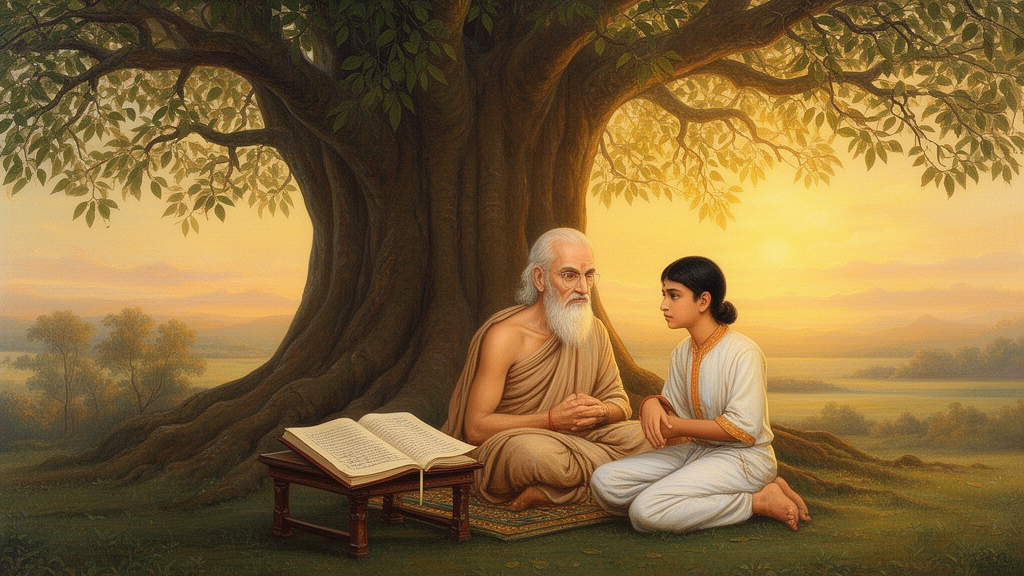
The word Upanishad is commonly explained as upa (near), ni (down), and shad (to sit). Several sources connect this to the image of a student sitting near a teacher to receive a teaching (Upanishad Gyanamrit; Hindu Mirror: Upanishads guide). The etymology is widely repeated, but the exact interpretation of the word is a matter of tradition and philology rather than a fully settled historical fact. Treat the explanation as a useful, commonly given reading.
Where the Upanishads sit within the Vedas
The Upanishads are not usually read as separate, free-floating books. They form the final part of each Veda. This placement explains the name Vedanta, often translated as “end of the Vedas” or “culmination of Vedic knowledge” (Hindu Mirror). Wikipedia discusses the association between the Upanishads and the individual Vedas as a classification question in its own right, which is a reminder that the links are part of the traditional and scholarly picture (Wikipedia).
A simple way to see the layers is as a sequence of contents within each Veda:
- Samhita: hymns, mantras, and prayers addressed to deities, used for devotion and invocation.
- Brahmana: prose explanations of ritual procedure and correct performance.
- Aranyaka: “forest texts” that interpret rituals symbolically and point toward inner meaning.
- Upanishad: philosophical teaching on the nature of reality, the self, and liberation.
This sequence is a commonly used model. Actual texts do not always fit neatly, and the boundaries between Brahmana, Aranyaka, and Upanishad material are discussed in scholarship. Readers should treat the list as an orientation, not a rigid rule.
How old are the Upanishads?
Many popular summaries date the Upanishads to roughly 800 to 200 BCE (Upanishad Gyanamrit; Hindu Mirror). Some summaries also describe an oral tradition that is much older than the written texts (Divine Aarti). These ranges are useful as approximations, but they should not be read as precise historical facts. Different Upanishads were composed and edited over long periods, and dating depends on the text, the method, and the scholar.
There is a difference between what a tradition says about these texts and what historians can establish. Tradition often treats the Upanishads as eternal revelation (Shruti). Historians study internal evidence, language, and the development of ideas to propose dates. Both perspectives matter, but they answer different questions.
How many Upanishads are there?
The number of Upanishads depends on how the category is defined. Sources commonly say there are more than 200 texts with “Upanishad” in the title, while tradition recognizes 108 as authentic in the Muktika list, which appears in the Muktika Upanishad (Divine Aarti). The Wikipedia article on the Upanishads also organizes the material into a Muktika canon with major and minor Upanishads (Wikipedia).
Within this larger group, the thirteen principal Upanishads, called Mukhya Upanishads, are the most widely studied. Devotional sources explain that they are commonly associated with major commentaries, especially those attributed to Adi Shankaracharya (Upanishad Gyanamrit; Divine Aarti). The principal list is the most common starting point for study. Readers should be aware that different traditions and editions can present the grouping differently.
The thirteen principal Upanishads named most often in devotional sources include the Isha, Kena, Katha, Prashna, Mundaka, Mandukya, Taittiriya, Aitareya, Chandogya, Brihadaranyaka, and several others. Each belongs to a particular Veda or recension, which is one reason the same teaching can appear in different wording across texts.
Core ideas: Brahman, Atman, Maya, and moksha
Most introductions to the Upanishads organize their philosophy around a small set of ideas. These terms are central, but they carry different nuances in different schools, so it helps to define them carefully.
Brahman
Brahman is the ultimate reality, the source and ground of all existence. It should not be confused with Brahma, the creator deity who appears in later mythology. A pronunciation and terminology note on one devotional site makes this distinction explicitly (Divine Aarti). Many Upanishadic passages describe Brahman in negative or paradoxical terms because it exceeds ordinary categories.
Atman
Atman means the self or inner essence of a person. The central inquiry of many Upanishads is the relationship between Atman and Brahman. The Hindu Mirror guide describes this relationship as the core of Upanishadic teaching (Hindu Mirror). How this relationship is understood is exactly where the major schools of Vedanta differ, as discussed below.
Maya
Maya is often explained as illusion or the power that veils ultimate reality, though the term also has cosmic and creative meanings in various sources (Divine Aarti). Interpretations vary considerably. Some schools treat the world as ultimately illusory, while others regard it as real but dependent on Brahman. A careful reader should not assume one meaning.
Moksha and jnana
Moksha is liberation from the cycle of birth and death, and jnana is knowledge, especially knowledge of the self and of ultimate reality. Several sources describe the Upanishads as focused on jnana and moksha rather than ritual performance (Hindu Mirror; Divine Aarti). In most Upanishadic framing, liberation comes through understanding and inner realization. The texts do not present this as a guaranteed material benefit, and their teaching is primarily about knowledge and transformation of understanding.
The Mahavakyas, or Great Sayings
The Mahavakyas are short statements from the Upanishads that are traditionally treated as condensed expressions of the non-dual teaching. Devotional and educational sites commonly list four. One of them, Tat Tvam Asi (“Thou art That”), is attributed to the Chandogya Upanishad (Upanishad Gyanamrit). The others are traditionally given as Aham Brahmasmi (“I am Brahman”), commonly linked to the Brihadaranyaka Upanishad, Prajnanam Brahma (“Consciousness is Brahman”), linked to the Aitareya Upanishad, and Ayam Atma Brahma (“This self is Brahman”), linked to the Mandukya Upanishad. These attributions are traditional and should be checked against a primary edition before being cited as scriptural fact.
Mahavakyas are easy to quote and difficult to understand without context. In traditional study, they are not treated as slogans. They are usually approached through the surrounding passage, a teacher’s explanation, and years of reflection. Reading them out of context can produce a distorted idea of what the text teaches.
Teachings through stories and verses
The Upanishads are not only abstract. Many of them teach through dialogues, stories, and memorable images. The examples below are drawn from summaries of specific texts and show how the teaching works in practice.
Katha Upanishad: Nachiketa and Yama
The Katha Upanishad presents the story of the young Nachiketa, who speaks with Yama, the lord of death. A devotional summary notes that the text distinguishes between the pleasant (preya) and the good (shreya) (Upanishad Gyanamrit). This distinction is a practical teaching: what gratifies the senses is not always what leads to lasting good. The story is one of the best-known Upanishadic narratives, and it is presented in a devotional setting in several sources.
Mundaka Upanishad: two birds on a tree
The Mundaka Upanishad distinguishes between higher (para) and lower (apara) knowledge, and a summary of the text describes its famous image of two birds on one tree, often read as the individual soul and the Supreme (Upanishad Gyanamrit). The image is an example of teaching through metaphor. Readers should note that the identification of the birds is an interpretation that commentators have discussed, so it is best presented as one reading of the image.
Taittiriya Upanishad: the five sheaths
The Taittiriya Upanishad describes the self in layers, often called the five sheaths (Pancha Kosha), moving from the physical body to subtler layers. A devotional summary notes that the text also contains the Ananda Valli section on bliss (Upanishad Gyanamrit). The layered model is a teaching device that invites inward reflection rather than a literal anatomy.
Mandukya Upanishad: the syllable AUM
The Mandukya Upanishad is among the shortest of the principal Upanishads, and summaries describe it as having twelve verses. It analyzes the sacred syllable AUM and the states of consciousness (Upanishad Gyanamrit). Its concise structure makes it a common starting point for study, though commentary is often needed to follow its argument.
Isha Upanishad: action and awareness
The Isha Upanishad is frequently described as short and concentrated. A devotional summary says it teaches that the Divine pervades creation and advocates a life that combines action with spiritual awareness (Upanishad Gyanamrit). Students often read it as an example of how Upanishadic thought does not always reject worldly life, but asks how one acts within it. Different traditions interpret the balance between action and renunciation in different ways.
Brihadaranyaka Upanishad: Yajnavalkya and Maitreyi
The Brihadaranyaka Upanishad includes a dialogue between the sage Yajnavalkya and his wife Maitreyi about the nature of the Self and immortality (Upanishad Gyanamrit). This dialogue is one of the best examples of the Upanishads presenting questions as shared inquiry. Note that the text’s wording is traditional and that interpretations of it differ among translators and commentators.
Prashna Upanishad: six questions
The Prashna Upanishad presents six seekers who approach the sage Pippalada with questions about creation, prana (life-breath), and supreme reality (Upanishad Gyanamrit). The question-and-answer structure shows a pattern common in Upanishadic teaching: a student asks, and the teacher responds in stages.
Schools of interpretation
One of the most important points for readers is that the Upanishads are read in different ways within Hindu philosophy. Wikipedia’s article on the Upanishads lists several schools of Vedanta, including Advaita Vedanta, Bhedabheda, Vishishtadvaita, and Dvaita (Wikipedia). These schools differ in how they relate Atman and Brahman, and in how they understand the world.
- Advaita Vedanta: generally associated with non-dual identity of Atman and Brahman, and linked with Adi Shankaracharya’s commentaries.
- Vishishtadvaita: qualified non-dualism, in which the self and the world are real but dependent on Brahman.
- Dvaita: dualism, in which the individual self and Brahman remain distinct.
- Bhedabheda: a view often described as difference-and-non-difference, which holds that the self is both distinct from and not separate from Brahman.
These are broad descriptions. Each school has its own internal debates and commentarial literature. When you read a teaching in the Upanishads, it helps to ask which school or commentator is being quoted, because the same passage can support different conclusions.
The Upanishads beyond India
Several sources note the influence of the Upanishads on thinkers outside India. A devotional website lists figures such as Schopenhauer, Emerson, Thoreau, and T.S. Eliot as readers or admirers of the texts (Upanishad Gyanamrit). The claim of influence is reported in that source, and readers who want to verify it should consult academic histories of Western reception. Wikipedia also includes a section on reception in the West, which can be used as a starting point (Wikipedia).
Reception is an important topic, but it should be kept separate from the internal history of the texts. Influence on later thinkers does not by itself establish what the Upanishads originally meant.
Belief, text, tradition, and scholarship
The wisdom of the Upanishads can be approached in several ways, and each approach answers different questions. Keeping them separate helps avoid confusion.
- Scripture (text): what the Upanishadic passage says, in the original Sanskrit and in a specific translation.
- Tradition: how Hindu communities, teachers, and lineages have received and taught the text, including devotional and philosophical commentary.
- Belief: what individuals or communities hold to be true about the self, Brahman, and liberation. Belief differs among Hindus.
- Scholarship: historical, linguistic, and philosophical study of how the texts developed and what they can be shown to mean.
A devotional summary and a scholarly study may both be valuable, but they are not interchangeable. For instance, a devotional site may present a particular interpretation as the meaning of the text, while a scholarly study may show that the passage is open to several readings. Good study notes which kind of claim is being made.
How to begin studying the Upanishads
Readers new to the Upanishads often find them dense. The following steps are one practical approach, not the only traditional method.
- Choose a manageable text. Many readers begin with a shorter principal Upanishad, such as the Isha or Mandukya, because they are concise. Longer texts like the Brihadaranyaka and Chandogya are better approached after some familiarity.
- Use a reliable translation with notes. Look for an edition that identifies the Sanskrit text, names the translator, and explains difficult terms. Check whether the translation is complete or selective.
- Read the surrounding passage. Do not stop at a striking line. The Mahavakyas and famous images make more sense within the dialogue or argument that surrounds them.
- Learn the key terms in context. Brahman, Atman, Maya, moksha, and jnana each change meaning between texts and schools. Keep a short glossary and note how each commentator uses the term.
- Compare commentaries. Read at least one traditional commentary and one modern academic study to see where interpretations agree or differ.
- Reflect and record. Many traditions emphasize contemplation (manana) and reflection after reading. A short journal of questions can help.
Many practitioners also study under a teacher or within a community. Traditional study of the Upanishads often assumes this kind of guidance, and readers who take up these texts devotionally may find a teacher, lineage, or study group helpful.
Frequently asked questions
Are the Upanishads the same as the Bhagavad Gita?
No. The Bhagavad Gita is a separate text, often treated as part of the Mahabharata, while the Upanishads are a collection of texts at the end of the Vedas. Hindu tradition and sources such as Wikipedia note that the Upanishads, together with the Brahmasutras and the Bhagavad Gita, are among the most influential texts in Hindu thought, so the two are often studied together (Hinduwebsite.com: The Wisdom of the Upanishads).
Do I need to know Sanskrit to read the Upanishads?
Not necessarily, but a basic familiarity with key terms helps. Many readers use translations with transliterated terms and glossaries. Where a translation is used, it is important to note the translator and to compare more than one version when possible.
Which Upanishad should I read first?
A common suggestion is to begin with a short principal Upanishad such as the Isha or Mandukya, paired with a commentary. This is a practical suggestion rather than a traditional requirement.
Do the Upanishads promise specific results like wealth or protection?
The Upanishads are primarily concerned with knowledge, self-understanding, and liberation. Sources summarizing them describe their aim as jnana and moksha rather than guaranteed material outcomes (Hindu Mirror). Readers should be cautious of any claim that study guarantees worldly benefit.
Key takeaways
The wisdom of the Upanishads centers on the inquiry into ultimate reality (Brahman), the self (Atman), the veiling power called Maya, and liberation (moksha). These texts appear at the end of the Vedas, teach through dialogue and metaphor, and have been interpreted in several schools of Vedanta. The best way to begin is to read a short text carefully, use a reliable translation, learn the key terms in context, and compare traditional commentary with modern scholarship.
If you want to explore related topics, you may find these HindusGod.com drafts useful as you continue reading. Their public status should be confirmed before you rely on the links: Upanishads overview (URL to confirm), 13 Upanishads (URL to confirm), 112 Upanishads (URL to confirm), About Upanishads in English (URL to confirm), Essence of the Upanishads (URL to confirm), and Aurobindo Upanishads (URL to confirm).
Sources and further reading
- Wikipedia: Upanishads. Overview of classification, schools of Vedanta, and reception; use as a starting point, then check cited references.
- Hinduwebsite.com: The Wisdom of the Upanishads. Essays by translator Jayaram V on the grouping of the Upanishads by theme and form.
- Upanishad Gyanamrit. Devotional summaries of the principal Upanishads and the Mahavakyas.
- Divine Aarti: Upanishads Complete Guide. Devotional guide used for Muktika count, terminology notes, and general framing.
- Hindu Mirror: Upanishads Core Teachings. Guide to Vedanta, Atman and Brahman, and study methods.
Readers who want to verify specific verses should consult a scholarly or traditional edition of the Sanskrit text with a named translator and commentary.