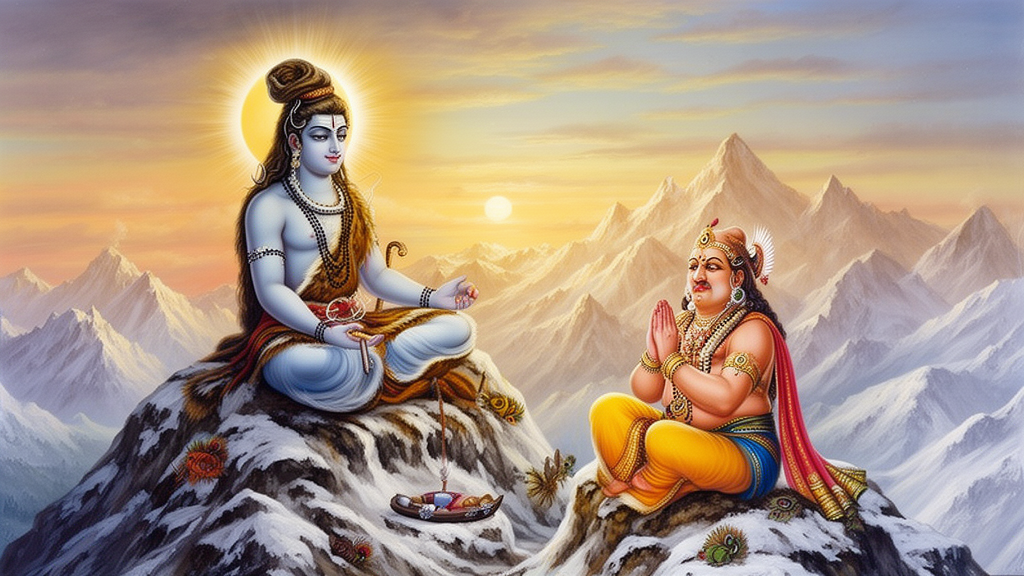
The Yoga Shikha Upanishad (also spelled Yogashikha Upanishad) is a Sanskrit text in the Upanishadic tradition that presents yoga as a path to liberation. In its best-known form, it is a long dialogue in six chapters in which Shiva teaches Brahma about a combined discipline called Maha Yoga, or “great yoga.” According to a translation summary on Hinduwebsite.com, this integration joins Mantra Yoga, Laya Yoga, Hatha Yoga, and Raja Yoga, and the text stresses that liberation requires both knowledge (jnana) and yoga practised together.
This article answers the basic questions a reader usually has: what the text is, where it sits within the Vedic literature, how its two versions differ, what it teaches, how scholars date it, and how its ideas relate to later Hatha Yoga and modern yoga. It also separates what the text says from later tradition and modern interpretation, because these are not the same thing.
The short answer: what the Yoga Shikha Upanishad teaches
The Upanishad belongs to a group of texts often called the Yoga Upanishads. Its central claim is that the bound soul (jiva) is caught in illusion (maya), and that freedom, which the text calls kaivalya, comes through a disciplined combination of inner knowledge and yogic practice. The text treats breath, sound, the body, and the mind as parts of one practice rather than separate techniques.
Three points are useful to keep in mind from the start:
- It is a yoga-focused Upanishad that discusses liberation, not a manual of physical postures.
- It has more than one version, and the length and placement of the text differ across manuscripts and anthologies.
- Its teachings are presented as revelation within a Shaiva framing, where Shiva is the teacher. Other Hindu communities may read yoga and liberation through different texts and teachers.
Name, meaning, and place in the Upanishadic literature
The title combines yoga and shikha, usually rendered as “crest,” “peak,” or “head.” Wikipedia gives the sense of the title as “peak of yogic meditation” in its article on the text, and Hinduwebsite.com glosses it as “head of the yogas.” Both readings point to the same idea: the text presents itself as the highest or most complete account of yoga.
The Sanskrit name appears in several spellings in published sources. The Wisdom Library page for a scholarly study lists variants including Yogaśikhopaniṣad, Yogaśikha-upaniṣad, Yogashikopanishad, and Yogasikhopanisad. When you search for the text, you may encounter any of these forms. They refer to the same work.
Sources differ on which Veda the text belongs to. Wikipedia notes that it is linked to the Krishna Yajurveda in some sources and to the Atharvaveda in others. Hinduwebsite.com and the veducation.world entry both place it in the Krishna Yajur Veda. The safest statement is that its association depends on the manuscript and anthology, and that the Krishna Yajurveda link is the most commonly reported.
The text is also listed in the enumeration of 108 Upanishads known as the Muktika. Wikipedia reports that it is number 63 in the serial order of that list. This is a traditional catalogue, so it tells you where the text is placed in a standard list, not how old it is.
Two versions: the short and the long text
Wikipedia describes two forms of the Yogashikha Upanishad. The short version is attached to the Atharvaveda in some anthologies. The long version is often found attached to the Krishna Yajurveda in Telugu-language anthologies. The long version has six chapters and is, according to the same source, about forty times longer than the short one.
The short version
The short version appears inside the first chapter of the long version. Readers who meet only the short text will therefore see a compressed statement of the same themes, not a different teaching. Because it is short, it is often treated as a separate Upanishad in collections that catalogue it on its own.
The long version
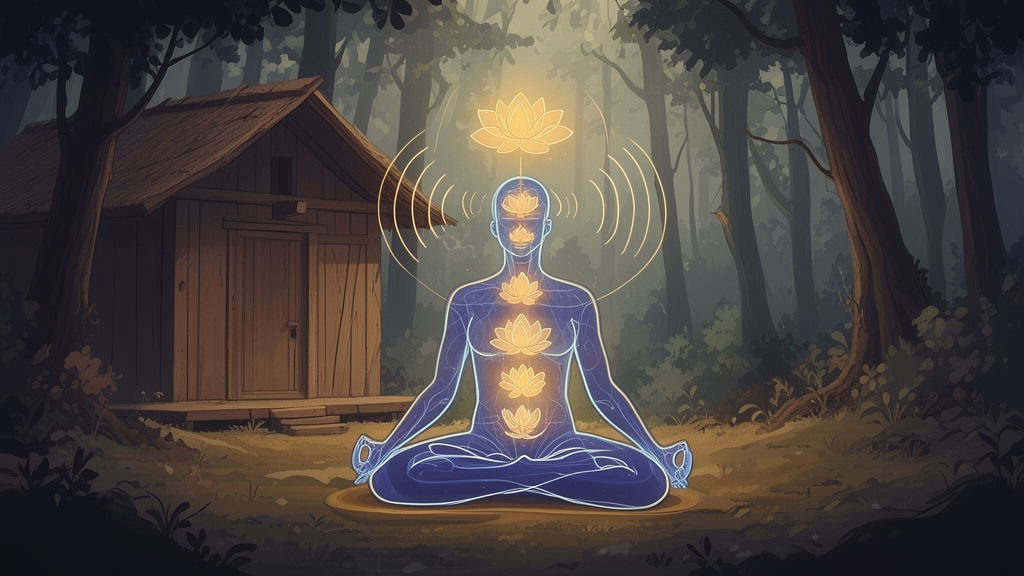
The long version is the form most often discussed in English-language summaries. Hinduwebsite.com describes six chapters that explore the inner sound (nada, also called Sabda Brahman in that summary), the body as a temple of Shiva, the locations of the chakras, and the view that the world of experience is illusory. Chapter contents and verse numbers vary by manuscript, so any specific verse reference should be checked against the particular edition you are using.
Why the versions matter for readers
Because verse counts range widely, a claim such as “the text has 390 verses” applies only to some manuscripts. Wikipedia gives the range as roughly 10 to 390 verses depending on the manuscript. Readers who compare editions should expect differences in order, wording, and extent.
The dialogue frame: who is teaching whom
The Sanskrit text, as reproduced on Sanskrit Documents, opens with a peace invocation and then a question. The first verses describe living beings as “bound by the net of illusion” (maya-jala) and ask how they may be freed. The next verse names the questioner as Hiranyagarbha and the answerer as Maheshvara, meaning Shiva.
Hinduwebsite.com summarises the same frame as a conversation between Lord Brahma and Lord Shiva, with Shiva as the World Teacher. The identification of Hiranyagarbha with Brahma is a common traditional equation, and the translation summary uses Brahma. A careful reader should note that this is a standard identification in many Hindu sources, not a point the Sanskrit verse itself spells out in the words quoted here.
The dialogue format matters for how the teaching is received. It presents yoga as something revealed by a divine teacher, which is a devotional claim. Modern academic readers treat such frames as literary and doctrinal choices that shape how a text wants to be read, rather than as a historical record of a conversation.
Maha Yoga: the four paths in one
The central teaching that the translation summaries highlight is Maha Yoga. The text presents it as a combination of four disciplines. Each contributes a different element, and the practice is meant to be integrated rather than chosen one at a time.
Mantra Yoga and the natural breath
According to Hinduwebsite.com, Mantra Yoga works with the natural hamsa breath. In many yoga traditions, the breath is associated with a sound that is continually repeated, and the practice of attending to this natural rhythm is a form of mantra. This is a tradition-based description of the practice, and readers should understand it as the text’s teaching rather than as a general rule across all yoga schools.
Hatha Yoga and solar and lunar energies
Hatha Yoga, in the summary, merges solar and lunar energies. These terms, often rendered as surya and chandra in later texts, refer to contrasting currents of breath and body energy. Hatha Yoga texts in later centuries developed detailed vocabulary for these currents. For the Yoga Shikha Upanishad, the summary is the best reliable guide, and specialists should consult the Sanskrit text for the exact wording.
Laya Yoga and the dissolving of individual awareness
Laya Yoga is described as the discipline in which individual consciousness dissolves into universal awareness. The word laya means absorption or dissolution. In this context it is a meditative absorption in which the sense of separate selfhood gives way to a wider awareness, a theme that appears across Vedanta-influenced yoga texts.
Raja Yoga and the union of principles
Raja Yoga is described as the discipline that unites masculine and feminine principles. Readers should handle this carefully. In many Shaiva and Tantric contexts, the imagery of Shiva and Shakti as complementary principles is central, but the summary does not provide enough detail here to explain the full doctrinal meaning. A good next step is to read the relevant chapters in a full translation or scholarly study.
Knowledge and practice: why both are needed
One of the most important ideas in the text is that knowledge alone is not enough and practice alone is not enough. Hinduwebsite.com’s summary says that liberation requires both jnana and yoga. The Sanskrit opening supports this theme: the text asks how a person can be freed from illusion and then describes knowledge and yoga as mutually needed.
This reflects a broader tension in Hindu philosophy between knowledge-centred paths and practice-centred paths. The Yoga Shikha Upanishad does not choose only one. It asks the seeker to study and understand the nature of the self while also training the body, breath, and mind. For a modern reader, this can be a useful way to see yoga as more than exercise, but it is also a religious claim about liberation that not every reader or tradition will share.
The text also warns against seeking siddhis, or extraordinary powers. The Hinduwebsite.com summary states that the teaching moves beyond the pursuit of siddhis toward complete realisation. This is a traditional caution, and it should be read as the text’s own priority. It is not a promise that yoga produces supernatural results, and it should not be used to claim that any practice will deliver a particular outcome.
The body, the inner sound, and the chakras
The summaries describe the body as Shiva’s temple and discuss the locations of the chakras. The inner sound, nada, is also central. Wikipedia notes that the ideas in the Yogashikha are shared with many Hatha Yoga texts, including those attributed to Gorakhnath.
These ideas belong to the text’s yogic and devotional framework. They describe a practitioner’s inner experience and map of the body in the terms of that tradition. They are not medical claims, and they do not describe anatomy as biology does. A scholarly study on the Wisdom Library site describes the text’s chapters as devoted to the faculties of the mind and internal body mechanisms such as chakras, along with the awakening of kundalini. That study is an interpretive work, so its descriptions should be attributed to its author rather than presented as the text’s own words.
For readers who want to explore these practices, the safest approach is to read the text itself in translation, learn from qualified teachers within a recognised lineage, and avoid treating descriptions of inner experience as guarantees of physical or spiritual results.
Dating the text: what scholars say
The date of the Yoga Shikha Upanishad is uncertain, and scholars give different estimates. Wikipedia reports that the Romanian scholar Mircea Eliade placed the text in a relative chronology. Eliade grouped it with texts such as the Maitri Upanishad, the didactic parts of the Mahabharata, and several early Yoga Upanishads including Brahmabindu, Tejobindu, and Yogatattva. He considered these earlier than a later group of yogic Upanishads such as the Yoga-kundali, Varaha, and Pashupatabrahma Upanishads.
Gavin Flood, as reported by Wikipedia, dates this text, together with other Yoga Upanishads, to probably the period from 100 BCE to 300 CE. This is an estimate based on textual and historical reasoning, not a documented date for a particular manuscript. Readers should treat it as one scholarly view among others.
These dates describe the composition of the text’s core teachings, not the age of every manuscript. Manuscripts may be much later, and the long and short versions may have different histories. A clear answer to “how old is it?” therefore has to include the phrase “scholars estimate.”
How scholars and tradition read the text differently
It helps to separate four kinds of statements that appear in discussions of this Upanishad:
- What the text says: for example, that Maha Yoga combines four paths, or that liberation requires both knowledge and practice.
- Traditional belief: for example, that the text is revealed by Shiva, or that its teachings lead to liberation.
- Historical and textual scholarship: for example, the dating estimates by Eliade and Flood, or the comparison with Hatha Yoga texts.
- Modern interpretation and devotional explanation: for example, how a contemporary teacher applies the text to daily practice.
Each category has its own kind of evidence. A devotional statement is not a historical finding, and a historical finding is not a devotional claim. Good reading keeps them separate.
Relationship to Hatha Yoga and modern yoga
Wikipedia notes that the ideas found in the Yogashikha are shared with many Hatha Yoga texts, such as those by Gorakhnath. This connection is one reason the Yoga Shikha Upanishad is often studied alongside later texts on physical and breath practices. Hatha Yoga, as a term and a set of texts, developed in a particular period and with its own vocabulary, and the relationship between early Yoga Upanishads and later Hatha texts is a subject of scholarly discussion.
The text also has a place in modern debates about yoga. The Wisdom Library study notes what it calls the modern misconstrual of yoga as mere physical exercise. Many people in the modern world practise yoga primarily for posture, fitness, or stress relief. The Upanishad itself presents yoga in a much wider frame that includes sound, breath, knowledge, and liberation. Readers who come to the text from a fitness background may find it useful to see how far the traditional concept reaches, while respecting that modern practice takes many forms.
Reading the text: translations and study resources
Several resources can help a reader approach the Yoga Shikha Upanishad responsibly:
- Hinduwebsite.com offers an English translation by P. R. Ramachander, with an introduction by Jayaram V. Its summary and introduction are useful for orientation, but readers should check the full translation for specific wording.
- Sanskrit Documents provides the Sanskrit text in Devanagari, along with other scripts and PDFs. It is useful for readers who want to compare the original wording with a translation.
- Wisdom Library hosts a 2015 critical study by Sujatarani Giri, which discusses the text in the context of yoga philosophy. It is an interpretive scholarly work and should be cited as such.
- Wikipedia provides a general overview with references, useful for dating and textual background, but its statements should be checked against primary and scholarly sources before citing in formal work.
When you read any translation, remember that translators make interpretive choices. Where a translation uses a word such as “liberation” for kaivalya or moksha, the choice reflects that translator’s reading. Comparing two translations often shows how much of a teaching depends on interpretation.
Related Upanishads on HindusGod.com
Readers interested in the Yoga Shikha Upanishad may also want to explore other yoga and Upanishad topics on HindusGod.com. The following pages are listed as target drafts in the site’s planning inventory. They may not yet be public, so check that each link opens before sharing it.
- For another yoga-focused text that discusses the chakras and the Shiva-Shakti theme, see Yoga Chudamani Upanishad.
- For a companion guide on yoga and kundalini themes, see Yoga Kundalini Upanishad in Hindi.
- For a Hindi-language overview of yoga Upanishads, see Yoga Upanishad in Hindi.
- For a general explanation of the word and concept, see Meaning of Upanishad.
- For a Yoga-related Katha Upanishad article that connects breath, self, and discipline, see Katha Upanishad Yoga.
- For readers exploring the wider list of Upanishads, see 10 Upanishad, 108 Upanishad, and Atharva Upanishad, since the short version of this text is associated with the Atharvaveda in some anthologies.
- For a broader Upanishad overview, see Aranyaka Upanishad and Aitareya Upanishad.
Practical reading guide
If you are reading the Yoga Shikha Upanishad for the first time, the following approach can help:
- Read a short overview, such as the Hinduwebsite.com summary, to understand the Maha Yoga framework.
- Choose one complete translation and read the first chapter slowly, noting the opening question about liberation.
- Compare the short version found in the first chapter with the long version to see how the material is arranged.
- Read one scholarly introduction to understand dating, manuscript variation, and the relationship to Hatha Yoga.
- If you intend to practise any breath, sound, or posture discipline described in the text, seek guidance from a qualified teacher within a recognised tradition and treat the text as one source among many.
This approach keeps the focus on understanding the text rather than on promised results. The Upanishad itself centres on liberation, and no reading or practice can be assumed to produce a specific material or spiritual outcome.
Frequently asked questions
Is the Yoga Shikha Upanishad about yoga postures?
Not primarily. The text discusses yoga as a path to liberation and includes breath, sound, and body-based practices within a wider integrated teaching. Postures are one part of the later Hatha Yoga tradition, which shares some ideas with this text, but the Upanishad’s main focus is the integration of knowledge and practice.
Which Veda does it belong to?
Hinduwebsite.com and veducation.world associate it with the Krishna Yajurveda. Wikipedia reports that some anthologies attach the short version to the Atharvaveda. The answer depends on which version and which anthology you are using.
Why do some sources say it has different numbers of chapters or verses?
Because manuscripts vary. Wikipedia reports that chapter counts range from one to six and verse counts from about 10 to 390, depending on the manuscript. The long six-chapter version is the one most often summarised.
How old is the text?
There is no single confirmed date. Mircea Eliade gave a relative chronology placing it among early Yoga and Sannyasa-related texts, and Gavin Flood estimates the period from 100 BCE to 300 CE for this group of Yoga Upanishads. These are scholarly estimates, and manuscripts may be later.
Summary and takeaway
The Yoga Shikha Upanishad is a Sanskrit text that presents yoga as an integrated path to liberation. In its long form, it teaches Maha Yoga, which combines Mantra, Laya, Hatha, and Raja yoga, and it insists that knowledge and practice must go together. Its textual history is complex, with short and long versions, varying manuscripts, and uncertain dates.
For readers, the most useful next step is to read a complete translation alongside a scholarly introduction, and to keep the teaching, the tradition, and the modern interpretation distinct. Where the text speaks of inner experience or liberation, present these as the tradition’s teachings rather than as guaranteed outcomes.
Sources and further reading
- Yogashikha Upanishad, Wikipedia: general overview of the two versions, the Muktika number, the dating views of Mircea Eliade and Gavin Flood, and the Hatha Yoga connection.
- Yoga Sikha Upanishad: Head of All Yogas, Hinduwebsite.com: translation summary by P. R. Ramachander with introduction by Jayaram V, describing the six chapters and the Maha Yoga framework.
- Yogashikha Upanishad, Sanskrit Documents: Sanskrit text in Devanagari, useful for checking original wording.
- Yogashikha Upanishad (critical study), Wisdom Library: a 2015 scholarly study by Sujatarani Giri discussing the text in the context of yoga philosophy and its title variants.
- Yoga Shikha Upanishad, veducation.world: brief reference noting its Krishna Yajur Veda association and its position as the 63rd Upanishad in the Muktika order.