The phrase vedas puranas itihas refers to three overlapping groups of Hindu sacred literature: the Vedas, the Itihasas (the epics, chiefly the Ramayana and the Mahabharata), and the Puranas. The Vedas are treated in Hindu tradition as the foundational revealed body of knowledge. The Itihasas and Puranas are story-based texts that carry history, mythology, ethics and devotion. Understanding how these categories differ helps readers avoid a common mistake: treating every story in every text as having the same kind of authority or the same kind of historical evidence.
This guide explains each category, shows where they overlap, and separates what the texts themselves say from traditional belief and modern scholarly interpretation. Readers will find that Hindu traditions do not all arrange these texts in the same way, so the explanations below describe widely cited patterns rather than a single universal system.
What the term Itihasa-Purana means
In Indian literary and religious usage, the paired term Itihasa-Purana joins two words. Itihasa is commonly rendered as “thus indeed it happened” or “this is what happened,” and the category is described in reference works as traditional Hindu accounts of past events. Purana means “ancient” or “old.” Together, the phrase names a body of narrative literature that presents the past through stories about gods, sages, kings and heroes.
Wikipedia’s overview of Itihasa-Purana describes it as traditional Hindu accounts of past events and places it within the wider Hindu literary and religious landscape, including the Vedic religion and the sampradayas (traditions) that later developed around particular deities and philosophies. Itihasa-Purana, Wikipedia This is a useful starting definition, but it is an encyclopedic summary. Readers who want to study the texts directly should consult the original editions and translations listed at the end of this article.
A scholarly study of Indian historiography, available as a book chapter summary, notes that the Itihasa-Purana tradition was one of the two main early historical traditions in India, alongside the epic tradition itself, and that the Puranic tradition provided a systematic dynastic history with details about kings and reign lengths. Itihasa-Purana Tradition in Ancient India, The Book Notes That source is a study aid rather than a primary text, so its claims about history should be treated as one interpretation among several. The same chapter also describes Vedic hymns as containing historical sense, a claim that scholars discuss in different ways.
The Vedas: the foundation of Hindu scriptural authority
The Vedas are usually grouped under the term Shruti, meaning “that which is heard.” Traditional Hindu teaching holds that the Vedas were revealed rather than composed by a human author, and that they form the highest authority for many orthodox schools. Smriti, meaning “that which is remembered,” is a second category that includes the Itihasas and Puranas. Puranas, Wikipedia The distinction matters because it shapes how traditional communities weigh one text against another.
The four Vedas are the Rigveda, Samaveda, Yajurveda and Atharvaveda. Each Veda is organized into layers. The Samhita is the collection of hymns or mantras. The Brahmanas explain ritual procedure. The Aranyakas are often described as forest texts that bridge ritual and meditation. The Upanishads are philosophical texts that are commonly associated with the end of the Vedas and are sometimes called Vedanta. Puranas, Wikipedia This layered structure explains why the word “Veda” can refer to the entire corpus, or to a particular hymn collection, or to the philosophical texts within it.
The Vedic hymns are older than the epics and Puranas in the traditional and most scholarly reconstructions. Readers should be cautious, however, about exact dates. Traditional chronologies and modern academic chronologies differ, and the dates discussed later in this article should be read as a range of views rather than settled facts.
Why the Vedas are often treated differently
In many traditional settings, the Vedas are associated with Vedic rituals, the Vedic sacrificial system, and the authority of the brahmin priestly tradition that preserved them. Hindu practice later developed many forms of worship that do not depend on Vedic ritual in the same way. Puja, temple worship, bhakti devotion and household observance draw on many sources, including the Puranas, and not every community uses the Vedas in the same manner.
This is one reason the relationship between the Vedas and the Puranas is important. The Puranas often retell Vedic themes in more accessible narrative form, while the Vedas themselves are more compressed, ritual-oriented and, in many cases, more difficult for ordinary readers to approach without guidance.
The Itihasas: the Ramayana and the Mahabharata
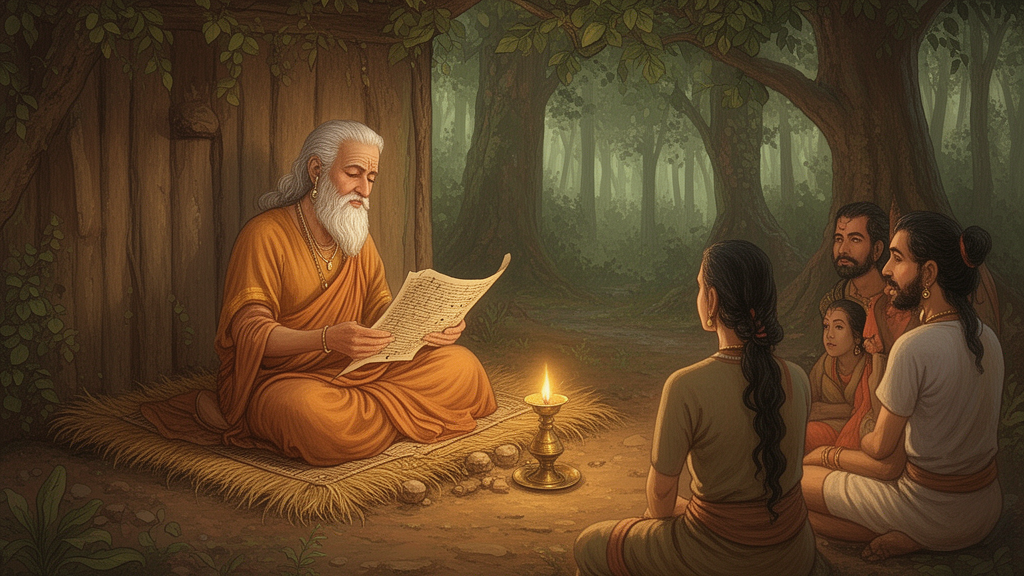
The Itihasas are most commonly identified with two epics: the Ramayana and the Mahabharata. Both are long narrative poems, and both are read widely in devotional and educational settings. A Hindu teaching resource notes that these two epics are read and retold by many religiously inclined Hindus, and that they have traditionally been shared through oral performance, including by specialist storytellers called Pouranikas in public gatherings. Ithihasas and Puranas, Hinduism Way of Life
The Ramayana
The Ramayana is traditionally attributed to the sage Valmiki. Its central narrative follows Rama, his exile, the abduction of his wife Sita by the demon king Ravana, and Rama’s eventual victory. Many devotional readers interpret the story as an illustration of dharma, or righteous duty, and the triumph of dharma over adharma. Itihasa and Puranas in Hinduism, Hindu Blog This interpretation is widely held, but it is a traditional and devotional reading rather than a single authoritative verdict that all communities share.
The Mahabharata
The Mahabharata is traditionally attributed to the sage Vyasa. Its main narrative concerns the conflict between the Pandavas and the Kauravas, culminating in a great war. The epic also contains extended philosophical and ethical passages, including the Bhagavad Gita, which presents a dialogue between Krishna and the warrior Arjuna on the eve of battle. Themes often discussed include duty, morality, devotion and the nature of the self. Itihasa and Puranas in Hinduism, Hindu Blog
The Bhagavad Gita is often read on its own, but it is part of the Mahabharata narrative. Readers who encounter it in isolation may miss the dramatic setting that gives Arjuna’s dilemma its meaning. Many modern editions present the Gita as a separate scripture, while the epic tradition places it within a larger story.
Authority and traditional status of the epics
A Hindu teaching site notes that the Itihasas, despite structural similarities to the Puranas, have traditionally been placed on a higher footing as basic and authoritative reference texts for understanding dharma. The same source gives two traditional reasons: that Valmiki and Vyasa are presented as people connected with the events they narrate. Ithihasas and Puranas, Hinduism Way of Life This is a devotional explanation of authority, not an academic proof. Scholars generally treat the authorship traditions as part of how the texts were received, not as settled biographical evidence.
The Puranas: mythology, cosmology and devotion
The Puranas are a large category of texts that focus on cosmology, mythology, genealogies, and religious teachings. They are often described as complementing the Vedas, presenting Vedic and philosophical ideas through stories, cosmic history, pilgrimage narratives, ritual details and accounts of gods and goddesses. Puranas, Wikipedia Itihasa and Puranas in Hinduism, Hindu Blog
The most common count is eighteen major Puranas, known as Mahapuranas. Traditional scholarship and devotional literature also refer to many lesser texts, sometimes called Upapuranas. Because the number and content of the Puranas have been discussed across centuries, readers should treat any specific list as a tradition-specific or edition-specific presentation.
The three broad groupings
Many introductions group the major Puranas according to the supreme deity they most strongly honour. The three commonly cited categories are:
- Vaishnava Puranas, focused on Vishnu and his avatars. Examples often cited include the Vishnu Purana and the Bhagavata Purana.
- Shaiva Puranas, focused on Shiva. The Shiva Purana is a commonly cited example.
- Shakta Puranas, focused on the Goddess or Shakti. The Devi Bhagavata and Devi Purana are commonly named in this group.
These groupings are useful for orientation, but they should not be read as rigid boundaries. Many Puranas contain material on several deities, and some are classified differently in different lists. The Markandeya Purana, for example, is often discussed because it contains the Devi Mahatmya, a text widely honoured in Goddess worship, even though the Purana as a whole is not solely devoted to the Goddess. Itihasa and Puranas in Hinduism, Hindu Blog
Examples of Puranic content
To understand how a Purana works in practice, consider the Vishnu Purana. A teaching summary describes it as focusing on Vishnu, his incarnations and the cosmological processes of creation and destruction. Itihasa and Puranas in Hinduism, Hindu Blog A reader studying this text might move from cosmic history to the stories of avatars, noticing how a single text links theology, cosmology and narrative. The same pattern appears in the Shiva Purana, which the same source describes as recounting the life and deeds of Shiva, his cosmic role and his devotees.
The Bhagavata Purana is widely known for its detailed narrative of Krishna’s life and miracles. Many Krishna devotees read or hear it regularly, and it has shaped devotional music, drama and storytelling across regions. This does not mean every Krishna tradition uses the Bhagavata Purana in the same way. Some communities privilege other texts, and interpretations of Krishna vary considerably.
How the Vedas, Itihasas and Puranas relate
The three categories share characters, cosmology and moral teaching, but they differ in form, purpose and traditional status. The following points summarize the widely cited distinctions:
- The Vedas are classed as Shruti. They include hymns, ritual explanations and philosophical texts, and they hold the highest scriptural authority in many traditional frameworks.
- The Itihasas are epic narratives, chiefly the Ramayana and Mahabharata. They combine history-like narrative with moral teaching and devotional content.
- The Puranas are narrative compendia that treat cosmology, genealogy, mythology and worship. They are usually grouped with the Smriti tradition in Hindu classification.
The Itihasas and Puranas are often discussed together because both are story-based and both belong to the Smriti category in many classifications. A Hindu teaching resource notes that the two epics and the eighteen Puranas are part of the Smritis, which also include other texts such as sutras and commentaries. Ithihasas and Puranas, Hinduism Way of Life The same source also notes that the Itihasas and Puranas are structured in similar ways, with stories, events and peripheral documents, but that the Itihasas have traditionally been kept on a higher pedestal.
A practical way to remember the difference is to ask what the text emphasizes most. The Vedas emphasize sacred sound, ritual and philosophical inquiry. The Itihasas emphasize human and divine action within a dramatic narrative about dharma. The Puranas emphasize cosmology, gods, worship, pilgrimage and genealogy across a wide range of topics.
History, memory and devotion: how to read the dates
Readers often ask when these texts were composed. The honest answer is that there is no single agreed date for any of the three categories as a whole, and dates for individual texts are debated. Traditional Hindu reckonings and modern historical scholarship should be kept separate.
Traditional chronologies
Some traditional sources assign very early dates to the epics. One Hindu teaching site states that the Ramayana belongs to the Treta Yuga, placing its events somewhere around 5000 BCE, and that the Kurukshetra war of the Mahabharata reportedly took place in 3139 BCE. The same source adds that there are contradicting viewpoints on these dates. Ithihasas and Puranas, Hinduism Way of Life These figures reflect a devotional and traditional chronological framework. They are not supported by a single accepted archaeological or textual proof, and they should be presented as traditional claims.
Manuscripts and textual history
The surviving manuscripts of many Puranas are much later than the traditional dates that some communities assign to their composition. A manuscript survey of the Puranas notes manuscripts dating from the fifteenth to the nineteenth century CE, a reminder that the physical copies consulted by most modern readers are not the same as the earliest oral or written forms. Puranas, Wikipedia Textual history involves layers of revision, expansion and regional variation, and scholars often describe the Puranas as living literature that changed over time.
The Book Notes chapter on Itihasa-Purana historiography adds that the Puranic tradition recorded dynastic genealogies and chronology, and that these Puranic lists are a major source of traditional historical information about kings and reign lengths. Itihasa-Purana Tradition in Ancient India, The Book Notes Historians use such genealogies carefully, because the lists may contain legendary elements, inconsistencies and symbolic numbers. A genealogy in a Purana is therefore a valuable historical text to study, but it does not automatically establish precise historical dates.
Reading these texts at three levels
A balanced approach distinguishes three levels of reading:
- What the text says: the narrative, verse or teaching as found in a specific edition or translation.
- What a tradition believes: the devotional, ritual or philosophical meaning a community attaches to the text.
- What scholars interpret: the historical, literary or comparative analysis based on manuscripts, archaeology and other evidence.
Keeping these levels apart helps readers appreciate both devotion and scholarship. A devotee may treat the Ramayana as sacred history, while a historian may study its literary structure and social context. Neither approach needs to erase the other, but they should not be mixed without labeling.
Regional and sampradaya differences
Hindu communities do not all read the Vedas, Itihasas and Puranas in the same order or with the same emphasis. Sampradayas such as Vaishnavism, Shaivism and Shaktism often privilege different Puranas, and regional traditions may have their own retellings, local sthala puranas, and oral performance styles. The Wikipedia entry on Itihasa-Purana lists many sampradayas and traditions, including Shaktism, Shaivism, Smartism and Vaishnavism, as part of the wider Hindu landscape. Itihasa-Purana, Wikipedia
For example, a Vaishnava reader may give special weight to the Bhagavata Purana and to Vishnu’s avatars, while a Shaiva reader may turn to the Shiva Purana and to Shiva’s cosmic role. A Shakta reader may read the Devi Bhagavata or the Devi Mahatmya as central texts. Smarta traditions often treat multiple deities as aspects of one supreme reality. None of these approaches is the only valid reading, and many families combine them.
Regional differences also affect how stories are told. The oral tradition of Puranikas, described in a Hindu teaching source, shows how epics and Puranas were performed in public gatherings and in family settings, including grandparents telling the epics to children. Ithihasas and Puranas, Hinduism Way of Life Such performance traditions may vary by language, region and community, so a single printed version should not be treated as the only authentic form of a story.
A practical reading path for beginners
Readers new to this literature often feel overwhelmed by the number of texts. A simple path can help, provided it is treated as one suggestion rather than a required curriculum.
- Start with the category. Learn the difference between Shruti and Smriti, and between the Vedas, Itihasas and Puranas. Our overview of the Vedas gives a starting point for the Vedic corpus.
- Read a clear summary of the epics. The Ramayana and Mahabharata are the most accessible Itihasas. Choose a translation that names the translator and explains its approach.
- Explore a few Puranas by deity. Begin with one Vaishnava, one Shaiva and one Shakta text rather than trying to read all eighteen at once. Our article on the eighteen Puranas and our guide to Vaishnava Puranas can help organize that choice.
- Compare the Vedas with the Puranas. Notice how Vedic themes reappear in later narratives. The discussion of the Puranas, Vedas and Upanishads is a useful next step.
- Check dates and claims. When a source gives a precise date, ask whether it is a traditional chronology, a manuscript date or a modern scholarly estimate.
This path also helps avoid one of the most common errors in online discussion: treating a single retelling as the only version of a story. A Purana may contain several versions of the same episode, and a modern summary may combine them.
Frequently asked questions
Are the Puranas and the Itihasas the same thing?
No. The Itihasas usually refers to the Ramayana and Mahabharata, while the Puranas are a separate group of texts that include the eighteen major Puranas and many others. Both are story-based and both are commonly classed as Smriti, but they differ in structure, focus and traditional status. Ithihasas and Puranas, Hinduism Way of Life
Which text is the oldest?
The Vedas are generally regarded as the oldest category in Hindu scriptural tradition, and the Rigveda is the earliest of the four Vedas in most accounts. However, the exact dating of Vedic texts, epics and Puranas is debated. Traditional claims and academic estimates differ, so the question is best answered with a range of views rather than one date.
Should a beginner start with the Puranas or the Vedas?
There is no single answer. Readers interested in ritual and early hymns may begin with the Vedas, perhaps with a guided translation. Readers drawn to stories, deities and devotion may find the Puranas or the epics more accessible. Many teachers suggest starting with a clear summary and then reading selected passages in a trusted translation.
Summary and next step
The phrase vedas puranas itihas names three related but distinct parts of Hindu literature. The Vedas are the foundational Shruti texts, the Itihasas are the epics that narrate past events through dharma-centered stories, and the Puranas are wide-ranging compendia of cosmology, genealogy, mythology and worship. Their traditional status, historical evidence and modern interpretations should be read separately.
For a next step, choose one text you want to understand better, find a reputable translation with clear attribution, and compare its narrative with a second source. Our related guides on the Puranas, the epics and Puranas and the Vedas and the Upanishads can help you continue.
Sources and further reading
- Itihasa-Purana, Wikipedia: an encyclopedic overview of Itihasa-Purana as traditional Hindu accounts of past events and its place within Hindu traditions.
- Puranas, Wikipedia: an overview of the Puranas, their grouping, their relation to the Vedas, and manuscript history. Read with the cited academic works listed on that page.
- Itihasa-Purana Tradition in Ancient India, The Book Notes: a study summary on Indian historiography, useful for understanding traditional historical claims. It is a secondary study aid, not a primary text.
- Itihasa and Puranas in Hinduism, Hindu Blog: a devotional comparison of the Itihasas and Puranas, including summaries of major texts.
- Ithihasas and Puranas, Hinduism Way of Life: a Hindu teaching resource on the epics, Puranas, oral tradition and traditional dates, with differing viewpoints noted.
For primary study, readers should consult critical editions and translations with clear attribution, such as those published by university presses or recognized scholarly series, and should check each claim against the specific text.