The phrase “the holy mountain book” most often refers to From the Holy Mountain, a 1997 historical travel book by William Dalrymple about Eastern Christian communities in the Middle East. It is not a Hindu scripture. This page explains what the book covers, why the title causes confusion, and where readers interested in Hindu sacred texts can look instead.
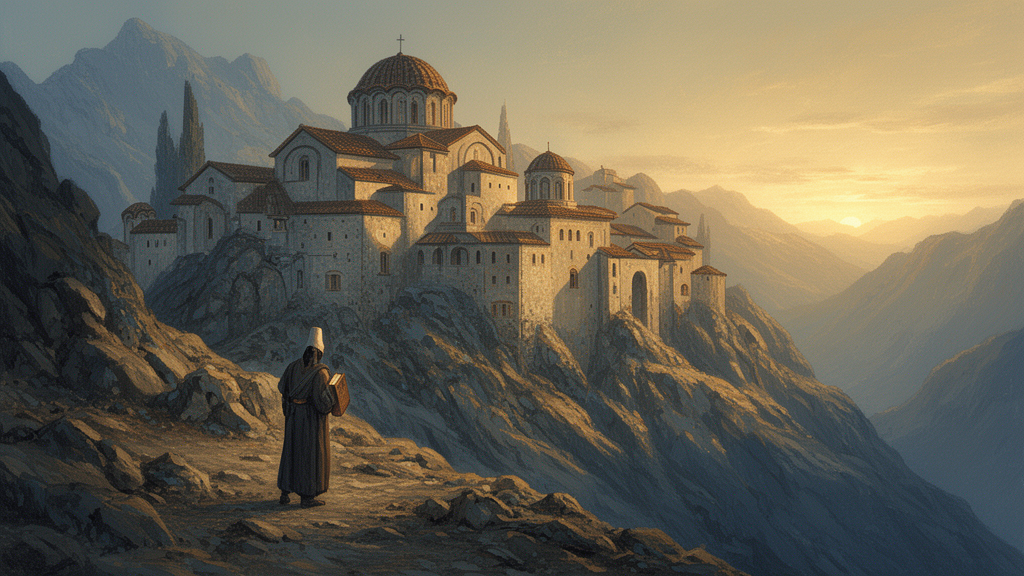
Direct answer: what is the book?

According to the Wikipedia entry for the book, From the Holy Mountain was published in 1997 by HarperCollins and is a historical travel book that deals with the affairs of the Eastern Christians (Wikipedia, From the Holy Mountain). Its full subtitle, given in Goodreads listings, is A Journey Among the Christians of the Middle East (Goodreads, From the Holy Mountain). Some listings use the subtitle A Journey in the Shadow of Byzantium, so readers may see either form.
Why the title is ambiguous
The title is shared by at least two well-known works that are unrelated to Hinduism:
- Dalrymple’s book (1997): a travel history of Eastern Orthodox and other Christian communities in the Middle East.
- Alejandro Jodorowsky’s film The Holy Mountain: a film that, according to Columbia University Press, helped shape the midnight-movie phenomenon and was relegated to underground circulation for decades before a limited restored release in 2007 (Columbia University Press).
Searchers looking for a Hindu holy book should not assume that either title is a Hindu text.
What the book covers
The route of John Moschos
Dalrymple structures the journey around the route of the sixth-century monk John Moschos, who travelled through the eastern Byzantine world and finished at Constantinople, where he wrote the Spiritual Meadow (Wikipedia). Goodreads describes the original journey as beginning in 587 A.D. and collecting the wisdom of stylites and desert fathers (Goodreads). The date and details of Moschos’s journey are from the book’s and publisher-listing descriptions, not an independent historical study checked here.
The modern journey
Dalrymple’s modern trip begins at Mount Athos in Greece in mid-1994 and moves through Istanbul, eastern Turkey, Syria, Lebanon, Israel, the West Bank, and Egypt. It ends at the monastery of Deir ul-Muharraq in Egypt (Wikipedia). The book describes communities that were under pressure from civil war and factional violence (Wikipedia).
Reception
Reviews are mixed on tone and detail. Ted Conover of The New York Times, quoted on Wikipedia, praised Dalrymple’s learning but said his enthusiasm for ecclesiastical detail sometimes obscured what would interest a general reader (Wikipedia). Readers who want a quick summary should treat reviews as opinion, not as evidence about the events described.
How this differs from Hindu holy books
Hindu sacred literature is a different category. It includes the Vedas, Upanishads, epics, and devotional texts, and its authority and use vary by tradition, region, and community. For Hindu readers, the relevant starting points are pages on specific texts rather than this travel history. The HindusGod.com drafts listed below cover several scripture-related topics; their live status should be confirmed before linking readers to them.
- Holy Book (URL to confirm: target draft, may not be public)
- Holy Book Meaning (URL to confirm: target draft, may not be public)
- Gita Holy Book (URL to confirm: target draft, may not be public)
- Geeta Holy Book (URL to confirm: target draft, may not be public)
- Buddhist Holy Book (URL to confirm: target draft, may not be public)
- Confucianism Holy Book (URL to confirm: target draft, may not be public)
- Daoism Holy Book (URL to confirm: target draft, may not be public)
- Avesta Holy Book (URL to confirm: target draft, may not be public)
- Bahai Holy Book (URL to confirm: target draft, may not be public)
- Holy Book in the World (URL to confirm: target draft, may not be public)
Practical takeaway
If you searched for “the holy mountain book” while looking for Hindu scripture, this book is probably not the text you need. If you are interested in Dalrymple’s work, it is a historical travel account of Eastern Christian communities and should be read as one author’s journey and interpretation, alongside other historical sources. Where a title is ambiguous, check the author, publisher, and subtitle before relying on it.
Sources and further reading
- From the Holy Mountain, Wikipedia: publication details, overview, route, reception.
- From the Holy Mountain, Goodreads: subtitle, publication date, and publisher-style description.
- The Holy Mountain, Columbia University Press: describes the unrelated Jodorowsky film.