The Holy of Holies is the innermost sanctuary described in the Hebrew Bible and later in the New Testament. In the Tabernacle and the Jerusalem Temple, it was the room behind a veil where the ark of the covenant was kept and where Jewish and Christian writers located the presence of God. Only the high priest could enter it, and according to Leviticus, only once a year, on the Day of Atonement. This article explains what the term means, where the scriptural passages appear, how later Jewish and Christian traditions read them, and why the phrase belongs to Abrahamic scripture rather than to Hindu texts.
A direct answer: what is the Holy of Holies?
The Holy of Holies, also called the Most Holy Place, is the inner room of the sacred structure described in the Hebrew Bible. In Hebrew it is usually given as qōdeš haqqŏdāšîm, often rendered as “the holiest place” or “most holy,” and a second term, devir, appears in some Jewish sources, meaning something like “the inner sanctuary” (Wikipedia, Holy of Holies; Bible Hub, What is the Holy of Holies in the Bible?).
In the scriptural account, the room held the ark of the covenant, was separated from the outer Holy Place by a veil, and was regarded as the place where God’s presence dwelt. The concept shaped Jewish worship of the Temple period and was reinterpreted in early Christian writing, especially in the Letter to the Hebrews.
The Hebrew terms and what they mean
Scholars and translators commonly note two Hebrew expressions. The first, qōdeš haqqŏdāšîm, uses a superlative form that conveys the sense of “holiest” or “most holy.” The second, devir, is used in the Hebrew Bible for the inner sanctuary of the Temple (Wikipedia, Holy of Holies).
English Bibles translate these terms differently. Some use “Most Holy Place,” which is common in modern Protestant and Catholic translations of the Old Testament. Others use “the inner sanctuary” or “the holy of holies.” The phrase “Holy of Holies” comes from the Hebrew superlative pattern. Readers who compare translations will notice that the content is the same even when the wording changes.
Why translation matters
A translation can shape how a reader understands the room. “Most Holy Place” emphasizes the place. “Holy of Holies” emphasizes the degree of holiness. Neither wording by itself settles the theological questions that later traditions debated. For a study of the passage, it helps to compare at least two translations and to note the Hebrew term behind each.
The Holy of Holies in the Tabernacle
The Hebrew Bible describes the Tabernacle as a portable sanctuary used during Israel’s journey after the Exodus. Its inner room was separated from the outer Holy Place by a woven veil. Exodus 26:33 describes hanging the veil under the clasps so that the ark of the testimony could be placed inside, with the veil dividing the holy place from the most holy place. This is a paraphrase of the verse, not a direct quotation; the wording varies by translation (Bible Maximum, Holy of Holies verses).
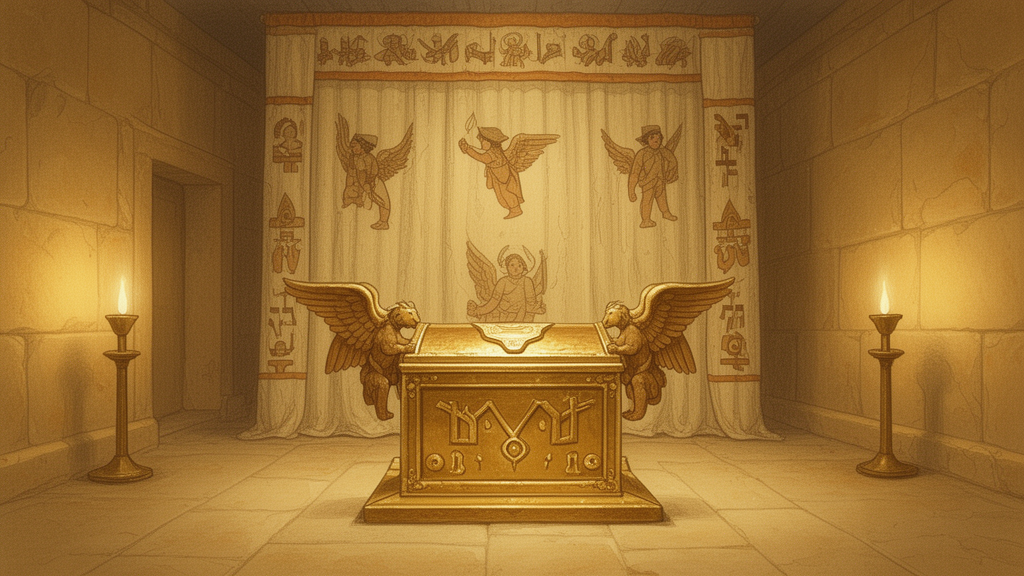
Exodus 25:18 to 22 describes the ark’s covering, the mercy seat, and the two cherubim at its ends. The passage also says that God would meet with Moses from above the mercy seat, between the cherubim on the ark. These verses are central to the Holy of Holies because they connect the room with the idea of God speaking from a specific place (Bible Maximum, Holy of Holies verses).
The ark, the mercy seat and the cherubim
According to the Hebrew Bible, the ark contained the Ten Commandments given to Moses on Mount Sinai (Wikipedia, Holy of Holies). Bible Hub’s summary also notes other items that Hebrews 9:4 associates with the ark: a jar of manna, Aaron’s rod that budded, and the tablets of the covenant (Bible Hub, What is the Holy of Holies in the Bible?). The mercy seat covered the ark, and the cherubim were placed at its ends.
Each element carries a different kind of meaning. The commandments are described as the covenant law. The mercy seat is the place where atonement was made. The cherubim are described as guarding or overshadowing the sacred space. Interpreting what these images meant to their original audience requires care, because the text describes their form and placement more clearly than it explains their symbolism.
The veil as a boundary
The veil was the boundary between the Holy Place and the Holy of Holies. Bible Hub’s summary describes it as finely woven linen with embroidered cherubim, citing Exodus 26:31 (Bible Hub, What is the Holy of Holies in the Bible?). The veil was also a practical barrier. Its function in the text is to separate ordinary priestly service from the most restricted space.
Who could enter, and when
The Hebrew Bible restricts entry to the Holy of Holies. Leviticus 16:2 records God telling Aaron not to come into the Holy Place inside the veil at any time, so that he would not die, because God would appear in the cloud over the mercy seat. The restriction is part of the instructions for the Day of Atonement (OpenBible.info, Holy of Holies topic).
The Letter to the Hebrews later summarizes this pattern. Hebrews 9:7 says that only the high priest entered the second part of the Tabernacle, once a year, and not without blood offered for himself and for the people’s unintentional sins (OpenBible.info, Holy of Holies topic).
The Day of Atonement in brief
Leviticus 16 is the main text for the annual ritual. Bible Hub’s summary states that the high priest sprinkled blood on the mercy seat to make atonement for himself and the people (Leviticus 16:14–15). Because this is a summary of a ritual described in detail in Leviticus, readers should consult the chapter itself or a reliable translation. Jewish tradition developed later practices around Yom Kippur after the Temple was destroyed, and those later practices should not be read back into the biblical text as if they were the same.
Solomon’s Temple
The First Temple in Jerusalem, traditionally called Solomon’s Temple, was built to house the ark. Wikipedia’s summary states that King Solomon was said to have built it for that purpose (Wikipedia, Holy of Holies). The Bible describes the building in 1 Kings 6 and 7. The inner sanctuary is described as a cube of twenty cubits in length, width and height, overlaid with pure gold (1 Kings 6:20, as shown in Bible Study Tools, Bible Verses about the Holy of Holies).
The same chapter describes a pair of olive-wood cherubim, ten cubits high, placed in the inner room with wings that touched one another at the center. The cherubim were overlaid with gold (1 Kings 6:23–28, as shown in the same Bible Study Tools page). These details show how the Temple version expanded the Tabernacle’s basic arrangement.
Placing the ark
Bible Hub notes that 1 Kings 8:6 describes the priests bringing the ark into its place in the inner sanctuary (Bible Hub, What is the Holy of Holies in the Bible?). This verse is often cited as evidence that the ark’s location was central to the Temple’s worship. Readers can verify the text in their own Bible translation.
The Second Temple and later references
After the Babylonian exile, the Temple was rebuilt. Bible Hub gives the approximate date as around 516 BC, but dates for the Second Temple vary among scholars, so the date should be treated as a traditional or approximate estimate rather than a precise fact (Bible Hub, What is the Holy of Holies in the Bible?). Bible Hub also refers to the first-century Jewish historian Josephus, who discussed Herod’s major renovations to the Temple precincts. Josephus is a historical source, not scripture, and his account should be read with that distinction in mind.
The Wikipedia article reports that, as part of the Temple in Jerusalem, the Holy of Holies was located on the Temple Mount. Its exact location is disputed. Some classical Jewish sources associate it with the Foundation Stone, which lies beneath the present Dome of the Rock. Other Jewish scholars argue that contemporary descriptions would place the Temple north or east of that spot (Wikipedia, Holy of Holies). This is a live scholarly and religious question, and it is not settled by a single source.
The Holy of Holies in Judaism
Jewish tradition described the Holy of Holies in cosmic terms. Wikipedia reports that Jewish traditions viewed it as the spiritual junction of the seven heavens and the earth, the axis mundi, or world-center (Wikipedia, Holy of Holies). This is a theological idea developed in later Jewish thought. It is not a statement that appears in the Hebrew Bible’s description of the Tabernacle.
After the Temple
The Temple was destroyed in 70 CE, and daily sacrificial worship in Jerusalem ended. Rabbinic Judaism developed prayer, study and ritual forms that did not depend on the Temple building. The Holy of Holies remained important in Jewish memory, liturgy and hope, but the practices of the Temple period were no longer performed in the same place. Wikipedia includes a section on Rabbinical Judaism and on synagogue architecture, which readers can consult for how these ideas developed (Wikipedia, Holy of Holies).
The Holy of Holies in the New Testament
The New Testament refers to the Temple veil and to the Holy of Holies in several places. Matthew 27:51 describes the curtain of the Temple being torn in two from top to bottom at the death of Jesus. Early Christian readers often connected this event with the ideas of access to God and the end of the old system of sacrifice (OpenBible.info, Holy of Holies topic).
Hebrews and the greater tabernacle
The Letter to the Hebrews gives the most extended discussion. Hebrews 9:11–12 describes Christ as a high priest who entered the greater and more perfect tent, not made with hands, once for all, through his own blood, and obtained eternal redemption. Hebrews 10:19–20 says believers have confidence to enter the holy places by the blood of Jesus, through a new and living way opened through the curtain (OpenBible.info, Holy of Holies topic). These are interpretive claims made within the New Testament, and they are part of Christian scripture rather than neutral historical description.
Believers as the temple
Bible Hub notes that 1 Corinthians 6:19 is often cited to describe the body of a believer as a temple of the Holy Spirit (Bible Hub, What is the Holy of Holies in the Bible?). Christian writers apply the temple language in different ways, and readers should distinguish the verse itself from later devotional applications.
How Christian traditions read the Holy of Holies
Christian churches do not share one interpretation of the Holy of Holies. Wikipedia’s article has sections on the Ethiopian Orthodox Tewahedo Church, the Catholic Church, the Eastern Orthodox Church, the Saint Thomas Christians, The Church of Jesus Christ of Latter-day Saints, and the Seventh-day Adventist Church, showing that the concept has been handled in different ways within Christianity (Wikipedia, Holy of Holies). This article does not summarize each church’s teaching, because those teachings would need to be verified from each church’s own official texts.
A reader studying a specific tradition should consult its catechism, liturgy, confession, or official commentary. The general biblical text is common to these traditions, but the theological meaning assigned to the Holy of Holies, the veil and the high priest can differ.
Scripture, commentary and modern interpretation
Several kinds of material are often mixed when people speak about the Holy of Holies. It helps to separate them:
- Scripture: the text of Exodus, Leviticus, 1 Kings, Matthew and Hebrews that describes the room, its furnishings and related rituals.
- Tradition: later Jewish and Christian teachings, such as the idea of the Holy of Holies as the axis mundi, or the typological reading of Hebrews.
- Historical evidence: archaeology and ancient writers such as Josephus, which can inform the Temple’s physical setting but do not prove every biblical detail.
- Scholarly interpretation: academic debate about dates, the Temple’s location, and how the text’s language should be translated.
- Devotional application: prayer, sermons and personal reflection, which are valuable for many readers but are not the same as the text.
Keeping these categories apart prevents a common error: assuming that a later devotional reading is what the original text says.
A note for readers on HindusGod.com
HindusGod.com focuses on Hinduism, and the Holy of Holies belongs to the Hebrew Bible, Judaism and Christianity. This article does not claim that the Hindu scriptures use the phrase or that Hindu temples have the same structure. Hindu temples do have an innermost sanctum, often called the garbhagriha, where the principal image of the deity is installed. That concept belongs to a different tradition, with its own architecture, rituals and textual sources. A responsible comparison would need separate verified sources for Hindu agamic, temple-architectural and devotional material, which are not part of the research gathered for this article.
Readers interested in Hindu scripture may find these pages useful: Hindu Scripture and Holy Gita. These are draft target pages and may not yet be public; the owner should confirm their status before relying on the links.
Practical ways to study the passage
- Start with Exodus 25 and 26. Read the Tabernacle instructions for the ark, the mercy seat, the cherubim and the veil.
- Read Leviticus 16. Note the restrictions on entry and the Day of Atonement procedures.
- Read 1 Kings 6 and 8. Compare the Temple’s inner sanctuary with the Tabernacle’s design.
- Read Matthew 27:51 and Hebrews 9–10. Notice how the New Testament reinterprets the veil and the high priest.
- Compare two translations. Check how each renders qōdeš haqqŏdāšîm and the terms for the veil and the mercy seat.
- Consult a commentary from the tradition you are studying. Note which claims are scripture, which are tradition and which are the commentator’s interpretation.
For a broader view of how scripture appears in devotional practice, see Scripture About the Holy Spirit and Holy Spirit the Revealer of Secrets Scripture. These pages address Christian scripture themes that connect with the New Testament discussion above.
Common questions
Was the Holy of Holies a physical room?
The biblical text describes it as part of a physical structure, the Tabernacle and later the Temple. The text also treats the room as the place of God’s presence, which is a theological claim. Historians and archaeologists debate how closely the written descriptions match the physical remains, and no reliable source reviewed here confirms the Temple’s exact dimensions beyond the biblical account.
Did everyone in ancient Israel enter it?
No. The biblical text restricts entry to the high priest, and only once a year on the Day of Atonement, according to Leviticus 16 and Hebrews 9:7. The exact rules are part of the priestly law as presented in those texts, and later traditions interpret them further.
Why do Christians read the veil as symbolic?
The New Testament, especially Hebrews 9–10, presents the veil as connected with access to God through Christ. Christian traditions differ in how they understand this. Readers should distinguish the New Testament text from the theological explanation offered by a particular church.
Summary and takeaway
The Holy of Holies is the innermost room of the Tabernacle and the Jerusalem Temple, described in the Hebrew Bible as the place of the ark and the dwelling of God’s presence, and separated from the rest of the sanctuary by a veil. Only the high priest entered, and only once a year, according to the biblical account. Jewish and Christian traditions developed the concept in different directions, while the Hebrew text and the historical questions about the Temple’s location remain matters for careful study.
For accurate study, read the biblical passages directly, compare translations, and separate scripture from tradition, history and devotional application. The most reliable path is to begin with Exodus 25 and 26, Leviticus 16, 1 Kings 6 and 8, Matthew 27 and Hebrews 9 and 10, and then consult scholarly or tradition-specific resources for deeper questions.
Sources and further reading
- Holy of Holies, Wikipedia: overview of Hebrew terminology, the ark, Jewish traditions, the Temple location debate and Christian traditions.
- What Does the Bible Say About The Holy Of Holies?, OpenBible.info: Bible verses on the topic, including Hebrews 9 and 10, Leviticus 16 and Matthew 27.
- What is the Holy of Holies in the Bible?, Bible Hub: summary of the Tabernacle, Solomon’s Temple, the Second Temple and New Testament references.
- Bible Verses about the Holy of Holies, Bible Study Tools: topical list including 1 Kings 6 descriptions of the inner sanctuary and cherubim.
- What Does the Bible Say About Holy Of Holies?, Bible Maximum: Exodus verses on the mercy seat, cherubim and veil.