“The holy mysteries” is a Christian term, not a Hindu one. In Eastern Orthodox and Byzantine Catholic usage, the Holy Mysteries are the sacraments, which the Church describes as visible signs of invisible grace. In Catholic devotion, “the mysteries” usually means the twenty scenes from the lives of Jesus and Mary that are prayed on the Rosary. This article explains both uses, shows how the sources define them, and notes where the phrase can be confused with Hindu vocabulary.
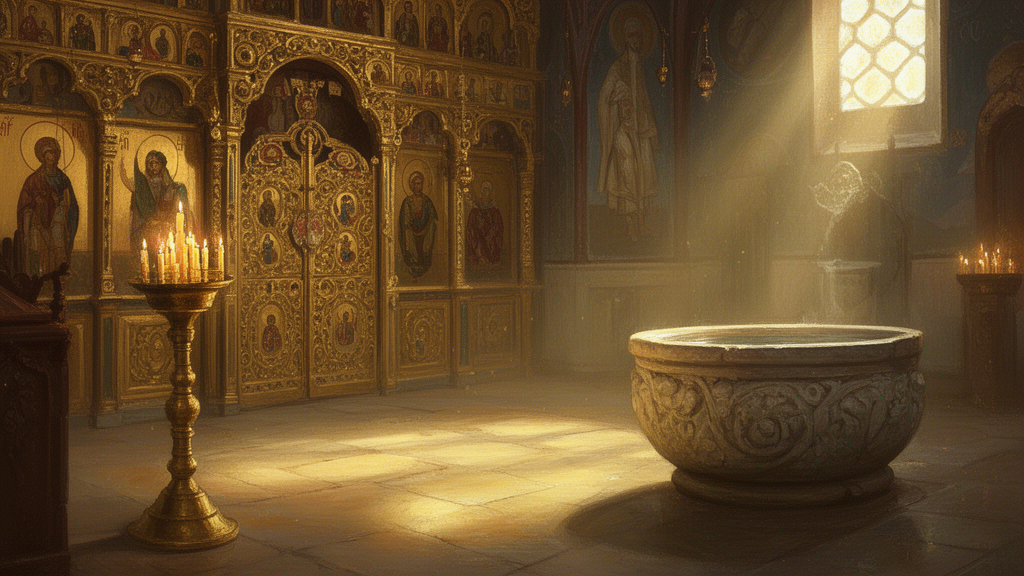
Quick answer: what “the holy mysteries” means
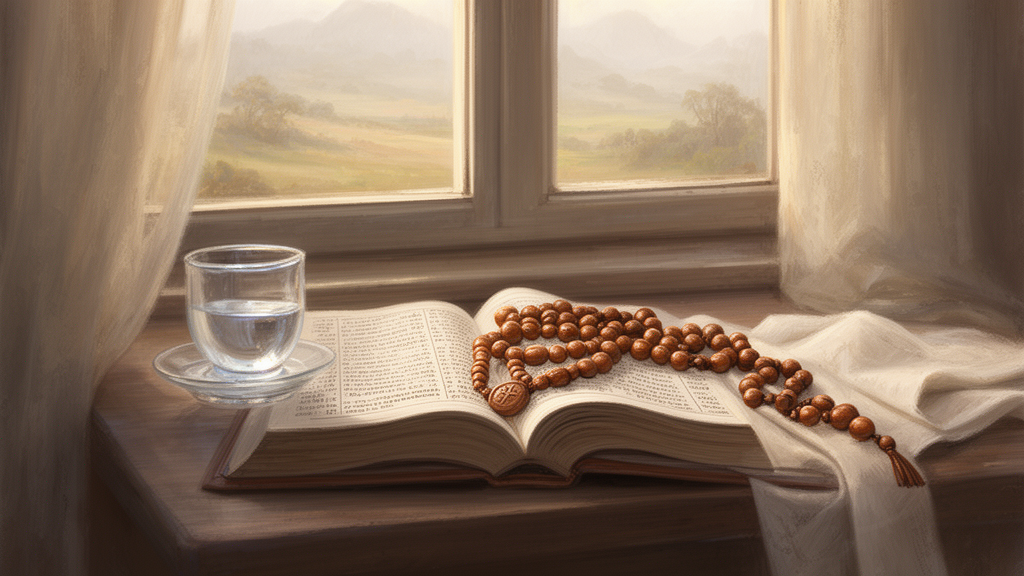
The phrase has two main meanings in Christian contexts. In the sacramental sense, the Holy Mysteries are the sacred rites through which the Church gives grace, and the Carpatho-Ruthenian catechism tradition cited by the Archdiocese of Pittsburgh’s Music and Cantor Institute describes them as “a visible sign of an invisible grace.” In devotional sense, the Mysteries of the Rosary are meditations on events in the life of Christ and Mary, grouped into four sets. The word “holy” is used in the first sense in Orthodox liturgical writing, while the Rosary is usually called “the Mysteries of the Rosary” rather than “the holy mysteries.”
If you searched this phrase while studying Hinduism, this page is not a description of a Hindu practice. The site’s Hindu-focused articles are a better place to explore sacred texts, deities, and puja traditions.
Why the phrase can confuse readers on a Hindu site
Readers who come from Hindu traditions often encounter words such as “mystery,” “sacred,” and “holy book” with meanings shaped by their own scriptures and practices. The English phrase “holy mysteries” does not map neatly onto a single Hindu term. Using it as if it described Hindu worship would be inaccurate.
Three points help avoid confusion:
- The phrase belongs primarily to Christian liturgy and devotion.
- Different Christian churches define sacraments and mysteries in different ways, even when they share vocabulary.
- The Rosary’s “mysteries” are not the same thing as the sacramental “Holy Mysteries.”
This article therefore keeps the Christian sources separate from any Hindu comparison. The research gathered for it does not include Hindu sources on mystery, sacrament, or sacred knowledge, so no such comparison is made here.
The Holy Mysteries in Eastern Christian teaching
The Holy Mysteries page from the Music and Cantor Institute (MCI) of the Archdiocese of Pittsburgh is written from within the Byzantine liturgical tradition. It begins by stating that the Lord “established the Church, and through it gave us the means of salvation,” and that “the most important of these are the Holy Mysteries.” The page then explains the meaning of the word itself.
What “mystery” means
The MCI page quotes Saint John Chrysostom (d. 407), who explained that a mystery is something in which we do not stop at what we see but consider something more. In his example, a person who hears of a bath may think only of water, while a believer considers the purification of the soul. The page is careful to say that believers can grow in insight into the great mysteries of faith, but cannot fully “comprehend” them. In its words, faith is the way understanding grows.
This is a religious account of meaning, not a historical or scientific one. It explains how the tradition reads the word, which is useful for understanding the phrase.
A sacramental definition
The same page quotes a definition from the first printed Carpatho-Ruthenian catechism in 1698, written by Bishop Joseph de Camillis of Uzhorod: a Holy Mystery is “a visible sign of an invisible grace instituted by our Lord Jesus Christ for the sanctification of man.” The page notes that this definition came from the Western Church, which uses the word sacraments, and that it has been widely adopted by both Catholic and Orthodox Churches. It also says that their detailed theological explanations may differ.
This point matters for accuracy. The definition is shared language, but the theology around it is not identical across churches.
The seven Holy Mysteries
According to the MCI page, from the seventh century onward the number of Holy Mysteries has generally been fixed at seven, a number it describes as sacred in the Old Testament and symbolic of completeness. The page begins its list with Baptism, which it describes as the mystery through which a person is washed clean of sins and made a child of God by adoption, and becomes a member of the Church.
The excerpt available for this article does not give full descriptions of the remaining six. Readers who want those details should consult the full MCI page directly rather than relying on a summary here.
Belief, tradition, and scholarship
The MCI page is a liturgical educational resource. Its statements about the seven mysteries reflect church teaching and tradition. The number seven being “generally” fixed from the seventh century is a historical claim, but the page presents it as a summary, not as a detailed historical study. Readers should treat church teaching, historical development, and academic interpretation as related but separate kinds of knowledge.
The Mysteries of the Rosary in Catholic devotion
The other common meaning of the phrase comes from Catholic prayer. The Holy See’s official page on the Rosary explains that the Rosary is made up of twenty “mysteries,” which it defines as significant events or moments in the life of Jesus and Mary. Following the Apostolic Letter Rosarium Virginis Mariae, these mysteries are grouped into four series.
The four sets and their prayer days
The Vatican page sets out the traditional weekly pattern:
- The joyful mysteries, recited on Mondays and Saturdays.
- The mysteries of light, recited on Thursdays.
- The sorrowful mysteries, recited on Tuesdays and Fridays.
- The glorious mysteries, recited on Wednesdays and Sundays.
The page also quotes Rosarium Virginis Mariae, paragraph 38, which says this arrangement “is not intended to limit a rightful freedom in personal and community prayer,” and that spiritual and pastoral needs, as well as particular liturgical celebrations, may call for adaptation. Many Catholics follow the weekly pattern, while others choose a set according to their prayer or intention.
The Joyful Mysteries
According to the Catholic Online prayer resource, the joyful mysteries are: the Annunciation of the Lord to Mary, the Visitation of Mary to Elizabeth, the Nativity of our Lord Jesus Christ, the Presentation of our Lord in the Temple, and the Finding of Jesus in the Temple at age twelve.
The Mysteries of Light
The Catholic Online page lists the luminous mysteries as: the Baptism in the Jordan, the Wedding at Cana, the Proclamation of the Kingdom, the Transfiguration, and the Institution of the Eucharist. The Guide Catholic blog, which is a devotional resource rather than an official document, reports that Pope John Paul II added these five mysteries in 2002. That claim is not in the Vatican page excerpt, so readers should verify it against an official Vatican or papal document before quoting it.
The Sorrowful Mysteries
The sorrowful mysteries listed by Catholic Online are: the Agony of Jesus in the Garden, the Scourging at the Pillar, the Crowning with Thorns, the Carrying of the Cross, and the Crucifixion.
The Glorious Mysteries
The glorious mysteries are: the Resurrection, the Ascension, the Descent of the Holy Ghost, the Assumption of Mary into Heaven, and the Coronation of Mary as Queen of Heaven and Earth.
How the Rosary mysteries are prayed
The Vatican’s “How to pray the Rosary” section gives a clear sequence. Practitioners begin with the Sign of the Cross and short opening prayers. At the beginning of each decade, the person announces the mystery to be contemplated. For example, the first joyful mystery is “The Annunciation.” After a short pause for reflection, the decade is prayed with one Our Father, ten Hail Marys, and one Glory Be. An invocation may be added after each decade. The Rosary ends with the Litany of Loreto or another Marian prayer.
The Holy Rosary Today resource presents the same basic idea as a practical method: name the mystery, read a short Scripture passage or reflection, hold the scene in mind while praying the decade, and then choose one small response for the day. This is a devotional guide rather than an official text, so its advice should be read as one way of praying, not a rule.
A note on counting and beads
The Guide Catholic resource explains that the beads are a counting device so the mind is free to focus on the mysteries. It also says the Rosary is not magic, which is a useful reminder. The Rosary is a meditative practice in Catholic devotion. It is not presented in these sources as a guaranteed means of obtaining a particular material or personal result, and this article does not make such claims.
Comparing the two meanings
Because the phrase has two common meanings, a simple comparison can help readers keep them apart.
| Aspect | Holy Mysteries (Eastern Christian sacramental sense) | Mysteries of the Rosary (Catholic devotional sense) |
|---|---|---|
| Basic meaning | Sacred rites through which the Church gives grace, described as visible signs of invisible grace | Meditations on significant events in the lives of Jesus and Mary |
| Number | Generally fixed at seven from the seventh century, according to the MCI page | Twenty, in four sets of five, according to the Vatican page |
| Main source tradition | Byzantine liturgical teaching, as presented by the MCI page | Catholic prayer, as presented by the Holy See |
| Typical use | Liturgical life and sacramental teaching | Personal and communal prayer, often with beads |
The table shows that the two uses share a word but not a structure. A reader who wants the Eastern sacramental teaching should not expect a list of twenty scenes, and a reader who wants the Rosary should not expect the seven-sacrament framework.
Why the distinction matters for readers
Confusing these meanings can lead to inaccurate writing about faith. For example, a Rosary guide does not explain sacramental theology, and a liturgical article does not explain the Rosary’s decade-by-decade method. Clear labelling of the tradition is the best way to avoid mixing them.
The distinction also matters because both traditions have internal variety. Catholic and Orthodox teaching differ in detail even when they use similar definitions. Individual Catholics may pray the Rosary in different ways, and some communities add customs or intentions. Where a practice is communal, cultural, or tied to a particular parish or region, readers should check the local tradition.
Relevant Hindu-site resources
Hindu readers who arrive at this page while exploring sacred vocabulary may find related HindusGod.com articles useful. The following drafts are on the same site, but as WordPress drafts they may not yet be public. Links may become public only if the owner later publishes those posts.
- For Rosary-related wording, see 20 Mysteries of the Holy Rosary and 4 Mysteries of the Holy Rosary.
- For the four sets, see Four Mysteries of the Holy Rosary and Light Mysteries of the Holy Rosary.
- For Holy Spirit wording that is sometimes searched alongside this phrase, see Mysteries of the Holy Spirit, 12 Mysteries of the Holy Spirit, and And the Holy Spirit.
- For general terms about sacred books, see Holy Book and Holy Book Meaning.
- For Hindu scripture, which is a different tradition, see Holy Gita and Holy Geeta.
These are internal targets, not confirmed live pages. Before publication, the owner should confirm each destination and its status.
Frequently asked questions
Are the Holy Mysteries the same as the Rosary mysteries?
No. The MCI page describes the Holy Mysteries as sacraments, with seven generally recognized in Eastern Christian teaching. The Vatican page describes the Rosary mysteries as twenty meditations on the lives of Jesus and Mary. Both use the word “mystery,” but in different senses.
Do all Christians use these terms?
No. The Holy Mysteries are a term used in Byzantine liturgical teaching, and the Western Church more often uses the word sacraments. The Rosary is a Catholic devotion, and many Christians do not pray it in this form.
Is there a Hindu equivalent of the Holy Mysteries?
The sources gathered for this article do not support a direct equivalent, and this page does not make one. Readers interested in Hindu sacred teaching should consult Hindu scriptures and tradition-specific guides.
Takeaway
“The holy mysteries” most often refers to the sacramental Holy Mysteries of Eastern Christian teaching or to the twenty Mysteries of the Rosary in Catholic devotion. The two uses are different in structure, source tradition, and purpose. Using the correct tradition and source for each meaning helps readers avoid confusion, especially on a site devoted to Hinduism.
Sources and further reading
- The Mysteries of the Rosary, The Holy See: official source for the twenty mysteries, their four sets, prayer days, and the Rosarium Virginis Mariae quotation.
- The Holy Mysteries, Music and Cantor Institute, Archdiocese of Pittsburgh: educational resource on the Holy Mysteries, the 1698 definition, the seven-mystery framework, and the description of Baptism.
- The Mysteries of the Rosary, Catholic Online: prayer resource listing the mystery titles and short descriptions.
- Mysteries of the Rosary, Holy Rosary Today: devotional guide to the weekly pattern and a practical prayer method.
- The Complete Rosary Guide, Guide Catholic: devotional overview, used here only for general context; historical claims should be checked against primary sources before reuse.