Searches for Sarvapriyananda Upanishads usually look for two things: who Swami Sarvapriyananda is, and what his lectures on the Upanishads cover. In short, he is a monk of the Ramakrishna Order who has taught Vedanta publicly for many years, and his lecture series on several principal Upanishads are widely available. His talks are commentary and teaching within the Vedanta tradition. They are not the Upanishads themselves, so readers should treat them as an explanatory guide and check important points against the primary texts.
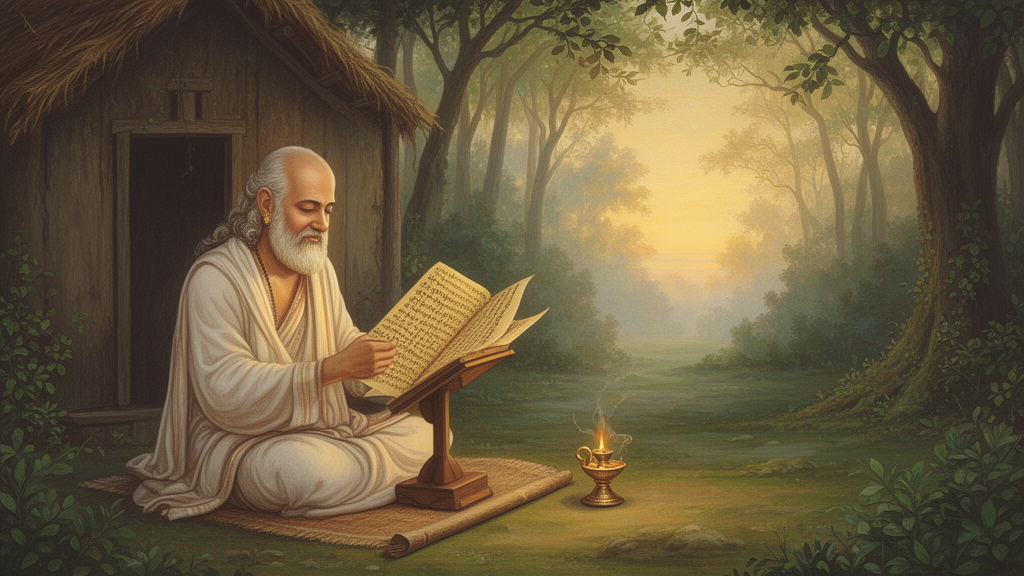
This article explains who he is, what the Upanishads are, which texts his listed talks cover, and how to study them without confusing scripture, commentary, and modern interpretation.
What the phrase usually refers to

The phrase joins a teacher’s name with a body of literature. Most readers who search for it want one of three things: a biography of the teacher, an overview of his talks on the Upanishads, or a way to begin reading the Upanishads with his explanations as a guide. This article covers all three without claiming that he authored the Upanishads or that his interpretation is the only valid one.
For a general introduction to the texts, readers can start with our overview of the Upanishads, which is a useful companion before listening to any long lecture series.
Who Swami Sarvapriyananda is
Swami Sarvapriyananda was born Biswarup Mitra on 10 February 1971 in Kolkata, West Bengal, according to his Wikipedia biography. He grew up in Bhubaneswar, Odisha. The same biography states that he was drawn to Sri Ramakrishna and Swami Vivekananda from childhood and that his family had a connection to the Ramakrishna Order. These are biographical details reported by a secondary source and should be checked against the order’s own records if a formal biography is needed.
Early life and training
He completed postgraduate studies in business management at the Xavier Institute of Management in Bhubaneswar. He later received mantra initiation into the Ramakrishna Order from Swami Bhuteshananda in 1994, according to both Wikipedia and the Vedanta Hub profile. He received sannyasa, the monastic vows, from Swami Ranganathananda in 2004.
Monastic and teaching roles
Vedanta Hub’s profile says that he served as an acharya, or teacher, at the monastic probationers’ training center at Belur Math, and in several educational institutes of the Ramakrishna Mission in India. It also says he was assistant minister of the Vedanta Society of Southern California. He has been the minister of the Vedanta Society of New York since 2017, succeeding Swami Tathagatananda.
The Wikipedia article also notes that he was a Nagral Fellow at Harvard Divinity School in 2019 and 2020. Vedanta Hub lists the same fellowship. Both sources describe his speaking engagements at forums such as TEDx and at interfaith events. Those activities show his public role, but they do not by themselves establish the accuracy of any particular teaching.
The Upanishads in brief
The Upanishads are a large body of Sanskrit prose and verse texts that are usually regarded as part of Vedic literature. They are generally understood to be a late layer of the Vedas, and they are often discussed in terms of philosophy about the self, the ultimate reality, and liberation. Scholars date the principal early Upanishads to various periods, and exact dating is debated, so readers should avoid any single date presented as settled fact.
Sarvapriyananda’s own teaching site describes the Upanishads as the portions found towards the end of each Veda, namely the Rigveda, Samaveda, Yajurveda, and Atharvaveda. Taken together, the same description says, they are called Vedanta, meaning the end of the Vedas, and are considered the final conclusion of the Vedic philosophical teaching. This is a traditional and interpretive framing, and it is the viewpoint from which his talks begin.
Why they are called Vedanta
The word Vedanta has two common uses. In its older sense, it refers to the Upanishads as the concluding portions of the Vedas. In its later sense, it refers to philosophical schools that interpret the Upanishads, often along with the Bhagavad Gita and the Brahma Sutras. Sarvapriyananda’s teaching sits within the later sense, particularly the Advaita Vedanta school that Wikipedia lists as his philosophical orientation.
This distinction matters because the Upanishads themselves do not all teach one doctrine in one voice. Different schools have read them differently, and Advaita Vedanta is one important lens among several.
The number 108 and the principal Upanishads
Sarvapriyananda’s teaching site refers to the 108 Upanishads. Readers will also see other counts in different lists. The number 108 is a traditional collection associated with a later canon, and not every text in that list is equally old or equally studied. Scholars and teachers usually focus on a smaller set of principal or early Upanishads.
The Vedanta Hub index lists the following principal texts, which are the ones most commonly discussed in Vedanta teaching: Isha, Kena, Katha, Prashna, Mundaka, Mandukya, Taittiriya, Aitareya, Chandogya, and Brihadaranyaka. Those ten are the usual starting point for readers who want the core texts before exploring the wider collection. Our posts on the 108 Upanishads and the 12 Upanishads explain how different lists are assembled and why they vary.
Which Upanishads his talks cover
Sarvapriyananda’s talks are listed on the Vedanta Hub page and on his own teaching site. The listing on Vedanta Hub, as inspected for this article, shows lecture series on several Upanishads and related texts. The class counts below are the numbers printed on that listing at the time it was checked. Because online catalogs change, readers should confirm current counts before planning a study schedule.
- Isha Upanishad: listed as 12 classes, each about 75 minutes.
- Kena Upanishad: listed as 18 classes, each about 70 minutes.
- Katha Upanishad: listed as 44 classes, each about 70 minutes.
- Mundaka Upanishad: listed as 28 classes, each about 75 minutes.
- Mandukya Upanishad with Gaudapada Karika: listed as 69 classes, each about 90 minutes.
The same listing includes talk series on the Bhagavad Gita and on several explanatory texts, such as Aparokshanubhuti, Drg Drsya Viveka, Manisha Panchakam, Panchadashi, and Vedantasara. Those texts belong to the wider Vedanta literature and should not be confused with the Upanishads. Readers who want the Gita specifically should consult a separate guide.
The Mandukya listing is worth noting for readers. Its title pairs the short Mandukya Upanishad with the Gaudapada Karika, a later commentary-style text. A reader should therefore keep in mind that the lecture series combines scripture with a classical interpretive work, and that the two should be distinguished when taking notes.
Talk titles on video platforms
Video platforms also host Sarvapriyananda talks under titles such as Brihadaranyaka Upanishad and Katha Upanishad. The inspected playlist pages show titles and platform boilerplate only. They do not, by themselves, confirm the contents, dates, or completeness of the series. Viewers should check the episode descriptions and the official teaching site before relying on any playlist as a complete course.
How to tell scripture, commentary, and interpretation apart
The most useful habit for a reader of any teacher’s Upanishad talks is to ask, at each point, what kind of claim is being made. Hindu teaching traditions distinguish between shruti, the revealed texts such as the Upanishads, and smriti and commentary, which explain and apply them. A modern lecture belongs in the commentary category. That does not make it unimportant, but it does mean it should be weighed differently from the text.
Scripture
The Upanishads themselves are the primary text. A claim that a particular verse says a particular thing should be checked against a reliable edition with a translation that is named and dated. Readers should avoid quoting memory or a secondary summary as if it were the verse. This article does not quote any Sanskrit verse, because the sources available for this draft did not include the primary text itself.
Commentary within a tradition
Sarvapriyananda’s teaching is grounded in Advaita Vedanta, a school traditionally associated with the non-dual reading of the Upanishads. Commentary in that school explains the texts in terms of the identity of the individual self, or atman, with ultimate reality, or Brahman. Readers who are new to the tradition should understand that this is one interpretation within a larger family of Vedanta schools, not the only way the Upanishads are read.
Other schools, such as those associated with qualified non-dualism and dualism, read the same texts with different conclusions about the relation between the self and the divine. A balanced study therefore compares a teacher’s reading with at least one other tradition’s reading, rather than treating any single teacher as the final word.
Devotional and modern explanation
Lectures often include examples from daily life, personal reflection, and comparisons with modern thought. These are valuable for understanding, but they are interpretive. A teacher’s illustration is not a historical claim about the text’s original audience. When a talk moves from explaining a verse to making a claim about history, language, or the mind, the listener should look for a source that supports that specific claim.
A practical way to study the talks
Readers who want to learn from Sarvapriyananda’s Upanishad lectures, without losing track of the text, can follow a simple sequence. The steps below are a suggested method, not a required practice, and different communities have their own ways of study.
- Choose one principal Upanishad, such as the Isha or Kena, and read a complete translation before listening to any lecture on it.
- Record the verse or section numbers that the talk discusses, then find those sections in your edition.
- Write two columns in your notes: what the text says, and what the teacher adds. Keep them separate.
- Look up any Sanskrit term that appears repeatedly, such as atman, Brahman, or maya, in a reliable glossary or the reference works listed at the end of this article.
- Compare the teacher’s explanation with another commentary from a different tradition, and note where they agree and where they differ.
- Review your notes after a week and write down one question you still cannot answer from the text.
This method keeps the study grounded. It also prevents a common problem in online learning, where a long lecture series can gradually replace the text itself in the learner’s mind.
Choosing a starting point
For many readers, the Isha Upanishad is a manageable first text because it is short. The Katha and Mundaka are longer and have dramatic narratives and concepts that repay repeated study. Readers who want an overview of the whole collection may prefer the essence of the Upanishads, which summarizes major themes before the texts are read in detail.
Interpretive differences across traditions
Hindu communities do not share one reading of the Upanishads. Within Vedanta alone, there are long-standing commentarial traditions that disagree about the nature of the self, the relation between the individual and God, and the path to liberation. Outside Vedanta, the Upanishads are also read within Yoga, Samkhya, devotional traditions, and regional religious practice. Presenting Sarvapriyananda’s reading as the universal meaning of the texts would be inaccurate.
Regional and community practices also differ. Some families and temples place the Upanishads in daily study. Others emphasize the Gita, the Puranas, or devotional hymns more. A reader should not assume that one community’s approach is the default for all Hindus.
When sources disagree
When two credible interpretations differ, the honest approach is to state both and explain the basis for each. For example, one commentary may read a passage as describing the identity of the self with Brahman, while another reads it as describing a relationship of devotion. Neither reading should be presented as a historical fact about what the author intended unless the evidence for that intention is clear.
Further reading within HindusGod.com
Readers who want to explore related topics can use the following posts. Each one covers a different question about the Upanishads, so it may help to choose the one closest to your interest.
- An English-language introduction to the Upanishads for readers who want a general overview before exploring lectures or translations.
- The five Upanishads as a smaller selection, useful for comparing texts that are often studied together.
- The four Upanishads and the three Upanishads for readers who want to see how different selections are grouped.
- The 14 Upanishads and the 18 Upanishads for a closer look at other traditional counts.
These are target drafts in the HindusGod.com content system. Their links become public only if the owner later publishes them, so they should be checked before this article is published.
Frequently asked questions
Is Swami Sarvapriyananda the author of the Upanishads?
No. The Upanishads are ancient texts in the Vedic tradition, and their authorship is traditionally attributed to sages rather than to a single modern author. Swami Sarvapriyananda is a teacher who gives lectures and commentary on them.
Should I read his talks instead of the Upanishads?
No. The talks are most useful alongside a translation of the text. Reading the primary text first, then listening to a lecture on the same section, helps you tell what the text says apart from what the teacher adds.
Why do different lists give different numbers of Upanishads?
The collection grew over time, and different lists include different texts. The 108 count is traditional, while scholars and teachers often focus on a smaller set of early or principal Upanishads. Check which list a source is using before comparing counts.
Summary
Swami Sarvapriyananda is a Ramakrishna Order monk and the minister of the Vedanta Society of New York. His lecture series on the Upanishads, including the Isha, Kena, Katha, Mundaka, and Mandukya, are widely available and useful for readers who want a teacher’s guided reading. The most reliable way to use them is to read the texts themselves, separate scripture from commentary, and compare his Advaita Vedanta reading with other traditions. Used this way, his talks can deepen study without replacing the primary sources.
Sources and Further Reading
- Swami Sarvapriyananda, Wikipedia: used for biographical details, his role at the Vedanta Society of New York, and the Advaita Vedanta orientation of his teaching.
- Upanishads, Sarvapriyananda teaching site: used for the description of the Upanishads as the concluding portions of the Vedas and the reference to 108 Upanishads. The page was only partly inspected for this draft and should be rechecked before publication.
- Swami Sarvapriyananda, Vedanta Hub: used for his biography, his teaching roles, and the listed class counts for the Upanishad talk series.
- Brihadaranyaka Upanishad playlist, Swami Sarvapriyananda, YouTube: used only to confirm that a talk series with this title is listed. The page content inspected did not describe the lectures.
- Katha Upanishad playlist, Swami Sarvapriyananda, YouTube: used only to confirm that a talk series with this title is listed.