The Sanghata Sutra is a Mahayana Buddhist scripture. Its formal Sanskrit title, as given in the research summary used for this post, is Ārya Saṅghāṭa Sūtra Dharma-paryāya. The text presents itself as a rare teaching that the Buddha Shakyamuni says he received from a previous buddha and passed on to the bodhisattva Sarvaśūra at Vulture Peak in Rājagṛha. Its central claims are that it can purify severe karmic obstacles, that honoring it yields very large merit, and that it leads hearers toward progress on the path to awakening. This post explains what the sutra says, how it is transmitted, and where scholarly and tradition-based claims need to be kept separate.
HindusGod.com focuses on Hinduism, but readers often meet Buddhist texts while studying the wider religious landscape of South Asia and Central Asia. The Sanghata Sutra is a Buddhist text, not a Hindu scripture. This article describes it on its own terms and does not claim that Hindus or Hindu traditions treat it as authoritative.
What the Sanghata Sutra Is

The Sanghata Sutra belongs to the Mahayana sutra literature, a body of texts that developed within Buddhism and emphasized the bodhisattva ideal, the aspiration to attain awakening for the benefit of all beings. The text describes itself as a dharma-paryāya, usually translated as a “discourse” or “transformative discourse” in the summary used here. The word signals that the teaching is meant to change the listener, not only to inform.
The sutra is also self-referential. It praises its own power, describing itself as a treasury of Dharma. In Mahayana presentations, texts that praise themselves in this way are common. Readers should understand that such praise is a feature of the text’s own rhetoric and devotional purpose, not an independent historical verification of its effects.
Why the name is spelled in several ways
Readers may see the title spelled Sanghata, Saṅghāṭa, Sanghāta, or Sangata. These variants reflect different transliteration systems and the different languages through which the text has been known. The Sanskrit form uses diacritics to mark sounds that English spelling does not show clearly. This article uses “Sanghata Sutra” for readability, and gives the Sanskrit form where it matters for accuracy.
The Setting and Narrative Frame
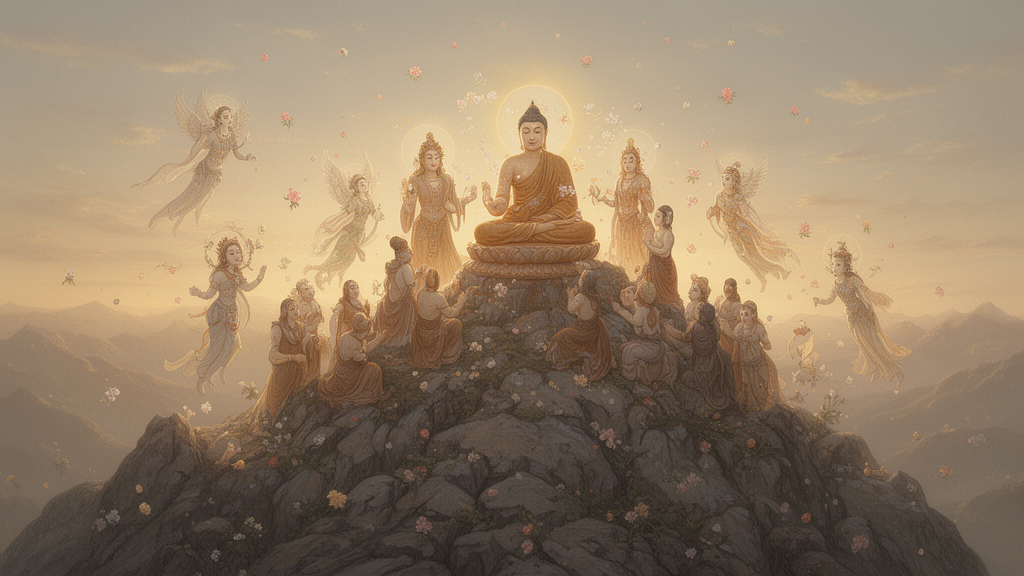
According to the summary of the text, the sutra is set in a large assembly at Vulture Peak near Rājagṛha, a city associated with the early Buddhist tradition. In the narrative, the Buddha Shakyamuni recounts a teaching he received from an earlier buddha and then transmits it to the bodhisattva Sarvaśūra in front of a vast gathering.
This frame matters for how the text works. By placing the teaching within a chain of buddhas and a named assembly, the sutra gives its message a lineage and a sense of rarity. Readers in the Buddhist traditions that revere the text treat that lineage as part of its authority. Historians, by contrast, treat the frame as a literary device and cannot use it to date the text.
The gathering and its miracles
The summary describes miraculous signs that accompany the teaching, including rains of flowers, earthquakes, and gatherings of devas, nagas, and bodhisattvas from many world systems. These images are common in Mahayana sutras. They signal the importance of the teaching within the narrative and help the story move among cosmic scale, ritual scene, and personal instruction.
These are narrative descriptions, not historical reports. A reader can appreciate the imagery as literature and as devotional symbolism while recognizing that it belongs to the text’s storytelling.
Main Teachings as Presented in the Text
The summary identifies several major themes. They are stated here as what the text says, not as settled facts about the world.
- Impermanence and karma: The sutra is said to address impermanence, the consequences of action, and the possibility of change for beings who engage with the teaching.
- Purification of severe obstacles: The text claims it can purify even very serious karmic obstacles, including the five uninterrupted negative actions that Buddhist literature traditionally describes as the gravest offenses.
- Accessibility of buddhahood: The narrative presents awakening as reachable through engagement with the text, including by people who had previously been far from practice.
- Merit through honor and faith: The summary says that honoring the text, even with a single act of faith or prostration, produces large merit.
Purification and the five uninterrupted actions
The claim that the sutra purifies the five uninterrupted negative actions is one of its most striking. In Buddhist doctrinal literature, these actions are treated as among the most serious. The sutra’s claim that the text can cleanse them is a devotional promise. Buddhist teachers have debated how such promises relate to ethical responsibility, repentance, and effort. Readers should treat this as a claim the text makes within its own framework, not as a guarantee that a person’s karma will change in a measurable way.
The text as a “treasury of Dharma”
The summary describes the Sanghata as a treasury of Dharma and says that wherever it is, the Buddha is present. This is one of the reasons the text is honored in ritual and devotional settings. The idea that a scripture can stand for the presence of a buddha is common in Mahayana thought, in which the Dharma, the teaching, is itself a form of the awakened presence. This is a belief within that tradition, not a historical claim.
Warnings in the text
The sutra also warns against disparaging it. According to the summary, the text says that speaking against it creates more non-virtue than hostility toward countless buddhas. This warning shapes how the text is treated in devotional communities, which often emphasize respect for the scripture. It also reflects a broader Mahayana concern with protecting teachings from disrespect.
Narrative Structure and Literary Features
According to the summary, the sutra mixes several forms. It includes prose explanations, verses often arranged in four-line stanzas, parables, and narrative episodes. This blend is typical of many Buddhist sutras, which were designed for recitation, memorization, and public teaching as well as for study.
The text includes dialogues with bodhisattvas such as Mañjuśrī and Maitreya. It also includes stories of kings and heretics who are said to attain enlightenment after hearing the teaching. In addition, the Buddha recounts his own past aspirations under earlier buddhas, including Dīpaṃkara, to show how long-term commitment leads to awakening.
Examples of narrative use
- Dialogue scenes let the bodhisattvas ask questions that the Buddha answers, giving the teaching a conversational structure.
- Stories about kings and non-Buddhist teachers show the text’s claim that its message can reach people outside existing monastic circles.
- The Buddha’s account of past lives under Dīpaṃkara illustrates the idea that awakening develops over many lifetimes through aspiration and practice.
These examples are described in the summary. A full reading of the Sanskrit or a complete translation would be needed to confirm details of how each episode is organized.
Translations and Transmission
The sutra is known from several languages. The summary used for this post identifies Sanskrit manuscripts, Khotanese and Sogdian translations, Chinese translations, and Tibetan translations. It states that the text is preserved primarily through Tibetan and Chinese versions, including versions in the Derge Kanjur and the Taishō Tripiṭaka. It also says that Sanskrit manuscripts were rediscovered at Gilgit in the 1930s.
These details are important because they show that the text moved across Central Asia and East Asia. However, this post has not yet checked the editions, catalogue numbers, translators, or dates against the Derge Kanjur, the Taishō Tripiṭaka, or the Gilgit manuscript publications. Readers who need exact citations should consult those primary editions and specialist catalogues before relying on any specific number, translator, or date.
Why transmission matters
A text that survives in several languages can differ in wording, structure, and emphasis. Translators may have worked from different manuscript families, and each tradition may have shaped the text for its own audience. For that reason, claims about “what the sutra says” should specify which version is meant. This article describes the text as summarized in a secondary source and flags where a version-specific reading is needed.
Khotanese, Sogdian, Chinese, and Tibetan witnesses
The summary lists Khotanese and Sogdian translations as part of the text’s history, along with Chinese and Tibetan versions. Each of these traditions has its own scholarship. Khotanese and Sogdian materials are associated with Central Asian Buddhist communities, while the Chinese and Tibetan versions became central to later East Asian and Tibetan Buddhist canons. Specialist studies would be needed to describe these witnesses accurately, and this post does not make claims about their content beyond the summary.
The Meaning of the Title Word
The title “Sanghata” has been discussed by translators and commentators. The summary notes that interpretations of the word vary and that the question of its meaning is part of the text’s study history. The name is sometimes discussed in relation to ideas of gathering or compounding, but the summary does not settle the question.
For this reason, readers should be cautious about any single explanation of the title. Translators may render the word differently depending on context and tradition. A careful reader can say that the meaning is debated or that the text’s title has been interpreted in more than one way, rather than presenting one etymology as final.
Belief, Text, Tradition, and Scholarship
Understanding the Sanghata Sutra requires separating four kinds of statements.
- What the text says: The sutra claims that it purifies obstacles, produces merit, and reveals the Buddha’s presence. These statements belong to the scripture.
- What traditions believe: Buddhist communities that honor the text may treat it as a source of protection, merit, and devotion. These beliefs vary among communities and individuals.
- What historical evidence shows: Manuscripts, translations, and catalogues help establish where and how the text circulated. Dating and authorship remain uncertain according to the summary.
- What scholars interpret: Academic studies examine the text’s literary structure, doctrinal ideas, and transmission. These interpretations can differ, and they should be presented as interpretations.
A post about any religious text becomes misleading if these categories are blended. For example, the belief that a scripture protects its reader is a devotional claim, not a historical finding. Likewise, the existence of Sanskrit manuscripts in one region does not by itself prove a specific date of composition.
Avoiding overstatement
The summary states that no precise date of composition is available. This is a critical caution. Many statements about Mahayana texts are based on general scholarly consensus about periods of production, but specific dates for an individual sutra often depend on contested evidence. The honest answer is that the Sanghata Sutra’s origins are uncertain and that readers should consult specialist scholarship for detailed dating arguments.
How Buddhist Communities Use the Text
The summary says the text has been treated as part of modern Buddhist practice after its revival in the twentieth century. Because the sources available for this post are secondary, this article cannot describe specific ritual forms, communities, or liturgical uses with confidence. Ritual practices vary widely across Buddhist regions and schools, and any description should be tied to a named tradition and a verified source.
In general terms, Mahayana communities may study, recite, copy, or honor sutras as part of devotion and study. Whether a particular community uses the Sanghata Sutra in a particular way is a question for that community’s teachers, texts, and published practice guidance.
Reading with respect
Readers who encounter this text should approach it with the same care that the text itself asks for. The sutra warns against disparaging it, and modern readers can honor that concern by describing its claims accurately, avoiding caricature, and distinguishing the text’s claims from their own assessments.
Practical Examples for Reading the Sutra
Readers who want to study the Sanghata Sutra can use a simple method that keeps claims clear.
- Start with a reliable translation or scholarly introduction that names the version being used.
- Note the narrative frame: who speaks, who listens, and where the teaching takes place.
- Separate the text’s promises, such as purification or merit, from its doctrinal explanations of karma and awakening.
- Check any Sanskrit term against a dictionary or specialist glossary, and note alternative translations.
- Compare the text with other Mahayana sutras to see which themes are shared and which are specific to this text.
For example, a reader who sees the claim that the text purifies severe karmic obstacles can ask how the text defines those obstacles, whether it links purification to repentance or faith, and how commentators in the tradition explain the claim. This approach keeps the reading grounded in the text rather than in general assumptions about Buddhism.
Related Buddhist Texts on HindusGod.com
Readers interested in the Sanghata Sutra may also find it useful to explore other Buddhist and Mahayana texts. The following pages are currently WordPress drafts. They may not be publicly visible until the owner publishes them, so readers should treat these links as future destinations, not confirmed live pages.
- Arya Sanghata Sutra for a companion article on the Arya form of the title.
- Sanghata for a broader look at the word and its uses.
- Dasabhumika Sutra for the ten bodhisattva grounds, a theme also mentioned in the Sanghata summary.
- Dharani Sutra for background on dharanis, which the Sanghata summary links to protective and clairvoyant benefits.
- Avatamsaka Sutra for another major Mahayana scripture with cosmic scope.
- Avalokiteshvara Sutra for the bodhisattva of compassion.
- Amida Sutra for a Pure Land text that also addresses devotion and merit.
- Amida Sutra Meaning for a plain-language explanation of that text.
- Brahmajala Sutra for Buddhist ethical precepts.
- Agama Sutra for the early Buddhist discourse collections.
Frequently Asked Questions
Is the Sanghata Sutra a Hindu scripture?
No. It is a Mahayana Buddhist scripture. It is described as attributed to the Buddha Shakyamuni and transmitted to the bodhisattva Sarvaśūra. Readers interested in Hindu scripture should consult texts and sources from Hindu traditions for that material.
Does the sutra guarantee that sins are removed?
The text itself claims that it purifies serious karmic obstacles. That is a claim within the scripture and its devotional framework. It is not a measurable guarantee. Buddhist teachers have discussed how such claims relate to repentance, ethical practice, and effort, and readers should consult the tradition’s teachers and specialist sources.
Which translation should I read first?
Choose a translation that names the source version, translator, and edition, and that includes an introduction. Because the Sanghata Sutra survives in several languages, the version you read will shape what you learn. A scholarly introduction is useful for context.
Summary
The Sanghata Sutra is a Mahayana Buddhist scripture that presents itself as a rare and transformative teaching. Its main claims include purification of severe karmic obstacles, great merit for honoring the text, and the presence of the Buddha wherever the text is kept. The summary used here describes its narrative frame, its literary forms, and its transmission through Sanskrit, Khotanese, Sogdian, Chinese, and Tibetan witnesses. Its date and origins are uncertain, and the meaning of its title is debated.
The best next step is to read a clearly attributed translation alongside a scholarly introduction, and to keep the text’s claims, tradition’s beliefs, historical evidence, and modern interpretation separate.
Sources and Further Reading
- Sanghata Sutra, Grokipedia. A secondary, wiki-style summary used for the background, narrative, and transmission claims in this post. It is not a primary scripture edition and should be verified against primary sources before any claim is treated as settled.
- Primary editions to consult, URL to confirm: the Derge Kanjur and the Taishō Tripiṭaka, the two collections the summary names as preserving the text.
- Gilgit Sanskrit manuscript publications, URL to confirm: the summary says Sanskrit manuscripts were rediscovered at Gilgit in the 1930s; consult specialist editions for details.
- Scholarly introductions to Mahayana sutra literature, URL to confirm: choose a university press or academic library edition with a named translator.