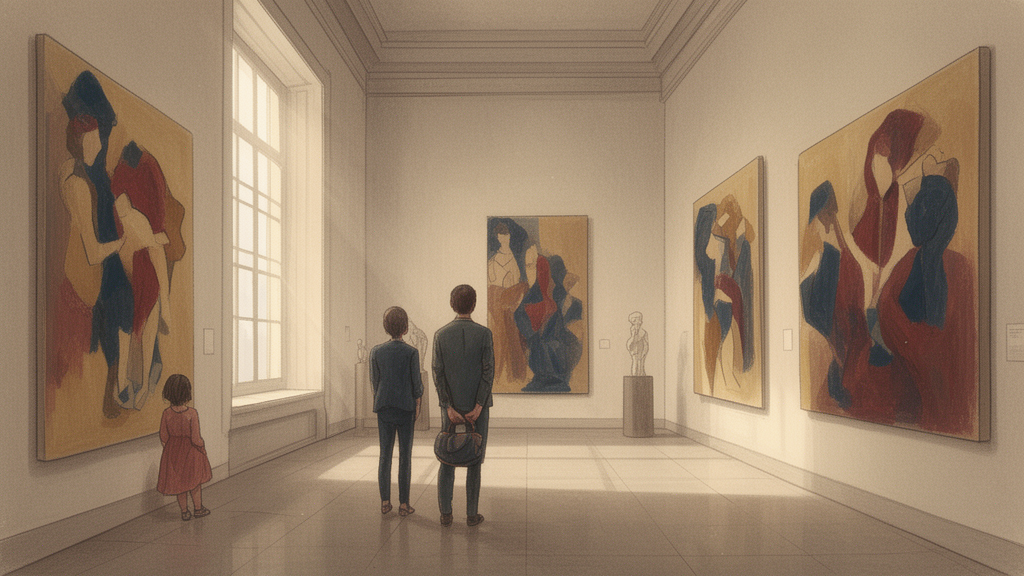
“Sadequain the Holy Sinner” refers to Sadequain: The Holy Sinner, a major retrospective of the Pakistani painter, calligrapher and poet Sadequain (Syed Sadequain Ahmed Naqvi, 1930–1987). It was held at the Mohatta Palace Museum in Karachi from February 2002 to August 2003 and presented over two hundred of his non-calligraphic works. The title was borrowed from the novel by the German Nobel laureate Thomas Mann, and it signals the exhibition’s focus on human suffering, moral struggle and what the artist called “mystic figuration.” This article explains the exhibition, the meaning of its title, and the artistic context behind it.
This is an art-history and museum topic. It is not a Hindu scripture, deity or ritual subject. The word “holy” in the title is a literary borrowing, not a claim about religious doctrine. Readers interested in Hindu texts can explore related HindusGod.com topics, linked below, but the claims in this article come from museum, museum-catalogue, arts-platform and reference sources about Sadequain’s life and work.
Who was Sadequain?

Sadequain was born Syed Sadequain Ahmed Naqvi on 30 June 1930 in Amroha, in British India (present-day Uttar Pradesh, India). He died on 10 February 1987 in Karachi, Pakistan, aged 56, and is buried at Sakhi Hassan Graveyard in Karachi. The English Wikipedia article describes him as a Pakistani artist and poet best known for calligraphy and painting, and it lists his movement as Islamic calligraphy, associated with the Hurufiyya movement.
The same article states that he was born into an educated Shia family and that he is often called “Sadequain Naqqash,” meaning “Sadequain the Painter.” Wikipedia also notes that he wrote hundreds of rubāʿiyāt, quatrains in the style of Omar Khayyam and Sarmad Kashani. These details help place his career: he worked across calligraphy, painting, murals and poetry rather than in a single narrow medium.
Wikipedia describes him as one of the finest painters and calligraphers Pakistan has produced and gives a figure of around 15,000 paintings. That number is repeated in reference material, but it is a large claim that should be treated as a reported figure rather than a verified inventory. A catalogue raisonné or museum-issued count would be needed to confirm it.
What “The Holy Sinner” means as a title
The exhibition title was not invented as a religious formula. According to the Mohatta Palace Museum’s exhibition page, “The Holy Sinner” was borrowed from the novel of the German Nobel prize-winning writer Thomas Mann. Google Arts & Culture’s record of the exhibition repeats the same attribution.
That borrowing matters for interpretation. A literary title can point toward themes without asking the viewer to adopt a particular theology. In the exhibition context, the phrase signals a concern with moral ambiguity, guilt, suffering and redemption as human experiences. Museum texts describe the works as reflecting the artist’s “existential preoccupations with human suffering.” That is an interpretive description by the museum, and visitors can weigh it against the works themselves.
For readers who want to compare the literary and artistic uses of the phrase, HindusGod.com has a related draft on the phrase “The Holy Sinner” and a separate draft on “Thomas Mann the Holy Sinner.” These links are internal drafts and may not be publicly live until the owner publishes them.
The 2002–2003 Mohatta Palace retrospective
The exhibition ran at the Mohatta Palace Museum in Karachi. The museum’s own page gives the dates as February 2002 to August 2003 and describes it as a “spectacular retrospective” of over two hundred of Sadequain’s non-calligraphic works. The emphasis on non-calligraphic work is important: many visitors know Sadequain primarily through calligraphy, but this exhibition deliberately foregrounded his figurative and allegorical painting.
Google Arts & Culture’s record credits the exhibition to the Mohatta Palace Museum and states that it was painstakingly curated by Hameed Haroon and assisted by Salima Hashmi. The same record says the show traced the transformation of Sadequain’s style from semi-realism to profound allegory. Read together, the sources present the exhibition as both a survey of a major artist and an argument about the development of his style.
The museum also published a related book, Sadequain: The Holy Sinner. Its shop page states that the first edition sold out and that a second edition with the same content was offered through the museum. The shop page includes pricing, but prices change and this article does not treat them as current. Anyone considering a purchase should check the museum’s current listing directly.
“Mystic figuration” and human suffering
The phrase most often used to explain the exhibition is “mystic figuration.” Both the Mohatta Palace page and Google Arts & Culture connect the works to this idea. The sources do not provide a detailed technical definition in the materials reviewed for this article, so it is best understood as the curators’ and museum’s descriptive term for the way Sadequain used figures, allegory and mystical or symbolic suggestion to address suffering and existential themes.
This is an important distinction for readers. The term describes an artistic approach discussed by curators. It is not a religious ritual, a scriptural teaching or a doctrine taught by any Hindu tradition. Treating it as a theological statement would go beyond what the sources support.
A practical way to approach the work is to look for three things: the figures and their postures, the mood created by colour and composition, and the allegorical situation the painting seems to present. Museum visitors often find that these elements do more to explain the exhibition than any single label. Readers who want a museum-based overview should start with the exhibition pages listed in the sources at the end of this article.
From calligraphy to figuration
Sadequain is widely known for calligraphy, which makes his non-calligraphic exhibition especially useful for understanding his range. Wikipedia lists Islamic calligraphy and the Hurufiyya movement among his associated movements. Hurufiyya is generally discussed in art-historical literature as a modern movement that uses letterforms as visual elements, but the sources reviewed for this article do not provide enough detail to describe its full history, so readers should consult specialist sources for that.
The Google Arts & Culture record gives a clear claim about the exhibition’s arc: it showed a shift from semi-realism to allegory. This is useful for a reader because it suggests that the exhibition was not simply a collection of unrelated paintings. It presented a developmental path across his output. The claim is attributed to the exhibition record, so it should be read as the exhibition’s curatorial interpretation rather than as a universal verdict on his career.
A simple comparison can help. Calligraphy places meaning in the structure and rhythm of script. Figurative painting places meaning in bodies, faces, gestures and settings. Sadequain worked in both, and the exhibition title points viewers toward the figurative and allegorical side of that practice.
Poetry, murals and the wider body of work
The exhibition title should not hide the fact that Sadequain was also a poet and muralist. Wikipedia states that he wrote hundreds of rubāʿiyāt in the style of Omar Khayyam and Sarmad Kashani. The rubāʿi is a quatrain form associated with Persian and Urdu poetry. This connection gives context to his interest in compressed, reflective statements about life, love, mortality and belief.
Wikipedia also lists murals among his media and includes a section on his works. Murals matter because they bring art into public spaces rather than only private collections or museum galleries. However, the sources reviewed for this article do not provide a complete list of mural locations, dates or conditions, so this article does not name specific murals or claim their status. Anyone planning to see his murals should check current local information.
His poetry and painting should be read as parts of one creative practice. The exhibition emphasis on non-calligraphic works does not mean the calligraphy is less important. It means that the 2002–2003 show offered a focused look at the painted and figurative side of his output.
Honours and public recognition
Wikipedia’s infobox lists several honours associated with Sadequain: Hilal-e-Imtiaz, Sitara-i-Imtiaz, Tamgha-e-Imtiaz and Pride of Performance. These are state honours in Pakistan. The article also notes a commemorative stamp and a Sadequain Foundation website. This article does not describe the award dates or citations in detail because those were not verified in the reviewed material. Owners and editors should confirm them with official Pakistani government records before publishing a detailed honours section.
Public recognition is one way to understand a figure’s place in national culture, but it does not by itself explain the artwork. For readers, the more useful question is how the work itself communicates. The exhibition, the museum publication and the critical reception together suggest why he remains a significant figure in Pakistani art history.
Why the phrase is easy to misread
Search results for phrases such as “holy sinner” can mix art, literature, religion and general moral language. A reader might assume that the phrase is a religious term, a biblical allusion or a teaching about sin. The sources here point elsewhere. The exhibition title comes from a novel, and the museum uses it to describe a body of artwork about suffering and human experience.
This distinction matters for a religious website. The title should not be used to imply that Sadequain was a religious teacher, that the paintings are scripture, or that the exhibition defines a particular faith. Sadequain’s biography and work are best described in artistic, literary and cultural terms, with religious references explained according to what the sources say.
When readers encounter Hindu-related or devotional content elsewhere on the web, they should separate three things: what a text says, what a tradition teaches, and what a modern author or artist says. This article uses only the last category for the exhibition and the first category for biographical facts from reference and museum sources.
Practical guidance for readers and visitors
- Check current hours and exhibitions. The Mohatta Palace retrospective ran from February 2002 to August 2003. It is not established by the reviewed sources that it is still on view today, so confirm with the museum before planning a visit.
- Read the exhibition’s own framing. The museum and Google Arts & Culture pages explain the title, scope and curatorial emphasis.
- Look at both calligraphy and figuration. Sadequain’s reputation rests on several media, so seeing one body of work alone may give an incomplete picture.
- Separate facts from interpretation. Phrases such as “mystic figuration” and “existential preoccupations” are interpretive descriptions. Treat them as critical language rather than established doctrine.
- Check purchase details directly. Book and collectors’ edition details, including price and availability, can change.
Common questions about the exhibition
Is “The Holy Sinner” a religious text?
No. According to the Mohatta Palace Museum, the exhibition title was borrowed from a novel by Thomas Mann. The exhibition itself is an art retrospective. Readers should not treat the title as a scripture, a doctrine or a Hindu religious term.
Was the exhibition only about calligraphy?
No. The museum describes it as focused on over two hundred non-calligraphic works. Calligraphy is central to Sadequain’s reputation, but this exhibition deliberately presented a different side of his practice.
Where should I start if I want to learn more?
Begin with the Mohatta Palace exhibition page and the Google Arts & Culture record, then read a broader biography or scholarly study. Wikipedia can help with orientation, but its own article notes that it needs more citations and includes issue tags, so it should be used as a starting point rather than final proof.
Related HindusGod.com reading
Readers who arrive here from a search for the phrase may also be interested in the broader meaning of “holy” in other contexts. HindusGod.com has related draft pages on “Holy Discontent,” “Holy Madness” and “Holy Ignorance.” These are useful for readers comparing how the word “holy” is used in everyday, literary and devotional language. Their public status should be confirmed before linking readers to them as live pages.
For readers who want to compare the phrase with religious scripture, the owner may also wish to review “Holy Book,” “Holy Scriptures” and “Holy Text.” Those pages address scripture and sacred texts in general and can help readers separate literary usage from religious literature. Their status as drafts means the links should be checked before publication.
For a Hindu scripture perspective on the word “holy” and on sacred literature, readers may consult “Holy Gita.” This is a separate subject from Sadequain’s exhibition and should not be treated as evidence about his work.
How to interpret the exhibition responsibly
A responsible reading of this exhibition begins with the sources. The Mohatta Palace page supplies the date range, the number of works, the theme of human suffering and the title’s literary origin. Google Arts & Culture adds the curators and the claim about a shift from semi-realism to allegory. Wikipedia supplies biographical and contextual information, along with a warning that the article itself needs better citations.
Beyond those facts, interpretation should be framed as interpretation. A viewer may find religious, moral, political or personal meanings in a painting. Those readings can be valuable, but they should not be presented as the artist’s explicit intention unless a source states it. This is especially important with a title that draws on Thomas Mann and with an artist whose work engages Islamic calligraphy and poetry. Those traditions deserve accurate, respectful description, not simplification.
The same caution applies to religious labels. Sadequain’s biography in the reviewed sources is that of a Pakistani artist and poet from an educated Shia family, as Wikipedia reports. The exhibition title is literary. Neither fact authorizes a broad statement about his personal faith beyond what a source directly supports.
What remains uncertain
- The total number of paintings. Wikipedia gives a figure of around 15,000, but this article has not verified it against a catalogue or museum inventory.
- Current exhibition status. The retrospective dates are historical. Present-day display of the works is not established here.
- Detailed honours dates and citations. The honours are listed in Wikipedia’s infobox, but the sources reviewed did not verify award years or official citations.
- Mural details. Murals are mentioned generally, but specific works, locations and conditions were not verified.
- Technical definitions. “Mystic figuration” and Hurufiyya need fuller art-historical treatment than the reviewed sources provide.
Takeaway
“Sadequain: The Holy Sinner” is best understood as a Karachi retrospective that presented Sadequain’s non-calligraphic work under a title borrowed from Thomas Mann. Its strength for readers lies in showing an artist who moved between calligraphy, painting, murals and poetry, and who used figurative and allegorical imagery to address human suffering. The title is literary, not doctrinal. Readers who want to go further should verify current exhibition details, read the museum and arts-platform pages, and consult specialist scholarship on Sadequain and modern Pakistani art.
Sources and Further Reading
- Sadequain – Wikipedia: used for biographical dates, birthplace, death place, honours listed in the infobox, associated movements, poetry and the approximate painting count reported by the article. The article itself notes that it needs more citations.
- The Holy Sinner – Mohatta Palace Museum: used for the exhibition dates, scope of over two hundred non-calligraphic works, the “mystic figuration” description, the Thomas Mann title attribution and the museum’s reading of the theme of human suffering.
- Sadequain: The Holy Sinner – Google Arts & Culture: used for the 2003 record, the curatorial credit to Hameed Haroon with assistance from Salima Hashmi, and the description of the shift from semi-realism to allegory.
- Sadequain: The Holy Sinner – Mohatta Palace Museum Shop: used only for the statement that the publication documented the artist’s works, that the first edition sold out and that a second edition was offered through the museum. Prices and availability should be checked directly.