The Holy Sinner (German: Der Erwählte) is a 1951 novel by the German writer Thomas Mann. It retells a medieval legend about a man born of an incestuous union who, after years of penance, becomes pope. Mann based the book on Gregorius, a medieval verse epic by the Minnesinger Hartmann von Aue, and used it to explore original sin, the origins of evil, and the possibility of grace. This article explains the story, its sources, its main themes, and the translation and dating questions readers should know about.
A short answer first: The Holy Sinner is a work of European literature, not a Hindu scripture. Its religious world is medieval Christian. It is most useful for readers who want to think about sin and forgiveness through a novel, or who want to compare literary treatments of moral failure across traditions. Its sources and themes are documented below, and claims are attributed to the sources that support them.
What Is The Holy Sinner?
The Holy Sinner is a novel, though some summaries call it a novella because of its length. The English edition was translated by H. T. Lowe-Porter and published by Knopf in 1951, the same year as the German first edition from S. Fischer. The German title, Der Erwählte, means roughly “The Chosen One.” The English title signals the book’s central paradox: a figure who is marked by sin and also chosen for holiness.
The book is told through an invented narrator, the monk Clemens, who announces the ringing of bells across Rome and then recounts the events that led to them. This framing is part of Mann’s method. The story is presented as a tale being told, with a narrator who comments on it, rather than as a plain retelling of a saint’s life.
Readers who know Mann’s larger works will recognize his habit of reworking older stories. He had used the biblical account of Joseph as the basis for Joseph and His Brothers. In The Holy Sinner, he applied a similar approach to a medieval legend about “the exceeding mercy of God and the birth of the blessed Pope Gregory,” as one reference summary describes it.
The Medieval Source: Hartmann von Aue’s Gregorius
The novel’s source is Gregorius, a verse epic usually attributed to Hartmann von Aue, a German poet of the medieval period. Dates for Hartmann are commonly given as c. 1165 to 1210. Sources differ on the date of the Gregorius manuscript itself. One literary essay gives 1187, while a Goodreads review gives c. 1190. Because the sources disagree, this article uses the broader phrase “late twelfth century” and avoids a single precise date.
Mann did not copy the medieval poem. He kept its basic shape, a sinner who is redeemed and becomes pope, and then filled it with his own irony, symbolism, and modern psychological interest. A literary analysis describes the result as far more than “a simple parody of a saint’s legend,” because it mixes playful storytelling with serious questions about guilt and grace.
The medieval legend presents a sinful birth, long penance, and eventual divine forgiveness. Mann keeps these elements but changes the tone. Where the medieval text presents a saint’s life in the language of religious instruction, Mann presents the same events with narrative distance and ironic commentary.
Plot Overview
The plot covers a long span of years and several settings. A brief summary helps readers follow the main movements without reading the entire novel first. Plot details below follow the English Wikipedia summary, which was available in the research record, and a literary analysis.
Flanders and the Brother-Sister Union
The story begins in Flanders with Duke Grimald, a widower, who presses his daughter Sibylla to marry in order to form an alliance with a neighboring king. Sibylla is attracted only to her brother Wiligis and refuses the match. After the duke dies, the siblings become lovers. Sibylla learns she is pregnant by her brother.
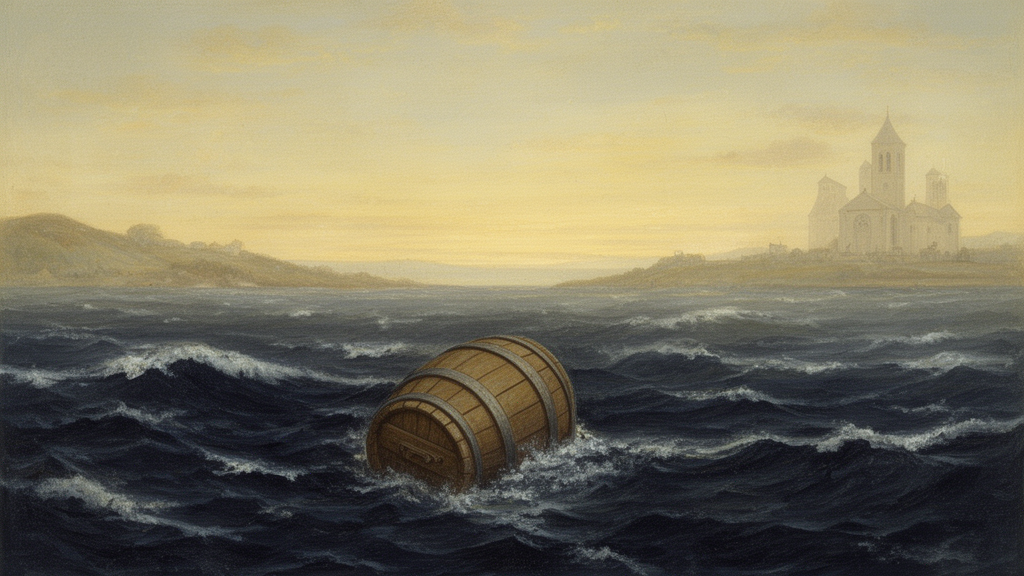
Their loyal counselor, the knight Eisengrein, advises Wiligis to join a crusade as a way to atone for what they have done. After the child is born, Eisengrein suggests the infant be set adrift in a sealed barrel. The siblings first distrust the advice but eventually conclude they have no better option. Wiligis departs and is killed before he reaches Massilia, modern Marseille. Sibylla gives the newborn to the sea.
This opening is the moral and dramatic core of the novel. It establishes the sin, the attempt to hide it, and the cruelty that follows. Mann does not treat the act lightly, but he also does not present the child as the sinner. The child is born into the consequences of others’ choices.
Childhood, Discovery, and Exile
The infant survives. As a literary analysis summarizes, he is taken in by fishermen and raised by an abbot. The boy grows up with a noble bearing and a disciplined nature. He surpasses the fishermen’s sons in physical contests, which the summary attributes to his intense discipline. Eventually he learns the truth of his birth and leaves the monastery.
The discovery drives the next stage of the story. Having learned who he is, the young man chooses a path of self-denial, in line with the penitential themes of the medieval source. The reference summaries agree that he goes into exile and undertakes extreme penance.
Penance, Marriage, and the Papacy
After wandering, the protagonist comes to a nation troubled by war and ruled by a pious, beautiful queen. He helps save the land, and then he marries the queen. Later the novel reveals that she is his mother. The literary analysis states that this couple is also aunt and nephew, reflecting the family relationships that the story has built up.
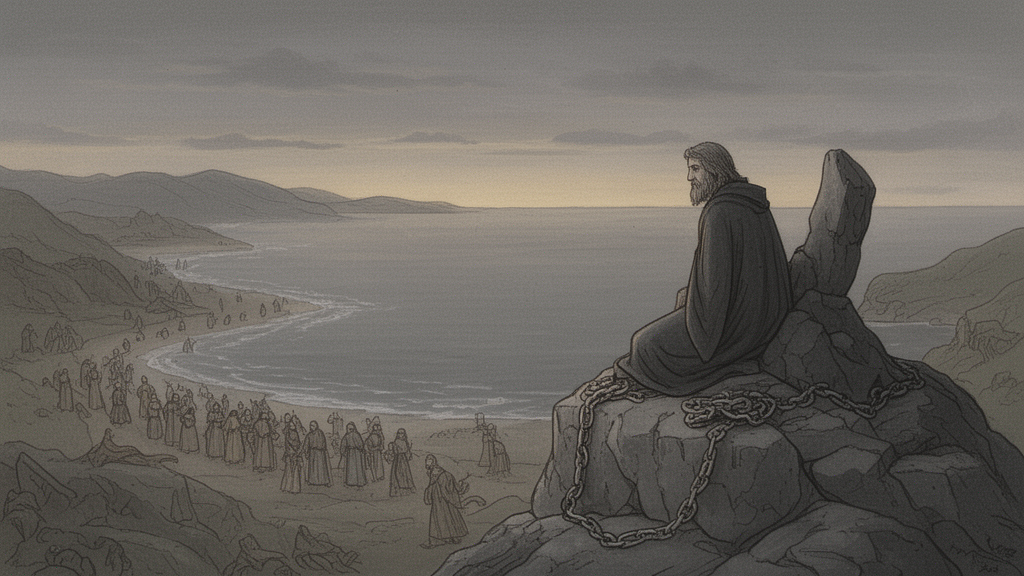
The protagonist’s realization of this second, deeper transgression leads him to a rock out at sea. There he is shackled for seventeen years in penance. The analysis describes him as representing “the epitome of all sin,” and then as devout. Pilgrims sent by God then arrive and crown him pope. The novel ends with divine forgiveness made visible through the papacy.
Plot summaries vary in how they present the protagonist’s name. One analysis uses the spelling “Grigorss,” while the Wikipedia summary uses the familiar name Gregory and the grokipedia entry uses “Gregor.” This article uses “Gregorius” when discussing the medieval poem and “the protagonist” or “Gregory” when describing Mann’s novel, so readers can recognize the same character across editions.
Thomas Mann and the Writing of the Novel
Mann’s Late Career
Thomas Mann was a German novelist, essayist, and Nobel Prize laureate, awarded the prize in 1929 according to a Goodreads author biography. He left Germany after the Nazis came to power in 1933 and later lived in the United States. He returned to Switzerland in 1952, the year after The Holy Sinner appeared. A biography summary also notes that Mann’s late career was shaped by exile, displacement, and the moral crisis of his time.
The Holy Sinner was published after Doctor Faustus, which the literary analysis calls his magnum opus. Where Doctor Faustus is dense and intimate, the analysis describes The Holy Sinner as lighter and more playful. Some readers treat the shift as a kind of relief after a heavy major work, while others read the playfulness as serious in its own way.
Irony and Storytelling
The novel is best understood as a work of irony. Mann takes a legend that could be read as pious instruction and presents it through a narrator who admires the “spirit of storytelling” and treats the events with some distance. The Wikipedia summary notes that this storytelling spirit is a term used often in Mann’s later works.
The irony does not mean the book is trivial. Its humor and surprise are used to raise questions about original sin, grace, and human nature. A reader who expects a conventional saint’s life will find something stranger and more searching.
Major Themes
Original Sin and Grace
The novel’s central theme is the relationship between sin and grace. The literary analysis states that Mann explores “the depths of the Judeo-Christian concept of original sin.” It also argues that the novel challenges the idea that a soul cannot reach the highest sanctity without first passing through deep sinfulness. In the analysis, sin is part of how the saint gains knowledge of human nature and how the power of penance and grace is tested.
This is a theological argument drawn from literary reading, not a doctrinal statement from the church. Readers should distinguish the novel’s ideas from the teachings of any church. The Holy Sinner is a literary treatment of older Christian ideas, and the sources cited here describe it that way.
The Epigraph and the Psalm
The analysis notes that Mann echoes the Latin phrase Beati quorum tecta sunt peccata, translated as “Blessed are they who are covered with sins.” The analysis attributes the phrase to Psalm 31. Numbering differs between Latin and English Bibles. In many English translations this verse is Psalm 32:1, so readers who check a different edition may find a different number. A reader comparing translations should confirm the psalm numbering in the edition they use.
Evil, Magic, and the Origins of Evil
The Wikipedia summary describes the origins of evil and their connection with magic as a subject that fascinated Mann to the end of his life. The Holy Sinner treats evil as a problem of origin and consequence, not only as a list of wrongs. The question of where evil begins runs through the whole story, from the duke’s household to the decisions of the siblings and the counsel of Eisengrein.
Sin as a Path to Holiness
Another repeated theme is the idea that sin, when faced honestly, can become a route to transformation. A Goodreads reviewer summarizes the book as being about the possibility of repentance and forgiveness. The novel does not excuse the sins it depicts. Instead, it places repentance and mercy at the center of the story’s moral logic.
Examples from the Text
Three concrete examples show how Mann’s method works.
- The barrel and the sea. The decision to set the infant adrift is an example of a bad choice made under pressure. Mann uses the sea as both a place of abandonment and a path to survival, which fits the story’s Moses-like pattern noted by a literary analysis.
- The discipline of the boy. The child’s success in contests with the fishermen’s sons shows his nobility and self-control. This is a detail that links his character to the theme of discipline that supports his later penance.
- The seventeen years on the rock. The long period of shackling is the clearest image of penance in the novel. Its length gives the reader a sense of time and endurance rather than a quick redemption.
Each example invites a reader to ask how the choice, the circumstance, or the discipline shapes the outcome. This is one of the best ways to read the novel: follow the causes, then the consequences.
Editions, Translation, and Reading Notes
German and English Editions
The German first edition was published in 1951 by S. Fischer Verlag. The English edition was translated by H. T. Lowe-Porter and published by Knopf in the same year. Library and bookseller listings give different page counts and formats, so readers should check the edition they are buying or borrowing. One listing gives 337 pages in hardcover, another gives 229 pages in paperback. Both may refer to different printings or formats.
A later English edition lists Russell A. Berman as an additional contributor, according to an Amazon listing. Readers who want the translation or introduction used in that edition should check the title page of the copy they are reading.
Translation Notes
Translation affects tone. Mann’s irony is partly a matter of sentence rhythm, word choice, and narrative distance. A reader who wants to study the novel closely should compare more than one translation or read the German original alongside an English version. The Holy Sinner was written in German, and the English title already differs from the German Der Erwählte.
When quoting the novel, readers should cite the edition they used. This article does not quote long passages, and it attributes ideas to literary analysis rather than presenting paraphrases as direct quotations.
Reception and Recognition
The Holy Sinner was received as a notable late work by Mann. A Grokipedia entry reports that the English edition was a finalist for the 1952 National Book Award for Fiction. That entry is an encyclopedia-style summary that was not independently verified in this article’s research, so readers should confirm the award claim with the National Book Foundation or a library catalog before relying on it.
Critical opinion is varied. The Goodreads page shows a community rating of 3.93 from about 2,098 ratings at the time it was accessed, with most ratings at four or five stars. Community ratings reflect popular opinion and are not a scholarly consensus. A reader looking for critical evaluation should consult academic reviews and literary histories.
The Holy Sinner and Hindu Readers
The Holy Sinner is not a Hindu text, and it does not describe Hindu deities, Hindu scriptures, or Hindu ritual. Its moral language comes from a medieval European legend and Christian ideas of original sin, penance, and papal authority. For that reason, this article does not present the novel as a Hindu teaching or claim that it reflects any Hindu scripture.
Hindu readers, and readers of Indian religious literature more generally, may still find the novel useful as a comparative text. The novel’s focus on how a person responds to wrongdoing, how repentance shapes a life, and whether a person can move beyond the consequences of past acts can be read alongside Hindu discussions of sin, atonement, and moral responsibility. Such a comparison should be done carefully, because the concepts are not identical and each tradition has its own vocabulary and internal debates.
Readers who want to explore Hindu teachings on moral failure, repentance, or devotion should begin with primary scripture editions and scholarly introductions. Related HindusGod.com articles may be helpful once they are published, including the guide to holy scriptures and the article on the Holy Gita. These pages are currently drafts and may not be public when this article is first published, so the owner should confirm their status before linking.
How to Read The Holy Sinner Well
A useful reading approach has three steps.
- Read the story first. Follow the sequence of events, the relationships among the characters, and the shifts from crime to exile to penance to papacy.
- Identify the narrator’s commentary. Notice where Clemens or the narrator comments on the story, and ask what that comment adds.
- Compare the medieval source and the modern novel. Look at what Mann keeps and what he changes, especially the tone, the irony, and the emphasis on psychology.
Readers new to Mann may also benefit from a short summary of his life and exile before reading. The novel was written after years of displacement, and that background helps explain the late-career themes of evil, guilt, and moral ambiguity.
Frequently Asked Questions
Is The Holy Sinner based on a real pope?
The novel is based on a medieval legend about Pope Gregory. The sources describe the book as a retelling of that legend, not as a historical biography. Historical claims about Gregory should be checked against historical sources rather than the novel.
Is The Holy Sinner a religious text?
No. It is a novel written by a modern author who reworked a medieval story. It engages with Christian ideas of sin and grace, but it should be read as literature rather than as scripture or church teaching.
Who wrote the medieval source?
The medieval source is commonly attributed to Hartmann von Aue, a German poet of the late twelfth century. The source’s exact date is discussed differently in different references, so readers should check a scholarly edition for precise dating.
Should I read the German or English version?
Readers who read German can compare the original text with the English translation. Readers who read only English should choose a translation and note its edition, because translation affects tone, rhythm, and irony.
Takeaway
The Holy Sinner is a late novel by Thomas Mann that turns a medieval legend about sin, penance, and grace into a work of irony and moral seriousness. Its story moves from a sinful birth to exile, marriage, penance, and papal crowning. Its themes are original sin, the origins of evil, and the possibility of forgiveness. For readers, the most productive approach is to follow the story closely, notice the narrator’s commentary, and compare Mann’s treatment with the medieval source.
Sources and Further Reading
- The Holy Sinner, Wikipedia: used for publication details, the basis in Hartmann von Aue’s Gregorius, and the plot summary of the Flanders section. The article was inspected, but the visible summary in the research record was incomplete.
- Analysis of Thomas Mann’s The Holy Sinner, Literary Theory and Criticism: used for the literary analysis of the plot after the abbot, the penance on the rock, the psalm echo, and the reading of original sin.
- The Holy Sinner, Goodreads: used for the community rating and a brief publisher-style description. Community ratings are not scholarly evaluation.
- The Holy Sinner, Grokipedia: consulted as a secondary summary for the National Book Award finalist claim. This source is flagged for verification before publication.
- The Holy Sinner, Amazon listing: used only to note an additional listed contributor and an edition listing. It is a retailer listing, not a bibliographic authority.
- The Holy Sinner, Internet Archive: listed as a digital copy record. The inspected page content was mostly navigation, so it was not used for factual claims.