The Holy Sinner (German: Der Erwählte) is a 1951 novel by the German writer Thomas Mann. It retells a medieval legend about a man born of an incestuous union who later becomes a pope, and it explores sin, penance, grace, and the origins of evil. This guide explains what the novel is, what it draws on, how its plot is usually summarized, and what its main themes are. It is a work of European literature, not a scripture of any Hindu tradition, so it is covered here as a comparative reading for readers of world religious and literary texts.
What The Holy Sinner is
The Holy Sinner is a German novel first published in 1951. The English translation by H. T. Lowe-Porter was also published that year by Knopf, according to the bibliographic details given on Wikipedia.[1] The original German title, Der Erwählte, can be translated as “the chosen one,” a detail that matters because the story is built around a person who is marked for an extraordinary destiny despite, or through, his sins.
Wikipedia describes the book as a novel that explores “the origins of evil and evil’s connection with magic,” a subject that Mann returned to for much of his life.[1] The same source notes that Mann used a medieval legend in much the way he had used the biblical account of Joseph in his earlier tetralogy Joseph and His Brothers, reworking it with his ironic sensibility to examine original sin and the possibility of transcending evil.[1]
Readers who know Mann mainly from Buddenbrooks or The Magic Mountain should expect a different tone. The Holy Sinner is shorter, more fable-like, and much more playful in its narration. Its humor and irony are central, and the book is often read as both comic and serious at once. EBSCO’s research starter notes that the novel is rich in humor and wit while also reflecting seriously on moral dilemmas.[4]
The medieval source: Hartmann von Aue’s Gregorius
The novel is based on a medieval verse epic called Gregorius, written by the German poet Hartmann von Aue. Wikipedia dates Hartmann’s life to about 1165 to 1210 and identifies him as a Minnesinger, a German lyric poet of the courtly tradition.[1] The Goodreads page for the novel repeats that the source is a medieval poem and describes Mann’s version as a rewriting of a medieval hagiography, a saint’s life, about “the good sinner.”[2]
EBSCO describes the novel as based mainly on a twelfth-century epic that was itself derived from a French chivalric romance.[4] Because this is a secondary summary, readers who want to trace the exact lineage of the legend should consult a scholarly edition or literary history of the German medieval tradition before treating that chain of sources as settled.
What the legend is about
Wikipedia describes Mann’s source as a medieval legend about “the exceeding mercy of God and the birth of the blessed Pope Gregory.”[1] The phrase is useful because it shows the spiritual claim behind the story. The plot does not present sin as the end of a person’s story. It presents a path in which great wrongdoing, acknowledged and answered with long penance, leads to an unexpected form of grace.
The legend is a Christian narrative. Its saint, traditionally identified with Pope Gregory I, belongs to the history of the Western church.[4] That context matters for any reader who wants to understand the book on its own terms.
Plot summary
Summaries of The Holy Sinner agree on the broad structure, but they differ on some details. Wikipedia’s plot summary is the most detailed of the sources reviewed here, so this summary follows it while noting where other sources differ.[1]
The twins in Flanders
The story opens in Rome, where the monk Clemens announces the ringing of the city’s bells. Clemens, who is moved by what Wikipedia calls the “spirit of storytelling,” then tells the reader how the bells came to ring: through the arrival of Gregory in Rome and his election as pope.[1] The narrative frame, with its storyteller inside the story, is one of the novel’s most distinctive features.
The main events take place in Flanders. Duke Grimald, a widower for seventeen years, presses his daughter Sibylla to marry in order to forge an alliance with a neighboring king. Sibylla is drawn only to her brother Wiligis and refuses the match.[1] EBSCO adds that the twins were devoted to each other from childhood, and that their mother died at their birth.[4]
The sin and the consequences
After the duke’s death, the brother and sister become lovers. Sibylla learns she is pregnant by her brother.[1] Both consider suicide out of shame. They instead turn to their loyal counselor, the knight Eisengrein, who advises Wiligis to join a crusade as a way of atoning for their sins.[1] EBSCO states that Wiligis sets out on a pilgrimage to Rome to do penance and dies before reaching his goal.[4] Wikipedia says he is killed before reaching Massilia, the modern Marseille.[1] The two sources describe his journey differently, so readers should treat the exact route as a detail that varies between summaries.
The child set adrift
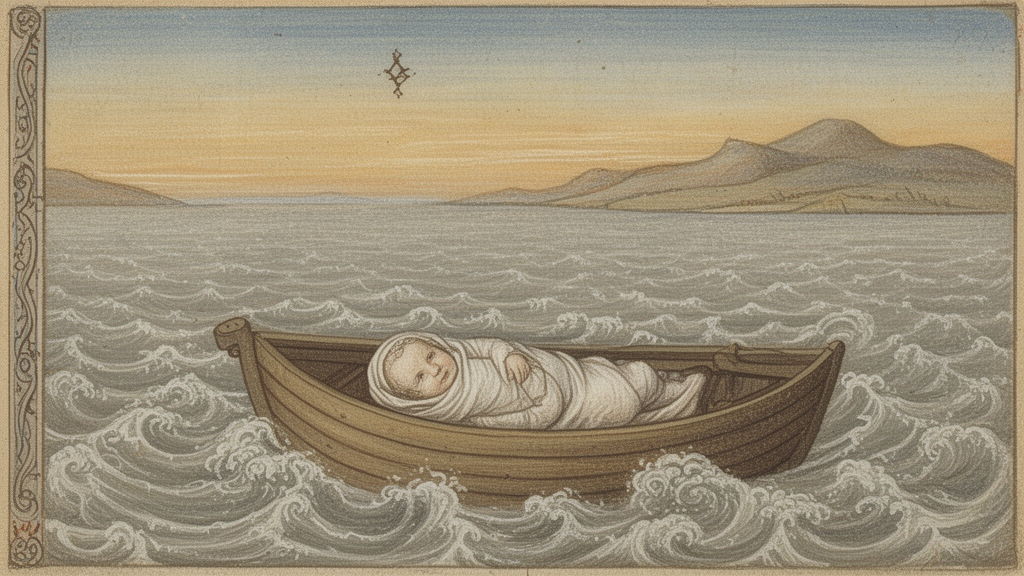
After the child is born, Eisengrein suggests that it be set adrift. Wikipedia says the infant is placed in a sealed barrel.[1] EBSCO describes a small boat, wrapped in rich cloths, with an ivory tablet carved by the mother that records the child’s noble but sinful origin without giving his name or birthplace.[4] This is a material disagreement between two sources. Neither source is cited here as more authoritative on this detail than the other; a reader who needs the exact form of the vessel should check the translation itself.
The child survives, is found by fishermen, and is eventually raised in a monastery. Goodreads summarizes the setting as the channel islands, and the child is named Gregorius, later known as Grigorss in some summaries.[2][4]
Return, marriage, and penance
As a young man, Gregorius learns of his origins and sets out to find his mother. Later he unknowingly marries Sibylla, who is his mother. When he discovers the truth, he does penance for seventeen years, according to the reviewer summary of the medieval legend that appears on Goodreads.[2] The Goodreads page presents this as the traditional legend’s version, and the detail should be read as coming from the legend as retold in a reader review rather than from Mann’s own text.
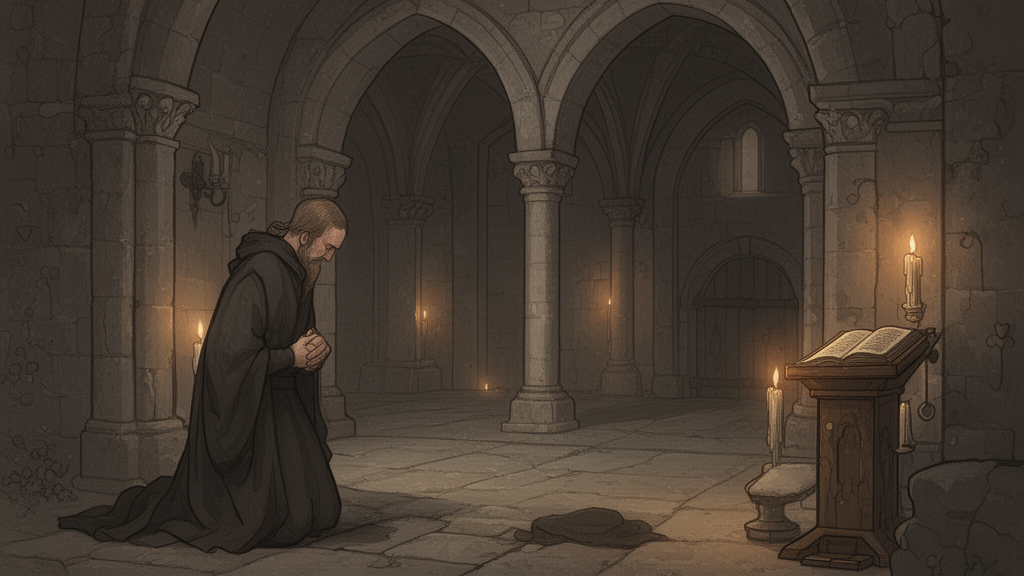
The story then turns toward grace. EBSCO says Gregorius ascends to become Pope Gregory I and eventually reconciles with Sibylla, who has lived a life of penance.[4] The final reconciliation is the emotional center of the plot, and it is why the title’s phrase “holy sinner” fits the book: the central figure is holy because of his penance and grace, not because he avoided sin.
Major themes
Sin, penance, and grace
The novel is organized around a question that religious traditions have long discussed: whether a grave wrong can be answered by repentance, and whether grace can reach a person who has committed it. Mann’s legend answers yes, but it does not treat the sin as trivial. The characters’ shame, their attempts at atonement, and their long separation are presented as real.
Wikipedia describes the book as exploring “the notion of original sin and transcendence of evil.”[1] The phrase “original sin” comes from Christian theology, and it is important not to project the concept onto other traditions without careful argument. Readers from Hindu, Buddhist, Jain, or Sikh backgrounds may find parallels in ideas of atonement or karma, but such comparisons are interpretive. They are not claims the novel itself makes.
Irony and storytelling
Mann’s narrator, Clemens, is a storyteller who introduces the story with a sense of wonder and some distance. That distance gives the book its irony. The reader is invited to take the legend seriously while also noticing the narrator’s delight in the telling, the way a story can be both sacred and entertaining.[1] The phrase “spirit of storytelling,” which Wikipedia notes is a term Mann used often in his later work, points to this self-aware style.[1]
Evil, magic, and human origins
Wikipedia states that the book explores the origins of evil and evil’s connection with magic.[1] The text should be read with that claim in mind, but the exact role of magic in the plot is a matter of interpretation. Readers should look at specific scenes in the translation rather than relying on a single summary.
Editions, translations, and reading choices
Several editions of the book are in circulation, and their details differ. Wikipedia lists the 1951 first edition in hardcover with 337 pages, published in English by Knopf and in German by S. Fischer.[1] Goodreads lists a 229-page paperback edition.[2] Amazon’s listing for a 1992 University of California Press edition credits Mann, H. T. Lowe-Porter as translator, and Russell A. Berman as the editor or introducer named in the product title.[3]
Because these editions differ in length and in the presence of introductions or notes, readers should check the edition’s title page and translator credits before citing a page number or a quotation. For academic use, identify the translation and edition in full.
Choosing a translation
- For the standard English-language version, look for the H. T. Lowe-Porter translation, which is the translator named on the Knopf-era and later editions in the sources reviewed here.[1]
- For German-language study, read Der Erwählte in the original, since the title and style carry meaning that a translation may adjust.
- For background, compare the novel with an English prose summary of the medieval Gregorius poem before reading the novel.
Why HindusGod readers might read this book
HindusGod.com focuses on Hinduism, deities, scriptures, festivals, and devotional practice. The Holy Sinner does not belong to those traditions, and this post does not present it as a Hindu text or as a commentary on one. Readers who arrived here while searching for the phrase “holy sinner” should know that the book is a German novel based on a Christian legend.
There are still useful reasons to read it alongside Indian religious literature. Both traditions ask how a person can respond to wrongdoing, how repentance is understood, and what role grace or divine mercy plays. A reader might compare the novel’s penance-and-grace structure with the discussion of atonement in Hindu dharma literature. Any such comparison should be made with care. Explain which text, translation, and tradition is being compared, and avoid stating that the two traditions teach the same thing.
Comparative reading steps
- Read a summary of the medieval legend or the novel’s plot, and note the sources that disagree on details.
- Identify the religious frame: the novel is set in a medieval Christian world and refers to papal authority.
- Choose a specific Hindu text, such as a dharma text or a scripture on penance, and state the edition and translation you are using.
- Compare the concepts of sin, atonement, and grace in their own terms before drawing parallels.
- Label any parallel as your own interpretation unless a scholar has made the comparison in a published source.
Frequently asked questions
Is The Holy Sinner based on a true story?
The novel is based on a medieval legend and a medieval poem, not on documented biography. Wikipedia describes the source as a medieval legend about God’s mercy and the birth of the blessed Pope Gregory.[1] Readers should treat the plot as a literary and legendary story, not as historical record.
Is The Holy Sinner a religious text?
It is a novel. It deals with religious themes, including sin, penance, and grace, and it draws on a Christian saint’s legend. It is not a scripture of Hinduism or of any other religious tradition covered on HindusGod.com.
Who wrote the original poem that inspired the novel?
Wikipedia identifies the medieval source as the verse epic Gregorius, written by the German Minnesinger Hartmann von Aue, whose dates are given as about 1165 to 1210.[1]
Sources and further reading
- The Holy Sinner, Wikipedia: used for publication details, the medieval source, the plot summary, and the book’s stated themes. Wikipedia is a secondary source; check its cited references before academic use.
- The Holy Sinner by Thomas Mann, EBSCO Research Starters: used for the summary of the twins, the child, the pope, and the reconciliation, and for the statement that the novel draws on a twelfth-century epic.
- The Holy Sinner by Thomas Mann, Goodreads: used for edition information and a reader-facing description. Goodreads contains user-generated reviews, so its summaries are not treated as authoritative.
- Amazon listing for The Holy Sinner, University of California Press edition: used only to identify a published edition and translator credit. A retail listing is not authoritative for literary facts.
- Thomas Mann the Holy Sinner, Internet Archive: listed as a digitized copy location. The retrieved page did not provide usable bibliographic text for this post, so no claims are drawn from it.
Takeaway
The Holy Sinner is a Thomas Mann novel that reworks a medieval legend about sin, penance, and grace. Its plot is dramatic, but its deeper interest lies in its ironic telling and its question about whether a person defined by wrongdoing can still become holy. For HindusGod readers, the book is best approached as a Christian-legend-based German novel, with any comparison to Hindu teachings clearly labeled as interpretation.