The Yoga Chudamani Upanishad is a short Sanskrit text, usually described as one of the minor Upanishads, whose title translates as “crown jewel of yoga.” It is associated with the Sama Veda, has 121 verses in a single chapter, and is best known for its discussion of Kundalini yoga, subtle-body concepts, and a breath-based mantra called Hamsa, also known as Ajapa Gayatri. This article explains what the text says, how it is dated and classified, what its practice instructions do and do not claim, and where sources disagree.

Short answer: what the Yoga Chudamani Upanishad is
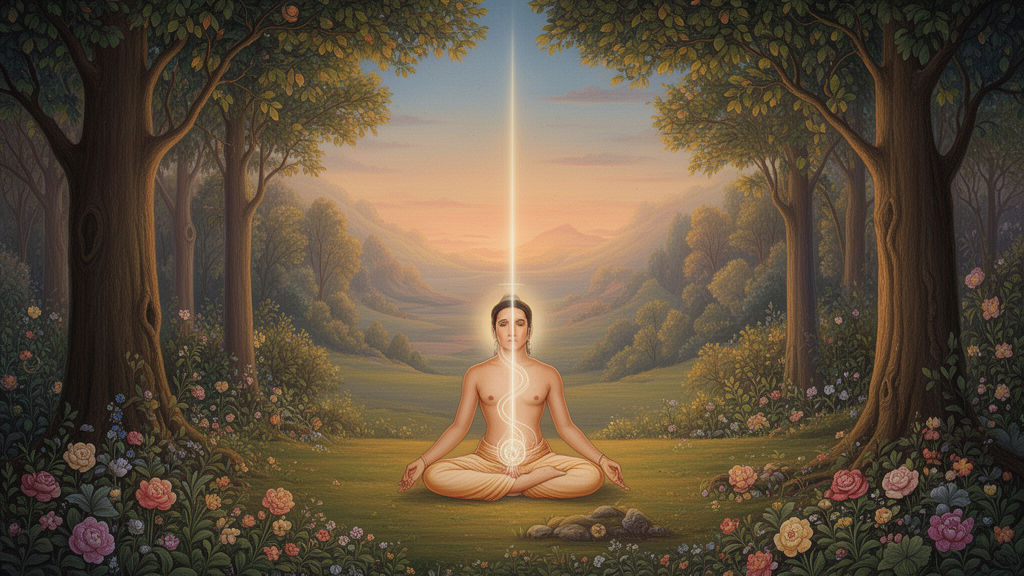
The Yoga Chudamani Upanishad is a Sanskrit Upanishad that teaches yoga as a path to liberation through disciplined inner practice. According to the Wikipedia article on the text, it is a minor Upanishad attached to the Sama Veda, is one of twenty Yoga Upanishads, and is notable for its discussions of Kundalini yoga [1]. The Hinduwebsite translation summary describes it the same way: a Sama Veda Upanishad of 121 verses for yogis seeking liberation through systematic practice [3].
Its most distinctive contribution is its detailed treatment of Kundalini, chakras, nadis, prana, and the Hamsa mantra. Readers who come to it expecting only philosophical inquiry will find more instruction on breath, subtle energy, and meditation than in many classical Upanishads.
Name, meaning and spelling
The title combines yoga with cūḍāmaṇi, meaning “crest jewel” or “crown jewel.” Wikipedia gives the Devanagari form योगचूडामणि and the IAST form Yogacūḍāmaṇi [1]. The text is also known as the Yoga-cudamany Upanishad and the Yogachudamanyupanisad, and a 1883 printed edition in Telugu is noted, with some errors [1].
Readers will meet several spellings, including “Yoga Chudamani,” “Yogachudamani,” and “Yoga Cudamani.” These refer to the same text. This article uses “Yoga Chudamani Upanishad” for consistency. Do not confuse it with the separate text Chudamani Upanishad, which has its own page on this site (see the internal links below).
Scriptural classification: Veda, Upanishad and Yoga genre
Most sources place the text within the Sama Veda. Wikipedia states that it is attached to the Samaveda [1]. Hinduwebsite lists it as a Sama Veda Upanishad [3]. The Sacred Texts of Hinduism editorial note describes it as a later Yoga Upanishad traditionally associated with the Samaveda [6].
One popular explanatory article, the Vedanta Students page, says the text is “traditionally associated with the Atharva Veda” [5]. This conflicts with the other sources above. Because the conflict is unresolved in the sources reviewed, this article follows the Sama Veda attribution that appears in the Wikipedia, Hinduwebsite, and Sacred Texts of Hinduism pages, and treats the Atharva Veda claim as a reported disagreement rather than a settled fact.
Within the Upanishadic classification, Wikipedia says the text is one of twenty Yoga Upanishads in the four Vedas [1]. Hinduwebsite places the Sama Veda Upanishad within its genre of Raja Yoga texts, as reported on its page [3]. Genre labels vary by publisher, so treat such groupings as classificatory conventions rather than fixed categories from the text itself.
Dating: what scholars and sources say
The date of the Yoga Chudamani Upanishad is not known precisely. Wikipedia reports that Richard Rosen dates it to about the 14th to 15th century CE [1]. The Sacred Texts of Hinduism note calls it a later Yoga Upanishad [6]. Swami Satyadharma Saraswati, as reported by Wikipedia, describes it as an advanced treatise for higher sadhana and notes that its Kundalini discussion was a precursor to later books on the subject [1].
Be cautious with precise dates. A single scholarly estimate, supported by general descriptions of a “later” text, does not establish an exact year of composition. Readers who need a firm chronology should consult the cited academic and reference works directly.
Structure of the text
The text is mostly poetic verses organized as one chapter of 121 verses [1]. Wikipedia summarizes its arrangement as follows:
- The opening verses state its goal as kaivalya, or liberating aloneness [1].
- The first seventy verses present its Kundalini theory, including chakras (energy centers), nadis (energy channels), prana vayus (life-force airs), mudras, and shakti (power) [1].
- The remaining verses describe meditative exercises with Om and assert that enlightenment can be reached by combining Hatha yoga, Kundalini yoga, and reflection on one’s innermost consciousness [1].
- The closing verses use analogies, such as taming a lion or elephant in gradual stages, to describe the slow mastery of the mind and body [1].
Translations do not always preserve this numbering consistently. The Vedanta Spiritual Library translation by P. R. Ramachander marks several passages as unavailable, including slokas 2 to 29 and 40 to 71 [4]. A reader using that translation will therefore see gaps in the sequence. For this reason, verse numbers cited in this article are limited to those shown on the sources consulted.
The Hamsa mantra and Ajapa Gayatri
The most widely discussed teaching of the text is the Hamsa mantra. In the Vedanta Spiritual Library translation, the text says that the breath goes out with the sound “ha” and comes in with the sound “sa,” so that beings chant “Hamsa” continuously [4]. The translation also says that this chanting happens day and night, and gives the count as twenty-one thousand one hundred times [4]. The same translation calls this mantra Ajapa Gayatri and says it grants liberation to yogis [4].
The Hinduwebsite summary states the figure differently. It says that the mantra is chanted naturally 21,600 times daily during inhalation and exhalation [3]. The number 21,600 also appears in the Hinduwebsite introduction in a different phrasing, while the introduction text itself reads “twenty one thousand and one hundred” [3]. Because the numbers differ between the summary and the translated verse, readers should quote the count from a verified translation and not from a summary.
Hinduwebsite also says that practiced consciously as Ajapa Gayatri, the mantra purifies accumulated sins and awakens Kundalini energy [3]. The Vedanta Spiritual Library translation says the mantra cleanses sins and grants salvation [4]. These are claims made within the text and its commentary tradition. They describe the Upanishad’s teaching. They are not health claims and not guarantees of any outcome.
How to understand this practice
The mantra is described as a breath-linked repetition rather than a sound pronounced aloud. The phrase “ajapa” is often explained in devotional and yogic writing as “unspoken,” meaning the mantra continues as a natural rhythm of breathing. That gloss is a traditional interpretation and should be attributed as such. The text itself, as presented in the translation, describes chanting that occurs in the breath.
Practitioners who wish to try breath-based mantra work should do so under the guidance of a qualified teacher from a lineage they trust. The text itself describes the practice as advanced, and Hinduwebsite and Vedanta Students both describe it as suited to serious seekers [3][5].
Kundalini, sushumna and the gate of Brahman
The Kundalini teaching is the text’s most cited feature. The Vedanta Spiritual Library translation says that the Kundalini power, located above the mooladhara and described in eight-coiled form, covers the mouth of the sushumna, which it calls the gate of Brahman [4]. It states that the power rests and that, through heat generated by yoga practice, the speed of breath, and mental power, it rises through the sushumna nadi [4]. The translation compares the yogi’s opening of this gate to opening the doors of a house with a key [4].
Wikipedia likewise identifies Kundalini discussion as the text’s notable feature and says the text has been a reference for studies on Kundalini theories and tantra traditions [1]. Hinduwebsite says the text details the relationship between Kundalini and the sushumna nadi and explains how prana ascends through the chakras when the gateway to Brahman opens [3].
These passages are part of the text’s internal system of subtle anatomy. They are not physiological descriptions in the modern medical sense. Readers should distinguish the text’s subtle-body model from anatomy and physiology, and should not read it as a claim about nerves or organs.
Yoga as a path: ethics, asana, pranayama and withdrawal
The Yoga Chudamani Upanishad does not present Kundalini alone. Hinduwebsite lists the text’s comprehensive instruction as covering pranayama techniques, pratyahara (withdrawal of the senses), and asana postures, all working toward spiritual awakening [3]. Vedanta Students summarizes a sequence that begins with ethical discipline and moderation, then moves to asana and pranayama, pratyahara and dhyana, and finally samadhi [5].
This sequence is a commentary-level summary. The Vedanta Students page is a modern educational explainer rather than a critical edition, so it should be treated as an interpretation of the text’s ordering. The general arrangement it describes, ethical preparation followed by breath work, sense withdrawal, meditation, and absorption, is consistent with the classical eightfold framework of yoga in broader Indian yoga literature. The Yoga Chudamani Upanishad is not a Yoga Sutra commentary, and the connection should not be overstated.
Wikipedia says the text’s later meditative section describes exercises with Om and asserts that enlightenment can be achieved by combining Hatha yoga, Kundalini yoga and reflection on innermost consciousness [1]. This is a useful way to see the Upanishad’s integrative approach: it treats breath, body, and consciousness as parts of one practice.
Philosophical orientation: Brahman, Atman and Shakti
The Upanishad moves beyond practice into metaphysics. The Sacred Texts of Hinduism note describes its realization-oriented and Advaita-oriented outlook, noting the integration of practical yogic instruction with meditative discipline and symbolism [6]. The Vedanta Spiritual Library translation contains an opening invocation and a passage describing Para Brahman as Om, as that which exists, which is clean, without stains, and without beginning or end, and says that from Para Brahman emerges Para Shakti, the female aspect [4].
The language of Shiva and Shakti becoming one within the self appears in Wikipedia’s quoted purpose of yoga, which states that yoga unites two principles so that Shiva and Shakti become one within the self [1]. This is a teaching drawn from the text’s symbolism. Readers should note that devotional traditions around Shiva and Shakti interpret this language in many ways, and the Upanishad’s use of the language is one interpretation among others.
Practice, devotion and caution
Many readers arrive at this text through practice. It is important to separate what the text describes from what a modern teacher or website promises. The text describes yoga as leading to liberation. It describes breath and mantra as spiritual disciplines. None of the sources reviewed support claims that the practice guarantees health, wealth, protection, or specific supernatural results, and this article does not make such claims.
Vedanta Students describes benefits such as mental stability, emotional balance, and reduced anxiety [5]. These are presented by that website as expected benefits of study and practice. They are not established as medical outcomes in the primary text, and the source does not cite clinical evidence for them. Readers with medical conditions, especially concerning breath retention or intense pranayama, should consult a qualified health professional and a qualified teacher before practice.
Tradition-specific context
The Upanishad belongs to a wider yoga literature that includes Hatha yoga texts, Tantric material, and the Yoga Sutras of Patanjali. Wikipedia notes that the text has been used in studies of tantra traditions [1]. Different lineages emphasize different aspects of yoga, from ethical discipline to devotion to Kundalini practice. A reader should not assume that one lineage’s practice describes all Hindu yoga.
Translations and reading notes
The Yoga Chudamani Upanishad has been translated and published in several forms. The Vedanta Spiritual Library translation was done by P. R. Ramachander and published by celextel.org [4]. Hinduwebsite presents a translation by P. R. Ramachander with an introduction by Jayaram V [3]. Sacred Texts of Hinduism provides an original text and editorial notes [6]. The Archive.org PDF description describes the text as a manual of higher sadhana for advanced and initiated aspirants, and states that it delineates the ancient path of kundalini awakening [2]. This archive description was not fully inspected in this research and is cited only for its descriptive statement.
Because translations differ in verse count, numbering, and wording, readers should compare at least two translations for important claims. Where a translation marks passages as unavailable, do not fill in the missing content from memory or from unverified websites.
Yoga Chudamani Upanishad and the wider Yoga Upanishads
The text is one of the Yoga Upanishads, a group of later texts that relate yoga to Upanishadic teaching. Wikipedia counts it among twenty Yoga Upanishads [1]. It is also listed as number 46 in the serial order of the Muktika enumerated by Rama to Hanuman in the modern anthology of 108 Upanishads, as reported by Wikipedia [1]. That anthology reference is a modern compilation tradition, not a sign of a single ancient canon, and should be read as such.
For a broader introduction to yoga-related Upanishads, readers can explore the HindusGod.com article on The Yoga Upanishads. For the wider relationship between yoga and Hindu thought, see Yoga and Hinduism. A related but separate text is discussed in Chudamani Upanishad, which should not be confused with this Yoga text.
Comparing Yoga Chudamani with other Upanishads on yoga
Several Upanishads in the Yoga and Samanya groups address breath, subtle body, and meditation. Readers often compare them. The following distinctions are based on the sources reviewed and should be checked against the texts themselves before being used in teaching or writing.
- Yoga Chudamani Upanishad: Sama Veda attribution in most sources, 121 verses, strong emphasis on Kundalini, Hamsa mantra and chakras [1][3].
- Yoga Shikha Upanishad: a separate text with its own HindusGod.com draft page. Comparative claims should be made only after checking that text directly. See Yoga Shikha Upanishad.
- Yoga Kundalini Upanishad: a separate text with its own HindusGod.com draft page. See Yoga Kundalini Upanishad in Hindi.
Where a title is similar, check the Veda attribution, verse count, and translation before assuming the two texts are related.
Yoga and Kathopanishad
Readers who study yoga in the Upanishads often ask how the Katha Upanishad, a different and older text, treats yoga. The Katha Upanishad is distinct from the Yoga Chudamani Upanishad in date, attribution, and content. For a separate treatment, see Yoga in Kathopanishad and Katha Upanishad Yoga. Do not treat the Yoga Chudamani Upanishad as a commentary on the Katha Upanishad unless a verified source says so.
Commentary and the Vyasa tradition
Some readers connect yoga texts to the commentarial tradition around the Yoga Sutras. The Yoga Chudamani Upanishad is not a Yoga Sutra commentary. Readers interested in classical yoga commentary can explore Vyasa Commentary on Yoga Sutras as a separate subject.
Why the text matters today
The text matters for three reasons. First, it is an important witness to later Yoga Upanishadic thought, as Wikipedia and the Sacred Texts of Hinduism note [1][6]. Second, its Kundalini teaching has influenced later writing on the subject, according to Swami Satyadharma Saraswati as reported by Wikipedia [1]. Third, it shows how Upanishadic metaphysics and yogic practice were combined in one text. Readers who study the Upanishad carefully can see how breath, mantra, body, and realization of Brahman are presented as connected.
At the same time, modern wellness writing often adopts Kundalini and chakra language without its original context. This article treats those terms as parts of the text’s internal framework and does not endorse commercial claims about them.
Frequently asked questions
Is the Yoga Chudamani Upanishad a Sama Veda text?
Most sources reviewed say yes. Wikipedia and Hinduwebsite both associate it with the Sama Veda [1][3]. Vedanta Students says it is traditionally associated with the Atharva Veda [5]. Treat the Sama Veda attribution as the one supported by most of the sources consulted, and note the disagreement when citing the text.
What does the Hamsa mantra mean?
The translation consulted describes the mantra as the breath going out with the sound “ha” and in with the sound “sa” [4]. Ajapa is explained in many traditional writings as “unspoken” or continuous. That explanation is an interpretation and should be attributed to the tradition that gives it.
Is this text only about Kundalini?
No. Kundalini is central, but the text also covers pranayama, pratyahara, asana, meditation with Om, and the aim of liberation [1][3]. Summaries that present it only as a Kundalini manual leave out much of its content.
Should beginners practice from this text alone?
The text describes itself as an advanced manual for initiated seekers in one publisher’s description [2]. Beginners should read with a qualified teacher and should not attempt intense breath or retention practices without guidance and medical caution.
Sources and further reading
- Wikipedia, “Yogachudamani Upanishad,” for the name, Sama Veda attribution, verse count, Richard Rosen’s dating, and the summary of Kundalini and meditative sections: https://en.wikipedia.org/wiki/Yogachudamani_Upanishad
- Hinduwebsite, “Yoga Chudamani Upanishad: Supreme Yoga Practices for Liberation,” translation by P. R. Ramachander with introduction by Jayaram V, for the 121-verse summary, Hamsa mantra summary, and the pranayama, pratyahara and asana content: https://www.hinduwebsite.com/vedicsection/upanishads/yogachudamani.asp
- Vedanta Spiritual Library, “Yoga Chudamani Upanishad,” translated by P. R. Ramachander, for the verses on Hamsa, Ajapa Gayatri, Kundalini and Sushumna, with the note that some slokas are unavailable: https://www.celextel.org/upanishads-sama-veda/yoga-chudamani-upanishad/
- Sacred Texts of Hinduism, “Yoga Chudamani Upanishad,” for the editorial note on its later date, Samaveda association, and realization-oriented outlook: https://texts.wara.in/upanishads/yoga/yoga-chudamani/
- Vedanta Students, “Yoga Chudamani Upanishad Complete Explanation,” for an educational summary of the text’s stages and the Atharva Veda claim, which conflicts with other sources: https://vedantastudents.com/yoga-chudamani-upanishad-complete-explanation-teachings-benefits-how-to-study-and-essence/
- Archive.org PDF, “Yoga Chudamani Upanishad – Crown Jewel of Yoga,” cited only for its descriptive statement that the text is a manual of higher sadhana. This PDF was not fully inspected: https://archive.org/download/folder-20230407-20/Yoga+Chudamani+Upanishad+-+Crown+Jewel+of+Yoga.pdf
Summary
The Yoga Chudamani Upanishad is a 121-verse Sanskrit text, usually associated with the Sama Veda, that presents yoga as a disciplined path to liberation. It is best known for its Kundalini teaching, its Hamsa or Ajapa Gayatri mantra, and its account of chakras, nadis, prana and the sushumna. Its date is commonly placed in the later medieval period, with a 14th to 15th century CE estimate attributed to Richard Rosen. Readers should compare translations, note the Veda attribution disagreement, and approach its practices with teacher guidance and medical caution.