The Yajnavalkya Upanishad is a short Sanskrit text on sannyasa, the life of formal renunciation in Hindu tradition. It describes who may renounce, how the renunciation is marked, how a renunciant should live, and what the highest state of the renunciant is said to be. It is classed as a minor Upanishad and is attached to the Shukla Yajurveda. Scholars generally date it to the late medieval period, and the text belongs to the group of Sannyasa Upanishads, which deal with monastic life rather than Vedic ritual.
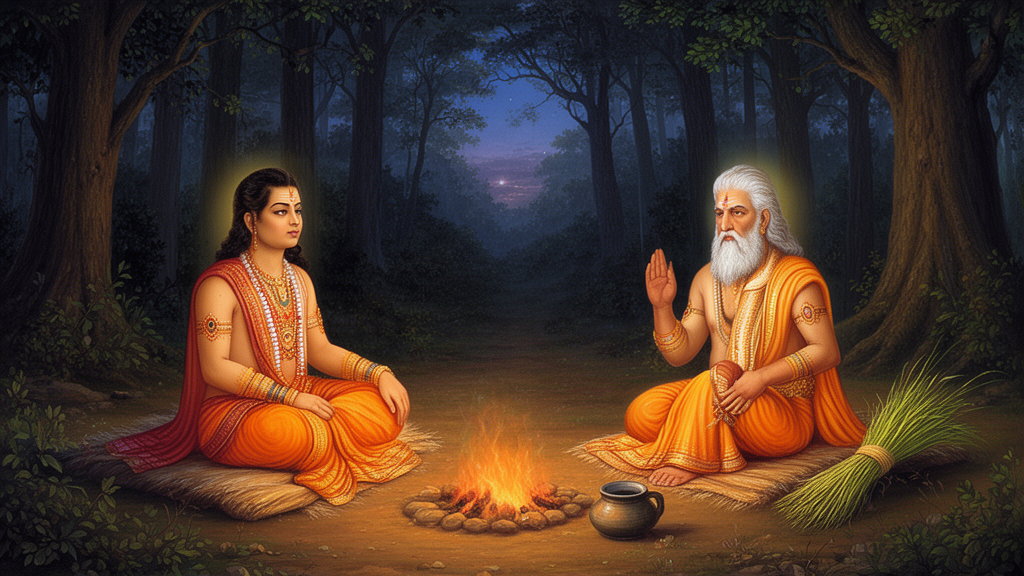
This guide explains what the text says, how it is organized, where it came from, and how different traditions read it. Where the sources do not settle a question, this article says so.
The short answer: what the Yajnavalkya Upanishad teaches
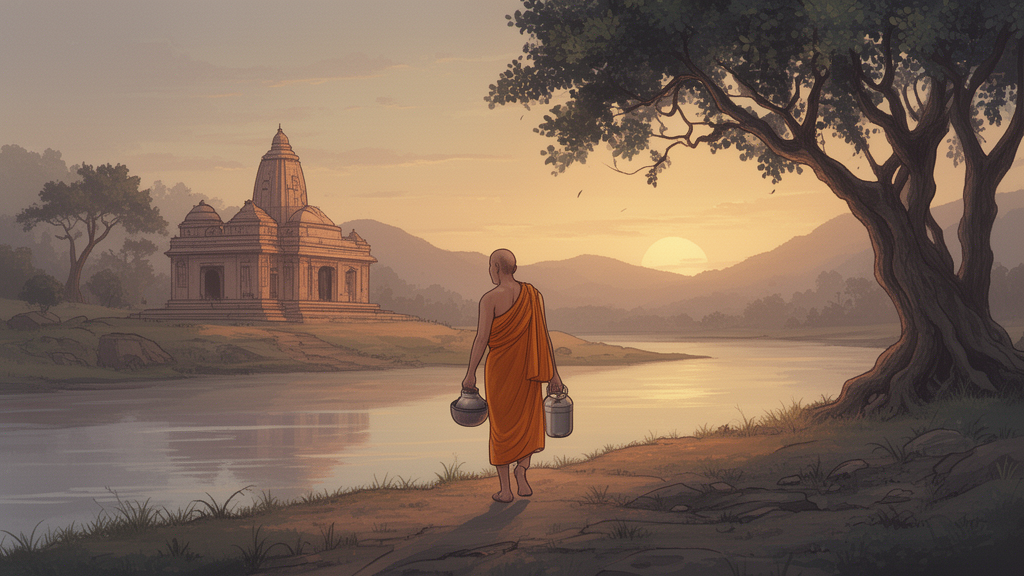
The text is a dialogue. King Janaka of Videha asks the sage Yajnavalkya how renunciation should be understood and practiced. Yajnavalkya answers with a set of rules for leaving household life, a description of the conduct expected of an ascetic who has renounced, and a description of the paramahamsa, the renunciant who has realized non-dual Brahman. According to a widely cited summary, the Upanishad teaches that renunciation can be undertaken from any stage of life, and that the highest state is one of inner knowledge rather than outward performance.
In short, the Yajnavalkya Upanishad teaches that:
- renunciation is a path that may be entered after studentship, after household life, after forest life, or even suddenly when a person turns away from worldly life;
- the renunciant should live simply, beg for food, avoid violence, and keep no fixed home;
- inner knowledge of the Self (Atman) as identical with Brahman is more important than external markers;
- the highest renunciant is the paramahamsa, who is described as beyond the pairs of opposites and beyond ritual obligation.
Where the text fits in Hindu scripture
The name and the sage
The title combines the name of the Vedic sage Yajnavalkya with the word Upanishad, which in this context refers to a teaching text. The Wikipedia entry on Yajnavalkya describes him as an Indian sage and philosopher, associated with the Brihadaranyaka Upanishad and with the teaching of the non-dual Self. The Yajnavalkya Upanishad is a later text that borrows his name and his role as teacher. Its use of his name does not mean that the sage composed it, and no reliable source identifies a single author.
Some manuscripts give the title as Yajnavalkyopanishad with the parts joined together. Readers who search for variant spellings will also see the title written in Devanagari as याज्ञवल्क्य उपनिषत् and in IAST transliteration as Yājñavalkya Upaniṣad. This article uses the common English form throughout.
Attachment to the Shukla Yajurveda
The text is attached to the Shukla Yajurveda, which is the Veda usually associated with Yajnavalkya in the tradition. That attachment is a traditional classification, and it should be read as a statement about how the text is grouped rather than as evidence that the Upanishad is an early Vedic composition. Its content, as described below, shows a later and more specialized concern with renunciation.
The Muktika canon and the list of 108 Upanishads
In the Telugu-language anthology of 108 Upanishads in the Muktika canon, which presents the teachings as narrated by Rama to Hanuman, the Yajnavalkya Upanishad is listed at number 97. Readers who want a broader map of the collection can start with the overview of the 108 Upanishad list on HindusGod.com (URL to confirm as live; currently a WordPress draft). The Muktika list is a specific tradition of enumeration. Other Upanishad lists count texts differently, so the number 97 should not be treated as a universal ranking.
Sannyasa Upanishads as a group
The Yajnavalkya Upanishad is one of twenty texts classed as Sannyasa (renunciation) Upanishads. This group focuses on monastic discipline, ascetic identity, and the spiritual states of renouncers. If you are new to the term, the broader HindusGod.com article on the meaning of Upanishad explains how these texts differ from the older Vedic portions. Those sections of Vedic literature focus on sacrifice and ritual, while the Upanishads often turn to inner knowledge, though the boundaries between them are not always sharp.
Date and authorship: what is known and what is uncertain
The date given by scholars
The Wikipedia article on the Yajnavalkya Upanishad states that the composition date and author are not known. It also says that chapter 4 is likely a late medieval text, because it refers to works composed in the first millennium CE and in the early second millennium. The article attributes the 14th- or 15th-century dating to Olivelle and Sprockhoff. That attribution is useful, but a reader should still check the cited scholarly works, since the Wikipedia article is a secondary summary.
Why dating is difficult
Dating a text like this involves several kinds of evidence: references to other works, the language and style of the verses, manuscript history, and the presence of quotations. The Yajnavalkya Upanishad has a complicated structure. The first three chapters match chapters 4, 5, and 6 of the Jabala Upanishad, which is itself an older text in the sannyasa group. The fourth chapter quotes or refers to later works. Scholars therefore tend to say that the text as we have it is layered, with older material and later additions combined.
This layering is why the phrase “late medieval” should be read carefully. It describes the text as it is preserved in the form most commonly known, not every verse in it. Readers should also avoid treating the dating as settled fact in the way a historical event would be settled.
Manuscripts and titles
Manuscript traditions differ in how the title and sections appear. The Sanskrit Documents edition, which is a digital transcription and not a critical scholarly edition, presents the text with an opening invocation, a dialogue between Janaka and Yajnavalkya, and a series of verses on renouncers. Readers who need a scholarly text should consult a critical edition or a published translation, and should note which edition they are using.
Structure and contents
Different summaries divide the Yajnavalkya Upanishad in different ways. The Wikipedia article describes four chapters. A commonly cited summary describes about 32 verses or sections. The divisions matter less than the sequence of topics, which can be outlined as follows.
The invocation and the Janaka dialogue
The text opens with a verse in praise of the supreme reality and a peace invocation. The peace invocation begins with the words Om purnam adah purnam idam, which speak of fullness coming from fullness. The Sanskrit Documents edition gives this as the closing peace mantra in transliterated form, and the Sanatan Hindu Dharma summary connects it with the Upanishad’s central teaching of Advaita, or non-duality. Peace mantras of this kind are recited at the start and end of study in many traditions, so the reader should understand this as a traditional liturgical use rather than a rule specific to this text.
The dialogue then begins. Janaka asks Yajnavalkya to explain the marks of renunciation, and Yajnavalkya answers by describing the stages of life and the conditions under which a person may renounce. The Grokipedia summary, which is an AI-assisted encyclopedia entry and should be checked against primary editions, describes the Janaka dialogue as including brief interjections by the sage Atri. The Sanskrit text on Sanskrit Documents shows Atri asking Yajnavalkya how a person becomes a brahmin in the sacred-thread context, which is a separate question.
Rites of renunciation
The Upanishad describes preparatory rites for those who renounce. According to the Sanskrit text on Sanskrit Documents, a person may renounce after studentship, or may renounce from householder or forest life, and the text describes an offering to Agni, the fire deity, connected with breath, or prana. Some traditions read this as a sacrifice that prepares the renunciant. The Grokipedia summary describes these as optional sacrifices to vitalize the breath. The optional character is important. The text gives alternatives, and a reader should not treat any single rite as mandatory for all renunciants.
The text also describes symbolic acts of leaving ordinary life. The Sanskrit passage refers to cutting the topknot (shikha) and the sacred thread (yajnopavita) and declaring three times that the renunciant has renounced. Commentary summaries describe these as the outward marks of leaving social and ritual identity. How these acts are performed today varies by community, lineage, and monastic order. Many renunciants do not perform these acts in the same form, and some traditions have their own initiation procedures. Readers should treat the text as one authority among several, and should consult a teacher within a specific lineage for practice.
Conduct of the renunciant
The Upanishad describes how the renunciant should live. The Grokipedia summary lists ochre robes, alms-begging, purity, non-violence in thought, word, and deed, and residence in solitary places without a fixed home. The Sanskrit text lists several possible dwelling places, including empty houses, temples, a hut of grass, an anthill, under a tree, a potter’s workshop, and a riverbank. The variety of places reflects the text’s emphasis on freedom from fixed attachments rather than a single prescribed location.
The Upanishad also describes the renunciant’s food vessel. The Sanskrit passage refers to alms collected with a begging bowl or with the cupped hands, and to a water pot. It says that gain and loss should be regarded equally. These details are taken from the text and are not a guide to daily practice for modern readers. In many monastic traditions, rules about robes, food, and lodging are set by a lineage or community, and they may differ from what this text describes.
The paramahamsa
The most distinctive part of the Upanishad is its account of the paramahamsa. The Sanskrit text names a list of sages associated with this state, including Samvartaka, Aruni, Svetaketu, Durvasa, Rbhu, Nidagha, Dattatreya, Suka, Vamadeva, and Harita. Commentary summaries name Samvartaka, Aruni, and Dattatreya as examples of the paramahamsa. The text describes such a renunciant as having no outward marks of a fixed kind, sometimes acting as if mad, and remaining free from sensual and social attachments.
The Upanishad concludes that the paramahamsa state is the supreme condition of renunciation. The Sanatan Hindu Dharma summary, citing its own numbering (Yajnavalkya.32), says the Upanishad concludes that the paramahamsa state is the highest spiritual attainment. Readers should note that this is a summary citation, and that the numbering may differ between editions.
Key teachings: Atman, Brahman, and Om
Inner conviction as the true sacred thread
A recurring theme in the Grokipedia summary is that inner conviction is the true sacred thread. The Sanskrit text, in the section on the sacred thread, says that the sacred thread is the Om (pranava) and the Self. This is a symbolic reinterpretation. The outward thread is not dismissed as meaningless, but the text places the essential marker of a twice-born person in inner knowledge and in the sacred syllable. Readers should understand this as the text’s own teaching, not as a universal Hindu position on the thread.
Atman and Brahman
The Upanishad portrays the Atman as identical with Brahman. This is a central idea in Vedanta, and it links the Yajnavalkya Upanishad to wider non-dual philosophy. The sources describe the text as aligning with broader Vedantic ideals of transcending ego and multiplicity. For a basic introduction to these ideas, see the HindusGod.com guide to the Advaita Upanishad, which is currently a WordPress draft and may not be public yet.
The idea of Atman and Brahman can be read in several ways. Advaita Vedanta reads it as strict non-duality. Other Vedanta schools read the relationship differently, and devotional traditions often describe the divine as personal. This article does not decide between these readings. It notes that the Yajnavalkya Upanishad is commonly read in Advaita terms, while other readers may place it within different frameworks.
Om as the essence of the Vedas
The Upanishad presents Om as the essence of the Vedas and as central to the mantra of liberation (moksha). The Sanskrit text speaks of the liberating mantra connected with the three Vedas, and it links the Om syllable with the highest reality. Modern readers can trace the same idea in the sacred syllable’s use in meditation and chanting, but the Upanishad’s own explanation is philosophical, not a set of ritual instructions.
Warnings about attachment
The Upanishad warns strongly against attachments. The Grokipedia summary describes its warnings against attachment to women, which it presents metaphorically as illusions and a bait leading to sin, and against attachment to children, which it says creates anxiety and binds a person to karma. The Sanskrit text includes verses describing the human body in unflattering terms, which the text uses to push the renunciant toward detachment. Modern readers should be careful here. These verses reflect the text’s ascetic purpose and its literary style. They are not an accurate general description of women, and many traditions read them as metaphor or as a warning aimed specifically at renouncers.
The text also contains verses critical of renunciants who are careless, quarrelsome, or attached to outward things. The Wikipedia article quotes a line describing renunciants who are backbiting and quarrelsome. This shows that the text does not present all renunciants as admirable. It distinguishes true renunciation from its imitation.
The later chapter and quoted texts
The fourth chapter of the Yajnavalkya Upanishad is the section most often identified as late. According to the Wikipedia article, it quotes extensively from the Yoga Vasistha, which is a text of the early second millennium CE, and from the Suta Samhita of the Skanda Purana. It also quotes the Pancadasi of the fourteenth-century author Vidyaranya. These references are the main basis for the late dating. Readers can compare these borrowings with the source texts themselves if they want to study how the Upanishad uses them.
The presence of quotations from other works is a useful reminder that Upanishads are not always self-contained. Later compilers often joined older teachings with newer material. Readers who want to understand the wider collection can compare this text with the 10 Upanishad overview, which is also a draft on HindusGod.com and not yet public.
Other sannyasa texts for comparison
The Yajnavalkya Upanishad belongs to a group that shares themes with other renunciation texts. Readers who want to compare its teachings may look at the Atmabodha Upanishad, which is also associated with inner knowledge and self-realization, and the Avadhuta Upanishad, which describes a different kind of ascetic figure. The Ashtavakra Upanishad is another non-dual teaching that is often read alongside Advaita texts. These are suggested comparisons, not claims that the texts share a single author or date. Each text should be read in its own edition and context.
How different traditions read the text
Renunciation within Hindu communities
Hindu tradition does not have one model of renunciation. Sannyasa is practiced within several monastic orders and lineages, and each has its own rules for initiation, dress, discipline, and daily life. The Yajnavalkya Upanishad is one authority among many, and some orders give it great weight while others rely more on their own founders and teachers. Some householders also practice forms of detachment without taking formal vows. The text’s rules should therefore be presented as one tradition’s description of renunciation, not as the only standard.
Scriptural reading and devotional reading
The Upanishad’s teachings are read in two broad ways. Some readers treat it as philosophical instruction about the Self and Brahman. Others read it within devotional frameworks where the highest reality is personal, and renunciation is a path of surrender. The opening invocation, which refers to the lineage of Rama, shows that the text has been received in devotional settings. Readers who approach it devotionally may find the verses on detachment helpful, while readers who approach it academically may focus on its textual history. Both approaches are valid, but they answer different questions.
Scholarly interpretation
Scholars study the Yajnavalkya Upanishad as a late sannyasa text. They compare its verses with the Jabala Upanishad, examine its quotations, and place it within the history of renunciation literature. Scholarly summaries are useful for understanding the text’s development, but they do not determine how a tradition should practice. The difference between a scholarly account and a devotional reading should be kept clear.
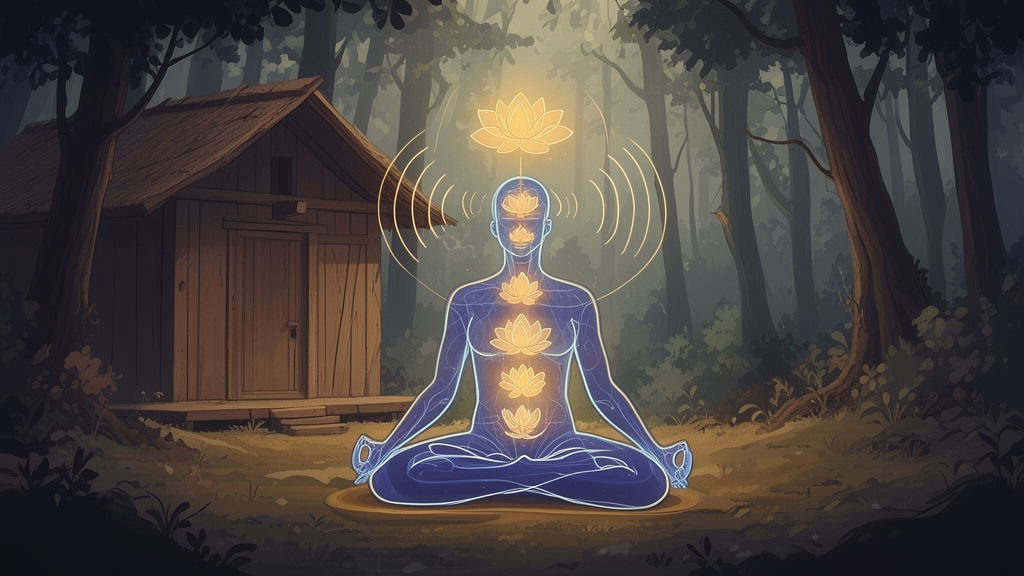
Practical examples for readers
The text can be read in several practical ways, depending on what the reader wants to learn.
- Studying the text: Begin with a complete translation from a named translator or scholar, and read the Janaka dialogue first. Then read the sections on the paramahamsa to see how the text moves from rules to inner knowledge.
- Comparing editions: Compare a Sanskrit edition with a translation. The verse numbering in summaries may not match the numbering in your edition, so check against the edition you are using.
- Understanding a term: When the text uses words like sannyasa, paramahamsa, or moksha, look for definitions in the translator’s notes or in a glossary before drawing conclusions.
- Learning from a teacher: If you are considering renunciation, the Upanishad’s rules should be discussed with a teacher or community that practices a specific lineage. The text describes general principles, and its rites are not a self-guided procedure.
Sources and textual notes
Several of the sources used for this article are secondary or digital, and they vary in reliability. The Wikipedia article on the Yajnavalkya Upanishad is useful for an overview and for its references to scholarship. The Grokipedia entry is an AI-assisted encyclopedia and was used only for summaries that could be checked against other sources. The Sanskrit Documents page is a digital transcription of the text, and it is not a critical edition. The Sanatan Hindu Dharma page is a devotional summary. The upanishads.org.in site is a resource on Yajnavalkya’s dialogues, including the Maitreyi story, which is a separate text from this Upanishad.
Verse numbers and section divisions differ across editions, and some summaries give their own numbering. This article does not give verse-level citations beyond what the consulted sources state. Readers who need precise references should consult a critical Sanskrit edition or a published scholarly translation.
Frequently asked questions
Is the Yajnavalkya Upanishad an ancient Vedic text?
Most scholarly summaries describe it as a late medieval text, probably from the fourteenth or fifteenth century, although its author is unknown. It is attached to the Shukla Yajurveda by tradition, but its content is most clearly concerned with later sannyasa practice.
Who speaks in the Yajnavalkya Upanishad?
The main speakers are King Janaka of Videha and the sage Yajnavalkya. Summaries also mention brief interjections by the sage Atri.
Does the Upanishad require renunciants to shave their heads and remove the sacred thread?
The text describes symbolic acts of leaving ordinary identity, including cutting the topknot and the sacred thread and declaring renunciation three times. Its own wording presents these as part of the renunciation process, and it also gives alternatives in some passages. Modern monastic practice varies, and a lineage or teacher should be consulted before any such act is taken up.
What does the text mean by paramahamsa?
The paramahamsa is the renunciant who has realized the Self and is described as beyond ritual obligation, dualities, and social markers. The text names several sages as examples of this state.
Is the Upanishad a guide to daily religious practice?
It describes principles of renunciation and conduct. Its rules about food, dwelling, and dress belong to a particular ascetic context and should not be treated as a daily routine for householders.
Closing takeaway
The Yajnavalkya Upanishad is a useful text for understanding how sannyasa was described in a late medieval Sanskrit teaching. Its most lasting message is that renunciation is measured by inner knowledge and detachment, not only by outward signs. Its rules and examples are specific to the ascetic life, and its dating and composition involve scholarly uncertainty. Readers who want to go further should choose a reliable translation, compare it with a critical edition, and learn how their own tradition or lineage understands renunciation.
Sources and further reading
- Wikipedia, ‘Yajnavalkya Upanishad’, for overview, dating references, the Muktika list position, and the summary of quoted works: https://en.wikipedia.org/wiki/Yajnavalkya_Upanishad
- Wikipedia, ‘Yajnavalkya’, for background on the sage, his association with Janaka, and the Brihadaranyaka Upanishad: https://en.wikipedia.org/wiki/Yajnavalkya
- Grokipedia, ‘Yajnavalkya Upanishad’, for a summary of the dialogue, rites, and paramahamsa description; AI-assisted and to be checked against primary editions: https://grokipedia.com/page/yajnavalkya_upanishad
- Sanskrit Documents, ‘Yajnavalkya Upanishad’, a digital Sanskrit transcription (not a critical edition) for the invocation, the Janaka dialogue, and the paramahamsa passage: https://sanskritdocuments.org/doc_upanishhat/yajnavalkya.html
- Sanatan Hindu Dharma, ‘Introduction to Yajnavalkya Upanishad’, a devotional summary including the peace mantra and the Paramahamsa conclusion: https://sanatanhindudharma.org/Upanishads/Yajnavalkya_Upanishad
- Upanishads.org.in, ‘Yajnavalkya and Maitreyee’, for a separate Yajnavalkya dialogue and context on the sage’s teachings: https://upanishads.org.in/stories/yajnavalkya-and-maitreyee