The phrase wisdom of the ancient sages is most often linked with the Mundaka Upanishad, one of the principal Upanishads of Hinduism. This post explains what the text teaches, how it is organized, and how different traditions and modern editions read it. It also clarifies a common point of confusion: Wisdom of the Ancient Sages: Mundaka Upanishad is the title of a book by Swami Rama that offers a translation and commentary. It is not a separate scripture.

In short, the Mundaka Upanishad teaches that there are two kinds of knowledge. Lower knowledge includes the Vedas and ritual learning. Higher knowledge is the realization of Brahman, the imperishable reality, through guidance from a qualified teacher and disciplined inner work. Attaining that higher knowledge is presented as the purpose of the text, not as a guaranteed result of any outward act.
What the Mundaka Upanishad Is
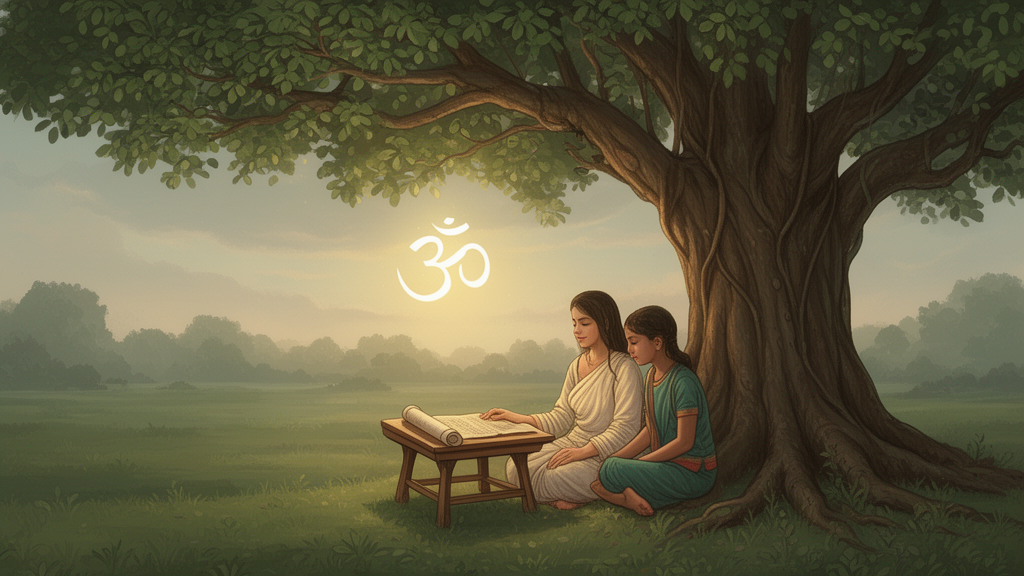
The Mundaka Upanishad belongs to the Atharvaveda. Wikipedia lists it as a Mukhya Upanishad (a principal Upanishad), linked to the Atharvaveda, and commented on by Adi Shankara and Madhvacharya.[1] The same article gives its date as the 1st millennium BCE. That is a broad scholarly range, not a precise date, and it should be read as an approximation.
The Upanishads are usually treated within Hinduism as shruti, revealed or authoritative scripture, and they are often read as the philosophical conclusion of the Vedas. The Mundaka’s own emphasis on the limits of ritual knowledge is one reason it is widely studied in discussions of Vedanta and of the path of knowledge (jnana).
The name is commonly associated with the idea of a shaved or ‘head-shaved’ figure, a term sometimes linked to ascetic practice. Because etymology is debated, this post does not rely on that explanation.
How the Text Is Divided
Editions of the Mundaka Upanishad divide the text differently, and readers will encounter more than one system.
- Three mundakas (sections): Wikipedia organizes the content into three mundakams, with the first and second further described by topic.[1]
- Six chapters: The VedaSeek online edition presents the text as six chapters, with separate titles for each, such as the chapter on the two forms of knowledge and the chapter on becoming Brahman.[5]
Because these systems do not match, this article uses topic-based headings rather than a single numbering scheme. When you consult a translation, check which system it uses before comparing verse or section references.
Higher Knowledge and Lower Knowledge
The first section of the Mundaka is known for distinguishing two kinds of knowledge. The VedaSeek summary describes Para Vidya, higher knowledge of Brahman, and Apara Vidya, lower knowledge that includes the Vedas and sacrificial ritual. It states that the results gained through lower knowledge are presented as impermanent.[5]
Wikipedia’s content outline uses the same contrast, describing the first mundakam as the difference between higher and lower knowledge, and sacrifices, oblations, and pious works as presented as less useful than knowledge.[1]
What this does and does not mean
It is important not to read this contrast as a blanket rejection of ritual in all Hindu life. The text places ritual within a hierarchy of aims. Within traditions that continue to observe Vedic rites, ritual remains a major practice. The Upanishad’s claim is that rites alone, understood as a means to temporary results, do not lead to the imperishable goal it describes. Commentators differ on how strongly to read this, and many traditions have held that ritual and knowledge are complementary in different stages of practice.
The role of a teacher
The VedaSeek summary of the first chapter also notes the importance of approaching a qualified guru for guidance toward the imperishable Brahman.[5] This is a teaching found in the source summary; readers who want the exact wording should consult a full translation of the first section. In the Upanishadic setting, the teacher-student relationship is central to how knowledge is understood to be transmitted.
Brahman as the Source and Inner Self
The second mundakam, as summarized by Wikipedia, presents Brahman as the inner Self of all things.[1] VedaSeek’s chapter summaries describe Brahman as the origin from which life, mind, senses, and the elements arise, using the image of a spider weaving its web. It also describes Brahman as the subtle, all-pervading reality that the seeker should perceive within the heart.[5]
The spider image is one of the most memorable in the text. It presents Brahman as the source from which the cosmos proceeds and into which it is held, without implying that Brahman is a separate figure acting like a craftsman. Translators and commentators explain this image in different ways, so readers should treat it as a teaching whose interpretation depends on the tradition.
Non-duality and the Vedanta reading
VedaSeek’s description of the third chapter emphasizes the non-duality of Brahman and the universe.[5] This is a central theme in the Advaita Vedanta tradition associated with Adi Shankara, who wrote a commentary on the Mundaka.[1] Other Vedanta schools, including the dualistic school associated with Madhvacharya, also commented on the text and read it differently.[1] A reader should therefore distinguish between what the Upanishad says and how a particular school interprets it.
Om, the Bow, and the Arrow
The second chapter of the VedaSeek edition describes the practice of meditating on Om to realize the Self and transcend duality.[5] Its fourth chapter summary develops an analogy: Om (Pranava) is the bow, the individual self is the arrow, and Brahman is the unmoving target that the seeker aims to reach through focused meditation.[5]
Wikipedia’s outline groups the topics of Om, Self, and Brahman together in the second mundakam.[1] The Om teaching is one of the points where the Upanishad is most often connected to devotional and meditative practice. In traditional Hindu usage, Om is also widely chanted in worship and recitation. The Upanishad’s use of Om as a path to self-knowledge should be distinguished from everyday chanting, which many traditions practice for other reasons.
Oneness, Liberation, and the Final Chapter
Wikipedia’s outline places the teaching on reaching the highest oneness in all beings in the third mundakam.[1] VedaSeek’s final chapter describes the culmination of knowledge as liberation, in which the individual consciousness sheds names and forms and merges with the supreme, using the image of rivers flowing into the ocean.[5]
The river-and-ocean image is a poetic description in the source summary. It does not describe a physical event and is best understood as a metaphor for the non-separation the text teaches. Readers should note that ‘liberation’ (moksha) is a central concept across Indian philosophy, but its precise meaning differs among schools.
Ethics, Self-Knowledge, and Tranquility
Wikipedia summarizes the third mundakam’s teachings as: be ethical, know yourself, and be tranquil.[1] VedaSeek’s description of the final chapter lists truth, austerity, proper knowledge, and celibacy as means by which a seeker reaches liberation.[5]
These are presented as disciplines that prepare the mind for knowledge. They are not presented as rewards that produce worldly results. The Upanishad’s ethical and inward emphasis is one reason many modern readers approach it as a text on self-discipline and inquiry, while traditional commentators read it primarily as a scriptural guide to liberation.
A note on modern interpretation
Swami Rama’s book, which carries the title used as this article’s keyword, is a modern translation and commentary. The publisher’s description says it presents the Mundaka’s teachings in relation to personal and spiritual development.[4] The Google Books description likewise presents the work as a translation and commentary that affirms human nature as peaceful, creative, and transcendent.[3] These are the publisher’s and the author’s framing, not the Upanishad’s own words. Readers should keep the Sanskrit text, the translator’s rendering, and the commentary distinct.
Distinguishing Text, Tradition, and Scholarship
The Mundaka Upanishad can be approached in several ways, and each serves a different purpose:
- The text itself: the Sanskrit verses and their plain meaning, which translators render differently.
- Commentary: classical commentaries, such as those attributed to Adi Shankara and Madhvacharya, which reflect particular philosophical schools.[1]
- Modern devotional or practical teaching: books and talks that apply the text to daily life, such as Swami Rama’s commentary.[3]
- Academic study: historical, linguistic, and textual analysis of the Upanishad’s composition and transmission. The date given by Wikipedia is a broad scholarly estimate in the 1st millennium BCE.[1]
When a claim about the Mundaka is made, it helps to ask which of these categories it belongs to. A statement about what the text says needs a translation or edition. A statement about a school’s reading needs a commentary. A statement about dating needs academic sources.
Reading a Translation Responsibly
Because the Mundaka is a dense text, readers often rely on translations. Some practical points:
- Choose a translation that states its translator and whether it includes commentary.
- Check whether the edition uses the three-mundaka system or the six-chapter system before comparing references.
- Read the translator’s preface to understand the tradition the translation follows.
- Keep notes that separate the Sanskrit-based rendering from the translator’s added explanation.
Swami Krishnananda’s PDF on the Mundaka Upanishad describes the text as among the most important Upanishads and as throwing light on the path of knowledge (jnana marga). Its foreword quotes the phrase Brahmavid Brahmaiva Bhavati, which it associates with the highest rung of knowledge.[6] That foreword represents one teacher’s reading of the text; it is not a universal interpretation.
Where the Mundaka Fits in Hindu Scripture
Wikipedia’s scripture list places the Upanishads among the divisions of the Vedas, and the Mundaka is listed under the Atharva-vedic Upanishads.[1] Readers exploring related texts can compare it with other Upanishads listed on HindusGod.com, though the links below should be treated as drafts until the owner publishes them.
For broader orientation, the Upanishads are often grouped by Veda, and the Mundaka’s association with the Atharvaveda sets it apart from texts such as the Isha or Katha Upanishads, which belong to other Vedic branches according to the same list.[1]
Practical Reflection for Today’s Reader
Many people come to the Mundaka Upanishad seeking practical guidance. The text itself is primarily concerned with knowledge of Brahman and the Self, and it does not offer promises of health, wealth, or other material results. Where readers find personal value in its teachings on truth, self-inquiry, restraint, and tranquility, they are engaging with the text in a way many traditions have long encouraged. Where they seek devotional practice, they should consult a teacher within their own tradition.
A useful starting approach is to read one section slowly, identify the teaching it presents, and then compare two or three translations or commentaries. This method keeps scripture, commentary, and modern application distinct, which is the approach this post has tried to model.
Frequently Asked Questions
Is ‘Wisdom of the Ancient Sages’ a separate Upanishad?
No. In this context it is the title of Swami Rama’s translation and commentary on the Mundaka Upanishad, published by the Himalayan Institute.[4]
Is the Mundaka Upanishad part of the Vedas?
The Upanishads are usually treated as the concluding parts of the Vedas. Wikipedia links the Mundaka to the Atharvaveda.[1]
Does the Mundaka reject all rituals?
The text distinguishes between lower knowledge, including ritual, and higher knowledge of Brahman. Its claim is that ritual-based results are impermanent compared with the knowledge it describes.[5] Interpretations of how strongly to read this vary by tradition, and ritual continues to be central in many Hindu communities.
Why do different editions number the sections differently?
Some editions follow the three-mundaka structure, while others, including the VedaSeek online edition, present six chapters with their own titles.[1][5]
Summary
The Mundaka Upanishad is a principal Upanishad associated with the Atharvaveda. It distinguishes higher knowledge of Brahman from lower knowledge that includes ritual, describes Brahman as the inner Self of all things, teaches meditation on Om, and presents ethical discipline and tranquility as preparation for liberation. Commentators from different schools read the text in different ways, and modern translations such as Swami Rama’s present it for personal and spiritual development. Reading the text carefully means keeping the scripture, the translator’s commentary, and your own tradition’s teachings clearly distinguished.
Sources and Further Reading
- Mundaka Upanishad, Wikipedia: date, Vedic linkage, commentators, three-mundaka outline.
- The Mundaka Upanishad, VedaSeek: six-chapter summaries and Sanskrit-English reading resource.
- Wisdom of the Ancient Sages, Himalayan Institute: publisher description of Swami Rama’s translation and commentary.
- Wisdom of the Ancient Sages, Google Books: description of the book’s translation and commentary (page content not fully inspected).
- The Mundaka Upanishad, Swami Krishnananda (PDF): foreword on the path of knowledge (not fully inspected).
Related HindusGod.com Posts
The following internal drafts may be useful for further reading. Their links become public only if the owner publishes them: Mundaka Upanishad, Mundaka Upanishad in English, Mundaka Upanishad Sanskrit, Mundaka Upanishad Swami Paramarthananda, Meaning of Upanishad, and Ancient Upanishad.